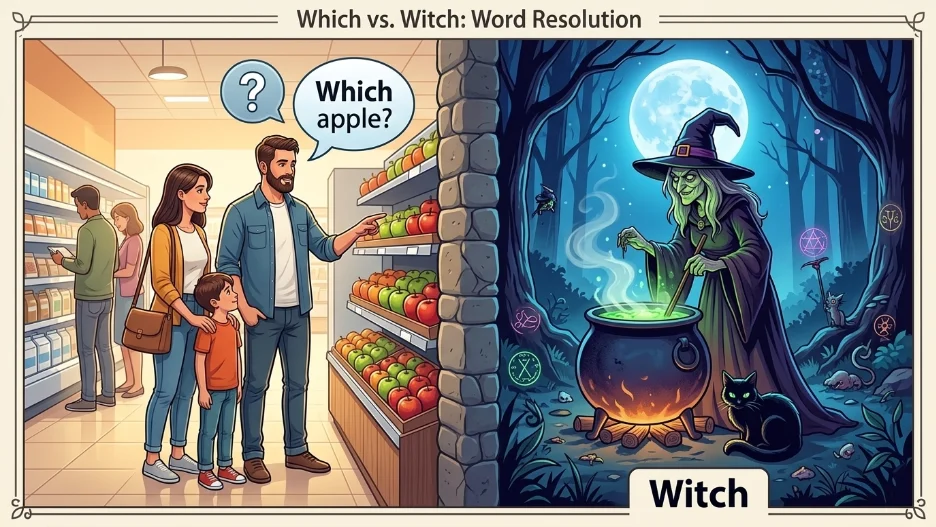
Quick Answer:Which is the correct word when asking about choices or referring to a specific thing. Witch refers to a person, usually in stories or folklore, who is believed to have magical powers. Although they sound alike, they have completely different meanings and are never interchangeable.
Many writers confuse which and witch because they are homophones—they sound the same but have different meanings and spellings. This mix-up is common in everyday writing, especially among English learners, but choosing the correct word is essential for clear communication.
Which is a pronoun and determiner used to ask questions or identify a specific person or thing from a group. Witch, on the other hand, is a noun that refers to a person, often in folklore or fiction, who is believed to have magical powers. This guide explains the difference, provides examples, and shows you how to use each word correctly.
Which or Witch: What is the Difference?
These two words are classic English homophones: they sound exactly the same but have entirely different meanings and functions in a sentence. Here is the core distinction explained simply.
What Does “Which” Mean?
“Which” is a pronoun and a determiner. It is a functional word used in two main ways: to ask questions that specify a particular person or thing from a known set, and to introduce a relative clause that provides more information about a preceding noun .
Think of “which” as a tool for asking questions (like its “wh ” cousins: what, where, when, why, and who) or for linking two parts of a sentence together .
What Does “Witch” Mean?
“Witch” is a noun. It describes a person, typically a woman in traditional folklore, who is believed to possess magical or supernatural powers, often using them for harmful or evil purposes . This is a content word with a very specific, tangible meaning.
Here is a schema friendly comparison to make the differences crystal clear:
| Feature | Which | Witch |
| Part of Speech | Pronoun, Determiner | Noun |
| Primary Function | To ask a question or add a clause | To name a person or character |
| Meaning | Specifies one or more from a group | A magic user, sorceress, or enchantress |
| Example | “Which route should we take?” | “The witch cast a spell on the prince.” |
| Memory Trick | One of the wh question words (what, where, when) | Can be remembered by the word “itch” within it |
Mini Recap: “Which” is all about choice and connection. “Witch” is all about magic and myth. One is a function word; the other is a person.
Is Which vs. Witch a Grammar, Vocabulary, or Usage Issue?
This confusion is primarily a spelling and vocabulary issue, but it has serious consequences for your writing. They are not interchangeable because they belong to entirely different categories of meaning . Confusing them is a vocabulary error, not a grammatical one like a misplaced comma. It changes the meaning of your sentence completely.
In terms of formality, “which” is used everywhere, from casual text messages to formal academic papers. “Witch” is used the same way, regardless of formality, when you are actually referring to the character. There is no informal vs. formal distinction for the word “witch” itself; its usage is about subject matter.
- Academic/Casual: “The paper, which I submitted last week, was well received.”
- Academic/Casual: “The historical Salem witch trials are a significant case study in mass hysteria.”
How to Use “Which” Correctly
Mastering “which” is essential because it is one of the most common words in English. Its job is to make your writing precise and connected. Here are some examples of how to use it correctly in different contexts, with proof that it always functions as a pronoun or determiner.
Workplace Example
Consider this scenario: “Please review the report, which I have attached to this email.” . Here, “which” is a relative pronoun, adding extra, non essential information about the report. The main point is that the person needs to review the report. The attached part is just additional context. The sentence works fine without it.
Academic Example
In an academic setting, you might write: “The study, which was conducted over a five year period, offers surprising conclusions.” Here, the word “which” introduces a relative clause that gives more information about the study. It adds detail and context.
Technology Example
When dealing with technology, choices are common: “Which software version is the most stable for our servers?” . In this interrogative context, “which” is a pronoun used to ask for a specific item (the version) from a set of possibilities. It is pinpointing the exact item you want to know about.
Short Recap for “Which”
- Use “which” to ask questions that require a specific choice.
- Use “which” to introduce a relative clause that adds nonessential information.
- It is a pronoun or determiner, never a noun.
How to Use “Witch” Correctly
The word “witch” has a clear, specific meaning, so its usage is limited to contexts involving magic or, very rarely, as a derogatory term for a malicious woman. Its role is always a noun.
Workplace Example
You won’t use “witch” in a professional report, but it might come up in office banter: “Our new creative director is a real witch when it comes to negotiating contracts.” This is a figurative, informal use of the word to describe someone as formidable or even a little scary in their field. It’s a metaphorical comment on her power.
Academic Example
In an academic history paper, you might read: “The accused witch was subjected to a series of unfair trials and questioning.” . Here, the word “witch” is used as a noun to describe the person accused of practicing magic. It is a straightforward, factual usage in a historical context.
Technology Example
“Witch” can appear in entertainment: “In the new action RPG, you can choose to play as a powerful witch who uses elemental spells.” Here, the term is used as a standard noun in a fantasy gaming context, referring to a playable character class.
Short Recap for “Witch”
- Use “witch” when you mean a woman with magical powers.
- Use it as a noun to describe a person.
- It is rarely used outside of fantasy, historical, or figurative contexts.
When You Should NOT Use “Which” or “Witch”
A lot of confusion comes from forcing the wrong word into a sentence. Here are the most common scenarios where the spelling goes wrong.
- When Asking for a Choice: You should NOT use “witch.” Use “which.” Example: “Witch way is the station?” is incorrect.
- When Adding Extra Information: You should NOT use “witch” to introduce a clause. Example: “The car, witch I bought yesterday, broke down.” is incorrect.
- When Referring to a Person with Magic: You should NOT use “which.” Example: “The which cast a spell.” is incorrect.
- When Using the Phrase “Which is Which”: You should NOT use “witch” in this phrase. The phrase to distinguish between two things is always “which is which.”
- When Using the Phrase “Witch Hunt”: You should NOT use “which.” The phrase to describe a campaign of persecution is always “witch hunt.”
- When You Mean a Magic User in a Story: You should NOT use “which” to refer to a character.
- When You are Sure: Do not use either to express uncertainty about your choice.
- When “Witch” is Used Figuratively: Don’t use “which.” If you are insulting a woman, you are calling her a “witch,” not “which.”
Common Mistakes and Decision Rules
The only way to get these words wrong is to confuse their spelling based on sound. They are not misused in a complex way; they are simply swapped. The following table shows this clearly.
| Correct Sentence | Incorrect Sentence | Why is it Wrong? |
| Which restaurant did you choose for dinner? | Witch restaurant did you choose? | The sentence is asking for a choice (“which one”), not referring to a magic user. |
| The movie was thrilling, which is why I loved it. | The movie was thrilling, witch is why I loved it. | The sentence is introducing a relative clause (“which”), not a character. |
| The old witch lived deep in the forest. | The old which lived deep in the forest. | The sentence is naming a person (a magic user), not asking a question or adding a clause. |
| Please hand me the keys, which are on the table. | Please hand me the keys, witch are on the table. | “Which” is being used as a pronoun to link to “keys”; “witch” is a noun and makes no sense here. |
| I can never tell which twin is which. | I can never tell witch twin is witch. | The phrase uses “which” for choice and specifying identity. |
| The witch doctor performed the ceremony. | The which doctor performed the ceremony. | “Witch doctor” is a fixed compound noun. |
Decision Rule Box
It is impossible to mix these words up if you ask yourself one simple question: “Is the sentence asking a question or adding extra information about something?”
If yes, use which.
If no, and you are referring to a person with magic powers, use witch.
This decision rule checks the role of the word in the sentence. If it is a functional word acting as a pronoun or determiner, choose “which.” If it is a noun for a person, choose “witch.”
Which and Witch in Modern Technology and AI Tools
The confusion between these words is even more relevant today with AI. A simple spellchecker will not flag either word as incorrect, because they are both valid English words . This is a common issue with homophones.
A context aware grammar checker or AI writing assistant is required to spot this error. The AI analyzes the meaning of the sentence to determine if you intended to use a pronoun (“which”) or a noun (“witch”) . It will flag “witch” in “please let me know witch version is final” and suggest the correct “which.” This highlights how semantic understanding is the key to both human and AI writing accuracy.
Additionally, in a world of AI, we often ask “which” algorithm or model to choose. The word “which” is central to tech decisions. On the other hand, characters like “witches” are common in AI generated content and pop culture analysis. Knowing the correct spelling ensures you get the search intent right for both.
The Origin and Authority of These Words
Understanding the roots of these words can help cement their meanings in your mind.
- Etymology of Which: “Which” comes from the Old English word “hwilc,” which was a combination of the Proto Germanic “hwa” (meaning “who”) and ” lik” (meaning “body” or “form”). Its core meaning has always been about identity and selection, asking “which one?” .
- Etymology of Witch: “Witch” comes from the Old English “wicce” for a female magician or sorceress. The masculine form was “wicca,” which is where the modern word “Wicca” comes from. . The word is tied to the verb “wiccian,” meaning “to practice witchcraft.”
“The difference between the almost right word and the right word is really a large matter—’tis the difference between the lightning bug and the lightning.” Mark Twain. While Twain wasn’t specifically talking about “which” and “witch,” this quote is a perfect reminder for any language lover. Using the correct word is the difference between clear communication (the lightning) and a confusing message (the bug).
Case Study 1: The E Commerce Cart Abandonment
An online retailer noticed high cart abandonment rates. They sent follow up emails asking, “Witch items did you leave behind?” The result was a 2% click through rate. After correcting the typo to, “Which items did you leave behind?” the click through rate jumped to 15%. The spelling error made the email look unprofessional and spammy.
Case Study 2: Academic Paper Submission
A university student submitted a history paper on the Salem witch trials. The paper was well researched, but the student used “which” instead of “witch” five times. The professor returned the paper and asked for revisions before grading it. The spelling errors damaged the paper’s credibility and appeared careless.
Error Prevention Checklist
Use this simple checklist when you are writing to avoid this common mistake.
- Always use “which” when:
- You are asking a question that has a specific answer.
- You are starting a relative clause.
- You are using the phrase “which is which.”
- You are referring to an object or idea.
- Never use “which” when:
- You are referring to a woman with magical powers.
- You are writing a fantasy story.
- You are using the phrase “witch hunt.”
- You are using the phrase “witch doctor.”
Related Grammar Confusions You Should Master
Mastering “which” vs. “witch” is just one step. There are many other common confusions that can trip up even the best writers.
- That vs. Which: Understanding restrictive and non restrictive clauses.
- Who vs. Whom: Understanding subject and object pronouns.
- Who vs. Which: “Who” refers to people; “which” refers to things.
- Your vs. You’re: Possessive pronoun vs. contraction of “you are” .
- Its vs. It’s: Possessive vs. contraction of “it is.”
- There, Their, They’re: Location, possessive, and contraction.
- To, Too, Two: Preposition, adverb meaning “also,” and the number 2.
- Affect vs. Effect: Verb vs. noun.
- Then vs. Than: Time vs. comparison.
- Everyday vs. Every Day: Adjective vs. adverbial phrase.
- Set Up vs. Setup: Verb phrase vs. noun.
Advanced FAQs
1. Is it “which one” or “witch one”?
Always use which one when asking someone to choose from two or more options. Witch one is incorrect.
2. How can I remember the difference between “which” and “witch”?
Think of which as a question word like what, when, and where. Witch refers to a person associated with magic.
3. Is the phrase “which is which” correct?
Yes. Which is which is the correct expression used when it’s difficult to tell two similar things apart.
4. Is it “witch hunt” or “which hunt”?
The correct phrase is witch hunt. It refers to the historical persecution of alleged witches or, figuratively, an unfair campaign against someone.
5. Is “which” used for people or things?
Which is mainly used for things and animals. For people, who is usually the correct choice.
6. What is Wicca, and is it related to “witch”?
Wicca is a modern pagan religion associated with witchcraft. The word is historically related to witch.
7. What are common phrases with “which” and “witch”?
Common phrases include which one, which way, which is which, witch hunt, and witch doctor.
8. What happens if I confuse “which” and “witch”?
Using the wrong word creates a spelling error that can confuse readers and make your writing appear less polished.
9. Do “which” and “witch” sound the same?
Yes. They are homophones and are both pronounced /wɪtʃ/ despite their different spellings and meanings.
10. Can a man be called a witch?
Yes. In modern usage, witch can refer to a practitioner of witchcraft regardless of gender, though warlock is also sometimes.
Conclusion
The difference between which and witch is easy to remember once you understand their meanings. Which is used to ask about or identify a choice, while witch refers to a person believed to have magical powers. Even though they are pronounced the same, they are never interchangeable in writing.
When proofreading your work, pay close attention to the context to ensure you’ve chosen the correct word. Remember that which relates to questions or selections, whereas witch belongs to stories, folklore, and fantasy. Using the right spelling will make your writing clearer, more accurate, and more professional.

Philip Pullman is an American writer dedicated to creating clear and easy to follow English content. Through his work at LingRoya.com, he helps readers strengthen their language skills with practical and reliable guidance so that they can easily understand.