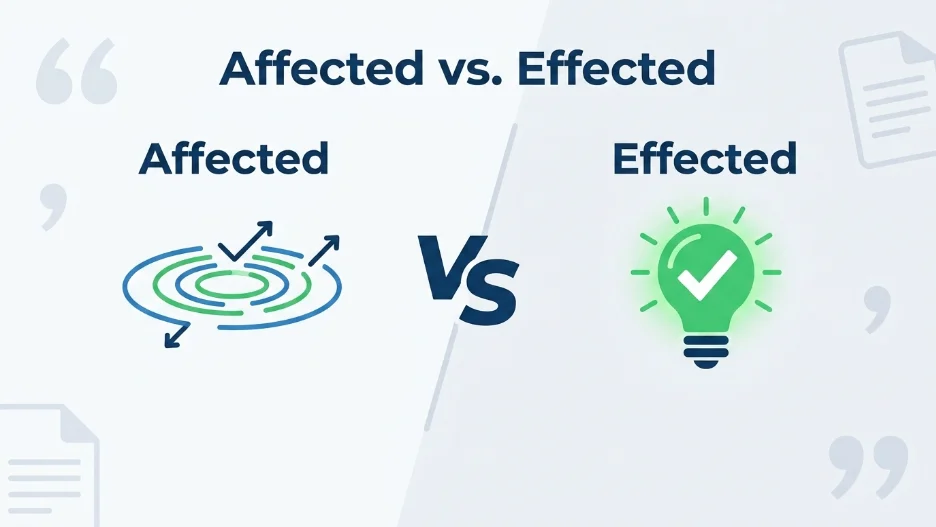
The difference between affected and effected is subtle but significant. In short, use affected when something has been influenced or changed, and use effected when something has been brought into existence or caused to happen. Master this distinction, and you will avoid a common error that undermines clear, professional writing.
Affected and effected are often confused because they come from the related words affect and effect. Although they look and sound similar, they have different meanings and are used in different contexts. Understanding the distinction will help you avoid one of the most common word-choice mistakes in English.
In most cases, affected means influenced, changed, or impacted by something, while effected means brought about, accomplished, or caused to happen. Since affected is far more common in everyday writing, many people mistakenly use it in place of effected or vice versa. This guide explains the difference with clear definitions, examples, and practical tips for using each word correctly.
Here is a quick comparison to help you visualize the difference.
| Word | Part of Speech (Primary) | Meaning | Example |
| Affected | Verb (Past Tense) | Influenced, changed, or had an impact on something . | The rainy weather affected our outdoor picnic plans. |
| Effected | Verb (Past Tense) | Brought about, caused, or made something happen . | The new CEO effected sweeping changes to the company culture. |
In essence, effected is about creation, while affected is about influence. If you are talking about a result that has been produced or initiated, you are likely dealing with effected. If you are discussing an existing thing that has been changed in some way, affected is your word. This primary distinction is the key to correct usage .
Is This a Grammar, Vocabulary, or Usage Issue?
The confusion between affected and effected is primarily a usage issue, though it touches on grammar and vocabulary. The words are not interchangeable, and using one in place of the other usually results in a sentence that makes no sense or conveys the wrong meaning . The error is so common because both words function as verbs and relate to the concept of change.
In formal and academic writing, the distinction is crucial. Using “effected” when you mean “affected” will appear as a glaring error. Conversely, in casual conversation, the word “effected” is rarely used at all; most people use phrases like “brought about” or “caused” instead. For instance, in casual writing, someone might say, “The new policy affected a lot of changes,” when they actually mean the policy caused or initiated changes. The correct word in that context would be effected .
When to Use “Affected”
Affected is the past tense of the verb “affect,” which most commonly means to influence or make a difference to something . It can also mean to move someone emotionally or to attack, as a disease . This is by far the more common of the two words .
Workplace Example
The company wide restructuring affected every department, leading to a reassignment of roles and responsibilities. The new management style affected employee morale, resulting in a noticeable increase in productivity and job satisfaction.
Academic Example
The professor’s feedback on my thesis affected the entire direction of my research. This new evidence affected the results of the study, forcing the researchers to reconsider their initial conclusions.
Technology Example
The software update affected the performance of older computer models, causing them to run more slowly. This new security patch affected the way users log into their accounts.
A Quick Recap for “Affected”
If you can replace the word with “influenced,” “impacted,” or “moved,” you need to use affected. It is the past tense word you will use most often to describe how one thing has changed or had an impact on another.
When to Use “Effected”
Effected is the past tense of the verb “effect,” which means to bring about or cause something to happen . It is used far less frequently and is almost always associated with initiating change .
Workplace Example
The project manager effected a new system for tracking deliverables, which streamlined the entire workflow. The new safety protocols were effected immediately after the incident.
Academic Example
The politician effected a major reform in the education system through years of persistent campaigning. The scientist’s discovery effected a paradigm shift in how we understand the universe.
Technology Example
The company effected a series of security upgrades to protect customer data. By updating its algorithm, the social media platform effected a noticeable change in the type of content users saw.
A Quick Recap for “Effected”
If you can replace the word with “implemented,” “brought about,” or “executed,” then you should use effected. It is the right choice when something is being created or instigated, often used in formal or organizational contexts.
When You Should NOT Use Affected or Effected
There are many common scenarios where one of these words is often misused. Here are some of the most frequent mistakes to avoid.
- Do not use “effected” when you simply mean “influenced.” If a situation has changed an outcome, use “affected.”
- Do not use “affected” when you mean “implemented.” If a person or organization has created a new system, use “effected.”
- Do not use “affected” or “effected” when a simpler word will do. Sometimes, “changed,” “influenced,” or “caused” are clearer and more direct.
- Do not use “effected” in casual or everyday conversation. It often sounds overly formal or pretentious. It is best reserved for specific contexts where a change was deliberately initiated.
- Do not confuse the verb “effected” with the noun “effect”. “Effect” as a noun is a result. “Effected” is an action.
- Do not confuse the verb “affected” with the adjective “affected.” The adjective “affected” can mean artificial or pretentious, as in “She spoke with an affected British accent” . This is a completely different word with a different meaning.
Common Mistakes and Decision Rules
Let’s look at some examples to solidify the correct usage.
| Correct Sentence | Incorrect Sentence | Explanation |
| The budget cuts affected our ability to hire new staff. | The budget cuts effected our ability to hire new staff. | The budget cuts had an influence on the hiring ability; they did not create it. |
| The new president effected a change in immigration policy. | The new president affected a change in immigration policy. | The president brought about or caused the change. |
| The sad movie affected her deeply. | The sad movie effected her deeply. | The movie had an emotional impact; it did not create her. |
| The manager effected a new training program. | The manager affected a new training program. | The manager implemented or brought the program into existence. |
Decision Rule Box
Here is a simple rule to guide your choice.
If you mean the action of influencing or changing something, use “affected.”
If you mean the person or thing that brings about a result, or if you are describing the process of creating or implementing, use “effected.”
Affected and Effected in Modern Technology and AI Tools
The vocabulary of change is everywhere in tech and AI, and words like affected and effected appear frequently in reports, analysis, and news articles. In the context of AI, we often discuss how automation affects the job market or how a new algorithm effected improvements in data processing .
The usage distinction is particularly important in technical writing. If an AI system updates its parameters, we say it has affected its performance. But if we deploy that same AI to overhaul a business process, we would say it has effected a change in the workflow. This nuance separates precise technical communication from confusing or inaccurate reporting.
Etymology and Expert Authority
The words “affect” and “effect” both trace their roots back to Latin. “Affect” comes from afficere, meaning “to do to” or “to influence,” while “effect” derives from efficere, meaning “to produce” or “to bring about” . This ancient distinction beautifully mirrors the modern usage.
To further clarify, consider this expert perspective: “Throughout history, music, art, and literature have both effected and reflected cultural movements” . This quote perfectly encapsulates the dual role of art as both a creator of change (effected) and a mirror of its time (reflected).
Error Prevention Checklist
When you are writing and are unsure about which word to choose, use this quick checklist to ensure you have made the right decision.
Always use affected when:
You are describing an emotional reaction or influence.
You are referring to something that has been changed by an external force.
You are talking about a disease or physical condition.
Never use effected when:
You are describing an influence or impact.
You are talking about an emotional state.
You are describing a passive change.
Related Grammar Confusions You Should Master
Mastering the difference between affected and effected is a great step. To polish your writing further, here are some related topics to study.
- Accept vs. Except
- Advise vs. Advice
- Capital vs. Capitol
- Complement vs. Compliment
- Elicit vs. Illicit
- Imply vs. Infer
- Loose vs. Lose
- Principal vs. Principle
- Stationary vs. Stationery
- Who vs. Whom
Advanced FAQs
1. Is “affected” or “effected” correct in most situations?
In most everyday writing, affected is the correct word because it means influenced or impacted. Effected is much less common.
2. Can “affected” and “effected” appear in the same sentence?
Yes. Effected means caused something to happen, while affected describes the impact of that change.
3. Is “effected” a real English word?
Yes. Effected is the past tense of effect and means brought about or accomplished.
4. How can I remember the difference between “affected” and “effected”?
Remember that affected means influenced, while effected means caused or created.
5. What is the difference between “affect” and “effect”?
Affect is usually a verb meaning to influence, whereas effect is usually a noun meaning a result.
6. Is “effected” ever used as an adjective?
No. Effected is used as a verb, not an adjective. Affected can function as both a verb and an adjective.
7. How does using “affected” instead of “effected” change the meaning?
Conclusion
The difference between affected and effected is easier to remember once you focus on their meanings. Affected means influenced or changed by something, while effected means brought about or accomplished. Although they are closely related, they are not interchangeable and should be used in different contexts.
When you’re unsure which word to choose, ask yourself whether you’re describing the impact of something or the act of causing something to happen. In most everyday situations, affected is the correct choice, while effected is less common and usually appears in formal, legal, or technical writing. Using the right word will make your writing clearer, more precise, and more professional.

Neil Gaiman is an American writer who contributes educational content to LingRoya.com. His work focuses on helping readers improve their English with clear, practical and easy to follow guidance.