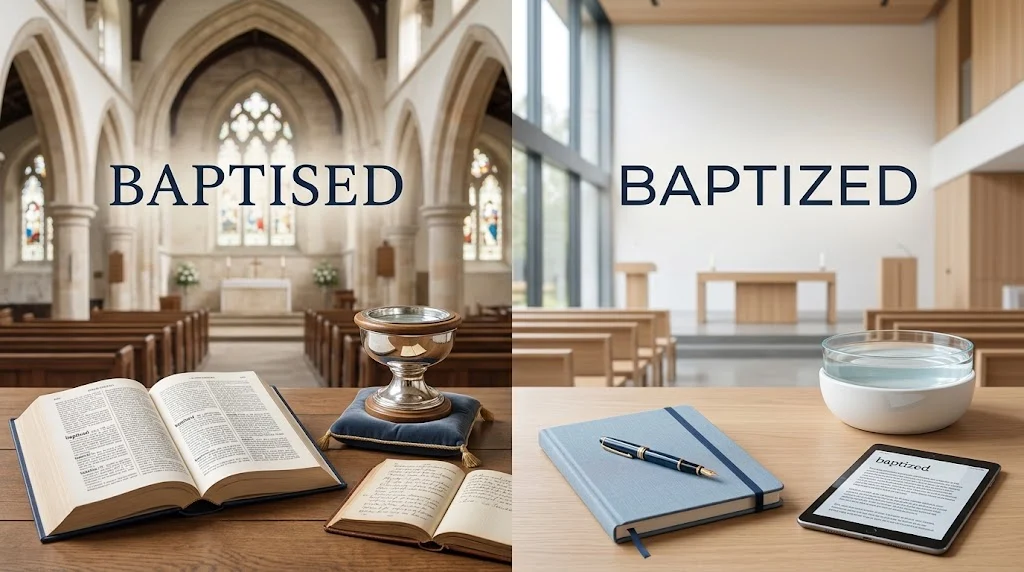
Baptised or baptized are both correct spellings of the same word, meaning to perform a religious ceremony of baptism or to give someone a name through a baptismal ceremony. Baptised is the standard British English spelling, while baptized is preferred in American English.
Have you ever wondered whether to write baptised or baptized in an essay, religious document, or everyday conversation? Both spellings are correct, and neither changes the word’s meaning. The difference comes from British and American English spelling conventions, which can cause confusion in formal writing and religious publications.
British English generally uses baptised, while American English prefers baptized. Understanding this distinction helps you write accurately, respect your publication’s style, and communicate clearly. Whether you’re preparing an academic assignment, a church announcement, or an article about Christian traditions, choosing the appropriate spelling keeps your writing consistent and professional.
Baptised vs Baptized: What’s the Difference?
The difference between baptised and baptized is regional spelling, not grammar or meaning. Both words are forms of the verb baptise or baptize, meaning to perform baptism. They can also appear as past participles and adjectives, depending on the sentence.
| Feature | Baptised | Baptized |
|---|---|---|
| English variety | British English | American English |
| Part of speech | Verb, past tense or past participle | Verb, past tense or past participle |
| Base form | Baptise | Baptize |
| Meaning | Performed a baptismal ceremony | Performed a baptismal ceremony |
| Common usage | UK and many British English publications | United States |
| Related noun | Baptism | Baptism |
| Example | She was baptised as a baby. | She was baptized as a baby. |
Quick Recap
- Baptised is generally preferred in British English.
- Baptized is the standard spelling in American English.
- Both forms have the same meaning and pronunciation in most varieties of English.
- Neither spelling is inherently incorrect.
- Consistency matters most in academic, religious, and professional writing.
What Does Baptised Mean?
Baptised is the past tense or past participle of baptise, a spelling commonly used in British English. The word describes someone performing or receiving baptism, a religious ceremony associated with Christianity and practiced in different ways across Christian traditions.
Examples:
- The family travelled to Scotland for the ceremony where their daughter was baptised.
- He was baptised at his local church last Sunday.
- The newly baptised child was welcomed by the congregation.
The word may also appear in historical records, biographies, church registers, and religious publications. In these contexts, the spelling often reflects the conventions followed by the writer or institution.
What Does Baptized Mean?
Baptized is the American English spelling of the past tense and past participle of baptize. It carries the same meaning as baptised and is widely used in American religious writing, historical accounts, and everyday communication.
Examples:
- The minister baptized the child during Sunday service.
- She was baptized in a small church near her home.
- The newly baptized members attended a gathering after the ceremony.
The word can also function as an adjective, as in “the baptized members of the congregation.” Its grammatical role depends on how it appears in the sentence, not on whether it contains an s or a z.
Usage recap: Choose baptised for British English and baptized for American English. Both forms refer to baptism and are suitable for formal writing when used according to the relevant spelling convention.
Is Baptised vs Baptized a Grammar, Vocabulary, or Usage Issue?
The distinction between baptised and baptized is primarily a spelling and regional usage issue. It is not a grammatical difference because both forms perform the same grammatical functions.
Are Baptised and Baptized Interchangeable?
Yes, they are interchangeable in meaning. For example, “The child was baptised last week” and “The child was baptized last week” communicate the same information.
However, writers should consider their audience. A British publication may expect baptised, while an American publication generally expects baptized.
Formal vs Informal Usage
Neither spelling is more formal than the other. Both are appropriate in formal contexts, including church records, biographies, official announcements, and academic writing.
The important factor is consistency with the relevant language convention. If an organization has a specific house style, follow it even if another spelling is common elsewhere.
Academic vs Casual Usage
In casual communication, either spelling is usually understood. In academic work, however, the expected form may depend on the institution, publisher, or required style guide.
For instance, a student writing about baptism in a British history course would generally use baptised. A student writing for an American university publication would normally use baptized.
When to Use Baptised
Use baptised when writing in British English or following a style guide that prefers British spelling. This is particularly useful for UK publications and other contexts where British conventions are standard.
Workplace Example
A church administrator in England might write:
“The child was baptised at St Mary’s Church on Sunday morning.”
This sentence is appropriate for a British church newsletter or administrative record.
Academic Example
A history student might write:
“The parish register records that the individual was baptised in 1842.”
The spelling fits an academic text following British English conventions.
Technology Example
A British church website might display the following information:
“Members can register online to arrange a date when their child will be baptised.”
The spelling remains consistent with the site’s regional language settings.
Usage recap: Use baptised in British English documents, UK church publications, and academic writing that follows British spelling conventions.
When to Use Baptized
Use baptized when writing in American English. It is the standard form in US publications, church announcements, educational resources, and general writing.
Workplace Example
A church office in the United States might write:
“The child was baptized during the Sunday morning service.”
This spelling is appropriate for an American congregation’s newsletter.
Academic Example
A researcher might write:
“The historical record indicates that the individual was baptized in 1842.”
The spelling aligns with American English conventions.
Technology Example
An American church website might state:
“Complete the online form to request information about having your child baptized.”
This example demonstrates how the American spelling appears in modern digital communication.
Usage recap: Use baptized for American audiences, US academic work, and professional documents that follow American English spelling conventions.
When You Should NOT Use Baptised or Baptized
Although both spellings are correct, certain situations require you to be careful.
1. Do not mix British and American spellings unnecessarily. Avoid switching between baptised and baptized in the same document without a clear reason.
2. Do not ignore your publisher’s style guide. A publication may require one spelling throughout its content.
3. Do not assume baptised is incorrect in American English everywhere. It is a recognized British variant, even if it is not the preferred American form.
4. Do not assume baptized is incorrect in British English everywhere. It is a recognized spelling, although baptised is generally preferred in British usage.
5. Do not confuse the verb with the noun. Baptised and baptized are verb forms, while baptism is the noun for the religious rite.
6. Do not change spelling inside official names without checking. Preserve the wording of church names, organization titles, and official records.
7. Do not alter a direct quotation unnecessarily. Retain the source’s original spelling unless your editorial rules permit adjustments.
8. Do not assume all Christian traditions interpret baptism identically. The spelling is a language issue, while the meaning and practice of baptism may differ among denominations.
Common Mistakes: Baptised or Baptized
The following examples distinguish regional spelling preferences from genuine grammatical errors.
| Correct sentence | Incorrect sentence | Explanation |
|---|---|---|
| She was baptised in London. | She was baptised in London. | The sentence is correct in British English. |
| She was baptized in Boston. | She was baptized in Boston. | The sentence is correct in American English. |
| The child was baptised last week. | The child were baptised last week. | The singular subject requires was. |
| They were baptized together. | They was baptized together. | The plural subject requires were. |
| His baptism took place in June. | His baptised took place in June. | Baptism is the noun needed in this sentence. |
The first two rows are included to emphasize an important point: a sentence does not become incorrect merely because it uses one regional spelling rather than the other. The final three rows illustrate actual grammatical or word choice errors.
Decision Rule
If you follow British English, use baptised.
If you follow American English, use baptized.
When you mean the religious ceremony itself, use baptism. If you mean the person who performs the ceremony, the usual word is baptiser in British English or baptizer in American English, though specific religious terminology may vary.
Baptised and Baptized in Modern Technology and AI Tools
Digital writing tools, online church registration systems, and AI writing assistants regularly process both spellings. However, a grammar checker configured for American English may flag baptised, while a British English checker may prefer baptised over baptized.
These suggestions generally reflect regional spelling preferences rather than a difference in meaning.
For accurate results, select the appropriate English language setting before proofreading. If you’re publishing religious content for an international audience, consider whether the site should follow British or American English consistently.
AI writing tools can also help identify spelling inconsistencies across a long article. Still, writers should review the suggestions carefully, especially when editing historical quotations, religious records, or official names.
Etymology: Why Do Baptised and Baptized Have Different Spellings?
The word baptize entered English through Latin and Greek, ultimately deriving from the Greek verb baptizein, meaning to immerse or dip. The word is closely associated with the Christian religious rite of baptism.
The spelling difference developed through regional English conventions. British English generally favors s in baptise and baptised, while American English typically uses z in baptize and baptized.
Similar differences appear in words such as organise and organize, recognise and recognize, and realise and realize. British English often uses s in these forms, while American English commonly uses z.
Both spellings of baptised and baptized remain established in modern English.
Expert Insight: The Importance of Consistent Spelling
A useful editorial principle is that regional consistency is more important than treating one accepted spelling as universally correct.
For example, a British religious publication should normally use baptised throughout its articles, while an American publication should generally use baptized. This approach helps readers follow the text without unnecessary variation and maintains a clear editorial style.
Two Practical Case Studies
Case Study 1: A British Church Newsletter
Imagine a church in England preparing a newsletter about an upcoming baptism ceremony. The first draft uses baptised in one section and baptized in another.
During proofreading, the editor standardizes the article to British English and uses baptised consistently. The team also checks related terms to ensure the rest of the newsletter follows the same spelling convention.
Result: The newsletter follows a consistent regional style and requires fewer spelling corrections during editing. This is an illustrative scenario, not a measured publishing result.
Case Study 2: An American Religious History Paper
Consider an American university student writing a paper about baptism records from the nineteenth century. The student initially uses baptised because the spelling appears in a British reference source.
After checking the university’s language guidelines, the student uses baptized in the main discussion while preserving original spellings in direct quotations and source titles where appropriate.
Result: The paper maintains consistent American English while respecting the historical wording of its sources. This is an illustrative example rather than a documented experiment.
Error Prevention Checklist
Use this checklist before publishing or submitting your writing.
Always Use Baptised When
- Writing in British English.
- Preparing content for a British audience.
- Following a style guide that specifies British spelling.
- Maintaining consistency with a British publication’s established language conventions.
Never Use Baptized When
- Your required style guide explicitly mandates the British form baptised.
- You’re editing a British English document that consistently uses baptised and have no reason to change its spelling.
- Replacing the original form would incorrectly alter an official quotation or historical source.
This does not make baptized universally wrong. It simply means that British English documents generally call for baptised.
Likewise, don’t automatically change baptised to baptized in an American document if the spelling appears in a direct quotation or an official title.
Related Grammar Confusions You Should Master
Learning regional spelling differences makes it easier to write confidently across different English varieties.
- Organise vs Organize: British and American spelling conventions.
- Recognise vs Recognize: Regional differences in the letter s and z.
- Realise vs Realize: Two accepted spellings of the same verb.
- Colour vs Color: The presence or absence of the letter u.
- Travelling vs Traveling: Differences in consonant doubling.
- Centre vs Center: Regional differences in letter order.
- Defence vs Defense: British and American noun spelling.
- Practise vs Practice: Differences between British verb and noun forms.
- Grey vs Gray: Regional spelling preferences.
- Baptism vs Baptised: The difference between a noun and a verb form.
These comparisons show why spelling conventions should be understood in context rather than memorized as a list of universally correct and incorrect forms.
Frequently Asked Questions
1. Is baptised or baptized correct?
Both are correct. Baptised is the preferred British English spelling, while baptized is the standard American English spelling.
2. Is baptised British or American English?
Baptised is primarily British English spelling. It is also used in other English speaking regions that follow British spelling conventions.
3. Is baptized British or American English?
Baptized is the standard American English spelling. It is commonly used in American religious publications, academic writing, and everyday communication.
4. What is the difference between baptised and baptized?
There is no difference in meaning. Both words describe the act of performing or receiving baptism. The difference is a regional spelling preference.
5. Should I write baptised or baptized in academic writing?
Follow your university or journal’s style guide. Use baptised for British English and baptized for American English unless your institution specifies otherwise.
6. Is baptised wrong in American English?
Baptised is a recognized British spelling, but baptized is generally preferred in standard American English. An American spellchecker may flag baptised because of its regional dictionary settings.
7. Is baptized wrong in British English?
Baptized is a recognized American spelling, but baptised is generally preferred in British English. Follow the required style guide when writing for a British audience.
8. What is the past tense of baptise or baptize?
The past tense is baptised in British English and baptized in American English. For example, “The minister baptised the child” and “The minister baptized the child” are both correct.
9. Is it baptism or baptised?
Baptism is a noun referring to the religious ceremony, while baptised is a British English verb form. In American English, the corresponding verb form is baptized.
Conclusion
The choice between baptised or baptized comes down to regional spelling conventions. Both words have the same meaning, pronunciation, and grammatical function. British English generally prefers baptised, while American English uses baptized.
For academic assignments, church announcements, historical articles, and professional publications, identify your audience and follow the relevant style guide. Consistent spelling makes your writing clearer and more professional. Once you understand the distinction, you can use both forms confidently without confusing a regional spelling preference with a grammatical rule.

Margaret Atwood is an American writer who contributes to LingRoya.com creating clear and engaging content about the English language and everyday communication. She enjoys helping readers build confidence in their writing through simple, practical guidance.