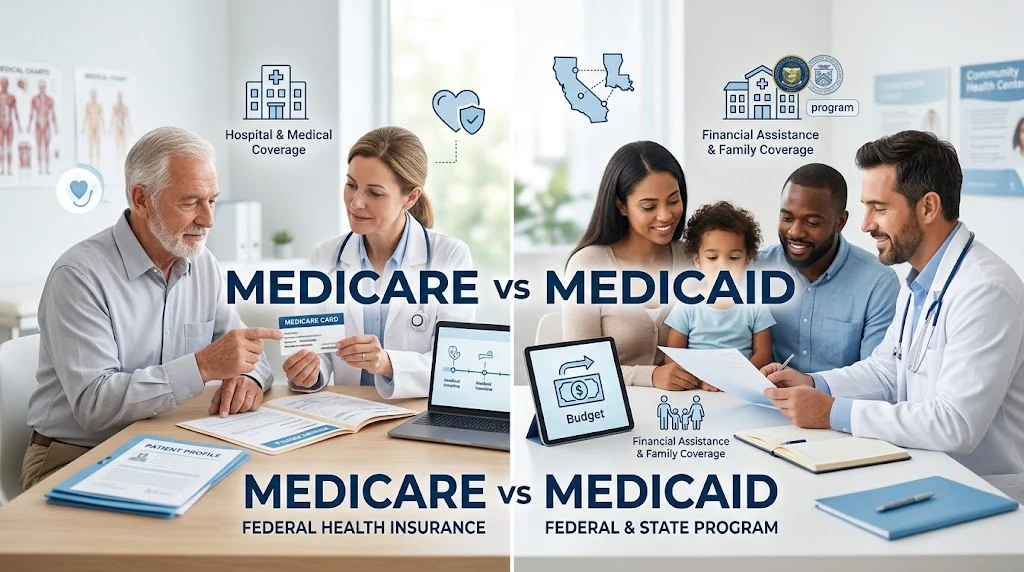
Medicare generally focuses on age or certain disabilities and conditions, while Medicaid generally focuses on financial eligibility and other state and federal requirements. Medicare is administered federally, whereas Medicaid is jointly funded and administered by federal and state governments. Some people qualify for both programs and are called dual eligible beneficiaries.
Choosing between Medicare and Medicaid can seem confusing because both are government health coverage programs, yet they serve different purposes and have different eligibility rules. The distinction matters because selecting the wrong program or misunderstanding eligibility can affect premiums, covered services, prescription drug coverage, nursing care, and out of pocket expenses.
Medicare is primarily associated with age and certain qualifying health circumstances, while Medicaid is closely connected to income, resources, household circumstances, and state requirements. Understanding these differences is especially important when comparing coverage, applying for benefits, or determining whether someone may qualify for both programs.
Medicare vs Medicaid: What’s the Difference?
Medicare and Medicaid are both major U.S. health coverage programs, but they operate differently and serve different populations.
Medicare is a federal health insurance program. It primarily covers people age 65 or older and also covers certain younger people with disabilities or specific qualifying conditions. Medicare has standardized federal rules, although beneficiaries can choose among different coverage arrangements.
Medicaid is a joint federal and state program. It helps provide health coverage to eligible people with limited income and, depending on the eligibility category, may cover children, pregnant people, parents, older adults, people with disabilities, and other adults. Eligibility rules and covered benefits can vary by state.
| Feature | Medicare | Medicaid |
| Program structure | Federal health insurance program | Joint federal and state program |
| Main eligibility basis | Age and certain disabilities or conditions | Income, circumstances, and state eligibility rules |
| Typical age group | Primarily people 65 and older | People of various ages |
| Administration | Federal | Federal and state |
| Benefits | Hospital, medical, and prescription drug coverage through different parts and plans | Medical coverage and additional services depending on state and eligibility |
| State variation | Federal standards apply nationwide | Eligibility and benefits can vary by state |
| Can someone have both? | Yes | Yes |
Mini Recap
Medicare is primarily associated with age and qualifying disabilities or conditions.
Medicaid is generally associated with financial and other eligibility requirements.
Medicare is federally administered.
Medicaid is jointly administered by federal and state governments.
Some people qualify for both programs.
Is Medicare vs Medicaid a Grammar, Vocabulary, or Usage Issue?
Unlike many word comparison topics, Medicare and Medicaid are not grammatical alternatives. They are names of two distinct government health coverage programs.
The confusion is therefore primarily a vocabulary, health insurance, and usage issue.
The words should not be used interchangeably. Saying that someone has Medicaid when they actually have Medicare can communicate incorrect information about eligibility, benefits, or payment responsibilities.
Formal vs Informal Usage
In formal writing, use the full program names when clarity is important. For example:
“Medicare provides federal health insurance coverage for eligible beneficiaries.”
“Medicaid provides coverage under federal and state rules.”
In casual conversation, people may simply say “Medicare” or “Medicaid” because the context is already understood.
Academic and Professional Usage
Academic researchers, healthcare professionals, journalists, and policy writers need to distinguish the programs carefully because eligibility, funding, benefits, and administration differ.
For example, a report discussing federal health insurance policy should not describe Medicaid as if it were exclusively a federal program. Medicaid is jointly administered and funded by federal and state governments.
How Medicare Works
Medicare is divided into different parts that cover different types of healthcare.
Part A generally covers hospital insurance services.
Part B generally covers medical insurance services, including physician services and many outpatient services.
Part C, known as Medicare Advantage, provides Medicare coverage through Medicare approved private health plans.
Part D helps cover prescription drugs.
Medicare beneficiaries can generally receive coverage through Original Medicare or choose a Medicare Advantage plan when eligible. Original Medicare includes Part A and Part B, while Medicare Advantage plans provide Medicare covered benefits through approved private plans and generally include Part A and Part B coverage. Most Medicare Advantage plans also include prescription drug coverage.
Workplace Example
An employee approaching retirement may need to understand how Medicare interacts with employer sponsored health coverage. The important question is not simply whether the person has health insurance, but how Medicare coordinates with other coverage.
Academic Example
A healthcare study might examine Medicare spending on hospital services among older adults. In that context, Medicare refers to the federal insurance program rather than a general term for government healthcare.
Technology Example
Online healthcare portals may ask users to identify whether their insurance is Medicare, Medicaid, or another form of coverage. Selecting the correct program helps route claims and eligibility information appropriately.
Usage Recap for Medicare
Use Medicare when discussing the federal health insurance program primarily serving older adults and certain younger people who meet qualifying requirements.
Remember that Medicare has different parts and coverage arrangements, so simply saying “Medicare covers everything” is inaccurate.
How Medicaid Works
Medicaid operates differently because federal and state governments share responsibility for the program.
Eligibility can depend on income, resources, age, disability, pregnancy, household circumstances, state residency, and other requirements depending on the eligibility category. State programs can differ, which means a person who qualifies in one state may face different rules in another.
Medicaid can also provide benefits that Medicare does not normally cover, including certain nursing facility and personal care services. It may also help eligible Medicare beneficiaries pay some Medicare premiums and cost sharing.
Workplace Example
An employee with limited income may investigate whether their state Medicaid program provides coverage or assistance with healthcare expenses. Eligibility depends on the applicable state and federal requirements.
Academic Example
A public health researcher might study Medicaid enrollment among low income families. In this context, the program’s state variation is an important part of the research.
Technology Example
A state healthcare website may allow applicants to submit information used to determine Medicaid eligibility. Online eligibility systems can connect applicants with Medicaid or other health coverage programs.
Usage Recap for Medicaid
Use Medicaid when referring to the joint federal and state health coverage program.
Do not assume that Medicaid has identical eligibility rules everywhere.
Always consider the person’s state and eligibility category when discussing Medicaid.
When You Should NOT Use Medicare or Medicaid
There are several situations where confusing these programs can create inaccurate information.
- Do not call Medicare a low income program. Age and certain qualifying disabilities or conditions are central Medicare eligibility pathways, while Medicaid eligibility commonly involves financial and other state requirements.
- Do not describe Medicaid as a purely federal program. States operate their Medicaid programs within federal requirements.
- Do not assume everyone over 65 automatically qualifies for Medicaid. Medicaid has separate eligibility requirements.
- Do not assume Medicare covers every medical service. Coverage depends on the program part, plan, service, and applicable rules.
- Do not assume Medicaid rules are identical in every state.
- Do not use Medicare and Medicaid as interchangeable names for government healthcare.
- Do not assume someone with Medicare cannot also have Medicaid. People can qualify for both.
- Do not assume Medicaid only covers children. Medicaid can cover eligible adults, older adults, pregnant people, and people with disabilities, depending on the applicable rules.
Common Mistakes and Decision Rules
| Correct Sentence | Incorrect Sentence | Explanation |
| Medicare primarily serves people 65 and older and certain younger eligible people. | Medicare is only for people over 65. | Certain younger people can qualify through disability or other conditions. |
| Medicaid eligibility varies by state. | Medicaid has exactly the same rules in every state. | States administer Medicaid within federal requirements. |
| Some people qualify for both programs. | You must choose one program. | Some people are dual eligible. |
| Medicare has Part A and Part B. | Medicaid has Medicare Part A and Part B. | Part A and Part B are Medicare coverage categories. |
| Medicaid may help pay certain Medicare costs for eligible beneficiaries. | Medicaid and Medicare never work together. | Some people have both forms of coverage. |
Decision Rule Box
If you mean the federal health insurance program primarily associated with age or qualifying disabilities and conditions, use Medicare.
If you mean the joint federal and state program with eligibility based on income and other requirements, use Medicaid.
If the person qualifies for both, the correct description is dual eligible, rather than treating the programs as identical.
Medicare and Medicaid in Modern Technology and AI Tools
Technology has made healthcare enrollment, claims processing, eligibility screening, and benefits management increasingly digital.
Healthcare portals may ask users to identify their coverage before displaying relevant services or forms. Insurance databases and claims systems also need to distinguish Medicare from Medicaid because the programs have different rules and payment structures.
AI tools can help explain these differences, summarize government guidance, and organize information. However, an AI generated answer should not automatically be treated as a final eligibility determination. Medicaid rules can vary by state, and Medicare coverage can depend on the specific service, plan, and circumstances.
For important enrollment or coverage decisions, users should verify information through official government resources or their relevant state Medicaid office.
Etymology of Medicare and Medicaid
The names themselves provide a useful clue.
Medicare combines “medical” with “care.” The name became associated with the federal health insurance program established under Title XVIII of the Social Security Act.
Medicaid combines “medical” with “aid.” The program was established under Title XIX of the Social Security Act and provides assistance through a federal and state partnership. CMS identifies Medicare and Medicaid as separate programs with different eligibility, coverage, and administrative structures.
An Expert Style Principle
“The safest way to distinguish Medicare and Medicaid is to ask what eligibility pathway applies and which program actually provides the coverage.”
That approach is more reliable than trying to remember a single age or income rule.
Two Practical Case Studies
Case Study 1: A Person Who Has Both Programs
Consider an older adult who qualifies for Medicare because of age and also meets their state’s Medicaid eligibility requirements.
This person can have both forms of coverage. Medicare generally pays first for Medicare covered services, while Medicaid can help with certain remaining costs and may cover services Medicare does not normally cover.
Concrete result: The person is considered dual eligible, and the two programs can work together rather than requiring the individual to choose only one.
Case Study 2: Different Medicaid Rules by State
Imagine two adults with similar financial circumstances who live in different states.
Their Medicaid eligibility may not be identical because states have flexibility within federal requirements and can operate different eligibility pathways.
Concrete result: The two individuals should not assume that qualifying information from one state’s Medicaid program automatically determines eligibility in another state. State specific rules must be checked.
Error Prevention Checklist
Always use Medicare when
You are discussing the federal Medicare program.
You are explaining Medicare Part A, Part B, Part C, or Part D.
You are discussing Medicare eligibility for older adults or certain younger people with qualifying disabilities or conditions.
You are explaining Medicare Advantage or Original Medicare.
Never use Medicaid when
You mean Medicare Part A or Part B.
You are discussing Medicare Advantage as a Medicare program.
You mean the federal Medicare insurance program.
You are describing Medicare coverage without reference to Medicaid.
Always use Medicaid when
You are discussing the joint federal and state Medicaid program.
You are discussing state based Medicaid eligibility.
You are explaining Medicaid benefits for eligible low income or other qualifying groups.
You are discussing Medicaid assistance with certain Medicare costs.
Related Healthcare Terms You Should Understand
Understanding Medicare and Medicaid becomes easier when you also know these related terms:
- Medicare Part A
- Medicare Part B
- Medicare Part C
- Medicare Part D
- Medicare Advantage
- Original Medicare
- Medicaid eligibility
- Dual eligibility
- Medicare Savings Programs
- Prescription drug coverage
These concepts are closely connected and help readers understand how government health coverage works.
FAQs
Is Medicare or Medicaid better?
Neither program is universally better. They serve different populations and have different eligibility and coverage rules. Some people can qualify for both.
Is Medicaid only for low income people?
Income is an important eligibility factor for many Medicaid groups, but Medicaid eligibility can also depend on age, disability, pregnancy, household circumstances, state residency, and other requirements.
Is Medicare only for people over 65?
No. Medicare primarily covers people 65 and older, but certain younger people can qualify because of disabilities or specific qualifying conditions.
Does Medicaid pay for Medicare?
For eligible people with both programs, Medicaid may help pay certain Medicare premiums, deductibles, coinsurance, and copayments depending on the person’s Medicaid eligibility category.
Does Medicaid cover things Medicare does not?
Yes. Medicaid may cover services that Medicare does not normally cover, including certain nursing facility and personal care services. Specific benefits depend on eligibility and state rules.
Can Medicaid eligibility vary by state?
Yes. Medicaid is jointly administered by federal and state governments, and eligibility rules and benefits can vary among states.
Conclusion
The difference between Medicare or Medicaid is much easier to understand when you focus on how each program works. Medicare is a federal health insurance program primarily serving people 65 and older and certain younger people who meet qualifying requirements. Medicaid is a joint federal and state program that provides coverage to people who meet applicable eligibility requirements, often involving income and other circumstances.
Some people qualify for both and can receive coordinated benefits. Because rules can change and Medicaid requirements vary by state, official program information should be checked before making an important coverage or enrollment decision.

Philip Pullman is an American writer dedicated to creating clear and easy to follow English content. Through his work at LingRoya.com, he helps readers strengthen their language skills with practical and reliable guidance so that they can easily understand.