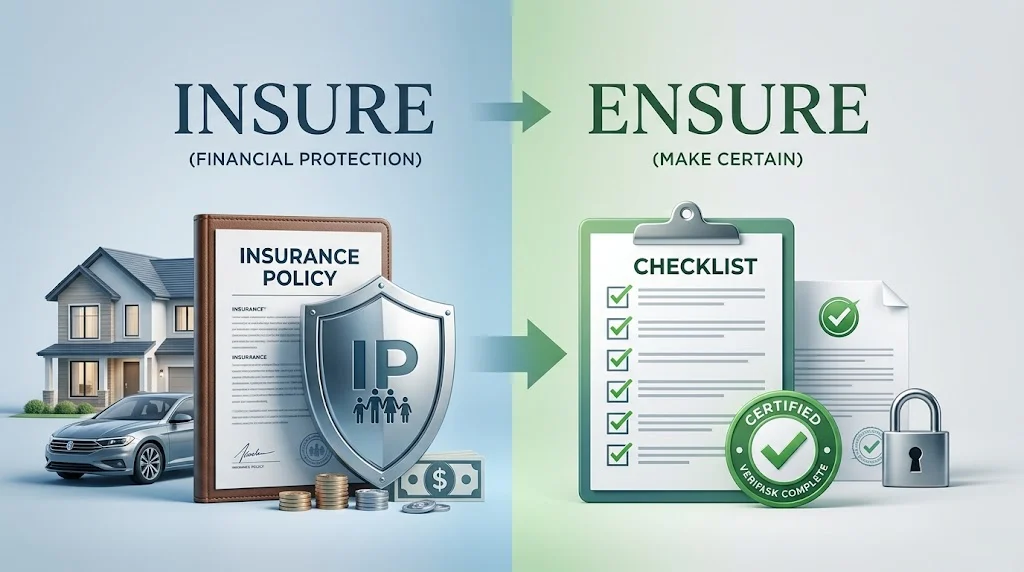
Insure means to protect something financially through an insurance policy, while ensure means to make certain that something happens or is true.
Although insure or ensure sound similar and are sometimes confused in everyday writing, they have different meanings and should not normally be used interchangeably. This distinction matters in workplace emails, academic writing, legal documents, business communication, and everyday English because choosing the wrong word can change the intended meaning.
Understanding the difference is simple once you connect insure with financial protection and ensure with making something certain. English usage experts generally recommend using each word according to its specific meaning rather than relying on pronunciation or context alone.
Insure vs Ensure: What’s the Difference?
The main difference between insure and ensure is their meaning.
Insure is primarily a verb meaning to protect a person, property, vehicle, business, or other valuable interest against financial loss by purchasing or providing insurance.
Ensure is a verb meaning to make certain that something happens, remains true, or produces a particular result.
Although both words are verbs and sound very similar, they serve different purposes.
| Word | Part of Speech | Meaning | Typical Context | Example |
| Insure | Verb | Protect against financial loss through insurance | Insurance and financial matters | We insured the house against fire. |
| Ensure | Verb | Make certain that something happens | General situations | Please ensure that the door is locked. |
Mini Recap
Insure is connected with insurance and financial protection.
Ensure means to make something certain.
They are not normally interchangeable.
Use the meaning of the sentence to decide which word belongs there.
Is Insure vs Ensure a Grammar, Vocabulary, or Usage Issue?
The confusion between insure and ensure is mainly a vocabulary and usage issue rather than a grammar problem.
Both words function as verbs, and both can appear in similar grammatical structures. The difficulty comes from their meanings and similar pronunciation.
Consider these sentences:
We insured the building against fire.
Here, insured refers to financial protection.
We ensured that the building was safe.
Here, ensured means that we made certain the building was safe.
The grammatical structure is similar, but the meanings are completely different.
Are Insure and Ensure Interchangeable?
In modern American English, insure and ensure generally have distinct meanings. In some varieties of English, especially British usage, insure can occasionally be found in broader senses related to making something certain. However, using ensure for general certainty is the clearest choice for most formal writing.
Formal vs Informal Usage
Both words are appropriate in formal and informal English when used correctly.
Insure is common when discussing insurance policies, premiums, coverage, claims, property, vehicles, health coverage, and financial protection.
Ensure is common in instructions, business communication, academic writing, technical documentation, and everyday conversation.
Academic vs Casual Usage
Academic writers generally use ensure when they mean guarantee or make certain.
For example:
Researchers should ensure that all participants understand the procedure.
Using insure in this sentence would suggest an insurance related meaning and would therefore be inappropriate.
How to Use Insure Correctly
Insure means to protect against possible financial loss by obtaining insurance or providing insurance coverage.
It is closely associated with words such as policy, coverage, premium, claim, property, vehicle, liability, and protection.
Workplace Example
The company insured its office equipment against theft and accidental damage.
The sentence refers to financial protection. If the equipment is stolen or damaged under covered circumstances, the insurance policy may provide compensation.
Academic Example
Insurance related academic writing may use insure when discussing financial risk.
Businesses often insure valuable equipment against unexpected losses.
Here, the verb describes a financial arrangement rather than simply making something certain.
Technology Example
Technology companies may insure expensive servers, data center equipment, or specialized hardware.
The company insured its expensive laboratory equipment against accidental damage.
The focus is financial protection.
Insure Usage Recap
Use insure when insurance or financial protection is involved.
If you could naturally replace the word with cover with insurance, insure is probably the correct choice.
How to Use Ensure Correctly
Ensure means to make certain that something happens or remains true.
It is much broader than insure because it can be used in countless everyday, professional, academic, and technical situations.
Workplace Example
Please ensure that all documents are submitted before the meeting.
The speaker is asking someone to make certain that the documents are submitted.
Academic Example
Students should ensure that their references are accurate before submitting their essays.
There is no insurance involved. The meaning is simply to make certain.
Technology Example
Developers should ensure that the software works correctly before releasing an update.
Again, ensure means to make certain that something happens.
Ensure Usage Recap
Use ensure when you mean make certain, guarantee, or take steps to make something happen.
If the sentence has nothing to do with insurance or financial protection, ensure will often be the appropriate choice.
When You Should NOT Use Insure or Ensure
Understanding when not to use these words can prevent several common mistakes.
- Do not use insure when you simply mean make certain.
Incorrect:
Please insure that the report is complete.
Better:
Please ensure that the report is complete.
- Do not use ensure when you are talking specifically about an insurance policy.
Incorrect:
We ensured the car against theft.
Better:
We insured the car against theft.
- Do not use insure as a general synonym for guarantee in formal writing when ensure clearly expresses your meaning.
- Do not use ensure when describing the purchase or provision of insurance coverage.
- Do not choose between the words based only on pronunciation.
- Do not assume that similar spelling means similar meaning.
- Do not use insure simply because something is being protected. Ask whether the protection involves insurance.
- Do not use ensure for a financial insurance contract unless you specifically mean making something certain rather than insuring it.
Common Mistakes and Decision Rules
| Correct Sentence | Incorrect Sentence | Explanation |
| Please ensure that the door is locked. | Please insure that the door is locked. | The meaning is make certain. |
| We insured the house against fire. | We ensured the house against fire. | The sentence refers to insurance protection. |
| The manager ensured that everyone received the information. | The manager insured that everyone received the information. | The manager made certain it happened. |
| She insured her car against theft. | She ensured her car against theft. | A car can be covered by an insurance policy. |
| The technician ensured that the system was secure. | The technician insured that the system was secure. | The technician made certain the system was secure. |
| The company insured its expensive equipment. | The company ensured its expensive equipment. | The first sentence refers to financial protection. |
Decision Rule Box
If you mean financial protection through insurance, use INSURE.
If you mean make certain that something happens or remains true, use ENSURE.
A simple memory trick is this: INSURE is connected with INSURANCE, while ENSURE is connected with making something CERTAIN.
This rule works for most modern English writing situations.
Insure or Ensure in Modern Technology and AI Tools
Modern technology has created many situations where ensure is especially useful.
Technical documentation frequently tells users or developers to ensure that settings are correct, files are backed up, systems are connected, or security requirements are satisfied.
For example:
Ensure that your device is connected to the internet before installing the update.
Using insure here would be incorrect because no insurance is involved.
The same distinction applies to artificial intelligence tools.
Developers should ensure that AI systems are tested before deployment.
The sentence means developers should make certain that testing takes place.
By contrast, an insurance company might insure servers, computer equipment, or other valuable technology against specified risks.
Etymology of Insure and Ensure
The two words are closely related historically, which helps explain why they are so easy to confuse.
Ensure developed from a form related to the idea of making something certain or secure. Its modern meaning centers on certainty and making sure that something happens.
Insure developed along a related historical path but became strongly associated with financial protection and insurance.
Their similar sounds and overlapping historical roots explain part of the confusion, but modern usage gives them different practical roles.
An Expert Rule for Remembering the Difference
“Use insure when the protection comes from insurance; use ensure when the goal is certainty.”
This distinction is especially useful for writers because it connects the word directly to its intended meaning rather than relying on spelling alone.
Two Practical Case Studies
Case Study 1: Business Insurance
Imagine a small business owner purchases coverage for expensive office equipment.
The correct sentence is:
The business insured its computers against theft and accidental damage.
The result is a financial protection arrangement. If a covered event occurs, the insurance policy may provide compensation according to its terms.
Using ensure would change the meaning and make the sentence incorrect.
Case Study 2: Software Deployment
Now consider a software development team preparing a major application update.
The project manager tells the team:
Ensure that the application has passed all required tests before release.
The result is procedural certainty. The team must make certain that testing has been completed.
Using insure would be incorrect because the sentence does not concern an insurance policy.
These examples demonstrate why the surrounding context matters more than pronunciation.
Error Prevention Checklist
Always Use Insure When
- You are talking about an insurance policy.
- You are protecting property against financial loss.
- You are discussing insurance coverage.
- You are referring to insuring a vehicle, building, business, equipment, or other valuable property.
- The sentence involves premiums, claims, coverage, or an insurer.
Never Use Insure When
- You simply mean make certain.
- You are giving instructions about completing a task.
- You are explaining how to prevent an error.
- You are talking about checking that something is correct.
- You mean guarantee in a general sense.
Always Use Ensure When
- You mean make certain.
- You want something to happen correctly.
- You are giving instructions.
- You are describing quality control.
- You are discussing procedures, safety, accuracy, or reliability.
Related Grammar Confusions You Should Master
Once you understand insure or ensure, several other commonly confused English words become easier to distinguish.
- Assure or ensure
- Affect or effect
- Advice or advise
- Accept or except
- Compliment or complement
- Principal or principle
- Practice or practise
- Then or than
- Lose or loose
- Its or it’s
These pairs often cause problems because they have similar sounds, spellings, meanings, or grammatical functions.
FAQs
What is the difference between insure and ensure?
Insure usually means to protect against financial loss through insurance. Ensure means to make certain that something happens or remains true.
Is insure a synonym for ensure?
Not normally. Although the words have related historical origins, modern standard usage generally distinguishes them. Insure is associated with insurance, while ensure means make certain.
Is it correct to say insure that?
It can occur in some varieties of English and older usage, but ensure that is the clearer and more widely recommended choice when you mean make certain.
Can insure and ensure be used interchangeably?
Generally, no. Their meanings are different in modern standard English, especially in formal and professional writing.
What is an easy way to remember insure and ensure?
Think of INSURE as being connected with INSURANCE. Think of ENSURE as meaning MAKE CERTAIN.
Conclusion
The difference between insure or ensure becomes straightforward when you focus on meaning. Use insure when you are talking about financial protection provided through insurance. Use ensure when you mean make certain that something happens or remains true.
For example, you insure a car, but you ensure that the car is properly maintained. You insure a house, but you ensure that its doors are locked. Remembering this distinction will help you avoid mistakes in academic writing, workplace communication, technical documentation, and everyday English.

Margaret Atwood is an American writer who contributes to LingRoya.com creating clear and engaging content about the English language and everyday communication. She enjoys helping readers build confidence in their writing through simple, practical guidance.