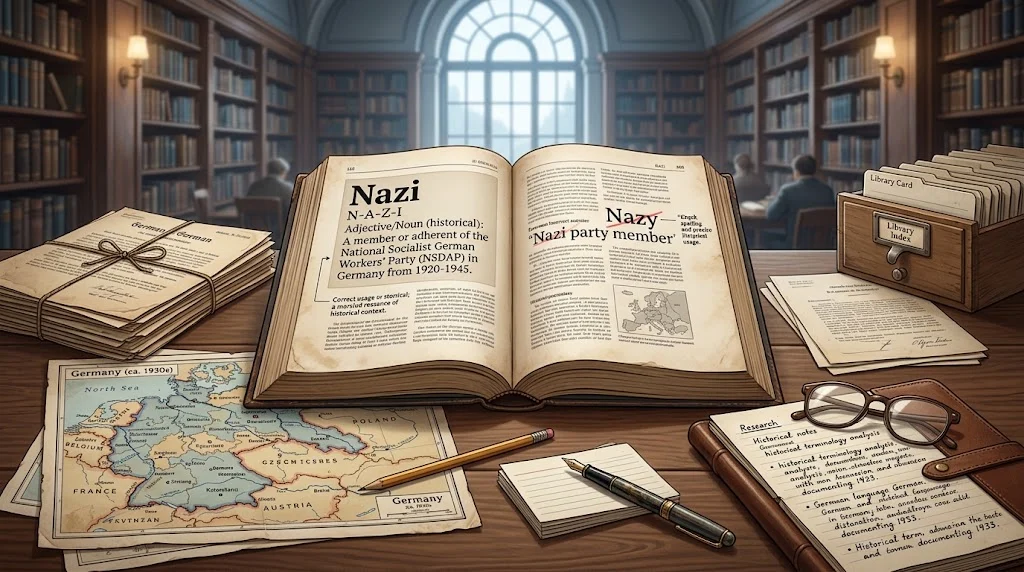
Nazi is the correct English spelling when referring to a member, supporter, or characteristic of the National Socialist movement associated with Adolf Hitler and the Nazi Party. Natzi is generally a misspelling in English.
The correct spelling is Nazi, not Natzi. The word Nazi is both a noun and an adjective. As a noun, it refers historically to a member or supporter of the National Socialist German Workers Party. As an adjective, it describes something associated with that movement, regime, ideology, or period. Natzi is not the standard English spelling.
Natzi or Nazi: What’s the Difference?
The difference is straightforward: Nazi is the standard spelling, while Natzi is normally an incorrect spelling.
| Word | Part of speech | Meaning | Standard English usage |
| Nazi | Noun | A member or supporter of the Nazi Party or, in broader modern usage, a person associated with Nazism | Correct |
| Nazi | Adjective | Relating to the Nazi Party, Nazi ideology, or Nazi Germany | Correct |
| Natzi | Noun or adjective | Intended as a reference to Nazi | Nonstandard spelling |
The word Nazi can function as a noun, as in “The Nazi Party came to power in Germany in 1933.”
It can also function as an adjective, as in “Nazi propaganda shaped public opinion.”
Natzi does not have an equivalent standard dictionary role in English.
The key point is simple.
Nazi is the accepted spelling.
Natzi is generally a spelling error.
Pronunciation can explain the confusion, but it does not change the standard spelling.
Is Natzi or Nazi a Grammar, Vocabulary, or Usage Issue?
This is primarily a spelling and vocabulary issue, rather than a grammar issue.
Grammar determines how a word behaves within a sentence. Spelling determines how the word itself is written. In this case, the important distinction is knowing which written form is recognized in standard English.
The two forms are not interchangeable. If you are writing an essay, historical article, academic paper, school assignment, news report, or professional document, use Nazi.
In casual conversation, a person might spell the word incorrectly because they have only heard it pronounced. That does not make Natzi an acceptable alternative spelling.
Formal usage
In formal writing, use Nazi when referring to the historical movement, its members, its government, its ideology, or related institutions.
For example:
The Nazi regime established a dictatorship in Germany.
Academic usage
Academic historians normally use established historical terminology. The United States Holocaust Memorial Museum consistently uses Nazi Party, Nazi regime, Nazi Germany, Nazi persecution, and related expressions.
Casual usage
Casual writing may contain misspellings, but a search query, social media post, or text message is not a reason to intentionally use Natzi when you mean Nazi.
Nazi: Meaning and Practical Usage
The word Nazi originated as a shortened form associated with the German term Nationalsozialist, meaning National Socialist. Merriam Webster identifies Nazi as a noun and adjective and gives its etymology as a shortening and alteration of Nationalsozialist.
Historically, the term refers especially to the National Socialist German Workers Party, known in German as the NSDAP. The party was a radical far right, racist, antisemitic and anti democratic political organization led by Adolf Hitler. It controlled Germany from 1933 until the end of the Second World War in Europe in 1945.
Workplace example
A historian preparing a presentation for colleagues might write:
The presentation examines how Nazi policies transformed German institutions after 1933.
Writing Natzi instead would create an avoidable spelling error in an otherwise professional document.
Academic example
A student might write:
The Nazi Party used propaganda, political violence and antisemitism to expand its influence.
This is appropriate historical terminology because the phrase identifies the organization discussed by historians and archival institutions.
Technology example
Digital archives, search engines, library databases and AI research systems generally depend on standardized terminology. Searching for Nazi history will normally produce substantially more authoritative material than relying on a misspelled form.
Usage recap: Use Nazi for the historical movement, its members, ideology, government, institutions and associated events. Avoid inventing a spelling such as Natzi.
Natzi or Nazi: When You Should NOT Use Either Form
Although Nazi is the correct spelling, there are situations where using the word without context can be misleading.
- Do not use Nazi as a casual synonym for anyone you strongly dislike.
- Do not describe ordinary political disagreement as Nazism without explaining the historical comparison.
- Do not use Nazi when you actually mean fascist, because the two terms are related but not identical.
- Do not use Nazi to describe every authoritarian government.
- Do not assume that a person who supports one nationalist idea automatically supports National Socialism.
- Do not use Natzi as an alternative spelling simply because it seems to match pronunciation.
- Do not remove historical context when discussing Nazi Germany or Nazi ideology.
- Do not use comparisons with Nazism as an insult when a precise political or historical term is available.
This distinction is particularly important in educational writing. The Nazi Party had a specific historical identity, ideology and political program. The Holocaust Encyclopedia describes it as a far right racist and antisemitic political party led by Hitler.
Common Mistakes and Decision Rules
| Correct sentence | Incorrect sentence | Explanation |
| The Nazi Party came to power in Germany in 1933. | The Natzi Party came to power in Germany in 1933. | Nazi is the standard spelling. |
| The article examines Nazi propaganda. | The article examines Natzi propaganda. | The adjective is spelled Nazi. |
| Historians study Nazi Germany. | Historians study Natzi Germany. | Natzi is a misspelling. |
| The museum discusses Nazi persecution. | The museum discusses Natzi persecution. | Standard historical terminology uses Nazi. |
| The Nazi regime persecuted millions of people. | The Natzi regime persecuted millions of people. | The historical adjective is Nazi. |
Decision Rule Box
The historical National Socialist movement or someone associated with it, use Nazi.
If you are writing the word in standard English, do not replace the z with tz.
If you are discussing a different political movement, choose the precise term that actually describes it rather than using Nazi as a general insult.
Nazi in Modern Technology and AI Tools
The spelling distinction matters even more in digital environments.
Search engines, digital libraries, historical databases and AI systems depend heavily on recognizable terminology. A misspelling may still be interpreted correctly by modern search technology, but that does not make it the preferred written form.
For example, someone researching the Holocaust may search for “Nazi persecution,” “Nazi Germany,” “Nazi propaganda,” or “Nazi Party.” These standardized phrases connect the search to established historical literature and archival material.
AI tools can also recognize misspellings from context, but users should not treat automatic correction as evidence that every spelling is equally valid. For academic research, consistent terminology remains important.
The distinction is especially valuable when creating metadata, headings, filenames, educational content and search optimized articles. A correct keyword gives readers and search systems a clearer indication of the subject.
The Etymology of Nazi
The history of the word explains why people sometimes wonder about its spelling.
Merriam Webster traces Nazi to German and identifies it as a shortening and alteration of Nationalsozialist. Oxford likewise explains the word as an abbreviation connected with the pronunciation of the beginning of Nationalsozialist, probably influenced by the German abbreviation Sozi for socialist.
The German National Socialist German Workers Party was formally called the Nationalsozialistische Deutsche Arbeiterpartei, commonly abbreviated as NSDAP. The party adopted this name in 1920.
Historical etymological sources also discuss an older German nickname, Nazi, associated with the name Ignaz and with a derogatory meaning in some regional usage. This history is useful for understanding the word’s development, but it does not make Natzi the correct modern English spelling.
An Expert Style Perspective
The United States Holocaust Memorial Museum describes the Nazi Party as a radical far right movement that was racist, nationalist, anti democratic and violently antisemitic.
That description illustrates why precision matters. Nazi is not merely a spelling exercise. It identifies a specific historical movement responsible for dictatorship, persecution and the Holocaust. The Holocaust Encyclopedia states that the Holocaust was the systematic, state sponsored persecution and murder of six million European Jews by Nazi Germany and its allies and collaborators.
Using the correct terminology therefore helps readers distinguish historical fact from casual political rhetoric.
Two Historical Case Studies
Case Study One: The July 1932 Election
The Nazi Party’s political rise provides a concrete example of why historical terminology needs precision.
In the July 1932 German elections, the Nazi Party received 37.3 percent of the vote, making it the largest political party in Germany at that point. The Holocaust Encyclopedia notes that the party’s membership had grown dramatically during this period, reaching about 450,000 members in 1932.
The result was not simply a vocabulary milestone. It represented a major political breakthrough that helped create the conditions for Hitler’s appointment as chancellor in January 1933.
Case Study Two: The March 1933 Election
In the March 1933 Reichstag election, the Nazi Party received almost 44 percent of the vote. Together with its conservative coalition partner, the government obtained a parliamentary majority. The election took place amid intimidation and political repression.
On March 23, 1933, the Enabling Act gave Hitler’s government the ability to enact laws without parliamentary approval. The Nazi regime subsequently abolished other political parties and consolidated its dictatorship.
These concrete events show why Nazi is a precise historical label rather than merely an emotional expression.
Error Prevention Checklist
Always use Nazi when
When Referring to the Nazi Party.
If you are member of the National Socialist movement.
Describing Nazi Germany.
Discussing Nazi ideology or Nazism.
Writing about Nazi persecution or propaganda.
Producing academic or historical content.
Never use Natzi when
You mean the standard English word Nazi.
Writing a formal essay.
Creating educational content.
Citing historical institutions.
Writing an academic research paper.
Optimizing a historical article for search.
Related Grammar and Vocabulary Confusions You Should Master
Learning the correct spelling of Nazi is only one part of precise historical writing. Other commonly confused terms include:
- Nazi vs fascist
- Nazism vs National Socialism
- Nazi Party vs German government
- Germany vs Nazi Germany
- antisemitism vs anti Jewish prejudice
- ideology vs political party
- dictatorship vs authoritarianism
- propaganda vs political communication
- Holocaust vs Second World War
- concentration camp vs killing center
These distinctions matter because historical terms often describe different things. For example, the Nazi camp system included different types of facilities, and the Holocaust Encyclopedia specifically warns against treating every Nazi detention or killing site as though it were the same type of camp.
Advanced FAQs
Is Nazi or Natzi the correct spelling?
Nazi is the correct standard spelling in English. Natzi is generally a misspelling. Major dictionaries including Merriam Webster and Oxford list Nazi as the established form.
Why is Nazi spelled with a z instead of tz?
The spelling comes from the German abbreviation and pronunciation associated with Nationalsozialist. English adopted Nazi as the established written form.
Is Natzi a real word?
Natzi can appear as a spelling mistake or an informal transcription, but it is not the standard English spelling for the historical political term Nazi.
What does Nazi mean?
Historically, Nazi refers to a member or supporter of the National Socialist movement associated with Hitler and the National Socialist German Workers Party. It can also function as an adjective describing things connected with that movement or regime.
Is Nazi a noun or an adjective?
It can be both. As a noun, it can refer to a member or supporter of the Nazi movement. As an adjective, it describes something associated with the Nazi Party, ideology or regime.
What is the difference between Nazi and Nazism?
Nazi generally identifies a person or describes something connected with the movement. Nazism refers to the political ideology and system associated with Hitler and the Nazi movement.
Should I use Nazi in academic writing?
Yes, when it is historically accurate and relevant. Academic writing should use established terminology consistently and should provide sufficient context when discussing National Socialism, the Nazi Party or Nazi Germany.
Conclusion
When choosing between natzi or nazi, the correct standard English spelling is Nazi. It can function as both a noun and an adjective, and it refers specifically to the National Socialist movement, its members, or things associated with that historical ideology and regime. Natzi is generally a misspelling, even though the pronunciation can make the error understandable.
The larger lesson is about precision. Historical vocabulary carries meaning, context and consequences. Using Nazi correctly helps readers understand exactly which political movement, period and ideology you mean. When writing about the Second World War, the Holocaust, Hitler, National Socialism or Nazi Germany, accurate spelling is a small but important part of accurate history.

Neil Gaiman is an American writer who contributes educational content to LingRoya.com. His work focuses on helping readers improve their English with clear, practical and easy to follow guidance.