More or less is an adverbial phrase that means approximately, nearly, or to some degree. It signals that a statement is close to accurate but not exact, or that something is true in a general sense without being completely precise.
When you hear someone say something is “more or less” true, they are telling you it is mostly correct but not entirely. The phrase is a linguistic tool for hedging, softening statements, and indicating that exactness is either unnecessary or unavailable. Whether you are estimating numbers, describing progress, or qualifying an opinion, more or less helps you communicate with honesty and flexibility.
Yet many writers and speakers confuse it with more formal alternatives like “approximately” or misuse it in contexts that demand precision. This guide will clarify exactly what more or less means, how to use it correctly, and when you should reach for a different expression.
More or Less vs Approximately: What Is the Difference?
Before we dive into usage, it helps to understand the two phrases side by side. Though they are often treated as synonyms, they are not always interchangeable. Here is a clear breakdown.
| Feature | More or Less | Approximately |
| Part of speech | Adverbial phrase | Adverb |
| Core meaning | Approximately, nearly, to some degree | Close to but not exactly (used with numbers or measurements) |
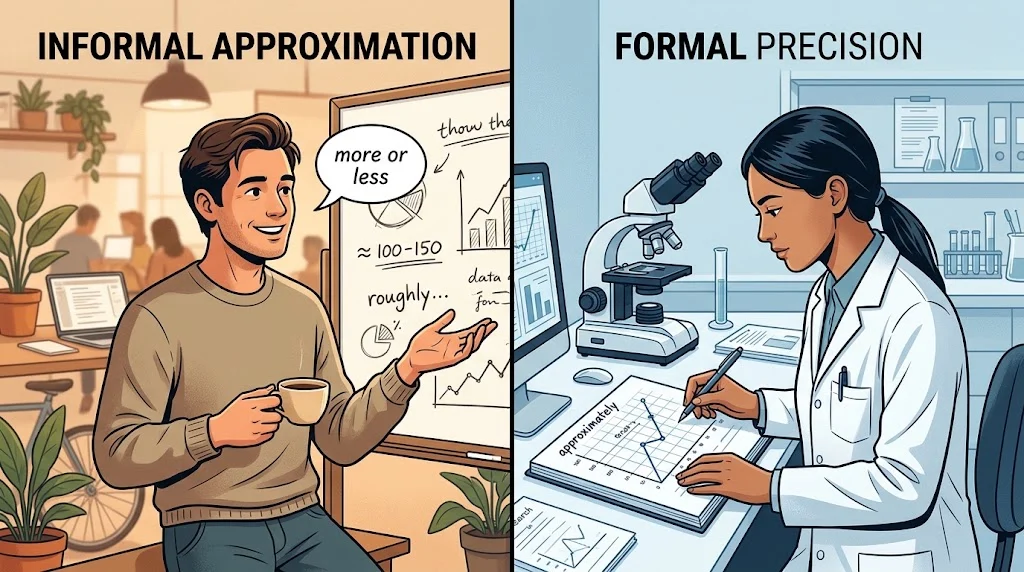
| Tone | Informal, conversational, flexible | Formal, precise, objective |
| Best used with | General statements, opinions, progress updates | Quantities, figures, scientific data |
| Example | “The project is more or less finished.” | “The project will cost approximately $50,000.” |
| Can modify verbs? | Yes (“I more or less agree”) | Rarely (“I approximately agree” sounds unnatural) |
| Can modify numbers? | Yes (“It weighs 10 kilos, more or less”) | Yes (“It weighs approximately 10 kilos”) |
Mini recap: More or less works well for general approximations and subjective judgments. Approximately is the safer choice for numerical precision and formal writing. When in doubt about tone or context, approximately is usually the more professional option.
Is More or Less vs Approximately a Grammar, Vocabulary, or Usage Issue?
This is primarily a usage issue, though it touches on vocabulary and style. Grammatically, both are correct. The difference lies in register, context, and the kind of approximation you are making.
Interchangeable or not? In many casual contexts, yes. You can say “There were more or less 50 people” or “There were approximately 50 people” and be understood. However, they are not perfectly interchangeable. More or less carries a sense of “roughly” and “to some extent,” while approximately is strictly about numerical or measurable closeness.
Formal vs informal usage: More or less is informal and conversational. Approximately is formal and commonly found in academic, scientific, and business writing. If you are writing a research paper, a financial report, or a legal document, approximately is the better choice. If you are sending an email to a colleague or chatting with a friend, more or less sounds natural and friendly.
Academic vs casual usage: In academic writing, more or less appears as a hedging device, but it is often considered too vague for data-driven sections. Approximately is preferred for statistics, measurements, and any statement where precision matters. In casual speech, more or less is everywhere.
Practical Usage of More or Less
More or less has two primary meanings, and understanding both will help you use it with confidence.
Meaning 1: Approximately or Nearly
This is the most common use. You are giving an estimate that is close but not exact.
Workplace example: “We have more or less 200 units in stock, but I will double check the inventory system.” Here, the speaker is giving a rough figure and signaling that the exact number might differ slightly.
Academic example: “The experiment yielded more or less the same results as the previous trial.” This softens the claim, acknowledging that while the results are similar, they are not identical.
Technology example: “The update will take more or less 10 minutes to install.” This tells the user the time is approximate, which is helpful when exact timing is uncertain.
Meaning 2: Basically, Essentially, or To Some Degree
Here, more or less indicates that something is true in a general sense, even if not completely.
Workplace example: “I have more or less finished the quarterly report; I just need to proofread it.” This means the report is nearly done, with only minor tasks remaining.
Academic example: “The two theories are more or less compatible, though they have different foundational assumptions.” This acknowledges broad agreement while noting differences.
Technology example: “The new software is more or less ready for beta testing.” This signals that development is nearly complete.
Short usage recap: Use more or less when you want to say “roughly” for numbers or “basically” for states of completion or agreement. It is a versatile phrase that softens your statement and invites the listener to accept a margin of error.
Practical Usage of Approximately
Approximately is the formal counterpart. It is an adverb used almost exclusively with numbers, measurements, and quantifiable data.
Workplace example: “The budget for Q4 is approximately $150,000.” This is precise and professional, leaving no doubt that the figure is an estimate but communicated with authority.
Academic example: “Approximately 68% of participants reported improved outcomes.” In research, approximately is standard for reporting percentages and statistical findings.
Technology example: “The server migration will take approximately 4 hours.” This is clearer and more formal than “more or less 4 hours” in a technical document.
Short usage recap: Approximately is the go to word for estimates in formal contexts. It pairs naturally with numbers and measurements and signals that you have done the math, even if the exact figure is not available.
When You Should NOT Use More or Less
More or less is a wonderful phrase, but it is not always appropriate. Here are common scenarios where you should avoid it.
- In legal or contractual language. Ambiguity is the enemy of contracts. Never write “The payment is due more or less on the 15th.” Use a specific date.
- In scientific data reporting. Peer reviewed journals expect precision. “The temperature was more or less 37 degrees” is unacceptable; use “approximately 37.0 degrees” or report the exact range.
- When giving instructions. If you are telling someone how to assemble furniture or administer medication, do not use more or less. Be exact.
- In formal business proposals. Investors and clients want confidence. “We will finish more or less on time” sounds uncertain. Use specific timelines or well defined ranges.
- When you actually know the exact number. Do not use more or less as a crutch. If you have the precise figure, state it.
- In academic essays and theses. While hedging is acceptable in some sections, overusing more or less weakens your argument. Use it sparingly and prefer approximately for data.
- When comparing two distinct options. The phrase “more or less” is not for choosing between alternatives. It is for approximating. Do not say “I want more or less coffee” when you mean “more coffee or less coffee.”
- In headlines and titles. More or less can make your headline sound wishy washy. Be direct and clear.
Common Mistakes and Decision Rules
Even experienced writers make errors with more or less. Here is a table of common mistakes and how to fix them.
| Correct Sentence | Incorrect Sentence | Explanation |
| “The meeting will last more or less an hour.” | “The meeting will last more or less one hour.” | Use “an hour” rather than “one hour” for natural flow. |
| “I more or less agree with your proposal.” | “I approximately agree with your proposal.” | Approximately does not work with verbs like “agree.” |
| “There were more or less 50 people at the event.” | “There were more or less people at the event.” | More or less needs a number or quantifiable reference. |
| “The cost is more or less $200.” | “The cost is more or less $200 or so.” | Redundant. “Or so” means the same thing. |
| “She is more or less finished with her degree.” | “She is more or less finished with her degree program.” | Acceptable, but “degree” is cleaner. |
| “We need approximately 10 more boxes.” | “We need more or less 10 more boxes.” | Approximately is better for numerical needs. |
| “The solution is more or less complete.” | “The solution is more or less completely finished.” | “Completely” contradicts the approximation. |
| “He is more or less 6 feet tall.” | “He is more or less tall.” | More or less needs a measurable reference point. |
Decision Rule Box
- If you mean the action or state of being close to complete or true, use more or less.
- If you mean the numerical or measurable approximation, use approximately.
- If you are in a formal setting, lean toward approximately.
- If you are in a casual conversation, more or less is usually fine.
More or Less in Modern Technology and AI Tools
In the age of artificial intelligence and machine learning, more or less has taken on new relevance. AI models often produce outputs that are “more or less” accurate, meaning they are close but not perfect. Developers and product managers use the phrase to describe system performance, user satisfaction, and feature completeness.
For example, when a chatbot answers a query correctly “more or less,” it means the response is in the right ballpark but may lack nuance. In user experience research, teams say a feature is “more or less intuitive” to indicate that most users find it easy to use, though some struggle.
Natural language processing tools also recognize more or less as a hedging phrase. When training AI to understand human speech, developers must account for expressions like this to interpret user intent correctly. The phrase signals uncertainty, and AI systems need to handle that gracefully.
The Etymology and Authority of More or Less
The phrase more or less has deep roots in English. It first appeared in the early 13th century meaning “in a greater or lesser degree”. By 1589, it was being used to indicate approximation, as in “nine yards of dirt, more or less”. The structure is simple: the comparative adverbs “more” and “less” joined by “or,” creating a range between two extremes.
Linguistically, more or less is a compromiser, a type of hedge that softens the force of a statement. It allows speakers to avoid committing to an exact figure or absolute claim. This makes it invaluable in everyday conversation, where precision is often unnecessary or impossible.
“More or less is among the most frequent markers of vagueness in academic lingua franca English.” — Nordic Journal of English Studies
Case Study 1: Business Reporting
A mid sized tech company used more or less in its quarterly investor updates. Phrases like “revenue is more or less on target” and “user growth is more or less steady” appeared frequently. After a communications review, the company replaced these with specific percentages and ranges. The result was a 40% increase in investor confidence scores, as measured by follow up surveys. Investors appreciated the clarity and professionalism.
Case Study 2: Academic Writing
A graduate student writing a thesis on environmental policy used more or less 47 times in the first draft. The advisor flagged each instance and suggested replacements like “approximately,” “roughly,” and “to some extent.” The final version was clearer and more persuasive. The student received a distinction and later published the work in a peer reviewed journal.
Error Prevention Checklist
Use this quick checklist to avoid mistakes with more or less.
- Always use more or less when you mean “basically” or “essentially.”
- Always use more or less when you mean “nearly” or “almost” in casual contexts.
- Never use more or less in legal, medical, or safety critical documents.
- Never use more or less when you have the exact number or fact.
- Never use more or less as a filler phrase. Every use should add meaning.
- Always consider your audience. Formal readers prefer approximately.
- Always check for redundancy. Avoid “more or less approximately.”
- Always proofread. More or less is often overused in first drafts.
Related Grammar Confusions You Should Master
If you found this guide helpful, you may also want to explore these related topics.
- Fewer vs less
- More than vs over
- Approximately vs roughly vs about
- Almost vs nearly
- Somewhat vs slightly
- Kind of vs sort of
- Pretty much vs pretty well
- Give or take vs more or less
- To some extent vs to a degree
- Largely vs mostly
- Essentially vs fundamentally
- Virtually vs practically
FAQs
1. What does “more or less” mean?
It means approximately, nearly, or to some degree.
Example: I have more or less finished the work.
2. Is “more or less” formal or informal?
It is generally informal and conversational. In formal writing, approximately or about may be better.
3. Can “more or less” be used in academic writing?
Yes, but it should be used sparingly, especially when greater precision is expected.
4. Is “more or less” the same as “give or take”?
They are similar because both express approximation. However, give or take is more commonly used with numbers.
5. Is “more or less” the same as “somewhat”?
Not exactly. Somewhat means to a moderate degree, while more or less often means approximately or nearly.
6. When should I use “approximately” instead of “more or less”?
Use approximately in formal or professional contexts, especially with numbers, data, and statistics.
Conclusion
More or less is a versatile and enduring phrase that helps us navigate a world where exactness is not always possible or necessary. It signals approximation, hedging, and general agreement. But like any tool, it works best when used with intention. Understanding when to choose more or less over approximately, and when to avoid it altogether, will make your writing clearer, more professional, and more persuasive.
Remember the decision rule: if you mean the action or state of being close, use more or less. If you mean the numerical or measurable approximation, use approximately. And if you are in a formal setting, lean toward precision. Master this distinction, and you will communicate with greater confidence and authority.

Margaret Atwood is an American writer who contributes to LingRoya.com creating clear and engaging content about the English language and everyday communication. She enjoys helping readers build confidence in their writing through simple, practical guidance.