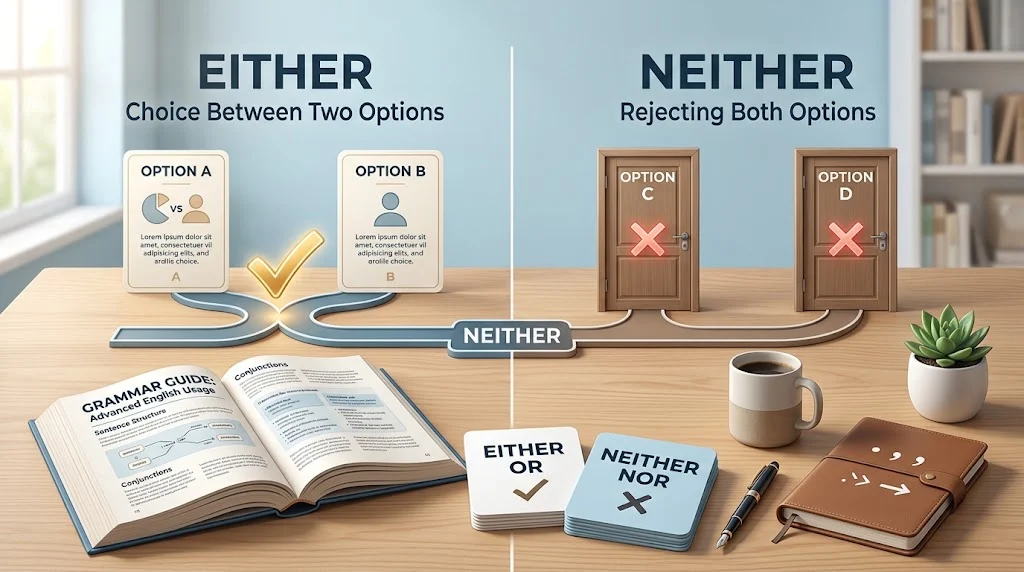
Either means one of two choices or possibilities, while neither means not one and not the other. Use either when at least one of two options is acceptable or possible, and use neither when both options are rejected. For example, “Either answer is acceptable” allows a choice, while “Neither answer is correct” rejects both.
Confusing either and neither can change the meaning of an entire sentence. These words are closely connected, yet they serve different grammatical purposes and communicate opposite ideas. Either introduces one option from two possibilities, or it can refer to both possibilities in certain negative constructions.
Neither means not one and not the other. This distinction matters in professional emails, academic essays, everyday conversations, instructions, and digital communication. In this guide, you’ll learn how each word works, when to use it, which common mistakes to avoid, and how to make the right choice quickly.
Either vs Neither: What’s the Difference?
The simplest way to understand these words is to think about choice versus rejection.
Either can function as a determiner, pronoun, conjunction, or adverb depending on the sentence. It commonly refers to one of two possibilities.
Example: “You can choose either option.”
This means that option A or option B is acceptable.
Neither is generally used as a determiner, pronoun, or conjunction. It refers to not one and not the other of two possibilities.
Example: “Neither option is suitable.”
This means option A is unsuitable and option B is also unsuitable.
| Feature | Either | Neither |
| Basic meaning | One of two | Not one and not the other |
| Main function | Choice or possibility | Rejection of both choices |
| Polarity | Usually positive or neutral | Negative |
| Common pair | Either…or | Neither…nor |
| Example | Either answer works | Neither answer works |
Mini Recap
Either gives you a choice between two possibilities.
Neither excludes both possibilities.
Either often works with “or.”
Neither commonly works with “nor.”
Remembering either = one of two and neither = zero of two makes the distinction much easier.
Is Either vs Neither a Grammar, Vocabulary, or Usage Issue?
It is primarily a grammar and usage issue, although vocabulary also plays a role.
The two words aren’t normally interchangeable because changing one to the other changes the meaning.
Consider these sentences:
“Either candidate can lead the project.”
This means candidate A or candidate B can lead it.
“Neither candidate can lead the project.”
This means candidate A cannot lead it and candidate B cannot lead it.
The grammatical structure also matters. Either commonly appears in the construction either…or, while neither commonly appears in neither…nor.
Formal and Informal Usage
Both words are standard English and are appropriate in formal writing.
In casual conversation, speakers may use slightly different constructions depending on dialect or context. However, the standard forms remain useful in professional and academic writing.
For example:
“Either proposal could solve the problem.”
This is suitable for a business report.
“Neither proposal addresses the underlying issue.”
This is also suitable for formal writing.
The key isn’t choosing between formal and informal vocabulary. The key is accurately communicating whether one option is possible or both are excluded.
How to Use Either Correctly
Either is used when referring to one of two choices, possibilities, people, or things.
Workplace Example
“Either department can handle the request.”
The sentence says that department A or department B can handle it.
Another example is:
“Please send the document to either manager.”
Here, the writer is allowing the recipient to choose between two managers.
Academic Example
“Either explanation could account for the results.”
The writer is saying that both explanations are possible, but only one may ultimately be correct.
Either is especially useful in academic writing when discussing alternatives without immediately rejecting one.
Technology Example
“Either device can connect to the network.”
This means device A can connect and device B can also connect, so the user can select either one.
Usage Recap
Use either when you are presenting or allowing a choice between two possibilities.
Think:
Either A or B.
The emphasis is on alternatives and possibility.
How to Use Neither Correctly
Neither means that both of two people, things, or possibilities are excluded.
Workplace Example
“Neither applicant has the required certification.”
This means applicant A does not have the certification and applicant B does not have it either.
Academic Example
“Neither study provides sufficient evidence for the claim.”
Both studies fail to provide enough evidence.
Technology Example
“Neither device supports this operating system.”
The statement excludes both devices.
Usage Recap
Use neither when you want to reject or exclude both of two options.
Think:
Neither A nor B.
The emphasis is on the absence of both possibilities.
When You Should NOT Use Either or Neither
Several common situations cause unnecessary confusion.
- Do not use either when you clearly mean that both options are impossible.
Incorrect: “Either answer is incorrect.”
This can sound ambiguous because either can sometimes suggest one of the two rather than both.
Better: “Neither answer is correct.”
- Do not use neither when one of two options is acceptable.
Incorrect: “Neither route will get you there,” when one route actually works.
Better: “Either route will get you there.”
- Avoid creating a double negative with neither.
Incorrect: “I don’t like neither option.”
Better: “I like neither option.”
- Don’t automatically pair either with nor.
Standard paired construction:
“Either John or Sarah will attend.”
Standard negative paired construction:
“Neither John nor Sarah will attend.”
- Don’t use neither when discussing more than two options in standard formal usage.
If you have three or more possibilities, expressions such as “none of them” are usually more appropriate.
- Don’t treat either and neither as interchangeable synonyms.
They express opposite logical relationships.
- Don’t choose the word based only on how it sounds.
First determine whether you are accepting a choice or rejecting both choices.
- Don’t ignore subject and verb agreement in constructions involving neither.
The exact agreement pattern can depend on the construction and style, so formal writing should be handled carefully.
Common Mistakes and Decision Rules
| Correct sentence | Incorrect sentence | Explanation |
| Either answer is acceptable. | Neither answer is acceptable. | The incorrect version changes the meaning. |
| Neither answer is correct. | Either answer is not correct. | Neither clearly rejects both answers. |
| Either John or Mark will attend. | Neither John or Mark will attend. | Neither normally pairs with nor. |
| Neither option works. | I don’t like neither option. | Avoid the unnecessary double negative. |
| You can choose either plan. | You can choose neither plan. | The second sentence rejects both plans. |
Decision Rule Box
If you mean one of two choices, use either.
If you mean not one and not the other, use neither.
Either commonly pairs with or.
Neither commonly pairs with nor.
A quick mental test is to count acceptable choices.
If the answer is one or possibly either choice, think either.
If the answer is zero choices, think neither.
Either and Neither in Modern Technology and AI Tools
Modern technology creates many situations where precise wording matters.
Imagine an application asking:
“Would you like to use either authentication method?”
The user is being offered alternatives.
Now consider:
“Neither authentication method is currently available.”
The system is saying that both methods are unavailable.
AI systems also benefit from this distinction because natural language instructions depend heavily on logical relationships. A prompt such as “Use either source” creates a different instruction from “Use neither source.”
In technical documentation, user interfaces, software instructions, and AI generated content, replacing either with neither can reverse the intended instruction.
A Short History and Etymology of Either and Neither
Both words have long histories in English.
Either developed from Old English forms associated with the idea of each of two or one of two. Over time, its meaning expanded into several related grammatical uses.
Neither developed from a combination historically connected with the negative concept of “not” and the word associated with either. Its fundamental meaning became “not either.”
That relationship explains why the two words look and sound similar.
It also provides a useful memory trick:
Neither can be understood as negative either.
An Expert Perspective
A useful way to teach these terms is to focus on logic rather than memorization:
“The easiest distinction is to ask whether the sentence permits an option or excludes both options.”
This approach makes the rule practical. Instead of memorizing isolated definitions, readers can identify the intended meaning first and then choose the appropriate word.
Case Study 1: Workplace Communication
Imagine a manager writing:
“Either employee can complete the report.”
The message gives two employees permission or identifies both as capable alternatives.
If the manager instead writes:
“Neither employee can complete the report.”
The meaning changes completely. Both employees are excluded.
A single vocabulary choice therefore changes the staffing instruction. In workplace communication, that can lead to confusion about responsibility, deadlines, and task ownership.
Case Study 2: Technology Instructions
Consider a software support message:
“Either browser can be used to access the dashboard.”
The user understands that browser A or browser B is acceptable.
Now change the sentence:
“Neither browser can be used to access the dashboard.”
The user understands that both browsers are unsupported.
The practical result is significant. The first message provides two workable alternatives. The second tells the user to find another solution.
Error Prevention Checklist
Always use Either when
- You are presenting two alternatives.
- One of two options is acceptable.
- You want to express a choice.
- You are using the common structure either…or.
- Both alternatives remain possible.
Never use Neither when
- One or both choices are acceptable.
- You are trying to offer an alternative.
- You mean “one of the two.”
- You are pairing it with “or” in the standard neither…nor construction.
- You have more than two options and “none” would be clearer.
Related Grammar Confusions You Should Master
Understanding either and neither becomes easier when you also understand several related English distinctions.
- Either vs any
- Neither vs none
- Either…or vs neither…nor
- Each vs every
- Less vs fewer
- Much vs many
- Who vs whom
- Since vs for
- Affect vs effect
- Then vs than
These topics involve similar questions about meaning, grammatical role, quantity, choice, and sentence structure.
FAQs
1. What is the difference between either and neither?
Either means one of two; neither means not one and not the other.
2. Is either positive and neither negative?
Generally, yes. Either shows alternatives, while neither excludes both.
3. Should I use either or neither with two choices?
Use either for a choice; use neither when both choices are rejected.
4. What is the difference between either…or and neither…nor?
Either…or gives alternatives; neither…nor excludes both.
5. Can either mean both?
In some contexts, yes. For example, “There is a tree on either side” means each of the two sides.
6. Can neither be used for more than two things?
Traditionally, neither is used for two. For three or more, none is usually clearer.
7. Is “I don’t like neither” correct?
In formal English, no. Say “I don’t like either” or “I like neither.”
8. Is either singular or plural?
When referring to one of two, either is generally singular: “Either option is suitable.”
9. Is neither singular or plural?
Neither is traditionally singular: “Neither answer is correct.”
10. What is the easiest way to remember either and neither?
Think either = one of two and neither = zero of two.
Conclusion
The difference between either and neither is straightforward once you focus on meaning. Either introduces or permits a choice between two possibilities, while neither excludes both. The most useful pairings are either…or and neither…nor.
When you’re unsure, ask one simple question: Am I allowing a choice, or am I rejecting both choices? If you are allowing a choice, use either. If both options are excluded, use neither. This simple decision rule will help you write more accurately in everyday, academic, workplace, technical, and professional English.

Neil Gaiman is an American writer who contributes educational content to LingRoya.com. His work focuses on helping readers improve their English with clear, practical and easy to follow guidance.