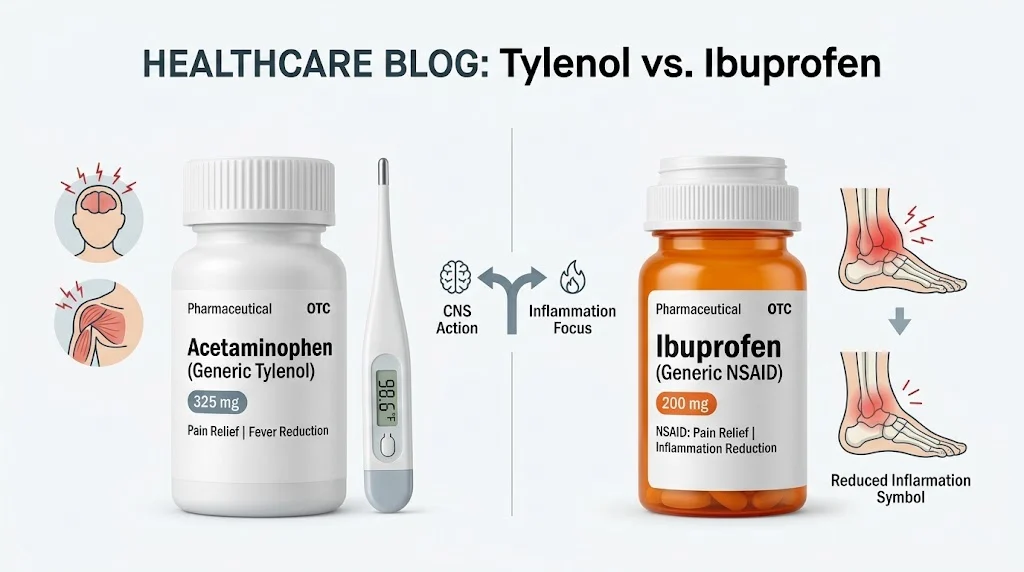
When choosing tylenol or ibuprofen, the main difference is that Tylenol contains acetaminophen, which mainly relieves pain and reduces fever, while ibuprofen is an NSAID that also reduces inflammation. Neither medicine is universally better.
Tylenol is a brand name noun for a medicine whose active ingredient is acetaminophen, also called paracetamol in many countries. Acetaminophen is commonly used to reduce fever and relieve mild to moderate pain. It does not belong to the NSAID class.
Ibuprofen is a generic drug name and noun. It belongs to the nonsteroidal anti inflammatory drug class, commonly called NSAIDs. In addition to relieving pain and reducing fever, ibuprofen reduces inflammation. FDA information identifies ibuprofen as an NSAID and notes that NSAIDs work by blocking substances involved in inflammation.
| Feature | Tylenol | Ibuprofen |
| Active ingredient | Acetaminophen | Ibuprofen |
| Drug class | Analgesic and fever reducer | NSAID |
| Relieves pain | Yes | Yes |
| Reduces fever | Yes | Yes |
| Reduces inflammation | Not considered its primary effect | Yes |
| Main safety concern | Liver injury when too much is taken | Stomach bleeding, kidney problems, and other NSAID risks |
| Common uses | Headache, fever, everyday aches | Muscle pain, inflammatory pain, headache, fever |
| Important caution | Avoid exceeding the labeled amount and check combination products | Extra caution with ulcers, bleeding risks, kidney problems, and certain medicines |
The most important point is that these medicines are not interchangeable in every situation.
Tylenol can be a useful option when pain or fever is the main concern.
Ibuprofen may be particularly useful when inflammation contributes significantly to pain.
Your health history can matter more than the name of the pain reliever.
Is Tylenol or Ibuprofen a Grammar, Vocabulary, or Usage Issue?
In ordinary English, this is primarily a vocabulary and usage issue, not a grammar problem. Tylenol and ibuprofen refer to different medicines, although many people casually compare them as though they were identical products.
They are not interchangeable terms. Saying “I took Tylenol” usually means the person took acetaminophen. Saying “I took ibuprofen” identifies an NSAID.
In formal medical writing, academic writing, workplace communication, and health education, precision matters. A pharmacist, clinician, or researcher needs to know which active ingredient is being discussed because the safety profile and drug interactions can differ.
In casual conversation, someone might simply say, “I took something for my headache.” That statement avoids making an unnecessary claim about which medicine was used.
The distinction becomes even more important when discussing combination cold and flu products. Acetaminophen can appear in several prescription and nonprescription medicines, so accidentally taking more than one acetaminophen containing product can lead to an overdose.
When Tylenol May Make Sense
Tylenol is often considered when the main goal is pain relief or fever reduction without specifically targeting inflammation.
Because Tylenol is acetaminophen, the active ingredient may appear under a different name outside the United States. The FDA and MedlinePlus identify Tylenol as a brand containing acetaminophen.
Workplace Example
“Her headache improved after she took acetaminophen according to the package directions.”
This is precise workplace language because it identifies the active ingredient rather than simply describing an effect.
Academic Example
“The participants received acetaminophen for pain relief.”
This wording is preferable in research because academic writing normally identifies the medicine or active ingredient clearly.
Technology Example
“A health application may list acetaminophen as an option for pain and fever, but it cannot determine whether the medicine is appropriate for every person.”
That distinction is important. Software can organize information, but medication decisions may depend on allergies, other medicines, age, existing medical conditions, and other factors.
Usage Recap
Use Tylenol when discussing that specific brand. Use acetaminophen when you mean the active ingredient generally. Never assume that every product containing acetaminophen has the same formulation.
Another important safety point is that excessive acetaminophen can cause serious liver damage. MedlinePlus warns that taking too much can be dangerous and that acetaminophen can appear in many combination products.
When Ibuprofen May Make Sense
Ibuprofen belongs to the NSAID family and has both pain relieving and anti inflammatory effects. This can make it useful when inflammation is an important part of the problem.
For example, swelling and inflammation can accompany some muscle injuries, joint problems, menstrual cramps, and other painful conditions. FDA information confirms that ibuprofen is an NSAID used for pain and fever and that NSAIDs act on inflammatory chemicals in the body.
Workplace Example
“He used ibuprofen for the muscle pain after checking the label and considering his other medicines.”
This sentence is responsible because it avoids claiming that ibuprofen is automatically suitable for everyone.
Academic Example
“The study compared ibuprofen with acetaminophen for short term pain relief.”
This is the kind of precise wording appropriate for medical research.
Technology Example
“An AI assistant can explain that ibuprofen has anti inflammatory properties, but it should not tell a user to take a specific medicine without considering medical context.”
This is especially relevant as people increasingly use search engines, health apps, and AI systems for medication questions.
Usage Recap
Use ibuprofen when you mean the NSAID itself. Its anti inflammatory action can be useful, but its safety considerations are different from those associated with acetaminophen.
Ibuprofen can cause ulcers, gastrointestinal bleeding, or other serious gastrointestinal problems, sometimes without warning. Risk can be higher in certain people, including those taking blood thinners or other medicines that increase bleeding risk.
Tylenol or Ibuprofen: Which Is Better for Pain?
There is no single answer for every type of pain.
For some inflammatory conditions, ibuprofen may have an advantage because it addresses inflammation as well as pain. For other situations, acetaminophen may be a reasonable choice when fever or pain is the main issue and NSAID related risks make ibuprofen less suitable.
Research also shows that the comparison is more complicated than simply labeling one medicine the winner.
A randomized clinical trial involving 411 adults with acute extremity pain found that a single dose containing ibuprofen and acetaminophen produced a 4.3 point reduction on an 11 point pain scale after two hours. The study found no clinically important difference compared with several opioid and acetaminophen combinations.
An earlier randomized trial involving adults with acute musculoskeletal pain found that ibuprofen, acetaminophen, and their combination all reduced pain, with no statistically significant difference among the groups during the study period.
These findings reinforce a useful principle: more medicine does not automatically mean better pain relief.
When You Should NOT Use Tylenol or Ibuprofen
There are situations in which simply choosing one medicine over the other without professional guidance can be a mistake.
- Do not exceed the labeled amount of acetaminophen.
- Do not accidentally combine multiple medicines that contain acetaminophen.
- Do not assume ibuprofen is appropriate if you have a history of stomach ulcers or gastrointestinal bleeding.
- Do not take ibuprofen casually if you use medicines that increase bleeding risk.
- Do not treat either medicine as a cure for the underlying illness.
- Do not rely on online symptom tools as a substitute for medical advice when symptoms are serious or unusual.
- Do not assume a medicine is appropriate during pregnancy without professional guidance.
- Do not give a child an adult formulation simply because the active ingredient appears familiar.
Pregnancy deserves particular attention. FDA advises avoiding NSAIDs such as ibuprofen at 20 weeks of pregnancy or later unless specifically recommended by a healthcare professional because of potential fetal kidney problems and reduced amniotic fluid.
Common Mistakes and Decision Rules
| Correct sentence | Incorrect sentence | Explanation |
| “I took acetaminophen for my fever.” | “I took ibuprofen for inflammation” when acetaminophen was actually used. | The sentence must identify the medicine accurately. |
| “Ibuprofen can reduce inflammation.” | “Tylenol is an NSAID.” | Tylenol contains acetaminophen and is not an NSAID. |
| “Check whether my cold medicine contains acetaminophen.” | “Every pain reliever is separate.” | Combination products may contain the same active ingredient. |
| “Ask a pharmacist whether ibuprofen is appropriate.” | “Ibuprofen is safe for everyone.” | NSAIDs have important contraindications and precautions. |
Decision Rule
If your concern is pain or fever, acetaminophen may be considered according to the product label and your personal circumstances.
If inflammation is an important part of the pain, ibuprofen may offer an additional anti inflammatory effect, provided it is appropriate for you.
If you have medical conditions, take other medicines, are pregnant, or are treating a child, professional guidance becomes especially important.
Tylenol or Ibuprofen in Modern Technology and AI Tools
Medication information is increasingly delivered through AI chatbots, symptom checkers, mobile health applications, and online pharmacies.
These tools can be helpful for explaining terminology. For example, an AI tool can clarify that acetaminophen and ibuprofen belong to different medication categories and can explain common precautions.
However, AI should not invent a diagnosis or treat a person’s medical history as though it were complete. A safe answer should encourage users to check the official label and consult a pharmacist or clinician when important risk factors are present.
This is especially important because a seemingly simple question such as “Which pain reliever should I take?” can involve age, pregnancy, kidney function, liver health, ulcers, allergies, blood thinners, and other medications.
What the Names Mean: A Brief Etymology
The brand name Tylenol is associated with acetaminophen products. Acetaminophen itself has a name derived from chemical terminology.
The name ibuprofen also comes from its chemical naming structure. Unlike Tylenol, ibuprofen is the generic name of the active drug rather than a brand name.
In medical writing, generic drug names are generally more informative because they identify the active ingredient regardless of the manufacturer or brand.
What Experts and Research Tell Us
A useful way to frame the comparison is this:
“The choice of analgesic should be individualized according to patient factors and the clinical situation.”
That principle reflects the fact that neither medicine is universally superior.
A large randomized clinical trial found no clinically important difference in short term pain reduction between ibuprofen and acetaminophen containing combinations and several opioid combinations in adults with acute extremity pain.
At the same time, medicine safety research makes clear that each option has different risks. Acetaminophen overdose can cause serious liver injury, while ibuprofen and other NSAIDs can cause gastrointestinal bleeding and other complications.
Case Study One: Acute Extremity Pain
Researchers studied more than 400 adults who arrived at emergency departments with significant acute extremity pain. Participants receiving ibuprofen and acetaminophen experienced a mean pain reduction of 4.3 points on an 11 point scale after two hours. The result was not clinically meaningfully different from the opioid combination groups tested.
Practical lesson: Effective pain treatment does not necessarily require an opioid, but medication selection still depends on the individual situation.
Case Study Two: Pediatric Acute Pain
A randomized pediatric study included 90 children with acute pain and compared acetaminophen, ibuprofen, and their combination. Pain reductions were similar among the three groups at 60 minutes, and no adverse events occurred during the study. The researchers noted that the trial was underpowered to establish superiority of the combination.
Practical lesson: Combining medicines should not be assumed to provide better pain relief simply because two active ingredients are involved.
Author expertise: Written with a focus on precise medical terminology, evidence based health communication, English usage, and search focused educational content.
Error Prevention Checklist
Always use Tylenol when
✓ You specifically mean the Tylenol brand.
✓ You are discussing a product that contains acetaminophen under that brand name.
✓ You are explaining brand specific labeling.
Never use Ibuprofen when
✓ You actually mean acetaminophen.
✓ You are treating the two medicines as though they belong to the same drug class.
✓ You ignore the important precautions associated with NSAIDs.
✓ You assume an over the counter label means a medicine is suitable for everyone.
Related Grammar and Medical Word Confusions You Should Master
People commonly encounter other terminology pairs where precision prevents mistakes:
Acetaminophen or paracetamol
Painkiller or analgesic
Fever or hyperthermia
Symptom or side effect
Infection or inflammation
Allergy or intolerance
Dose or dosage
Medicine or medication
Prescription or nonprescription medicine
Brand name or generic name
Understanding these distinctions improves both everyday communication and health related writing.
FAQs
What is the difference between Tylenol and ibuprofen?
Tylenol contains acetaminophen, which relieves pain and reduces fever. Ibuprofen is an NSAID that relieves pain and fever and also reduces inflammation. Their safety concerns are different.
Which is better for a headache, Tylenol or ibuprofen?
Either may help some people, but the best choice depends on personal health factors, other medicines, and the nature of the headache. A pharmacist or clinician can help when headaches are severe, unusual, frequent, or persistent.
Is ibuprofen an anti inflammatory medicine?
Yes. Ibuprofen belongs to the NSAID class, which works by reducing the production of chemicals involved in inflammation.
Is Tylenol an NSAID?
No. Tylenol contains acetaminophen and is not classified as an NSAID. Its main roles are pain relief and fever reduction.
Can you overdose on Tylenol?
Yes. Taking more acetaminophen than recommended can cause severe liver injury and may be life threatening. It is especially important to check combination medicines for hidden acetaminophen.
Conclusion
The choice between tylenol or ibuprofen should not be treated as a simple competition with one universal winner. Tylenol contains acetaminophen and is mainly used for pain and fever, while ibuprofen is an NSAID that also reduces inflammation. The better option depends on the type of pain, your health history, other medicines, age, and other personal factors.

Philip Pullman is an American writer dedicated to creating clear and easy to follow English content. Through his work at LingRoya.com, he helps readers strengthen their language skills with practical and reliable guidance so that they can easily understand.