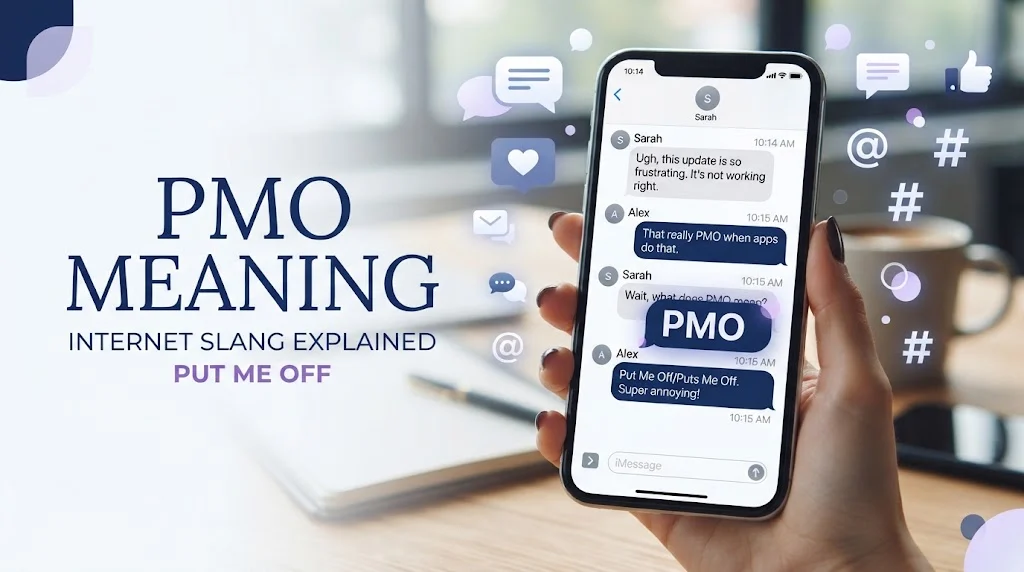
PMO has two common meanings in informal online conversations: “pisses me off” and “put me on.” The intended meaning depends on how the abbreviation appears in a sentence.
When someone says “You PMO,” they usually mean that you annoy or frustrate them. When someone says “PMO to some good songs,” they are asking you to recommend music.
| Detail | Explanation |
|---|---|
| Common slang meanings | Pisses me off; put me on |
| Main purpose | Express annoyance or ask for recommendations |
| Tone | Frustrated, playful, curious, or friendly |
| Common platforms | TikTok, Snapchat, Instagram, and text messages |
| Formal or informal | Informal internet slang |
The Two Main Meanings of PMO
Understanding the two common meanings makes it much easier to interpret this abbreviation in messages and social media comments.
PMO Meaning: Pisses Me Off
PMO often stands for “pisses me off,” an expression people use when something annoys, frustrates, or irritates them.
For example:
“People who cancel plans at the last minute PMO.”
In this sentence, the sender is saying that last-minute cancellations annoy them. The expression can communicate genuine frustration, but friends may also use it casually when complaining about minor inconveniences.
Another example is “You PMO sometimes,” which means “You piss me off sometimes.” Depending on the relationship and tone, this could be a serious complaint or playful teasing.
PMO Meaning: Put Me On
PMO can also mean “put me on,” an informal expression used to ask someone to introduce you to something or recommend it.
People commonly use this meaning when discussing music, clothing, restaurants, entertainment, products, or new interests.
For example:
“PMO to some good artists. I’m tired of listening to the same songs.”
Here, the sender wants recommendations for new musicians.
You might also see “Put me on to that brand” or “PMO to your favorite shows.” In these cases, the person is asking you to share something they might enjoy.
How Context Changes the Meaning of PMO
The easiest way to understand PMO is to read the entire sentence instead of interpreting the abbreviation by itself.
Look for clues in the wording, conversation topic, punctuation, emojis, and relationship between the people involved.
Here are four examples showing how the meaning changes.
Example 1: Annoyance
“Waiting three hours for a reply PMO.”
Meaning: The person is frustrated about waiting for a response.
Example 2: Recommendations
“PMO to some good Netflix shows.”
Meaning: The person wants recommendations for television shows.
Example 3: Playful frustration
“Bro, you PMO 😂”
Meaning: The sender may be teasing a friend who is being annoying. The emoji suggests humor, although it does not guarantee that the message is harmless.
Example 4: Discovering something new
“This outfit is fire. PMO to the brand.”
Meaning: The sender wants to know which brand makes the clothing.
A useful rule is to look at what follows PMO. If the message describes something irritating, “pisses me off” is likely. If it asks for a recommendation or introduction, “put me on” is more likely.
PMO Meaning on Different Platforms
PMO generally keeps the same meanings across social platforms, but the conversation can provide different clues about the sender’s intention.
On TikTok
On TikTok, PMO may appear in video comments, captions, or direct messages. Users may use it to complain about something irritating or ask others to recommend music, creators, products, or trends.
Example: “PMO to some underrated TikTok creators.”
Meaning: The commenter wants people to recommend creators worth following.
PMO on Snapchat
On Snapchat, PMO often appears in casual conversations between friends. It may express frustration or request recommendations, depending on the wording.
Example: “You PMO when you keep sending me spoilers.”
Meaning: The sender is annoyed because someone keeps revealing details about a show or movie.
PMO on Instagram
On Instagram, users may write PMO in comments, stories, or direct messages. The abbreviation can communicate annoyance or a request for recommendations.
Example: “PMO to your skincare routine.”
Meaning: The sender wants the other person to share their skincare recommendations.
PMO in Text Messages
In ordinary texting, PMO can have either meaning. The surrounding words usually provide the clearest clue.
Example: “That traffic really PMO today.”
Meaning: The sender is saying that the traffic makes them angry or frustrated.
Real Conversation Examples of PMO
These realistic conversations demonstrate how PMO works in everyday communication.
Example 1: Friends discussing music
Person A: “I’ve listened to every song on my playlist.”
Person B: “PMO to some new artists.”
Meaning: Person B is asking for music recommendations.
Example 2: A frustrating situation
Person A: “He canceled our plans again without telling me.”
Person B: “That would PMO too.”
Meaning: Person B understands why the situation would be irritating.
Example 3: Friends teasing each other
Person A: “I ate the last slice of pizza.”
Person B: “You PMO so bad 😂”
Meaning: Person B is expressing annoyance, probably in a playful way because of the context and emoji.
PMO Tone and Emotional Meaning
PMO does not always communicate the same emotion. Its tone depends on which meaning the sender intends and how the phrase fits into the conversation.
Is PMO Rude?
PMO can sound rude when it means “pisses me off,” especially when directed at a person. Saying “You PMO” may suggest irritation or criticism.
However, friends sometimes use the expression jokingly to complain about harmless behavior. The relationship and previous messages help clarify whether the sender is serious.
When PMO means “put me on,” it is usually a casual request rather than an insult.
Is PMO Friendly?
Yes, PMO can be friendly when someone uses it to ask for recommendations.
For example, “PMO to your favorite movies” is an informal way of asking someone to share their interests. It can help start a conversation about music, entertainment, fashion, or hobbies.
Can PMO Be Sarcastic?
Yes. Someone might write “Wow, that really PMO 🙄” to express genuine frustration or exaggerate their annoyance for comedic effect.
An eye roll, laughing emoji, or playful conversation may provide clues, but the words alone cannot establish the sender’s exact intention.
How to Reply to PMO
Your response should match the meaning of PMO in the original message. First, determine whether the person is asking for recommendations or expressing annoyance.
Friendly Replies
When PMO means “put me on,” you can respond by sharing something you enjoy.
- “Sure! What kind of music do you like?”
- “I’ve got a few recommendations for you.”
- “Try this artist. I think you’ll like them.”
- “Absolutely, I’ll send you my favorites.”
These replies help continue the conversation naturally.
Funny Replies
If a friend uses PMO to complain playfully, a lighthearted response may fit.
- “My bad, I’ll behave 😂”
- “I’m just keeping life interesting.”
- “You love the drama.”
- “Okay, okay, I’ll stop.”
Use these responses only when the conversation suggests that both people are joking.
Polite Replies
If someone says you PMO and appears genuinely upset, acknowledge their concern rather than escalating the situation.
- “Sorry, I didn’t mean to annoy you.”
- “What did I do that upset you?”
- “I’ll listen. Tell me what’s bothering you.”
- “Let’s talk about it calmly.”
If you are unsure which meaning the sender intends, you can simply ask, “Do you mean you’re annoyed, or are you asking me for recommendations?”
When to Use PMO
PMO is appropriate for casual conversations where the other person understands internet slang.
You might use it in:
- Text messages with friends.
- TikTok and Instagram comments.
- Snapchat conversations.
- Discussions about music, movies, fashion, or hobbies.
- Informal group chats and online communities.
For example, “PMO to some good podcasts” works well when asking friends for recommendations.
Before using PMO to express frustration, consider whether the recipient might interpret it as a personal insult. Direct language can easily sound harsher in writing than it would in a face-to-face conversation.
When to Avoid PMO
Avoid relying on PMO when the audience may not understand internet slang or when clear, professional communication is necessary.
Professional emails, job applications, academic writing, client conversations, and formal announcements are generally better suited to complete phrases.
Instead of writing “You PMO,” you could say:
- “That behavior frustrates me.”
- “I’m getting annoyed by this situation.”
- “Could you please stop doing that?”
If you mean “put me on,” use a clearer request when necessary:
- “Can you recommend some good songs?”
- “Could you tell me which brand that is?”
- “Do you have any movie recommendations?”
These alternatives communicate your intention without requiring the recipient to know the abbreviation.
Common Mistakes About PMO
PMO is easy to misinterpret when readers assume it has only one meaning.
| Common Mistake | Correct Understanding |
|---|---|
| Assuming PMO always means “pisses me off” | It can also mean “put me on” |
| Thinking PMO is always an insult | The recommendation meaning is usually friendly |
| Ignoring the rest of the message | The sentence and conversation reveal the likely meaning |
Another common mistake is assuming that a laughing emoji automatically makes a complaint harmless. Emojis can suggest humor, but the recipient should still consider the words and the relationship involved.
PMO and Similar Internet Slang
These abbreviations may appear in similar conversations, but their meanings differ.
| Term | Meaning | Main Difference |
|---|---|---|
| PMO | Pisses me off or put me on | Expresses annoyance or requests recommendations |
| PPL | People | Refers to people rather than an emotion or request |
| NGL | Not gonna lie | Introduces an honest opinion or admission |
| IMO | In my opinion | Signals a personal viewpoint |
| LMK | Let me know | Asks someone to provide information or respond |
For example, “PMO to some new artists” asks for recommendations, while “LMK which artists you like” asks someone to share information.
Origin and Popularity of PMO
PMO is part of informal internet and texting language. Its different meanings developed around commonly used expressions, including “pisses me off” and “put me on.”
The exact origin and first use of the abbreviation are uncertain, so it would be misleading to assign it a specific creator or date. Its meaning is best understood through how people use it in online conversations.
Because both expressions share the same initials, PMO can be ambiguous when it appears without context. Reading the full sentence is more reliable than assuming the sender intends one particular definition.
Quick Recap: PMO Meaning
- PMO commonly means “pisses me off” or “put me on.”
- “Pisses me off” expresses annoyance, frustration, or irritation.
- “Put me on” asks someone to recommend or introduce something.
- TikTok, Snapchat, Instagram, and text messages can use either meaning.
- Read the surrounding words before deciding how to interpret or reply to PMO.
Frequently Asked Questions
What does PMO mean in text?
PMO commonly means “pisses me off” when expressing frustration or “put me on” when asking someone for recommendations.
What does PMO mean on TikTok?
On TikTok, PMO usually expresses annoyance or asks viewers to recommend music, creators, products, or other interesting things.
What does PMO mean on Snapchat?
On Snapchat, PMO can mean “pisses me off” in complaints or “put me on” when requesting recommendations.
How should you reply to PMO?
Share recommendations when someone means “put me on,” or acknowledge their feelings calmly when PMO expresses genuine frustration.
Can PMO have different meanings?
Yes, PMO has multiple meanings in informal communication, with “pisses me off” and “put me on” being common slang interpretations.
Final Thoughts
The PMO meaning depends on the conversation, but two common interpretations are “pisses me off” and “put me on.” One expresses annoyance, while the other asks someone to recommend or introduce something interesting. You can usually identify the intended meaning by reading the entire message and considering the topic, wording, and relationship between the people involved.
PMO is common in casual online communication, but it may confuse readers who are unfamiliar with internet slang. When clarity matters, spelling out the intended phrase is often the simplest way to avoid misunderstandings.
Discover More Articles:-
- Isle or Aisle: Meaning, Difference & Examples for 2026
- Semaglutide or Tirzepatide: Key Differences, Benefits & Risks …
- An or A: Correct Usage of Article In 2026 – LingRoya

Margaret Atwood is an American writer who contributes to LingRoya.com creating clear and engaging content about the English language and everyday communication. She enjoys helping readers build confidence in their writing through simple, practical guidance.