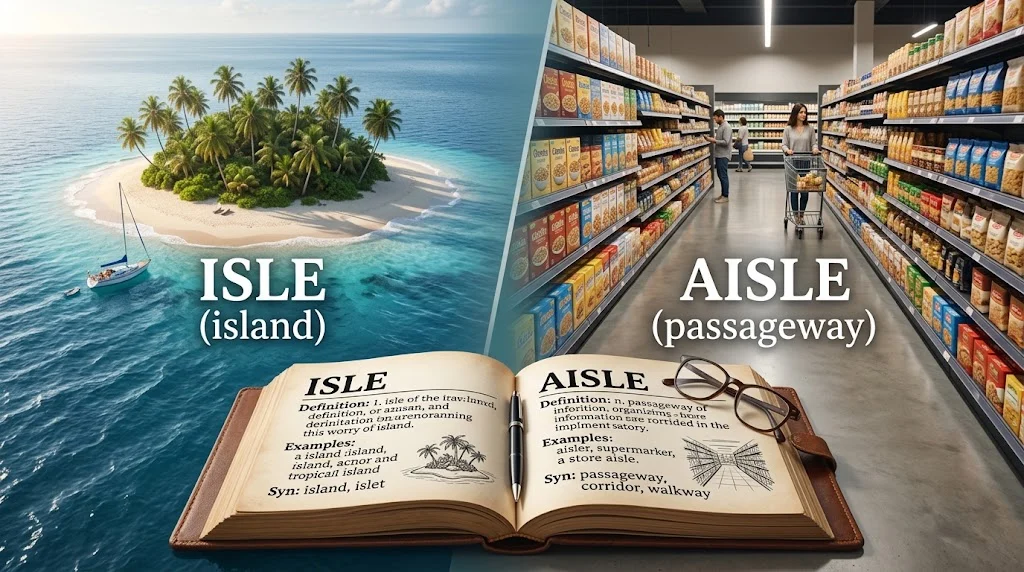
Quick Answer: Isle or aisle are not interchangeable. An isle is a small island, usually surrounded by water, while an aisle is a passage or walkway between rows of seats, shelves, or other objects. Although they sound alike, their meanings, spellings, and uses are completely different.
Have you ever wondered whether the correct word is isle or aisle when writing about a small island or a passage in a store? These two words are homophones, meaning they have the same pronunciation but different meanings and spellings. An isle refers to an island, especially a small one, while an aisle means a passage between rows of seats, shelves, desks, or other objects.
The confusion often causes real mistakes in emails, school assignments, travel writing, shopping instructions, and everyday messages. A linguistically careful writer needs to understand not only what each word means, but also where it belongs in a sentence. Once you connect isle with water and aisle with a walkway, choosing the correct spelling becomes much easier.
Isle vs Aisle: What’s the Difference?
The simplest way to understand these words is to connect each spelling with its physical meaning. An isle is a noun that means an island, particularly a small or picturesque island. An aisle is also a noun, but it describes a passage that allows people to move between rows of seats, shelves, desks, or similar structures.
| Word | Part of Speech | Meaning | Typical Context | Example |
| Isle | Noun | A small island surrounded by water | Geography, travel, literature | The travelers visited a peaceful isle. |
| Aisle | Noun | A passage between rows or sections | Stores, airplanes, churches, theaters | She walked down the aisle. |
The words sound alike, but their meanings have no direct connection.
Isle belongs to the vocabulary of islands, oceans, lakes, and geography.
Aisle belongs to the vocabulary of passages, rows, shops, airplanes, and seating.
A useful memory trick is simple: an isle is surrounded by water, while an aisle is surrounded by things such as seats or shelves.
Is Isle vs Aisle a Grammar, Vocabulary, or Usage Issue?
The difference between isle or aisle is mainly a vocabulary and usage issue rather than a grammar rule. Both words are nouns and can perform similar grammatical roles in sentences, but they represent entirely different concepts.
They aren’t interchangeable. Replacing one with the other can change the meaning of a sentence or make the sentence incorrect.
For example, saying, “We walked along the aisle,” suggests that someone moved along a passage. Saying, “We walked along the isle,” suggests movement on or around a small island.
The distinction also matters in formal writing. Academic papers about geography may use isle, while research involving retail environments, transportation, or architecture may use aisle. Casual conversation depends heavily on context, but the correct spelling still matters in writing.
Workplace Usage
In a workplace, aisle commonly appears when people discuss offices, warehouses, stores, or event spaces.
For example:
“The boxes are stored in the second aisle.”
Here, aisle refers to a passage between storage sections.
By contrast, isle might appear in tourism, travel, or business writing:
“The company operates a resort on a remote isle.”
Usage recap: Use aisle for a physical passage at work and isle when referring to a small island.
Academic Usage
Students may encounter isle in geography, history, literature, and travel studies.
“The ancient settlement developed on a small isle.”
In academic writing, aisle can appear when discussing buildings, transportation, seating arrangements, or retail design.
“The researchers observed how passengers moved through the aircraft aisle.”
Usage recap: Academic context does not change the meanings. Geography favors isle, while physical passages require aisle.
Technology Usage
Modern technology creates plenty of situations where aisle is relevant. Retail applications may help customers locate products in a particular aisle. Warehouse management systems can identify inventory stored along specific aisles.
For example:
“The shopping app directs customers to the correct aisle.”
Isle can also appear in digital travel guides, mapping applications, and tourism websites when describing islands.
“The travel application features a guide to a remote isle.”
Usage recap: Digital context does not make the words interchangeable. The intended object still determines the spelling.
When You Should NOT Use Isle or Aisle
Several situations make the distinction especially important.
- Do not use isle when describing a passage between supermarket shelves.
- Do not use aisle when describing a small island.
- Do not write isle when referring to the passage inside an airplane.
- Do not write aisle for an island mentioned in a geography assignment.
- Do not choose the spelling based only on pronunciation because both words sound alike.
- Do not assume that a familiar phrase automatically determines the spelling in every context.
- Do not use aisle in place of isle simply because the longer spelling looks more familiar.
- Do not use isle in place of aisle when giving directions through a store, theater, church, or aircraft.
The key is to identify the physical object before choosing the spelling.
Common Mistakes and Decision Rules
| Correct sentence | Incorrect sentence | Explanation |
| We visited a beautiful isle. | We visited a beautiful aisle. | The sentence refers to an island. |
| She walked down the aisle. | She walked down the isle. | The sentence refers to a passage. |
| The isle was surrounded by clear water. | The aisle was surrounded by clear water. | Water surrounds an island, not a normal walkway. |
| The cereal is in the third aisle. | The cereal is in the third isle. | A supermarket has aisles between shelves. |
| Passengers moved into the aisle. | Passengers moved into the isle. | An aircraft contains an aisle. |
| They explored the remote isle. | They explored the remote aisle. | The travelers explored an island. |
Decision Rule Box
If you mean a small island surrounded by water, use “isle.”
If you mean a passage between rows, seats, shelves, or sections, use “aisle.”
Think water for isle and walking space for aisle.
This rule works in most everyday and academic situations.
Isle and Aisle in Modern Technology and AI Tools
Modern search engines, writing assistants, spell checkers, and AI tools can usually identify the intended word from surrounding context. However, context is not always enough.
Consider the sentence:
“Please meet me near the aisle.”
An AI system can infer that the writer probably means a passage. If the sentence says:
“They spent their vacation on a beautiful isle.”
The surrounding words strongly indicate an island.
Still, automated correction should not replace language knowledge. In short or ambiguous sentences, a writing assistant may need additional context to determine the intended meaning. Writers should therefore understand the semantic distinction rather than relying entirely on automatic correction.
Etymology of Isle and Aisle
The histories of these words help explain why their spellings look unusual.
Isle comes through Old French and ultimately traces back to Latin insula, meaning island. Its spelling reflects its historical relationship with words associated with islands.
Aisle also developed through French and has historical connections with the word for a wing or side section of a building. Its modern meaning developed around the idea of a passage or side space.
Interestingly, both words contain letters that aren’t pronounced in modern English. This is one reason they can be confusing for English learners.
An Expert Linguistic Perspective
“Homophones require writers to use meaning, not pronunciation, as the guide to spelling.”
This principle applies particularly well to isle and aisle. Hearing the word alone does not tell you which spelling is correct. The surrounding meaning provides the answer.
Two Practical Case Studies
Case Study 1: The Supermarket
Imagine a customer receives this instruction:
“Your preferred cereal is located in the fourth aisle.”
The word aisle is correct because the customer needs to walk between shelves to reach the product. Writing “fourth isle” would incorrectly suggest a fourth small island.
This distinction becomes especially important in digital shopping instructions, store signage, product descriptions, and customer service messages.
Case Study 2: Travel Writing
Now consider a travel article describing a quiet island:
“Visitors can escape to a secluded isle surrounded by turquoise water.”
Here, isle is the correct choice because the subject is a small island. Replacing it with aisle would make the sentence semantically incorrect.
The practical result in both cases is the same: identifying the object first prevents the spelling error.
Author expertise: Written by an English language and SEO content specialist focused on practical grammar, vocabulary, and usage clarity.
Error Prevention Checklist
Always use Isle when
☑ You mean a small island.
☑ The location is surrounded by water.
☑ You are writing about geography or travel.
☑ You are describing a picturesque island in literary or descriptive writing.
Never use Aisle when
☑ You are referring to an island.
☑ You are describing land surrounded by water.
☑ You are naming or describing a small island destination.
Always use Aisle when
☑ You mean a passage between supermarket shelves.
☑ You mean a walkway between airplane seats.
☑ You mean a passage between rows of seats.
☑ You are describing a passage inside a building.
Related Grammar Confusions You Should Master
Understanding isle or aisle can help you recognize a broader group of English homophone problems. These pairs sound alike or nearly alike but have different meanings and spellings.
- Their vs there vs they’re
- Your vs you’re
- To vs too vs two
- Where vs wear
- Weather vs whether
- Here vs hear
- Advice vs advise
- Breathe vs breath
- Principal vs principle
- Affect vs effect
Learning these pairs is valuable because pronunciation alone often cannot determine the correct spelling. Meaning and sentence context must guide the choice.
Frequently Asked Questions About Isle or Aisle
Is an isle the same as an island?
An isle is a type of island, usually referring to a small island. The word often appears in geographical, literary, historical, or descriptive contexts.
What is the difference between isle and aisle?
Isle means a small island, while aisle means a passage between rows of seats, shelves, desks, or other objects. They sound alike but have different meanings.
How do you spell aisle in a supermarket?
The correct spelling is aisle when referring to a passage between supermarket shelves. For example, “The pasta is in aisle five.”
How do you spell isle for an island?
The correct spelling is isle when referring to a small island. For example, “They visited a remote isle.”
Is aisle pronounced the same as isle?
Yes. In standard English pronunciation, aisle and isle are homophones. They sound the same despite having different spellings and meanings.
What does aisle mean in a sentence?
Aisle means a passage between rows or sections. For example, “The passenger placed her bag under the seat beside the aisle.”
What does isle mean in a sentence?
Isle means a small island. For example, “The tiny isle attracted visitors throughout the summer.”
Why are isle and aisle confusing?
They are confusing because they have the same pronunciation but different spellings and meanings. Writers must use context to select the correct word.
Which is correct, isle or aisle?
Both are correct words, but they are used in different situations. Choose isle for a small island and aisle for a passage or walkway.
Conclusion
Choosing between isle or aisle becomes easy once you focus on meaning rather than pronunciation. An isle is a small island, while an aisle is a passage between rows, shelves, seats, or sections. Although these words are pronounced alike, they cannot be used interchangeably. Remember the simple association: isle connects with water and islands, while aisle connects with walking spaces.
This distinction is useful in school assignments, workplace communication, travel writing, shopping instructions, and everyday English. When you pause to identify what the sentence is actually describing, the correct spelling becomes clear. Mastering homophones such as these also strengthens overall vocabulary accuracy and helps make written English more precise, professional, and easier to understand.

Margaret Atwood is an American writer who contributes to LingRoya.com creating clear and engaging content about the English language and everyday communication. She enjoys helping readers build confidence in their writing through simple, practical guidance.