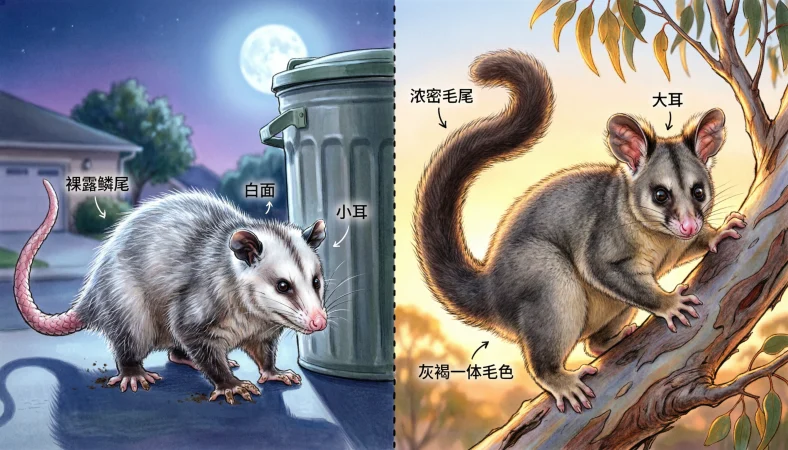
Quick Ans: . Opossums are North American marsupials with white faces and bare tails, while possums are their Australian cousins with furry tails and cuter features.
“Possum” and “opossum” are often confused because the names are closely related, but they can refer to different animals depending on the region. “Opossum” commonly refers to marsupials native to the Americas, while “possum” usually refers to marsupials found in Australia, New Zealand, and nearby regions.
The terms can also overlap in casual American English, where “possum” is sometimes used as a shortened form of “opossum.” Understanding the regional difference between these words can help you use them accurately when talking about these distinctive marsupials.
Possum vs Opossum: What’s the Difference?
The short answer is that opossums and possums are different animals living on different continents. Opossums are marsupials native to North and South America, belonging to the family Didelphidae. The most familiar species is the Virginia opossum (Didelphis virginiana), which is the only marsupial found north of Mexico. Possums, on the other hand, are marsupials native to Australia, New Guinea, and nearby islands, belonging to the family Phalangeridae.
| Feature | Opossum | Possum |
| Scientific Name | Didelphidae family | Phalangeridae family |
| Location | North and South America | Australia, New Guinea, Sulawesi |
| Tail | Bare, scaly, rat like | Bushy, covered in fur |
| Face | White, pointed, with small ears | Stout snout, large ears, uniform color |
| Size | 15 to 20 inches | 13.75 to 21.65 inches |
| Color | Gray white body, black legs and ears | Gray brown to red brown, varies by species |
| Defense Mechanism | Plays dead when threatened | Generally avoids confrontation |
| Diet | Omnivorous scavenger, eats ticks, insects, carrion | Mostly leaves, fruits, some meat |
Mini Recap: The table above makes it clear that these are two distinct animals with different appearances, habitats, and behaviors. The bare tail versus bushy tail is the quickest way to tell them apart at a glance. Remember that opossums live in the Americas and possums live in Australia and surrounding regions.
Is Possum vs Opossum a Grammar, Vocabulary, or Usage Issue?
This is primarily a vocabulary and usage issue rather than a strict grammar problem. Both words are nouns that refer to specific animals, but their interchangeability depends entirely on context and audience.
In formal and scientific writing, the two words are not interchangeable. If you are writing a biology paper or a wildlife report, you must use “opossum” for the North American marsupial and “possum” for the Australian species. Using the wrong term in these contexts signals a lack of expertise and can undermine your credibility.
In casual and informal usage, however, the lines blur significantly. In North America, people routinely shorten “opossum” to “possum” when talking about the animal in their backyard. This is so common that many Americans don’t even know the “o” exists at the front of the word. The Associated Press style guide actually declares “opossum” as the one true name for the American marsupial, but in everyday speech, “possum” has been the far more common choice for generations.
Academic usage typically favors “opossum” for the North American species. Textbooks, encyclopedias, and science publications consistently prefer the longer form. In Australian academic contexts, “possum” is the standard term for their native species.
Casual usage heavily favors “possum” in North America. In fact, the idiom is always “playing possum,” never “playing opossum,” even though the behavior comes from the Virginia opossum.
Practical Usage: Opossum
The word opossum functions as a noun in English sentences. It refers specifically to the marsupial of the Americas, particularly the Virginia opossum.
Workplace Example
“The facilities manager confirmed that an opossum had been living in the crawl space beneath the office building, and pest control would need to be called.”
Academic Example
“According to the study published in the Journal of Mammalogy, the Virginia opossum (Didelphis virginiana) exhibits a remarkable resistance to rabies and snake venom, making it a subject of ongoing immunological research.”
Technology Example
“Wildlife tracking apps now allow citizen scientists to log opossum sightings across North America, contributing valuable data to migration and population studies.”
Opossum Usage Recap: Use “opossum” when you are writing formally, when you are referring to the North American species specifically, or when you want to be technically precise. The pronunciation can include the first “o” sound (uh POS um) or drop it, though many dictionaries now accept both.
Practical Usage: Possum
The word possum also functions as a noun. It refers to the Australian and Oceanic marsupials belonging to the Phalangeridae family.
Workplace Example
“The Australian tourism board’s marketing campaign features the adorable brushtail possum as a symbol of the country’s unique wildlife, attracting visitors interested in eco tourism.”
Academic Example
“Researchers at the University of Melbourne have documented the common brushtail possum’s adaptability to urban environments, noting that these marsupials have thrived in Australian cities despite habitat loss.”
Technology Example
“Conservationists are using drone technology and thermal imaging to track possum populations in New Zealand, where they are considered an invasive species threatening native bird life.”
Possum Usage Recap: Use “possum” when referring to Australian or Oceanic marsupials, or when you are writing informally in North American contexts. The word is always pronounced “poss um” without the initial “o” sound.
When You Should NOT Use Possum or Opossum
Understanding when not to use these words is just as important as knowing when to use them. Here are common scenarios where using the wrong term can cause problems:
- In scientific writing about North American wildlife: Never use “possum” when you mean the Virginia opossum. Biology journals and peer reviewed articles expect “opossum.”
- In Australian wildlife contexts: Never use “opossum” when referring to Australian species. Local experts and publications use “possum.”
- When discussing the idiom: Always use “playing possum,” never “playing opossum.” The phrase is fixed and does not change.
- In formal presentations or reports: Avoid using “possum” for the North American animal if your audience includes scientists, academics, or international professionals who know the difference.
- When spelling matters: Never spell it “opposum” or “oppossum.” These are common errors that immediately mark you as careless.
- In global publications: If your writing will be read internationally, use the precise term for the species you are discussing to avoid confusing readers from different continents.
- When teaching children or students: Use the correct terms to prevent perpetuating the confusion. Explain that while people often say “possum” informally, the animal’s proper name is “opossum.”
- In translations or localization: Be careful when translating content into other languages, as many languages have distinct words for these different animals.
Common Mistakes and Decision Rules
| Correct Sentence | Incorrect Sentence | Explanation |
| The opossum played dead when the dog approached. | The opposum played dead when the dog approached. | “Opposum” is a misspelling. The word has only one “p.” |
| Australian possums have bushy, furry tails. | Australian opossums have bushy, furry tails. | Australian marsupials are called possums, not opossums. |
| I saw an opossum in my backyard last night. | I saw a opossum in my backyard last night. | Use “an” before “opossum” because the word begins with a vowel sound. |
| The Virginia opossum is North America’s only marsupial. | The Virginia possum is North America’s only marsupial. | The proper name is Virginia opossum, not Virginia possum. |
| She’s just playing possum to avoid the conversation. | She’s just playing opossum to avoid the conversation. | The idiom is always “playing possum.” |
Decision Rule Box
When you are referring to the North American marsupial with the white face and bare tail, use “opossum” in formal writing and “possum” in casual conversation.
If you are referring to the Australian marsupial with the bushy tail and cuter features, use “possum” in all contexts.
If you are using the idiom about pretending to be asleep or dead, always use “playing possum.”
Possum and Opossum in Modern Technology and AI Tools
The possum versus opossum confusion has found its way into the digital age in interesting ways. Search engines and AI language models have had to learn the distinction, and they don’t always get it right.
Natural language processing tools like Grammarly and other AI writing assistants now flag incorrect usage in formal contexts. If you write “possum” in a scientific paper about North American wildlife, these tools will suggest changing it to “opossum.” Similarly, if you write “opossum” in content about Australian wildlife, the AI will likely flag that as well.
Search engine optimization has also been affected by this confusion. Content creators targeting keywords like “possum or opossum” need to understand user intent. Many people searching for “possum” in North America are actually looking for information about opossums, and smart SEO strategies account for this by including both terms naturally in the content.
Voice search and digital assistants have also had to adapt. When someone asks Siri or Alexa about “possums,” the response often includes clarification about the North American versus Australian distinction, showing how AI has learned to handle this linguistic quirk.
The Fascinating Etymology Behind the Confusion
The word opossum entered the English language in the early 1600s, with the first recorded use dating to 1610. It comes from a Virginia Algonquian word, transcribed in early English documents as “apossoun” or “opassom”. The Algonquian root words mean “white” and “dog” or “small animal,” referring to the Virginia opossum’s distinctive white face.
The word possum appeared just a few years later, around 1613, as a shortened form of opossum through a linguistic process called aphesis, which is the loss of an unstressed vowel at the beginning of a word. (The same process gave us “lone” from “alone.”)
The real trouble began in 1770 when Sir Joseph Banks, the botanist accompanying Captain James Cook on his voyage to Australia, saw bushy tailed marsupials and described them as “an animal of the Opossum tribe”. He thought they looked similar enough to the American opossum to warrant the same name, and the name stuck in Australia even though the animals are quite different.
As linguist and lexicographer Kory Stamper notes, “The history of these two words is a perfect example of how language evolves through a combination of colonial encounter, scientific classification, and everyday speech habits. What started as a simple shortening became a transcontinental confusion that persists to this day.”
Case Studies: When Getting It Right Matters
Case Study 1: The Wildlife Documentary
A nature documentary production company was editing a segment about North American wildlife when the script supervisor noticed that the narrator kept saying “possum” while the on screen animal was clearly a Virginia opossum. The production team had to re record several minutes of narration to correct the terminology before the film could be submitted to academic reviewers. The correction cost the production company approximately $5,000 in additional studio time and post production work, all because someone assumed the words were interchangeable.
Case Study 2: The International Research Paper
A graduate student at an American university was preparing a research paper on marsupial behavior for an international journal. The student had grown up calling the backyard animal a “possum” and used that term throughout the paper. The peer reviewers, who included Australian researchers, flagged the usage as incorrect and confusing. The student had to revise the entire paper, changing every instance of “possum” to “opossum” where it referred to the North American species. The student’s advisor noted that this mistake could have resulted in rejection from the journal if not corrected.
Error Prevention Checklist
Always use “opossum” when:
- Writing formally about North American marsupials
- Submitting academic or scientific papers
- Referring to the Virginia opossum specifically
- Using the full, proper name of the species
- Writing for international audiences who expect precision
Never use “opossum” when:
- Referring to Australian marsupials
- Using the idiom “playing possum”
- Writing casually for a North American audience
- Describing the bushy tailed possums of Oceania
Always use “possum” when:
- Referring to Australian and Oceanic marsupials
- Using the idiom “playing possum”
- Writing informally in North American contexts
- Describing the common brushtail possum
Never use “possum” when:
- Writing formally about North American wildlife
- Submitting scientific papers about Didelphidae
- Referring to the Virginia opossum in academic contexts
- Precision is required for the species identification
Related Grammar Confusions You Should Master
- Affect vs Effect – Understanding when each is a verb or noun
- Who vs Whom – Subject versus object pronoun usage
- Its vs It’s – Possessive versus contraction
- Your vs You’re – Possessive versus contraction
- There vs Their vs They’re – Location, possession, and contraction
- To vs Too vs Two – Preposition, adverb, and number
- Then vs Than – Time versus comparison
- Accept vs Except – Receive versus exclude
- Principle vs Principal – Rule versus primary or school leader
- Complement vs Compliment – Complete versus praise
FAQs
- What is the difference between a possum and an opossum?
- Opossums are native to the Americas, while possums are mainly native to Australia and nearby regions.
- Is “possum” or “opossum” correct?
- Both can be correct; “opossum” is preferred for North American species, while “possum” commonly refers to Australian species.
- Why do Americans say “possum”?
- “Possum” is a shortened form of “opossum” that developed through a process called aphesis.
- Do possums and opossums play dead?
- Opossums are known for involuntarily playing dead when frightened; this behavior is not typical of Australian possums.
- Are possums and opossums related?
- Yes, both are marsupials, but they belong to different families and are not closely related.
- How do you pronounce “opossum”?
- It can be pronounced with or without the initial “o,” while “possum” is pronounced “POS-um.”
Conclusion
In conclusion, “possum” and “opossum” are related terms, but they generally refer to different groups of marsupials. “Opossum” usually describes animals native to the Americas, while “possum” commonly refers to marsupials found in Australia and nearby regions.
However, in American English, “possum” is also often used informally as a shortened form of “opossum.” Therefore, the correct term depends on the animal being discussed and the regional context.

Philip Pullman is an American writer dedicated to creating clear and easy to follow English content. Through his work at LingRoya.com, he helps readers strengthen their language skills with practical and reliable guidance so that they can easily understand.