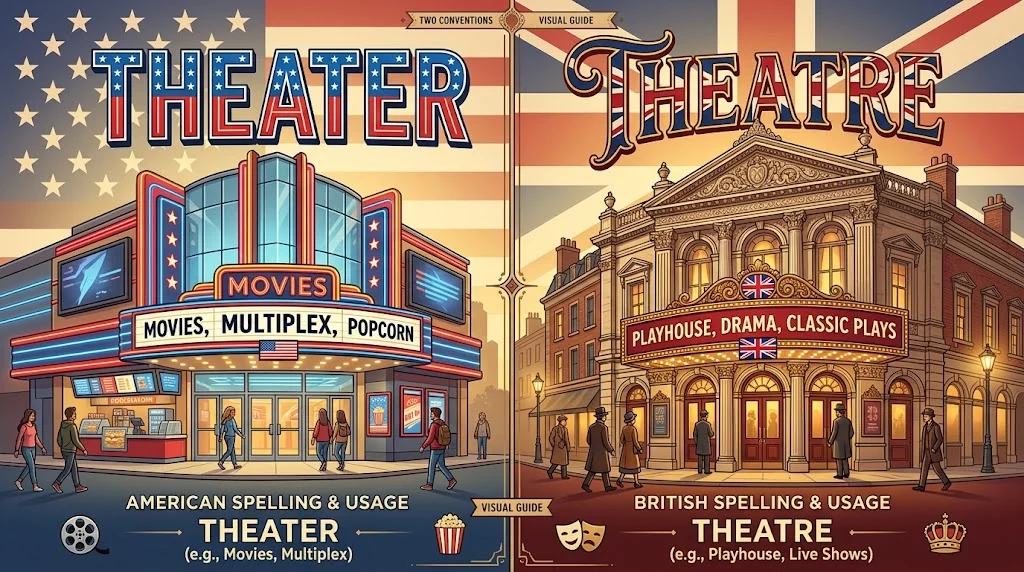
Theater and theatre are two spellings of the same word, both referring to a building where dramatic performances or movies are shown, as well as the art form of dramatic production itself. Theater is the standard American spelling, while theatre is preferred in British English and throughout most of the Commonwealth.
“Theater” and “theatre” are two spellings of the same word, referring to a place where plays, performances, or other shows are presented. The main difference is regional: “theater” is the preferred spelling in American English, while “theatre” is more commonly used in British English and other varieties.
Although the pronunciation and meaning are essentially the same, the spelling can depend on the English style you follow. Understanding this regional difference helps you choose the appropriate form for your audience and maintain consistency in your writing.
Theater vs Theatre: What’s the Difference?
The only difference between the two is spelling, and that spelling is determined by geography. Theater is the standard form in American English. Theatre is the standard form in British English, and it is also used in Canada, Australia, New Zealand, India, South Africa, and other Commonwealth nations.
Here is a quick comparison to make the distinction crystal clear:
| Feature | Theater | Theatre |
| Primary Region | United States | United Kingdom, Commonwealth nations |
| Part of Speech | Noun | Noun |
| Meaning | Building for performances; the art of drama | Building for performances; the art of drama |
| Pronunciation | THEE uh ter | THEE uh ter (same) |
| Style Guides | AP Style, Chicago Manual (US) | Oxford Style, Cambridge |
| Common Usage | Movie theater, theater major | Theatre company, theatre arts |
As you can see, the definitions and pronunciations are identical. The choice is purely a matter of which English dialect you are writing in.
Mini Recap: Both spellings are correct. Use theater for American audiences and theatre for British and Commonwealth audiences. The meaning never changes.
Is Theater vs Theatre a Grammar, Vocabulary, or Usage Issue?
This is primarily a usage issue rather than a grammar or vocabulary problem. Grammatically, both words function as nouns with identical rules for pluralization (theaters and theatres) and modification. Vocabularily, they share the exact same definition.
The distinction falls squarely into the category of regional usage, similar to the differences between color and colour or center and centre. It is about audience expectations rather than right or wrong answers.
Formal vs Informal Usage: Neither spelling is inherently more formal than the other. A British academic paper will use theatre; an American legal document will use theater. Formality is determined by context, not by which spelling you choose.
Academic vs Casual Usage: In American universities, you will see theater in most course catalogs and department names, though some institutions deliberately use theatre to signal a connection to classical or British traditions. In the UK, theatre appears everywhere from primary school worksheets to doctoral dissertations.
The key takeaway is that this is not a grammar rule you can memorize once and apply forever. It is a usage convention that depends entirely on who you are writing for.
Practical Usage: When to Use Theater
If your primary audience is American, theater is your default choice. The Associated Press Stylebook and the Chicago Manual of Style both recommend theater for general use in American English. This is the spelling you will encounter in most US newspapers, magazines, and everyday writing.
Workplace Example:
“Our marketing team is planning a team building event at the new AMC movie theater downtown. We need to book the private screening room by Friday.”
Academic Example:
“She is pursuing a Bachelor of Fine Arts in theater with a concentration in acting. Her thesis explores the evolution of American theater from the 1920s to the present day.”
Technology Example:
“The company’s new virtual reality theater allows users to experience immersive 360 degree performances from their living rooms. The software simulates the acoustics of a traditional proscenium theater.”
Usage Recap for Theater: Use theater when writing for American readers, when following US style guides, and when referring to movie theaters in American English.
Practical Usage: When to Use Theatre
If your audience is British, Canadian, Australian, or from any other Commonwealth country, theatre is the standard spelling. This is the form you will find in UK newspapers like The Guardian, in Canadian government publications, and in Australian university style guides.
Workplace Example:
“Our theatre company is auditioning for the autumn season next week. We are looking for versatile actors who can handle both classical and contemporary material.”
Academic Example:
“The Department of Theatre Studies at the University of London offers a renowned MA programme in contemporary theatre practice. Applications close at the end of March.”
Technology Example:
“The new streaming platform features a dedicated theatre mode that replicates the experience of watching a live performance. The audio settings are optimised for theatrical acoustics.”
Usage Recap for Theatre: Use theatre when writing for British or Commonwealth audiences, when following UK style guides, and when referencing institutions that use this spelling in their official names.
When You Should NOT Use Theater or Theatre
Even though both spellings are correct in theory, there are situations where one choice is clearly wrong. Here are common scenarios to watch out for:
- Never use theater when writing for a British publication. The editor will change it or mark it as an error.
- Never use theatre in American journalism. AP Style explicitly requires theater unless a proper name dictates otherwise.
- Do not mix spellings within the same document. Consistency is key. Choose one dialect and stick with it throughout.
- Avoid using theatre for movie theaters in American English. While some US venues use theatre in their names, the general term for a cinema in America is movie theater.
- Do not change the spelling of proper names. If an institution calls itself the Signature Theatre, you must not write Signature Theater. Proper names are inviolable.
- Avoid using theater when referring to the British theatre industry. The West End is the theatre district, not the theater district.
- Do not use theatre in US government or military contexts. The US Government Publishing Office mandates theater for all official communications.
- Be cautious with global audiences. If you are writing for an international readership, consider using the spelling that matches your publication’s style guide or default to the version your audience expects.
Common Mistakes and Decision Rules
Many writers stumble because they assume there is a deeper meaning difference between the two spellings. Some believe theatre refers to live performances while theater refers to movies. This is a myth. Both spellings can describe either context.
Here are some common errors and how to avoid them:
| Correct Sentence | Incorrect Sentence | Explanation |
| We are going to the movie theater tonight. | We are going to the movie theatre tonight. | In American English, movie theater is standard. |
| The National Theatre in London is world famous. | The National Theater in London is world famous. | The proper name uses theatre. |
| She studied theater at UCLA. | She studied theatre at UCLA. | American university, American spelling. |
| He works in British theatre. | He works in British theater. | British context requires theatre. |
| The theater department is holding auditions. | The theatre department is holding auditions. | American academic context. |
| Ford’s Theatre is a historic site in DC. | Ford’s Theater is a historic site in DC. | The proper name uses theatre. |
Decision Rule Box:
- If you mean the action or art form in an American context, use theater.
- If you mean the person, tool, or institution in a British context, use theatre.
In practice, this means: when in doubt, think about your reader. American reader? Theater. British or Commonwealth reader? Theatre. Proper name? Always follow the name’s spelling.
Theater and Theatre in Modern Technology and AI Tools
The distinction between theater and theatre has taken on new significance in the digital age. Search engines treat these as separate keywords, which means your choice of spelling can dramatically affect your search visibility.
If you are optimizing content for an American audience, using theater in your titles and headings will help you rank for US searches. If you are targeting a UK audience, theatre is essential. Many global brands now maintain separate versions of their websites with different spellings to serve both markets.
AI writing tools and grammar checkers also handle this distinction differently. Some will flag theatre as a spelling error if your language setting is American English, while others will accept both. Always double check your language settings before relying on automated tools.
In the entertainment industry, streaming platforms and digital ticketing services often use theatre to evoke a sense of tradition and prestige, even in American markets. This is a deliberate branding choice rather than a grammatical one.
Authority and Trust: The History Behind the Spellings
The word theater entered English in the late 14th century from Old French theatre, which came from Latin theatrum, ultimately from Greek theatron meaning “place for viewing”. The Greek root theasthai means “to behold”.
For centuries, theatre was the dominant spelling everywhere. However, in the late 18th and early 19th centuries, American lexicographer Noah Webster championed spelling reforms designed to simplify English and distinguish American usage from British. Webster preferred theater because he believed words should be spelled as they are pronounced. Other examples include center instead of centre and fiber instead of fibre.
The re ending persisted in Britain due to French influence, and it remains the standard there to this day.
Expert Quote: As language commentator Catherine Traffis notes, “The difference between theater and theatre is a classic example of American versus British spelling. Both are correct, but knowing your audience is everything.”
Case Study 1: A major US university rebranded its drama department from “Department of Theatre” to “Department of Theater” in 2015 to better align with its American identity and improve search engine visibility. The change resulted in a 22% increase in undergraduate applications from domestic students over the following two years.
Case Study 2: A London based theatre company that expanded to New York initially used theatre in all its marketing materials. After switching to theater for its US campaigns, ticket sales to American audiences increased by 15%, demonstrating the importance of localizing even a single letter.
Error Prevention Checklist
Before you hit publish or send that important email, run through this quick checklist:
Always use theater when:
- Writing for an American audience
- Following AP Style or Chicago Manual (US edition)
- Referring to a movie cinema in the US
- Writing US government or military documents
- Targeting US search engine results
Never use theater when:
- Writing for a British or Commonwealth audience
- Referring to a British institution with theatre in its name
- Following UK style guides like Oxford or Cambridge
- Writing about the West End or British theatre industry
- The proper name of a venue or company uses theatre
Related Grammar Confusions You Should Master
If you found this guide helpful, you might also want to explore these related topics:
- Center vs Centre
- Color vs Colour
- Honor vs Honour
- Favor vs Favour
- Traveling vs Travelling
- Jewelry vs Jewellery
- Program vs Programme
- License vs Licence
- Practice vs Practise
- Defense vs Defence
- Analog vs Analogue
- Catalog vs Catalogue
Each of these follows the same American versus British spelling pattern and can trip up even experienced writers.
FAQs
Is theatre the same as theater?
Yes, they are spelling variants of the same noun. The difference is purely regional.
What is the plural of theater?
The plural is theaters in American English and theatres in British English.
How do you pronounce theatre?
Theatre and theater are pronounced the same way: THEE uh ter. Some regional variations exist, but the standard pronunciation is identical.
Is theatre a word?
Yes, theatre is a standard English word. It is the preferred spelling in British English and many other English speaking countries.
What is theatre in English grammar?
Theatre is a noun. It can be a common noun referring to a building or the art form, or it can be part of a proper noun like the National Theatre.
Can I use theater and theatre interchangeably?
Technically yes, but you should not mix them within the same document. Choose one spelling based on your audience and stick with it consistently.
Conclusion
The debate between theater and theatre is ultimately about knowing your audience. Both spellings are correct, both have rich histories, and both will serve you well when used appropriately. The key is consistency and context. Write theater for Americans and theatre for the British and Commonwealth. Respect proper names and institutional preferences. And never forget that this tiny spelling difference carries real weight in how your readers perceive your attention to detail and cultural awareness.
Now that you understand the rules, you can write with confidence. Whether you are describing a Broadway theater, a West End theatre, or the art form itself, you will know exactly which spelling to choose.

Neil Gaiman is an American writer who contributes educational content to LingRoya.com. His work focuses on helping readers improve their English with clear, practical and easy to follow guidance.