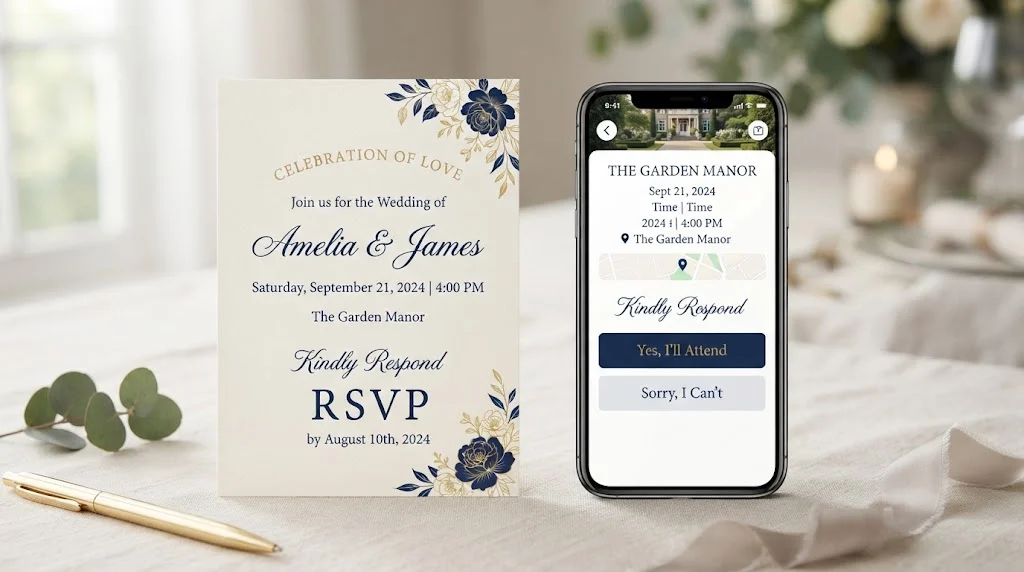
The RSVP meaning is “please respond,” a request asking you to confirm whether you will attend an event. The abbreviation comes from the French phrase répondez s’il vous plaît, which means “please respond” in English. RSVP appears on formal invitations, event pages, emails, and text messages.
RSVP stands for the French phrase répondez s’il vous plaît, which translates to “please respond” in English.
When someone asks you to RSVP, they want you to tell them whether you plan to attend an event. The request helps the host estimate attendance, organize seating, arrange food, and prepare for guests.
For example:
“Please RSVP by November 10 for our wedding.”
This means you should inform the couple by November 10 whether you will attend. You should respond even if you cannot make it.
| Detail | Explanation |
|---|---|
| Full form | Répondez s’il vous plaît |
| English meaning | Please respond |
| Main purpose | Confirm whether you will attend an event |
| Common settings | Invitations, texts, emails, and event pages |
| Tone | Polite, practical, and sometimes formal |
| Formal or informal | Suitable for both formal and casual situations |
How People Use RSVP in Everyday Communication
RSVP is not just a word printed on wedding invitations. People use it whenever they need a clear response about attendance or participation.
RSVP on Invitations
Wedding invitations, birthday invitations, graduation celebrations, and formal dinners often include an RSVP request.
Example: “Kindly RSVP by December 5.”
The host wants to know how many people will attend before making final arrangements. You should follow the stated deadline and provide any requested details.
RSVP in Text Messages
People also use RSVP in casual messages when planning parties, dinners, or meetups.
Example: “Hey, can you RSVP for Saturday’s barbecue?”
The sender is asking you to confirm whether you will come. The wording may sound more formal than ordinary texting, but its meaning remains the same.
RSVP in Emails
Workplaces, schools, organizations, and event planners may request an RSVP by email.
Example: “Please RSVP to confirm your attendance at the team dinner.”
You should reply clearly, state whether you will attend, and include any requested information.
RSVP on Online Event Pages
Digital invitations and event platforms may provide buttons such as “Going,” “Not Going,” or “Maybe.” Selecting an option communicates your response.
Example: “RSVP through the event page before Friday.”
The host wants an accurate attendance estimate, even if the event is organized entirely online.
What Does RSVP Mean in Text Messages?
In text messages, RSVP means that the sender wants you to confirm your attendance or participation. It does not usually have a separate slang meaning.
For example:
Friend: “I’m hosting dinner on Sunday. Please RSVP by Thursday.”
You: “I’ll be there! Thanks for inviting me.”
Meaning: Your friend needs to know whether you will attend before finalizing the plans.
Sometimes people use RSVP casually or humorously when they want a quick answer.
Example: “RSVP already! I need to know how much pizza to order.”
Here, the sender is emphasizing the importance of responding promptly.
Unlike slang abbreviations such as LOL or STFU, RSVP is a widely recognized expression used in both everyday conversation and formal communication.
How Context Changes the Meaning of RSVP
The basic meaning of RSVP stays consistent, but the surrounding conversation determines what response the sender expects.
Here are four common situations.
A wedding invitation: “RSVP by June 1.”
You should confirm whether you will attend the wedding before the deadline.
A birthday party text: “Can you RSVP tonight?”
The host needs to know whether to count you among the guests.
A workplace email: “Please RSVP for the annual conference.”
You are expected to confirm your attendance, often through email or an event registration form.
A casual group chat: “Everyone RSVP so we can book a table.”
Your friends want a headcount before making a reservation.
The key is to recognize that RSVP is a request for a response, not an automatic confirmation that you will attend.
RSVP Meaning on Different Platforms
RSVP generally has the same meaning across platforms. The main difference is how you submit your response.
RSVP in Text Messages
A text message asking you to RSVP usually requires a simple yes or no.
Example: “RSVP for movie night by Wednesday.”
Tone: Casual and direct.
RSVP on Instagram
An Instagram invitation may ask you to reply to a direct message, respond to a story, or complete an event form.
Example: “DM me to RSVP for the launch party.”
Tone: Usually informal, even when the event itself is organized professionally.
RSVP on Facebook
Facebook events may let you select an attendance status, such as “Interested” or “Going,” depending on the event options.
Example: “Please RSVP on the Facebook event page.”
Tone: Practical. The organizer wants to estimate attendance.
RSVP in Email
An email invitation may request a reply by a particular date or direct you to an online registration page.
Example: “Kindly RSVP by replying to this email.”
Tone: Often professional or formal.
Regardless of the platform, make sure your response reaches the organizer through the method they requested.
Real Conversation Examples of RSVP
These examples show how RSVP works in different situations.
Example 1: Friends planning a party
Person A: “I’m having a birthday party next Saturday. Can you RSVP by Tuesday?”
Person B: “Absolutely! I’ll be there.”
Meaning: Person A needs confirmation, and Person B accepts the invitation.
Example 2: A wedding invitation
Person A: “The invitation says we need to RSVP by May 15.”
Person B: “Let’s respond today so they can finalize the guest list.”
Meaning: They need to tell the hosts whether they will attend before the deadline.
Example 3: A workplace event
Person A: “Did you RSVP for the company dinner?”
Person B: “Yes, I confirmed through the registration email.”
Meaning: Person B has already submitted an attendance response.
How to Reply to an RSVP Request
Your response should clearly state whether you will attend. If you are unsure, communicate that honestly rather than leaving the host without an answer.
If You Can Attend
Use a friendly and direct response.
- “Yes, I’ll be there. Thanks for inviting me!”
- “I’d love to attend.”
- “Count me in!”
- “Thanks for the invitation. I’ll be happy to join.”
If You Cannot Attend
A polite decline lets the host finalize their plans.
- “Thank you for inviting me, but I won’t be able to attend.”
- “Sorry, I can’t make it this time. I hope you have a wonderful event.”
- “Unfortunately, I have another commitment that day.”
- “Thanks for thinking of me. I appreciate the invitation.”
If You Are Not Sure Yet
If you genuinely need more time, ask whether a later response is possible.
- “Thanks for inviting me. Could I confirm by Friday?”
- “I’m checking my schedule and will let you know before the deadline.”
- “I’m not certain yet. Would it be okay if I gave you a final answer tomorrow?”
Remember that the host may need a definite answer for catering, seating, or other arrangements. If the invitation includes a deadline, try to respond by that date.
When Should You Use RSVP?
RSVP is appropriate whenever you want someone to confirm attendance or participation.
Common situations include:
- Wedding invitations and engagement parties.
- Birthday celebrations and family gatherings.
- Business meetings and corporate dinners.
- School functions and graduation ceremonies.
- Conferences, workshops, and networking events.
- Casual dinners, group outings, and social gatherings.
You can use RSVP in formal invitations or casual messages. The word itself does not make the conversation formal; the audience and surrounding language determine the overall tone.
For example, “Please RSVP by Friday” works in a professional email, while “RSVP so I know how much food to make!” is suitable for a casual party invitation.
When Should You Avoid Using RSVP?
RSVP is widely understood, but it may not be the clearest wording for every audience.
Consider using a simpler phrase when communicating with someone who may not recognize the abbreviation, particularly in messages to young children, people learning English, or readers unfamiliar with invitation conventions.
Instead of writing “RSVP,” you could say:
- “Please let me know if you can attend.”
- “Please confirm whether you’ll be there.”
- “Tell me by Friday if you’re coming.”
- “Please respond by November 10.”
You should also avoid treating RSVP as a substitute for a complete invitation. Guests still need relevant details, such as the event date, time, location, and response deadline.
Common Mistakes About RSVP
RSVP is simple once you understand its purpose, but several misunderstandings are common.
| Common Mistake | Correct Understanding |
|---|---|
| Thinking RSVP means accepting an invitation | It asks you to respond, whether your answer is yes or no |
| Believing RSVP is an English acronym | It comes from the French phrase répondez s’il vous plaît |
| Assuming you only need to reply if attending | You should generally respond even if you cannot attend |
Another mistake is ignoring the RSVP deadline. Hosts may need a final headcount to arrange meals, seating, tickets, or venue space. Responding promptly helps them plan and shows consideration for their time.
RSVP and Similar Terms
Several expressions are related to RSVP, but they do not mean exactly the same thing.
| Term | Meaning | Main Difference |
|---|---|---|
| RSVP | Please respond | Requests an attendance response |
| Regrets only | Respond only if you cannot attend | No reply generally indicates acceptance under this convention |
| Save the date | Let guests know an event is planned | Announces the date before the full invitation |
| Invitation | A request to attend an event | Provides an opportunity to attend but does not itself confirm attendance |
| Confirmation | A statement that something is agreed or arranged | Can indicate acceptance after you respond |
These distinctions matter when reading formal invitations. For instance, “regrets only” generally asks you to reply only if you cannot attend, while a standard RSVP request usually expects a response either way.
Origin and Popularity of RSVP
RSVP comes from the French expression répondez s’il vous plaît, which translates to “please respond.” The phrase became associated with invitations and social etiquette, particularly when hosts needed guests to confirm attendance.
Although its wording is French, RSVP is now commonly used in English-speaking settings. It appears on printed invitations, event announcements, email messages, and digital registration forms.
The abbreviation has retained its central purpose: asking recipients to communicate their intentions. Whether you receive it on an elegant wedding card or in a quick text message, the practical request remains the same.
Quick Recap: RSVP Meaning
- RSVP stands for the French phrase répondez s’il vous plaît, meaning “please respond.”
- It asks you to confirm whether you will attend an event.
- RSVP is commonly used for weddings, parties, meetings, and other gatherings.
- You should generally reply whether you can attend or not.
- Check the invitation for a deadline and use the requested response method.
Frequently Asked Questions
What does RSVP mean in text?
RSVP means “please respond” in text messages and asks you to confirm whether you plan to attend an event or gathering.
What does RSVP stand for?
RSVP stands for the French phrase répondez s’il vous plaît, which translates into English as “please respond.”
Does RSVP mean yes or no?
RSVP does not mean yes or no; it asks you to communicate whether you accept or decline an invitation.
How do you reply to RSVP?
Reply clearly by accepting the invitation, politely declining, or asking for more time if you cannot confirm immediately.
Do you have to RSVP if you cannot attend?
Yes, you should generally respond even when declining, unless the invitation specifically requests replies only from people who cannot attend.
Conclusion
The RSVP meaning is simple: “please respond.” When an invitation asks you to RSVP, the host wants to know whether you plan to attend so they can organize the event properly. You may encounter the abbreviation on wedding invitations, birthday announcements, workplace emails, and social media event pages.
The most considerate approach is to reply clearly and meet the stated deadline, whether you accept or decline. If you need more time, let the organizer know. Understanding RSVP helps you handle invitations confidently and communicate your plans politely in both formal and casual situations.
Discover More Articles:-
- Isle or Aisle: Meaning, Difference & Examples for 2026
- Semaglutide or Tirzepatide: Key Differences, Benefits & Risks …
- An or A: Correct Usage of Article In 2026 – LingRoya

Philip Pullman is an American writer dedicated to creating clear and easy to follow English content. Through his work at LingRoya.com, he helps readers strengthen their language skills with practical and reliable guidance so that they can easily understand.