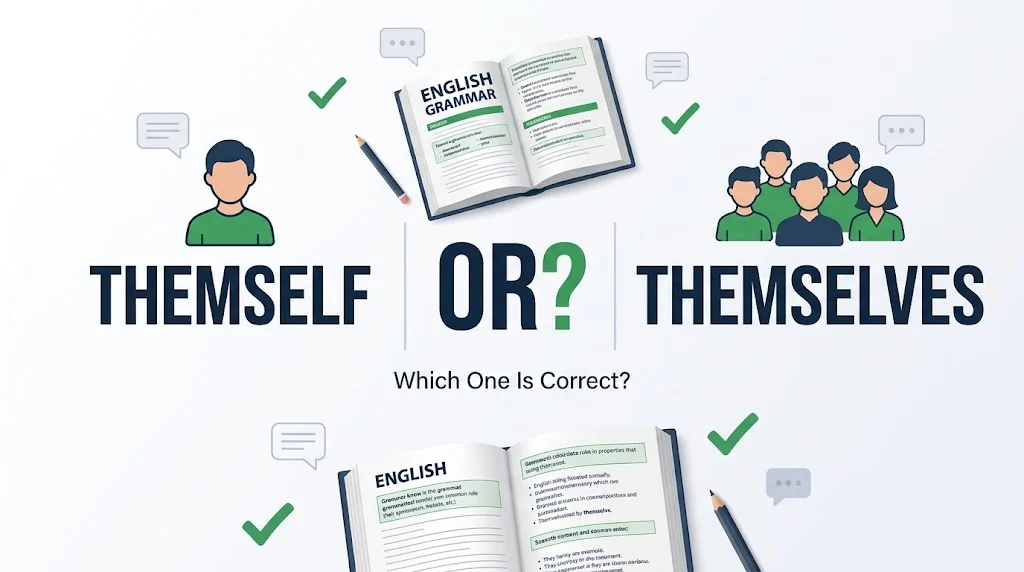
Quick answer: Both themself or themselves can be correct, depending on the antecedent and meaning. Themselves is the traditional plural reflexive pronoun and is also widely used with singular they. Themself is a singular reflexive form used especially when they refer to one person.
The choice between themself and themselves can seem surprisingly difficult because modern English uses they in both plural and singular contexts. Themself is a singular reflexive pronoun generally used when they refers to one person, while themselves traditionally refers to multiple people and is also commonly used with singular they.
This creates real mistakes in workplace communication, academic writing, editing, and everyday conversation because writers may assume that one form is always correct. In reality, context determines the best choice. Understanding the antecedent, grammatical number, register, and intended emphasis gives you a reliable way to choose the right reflexive pronoun.
Themself or Themselves: What’s the Difference?
Both forms are reflexive pronouns, but they differ mainly in grammatical number and usage.
Themself is a singular reflexive pronoun. It is most commonly used when singular refers to one person.
Example:
Jordan reminded themself to submit the report.
Here, Jordan represents one individual, so themself emphasizes the singular reference.
Themselves is traditionally the plural reflexive pronoun corresponding to they.
Example:
The employees reminded themselves to submit the reports.
Here, they refers to several employees, so themselves is the natural choice.
However, English has developed an important additional pattern. Themselves is also widely used when singular refers to one person.
Example:
Jordan reminded themselves to submit the report.
This sentence is also standard and widely accepted.
| Feature | Themself | Themselves |
| Part of speech | Reflexive pronoun | Reflexive pronoun |
| Typical number | Singular | Plural |
| Singular they | Used by some speakers and writers | Very widely used |
| Plural they | Not normally used | Standard |
| Formal writing | Acceptable when context supports it | Widely accepted |
| Casual writing | Common enough in relevant contexts | Very common |
| Main function | Refers back to one individual | Refers back to several people, or sometimes one person |
| Example | Alex blamed themself | The players blamed themselves |
Mini recap
Themself normally points back to one person.
They normally point back to multiple people.
Themselves can also refer back to one person when singular they are used.
Context, rather than the pronoun alone, determines the best choice.
Is Themself or Themselves a Grammar, Vocabulary, or Usage Issue?
This is primarily a grammar and usage issue.
Both words belong to the same grammatical category: reflexive pronouns. The important difference concerns the relationship between the reflexive pronoun and its antecedent.
An antecedent is the noun or pronoun that the reflexive form refers back to.
Consider:
The children prepared themselves.
The antecedent is children, which is plural. Therefore, they are appropriate.
Now consider:
Riley prepared themself.
Riley represents one individual, and themself makes the singular reference explicit.
But another sentence is also possible:
Riley prepared themselves.
This version uses singular they with themselves, a construction that is now well established in contemporary English.
Are they interchangeable?
Not in every context.
For clearly plural antecedents, use themselves.
For singular they, both forms can occur, although themselves is generally more familiar and widely accepted.
Formal vs informal usage
Themselves is the safer choice in most formal writing because it is established across major varieties of English.
Themself can be perfectly appropriate when singular refers to one person, particularly when the writer wants the singular nature of the reference to remain clear.
Academic vs casual usage
Academic writing benefits from consistency and clarity. If a singular person is represented by they, either form may be defensible depending on the style guide and context. Writers should follow the conventions of their institution or publication.
In casual writing, speakers may use whichever form sounds natural to them.
How to Use Themself Correctly
Themself is useful when they refers to one individual and the reflexive action returns to that same individual.
For example:
Casey told themself to stay calm.
The action of telling is directed back toward Casey.
Workplace example
The manager reminded themself to review the contract before the meeting.
Here, one manager is involved. Themself makes the singular reference especially transparent.
Academic example
A student may ask themself whether the evidence supports the argument.
The noun student is singular, and singular is being used as a gender neutral pronoun. Themself can reinforce that singular relationship.
Technology example
A user can customize the application for themself.
The sentence refers to one user at a time rather than a group of users.
Usage recap
Use themself when singular they clearly refers to one person and you want a singular reflexive form. It is especially useful when the distinction between one individual and a group needs to remain clear.
How to Use Themselves Correctly
The themselves is the standard reflexive form for plural they.
For example:
The students prepared themselves for the examination.
The antecedent students are plural, so themselves is required.
It is also commonly used with singular they.
Someone should ask themselves whether the decision is reasonable.
This construction is extremely common in contemporary English.
Workplace example
The team members introduced themselves to the new director.
Because team members refers to several people, themselves is clearly correct.
Academic example
Researchers should ask themselves whether their methodology introduces bias.
Again, the antecedent is plural.
Technology example
Users can teach themselves how to configure the software.
The word users refers to multiple people.
Usage recap
Use themselves with plural antecedents. It is also widely accepted with singular they, especially in general statements such as someone should ask themselves.
When You Should NOT Use Themself or Themselves
Understanding when a reflexive pronoun does not belong is just as important as choosing between the two forms.
- Do not use themself with an obviously plural antecedent.
Incorrect:
The students prepared themself.
Correct:
The students prepared themselves.
- Do not use themselves when the antecedent is clearly another pronoun such as he or she.
Incorrect:
Maria prepared themselves.
Correct:
Maria prepared herself.
- Do not automatically choose themself simply because the person is singular.
The traditional reflexive form for a singular male or female pronoun remains himself or herself.
- Do not use a reflexive pronoun merely to sound formal.
Incorrect:
Please send the document to myself.
Better:
Please send the document to me.
- Do not confuse reflexive and emphatic functions.
A sentence such as They themselves approved the proposal uses themselves for emphasis rather than because the action is necessarily directed back toward the subject.
- Do not assume they are always plural.
Contemporary English frequently uses themselves with singular they.
- Do not assume themself is universally preferred for singular they.
Many readers are more familiar with themselves, and style preferences vary.
- Do not change the form without checking the antecedent.
The noun or pronoun being referred to should always guide the decision.
Common Mistakes and Decision Rules
| Correct sentence | Incorrect sentence | Explanation |
| The children dressed themselves. | The children dressed themself. | Children is plural. |
| Alex reminded themself about the appointment. | Alex reminded himself about the appointment. | Themself can reflect singular they. |
| Someone should ask themselves first. | Someone should ask themself first. | They are widely accepted with singular they. |
| The players congratulated themselves. | The players congratulated themself. | Players is plural. |
| The employee blamed themself for the error. | The employee blamed themselves for the error. | Themself clearly marks the singular reference, though themselves can also occur with singular they. |
| I reminded myself to call. | I reminded myself to call. | Myself is the correct first person reflexive form. |
Decision Rule Box
If you mean one individual represented by singular they, use themself or the widely accepted themselves according to context and style.
When you mean multiple people, use themselves.
If you mean a specific person represented by he or she, use himself or herself.
If the pronoun is not reflexive, do not use either form simply for emphasis.
This is a better decision rule than trying to memorize one form as universally correct.
Themself or Themselves in Modern Technology and AI Tools
Digital communication has accelerated the visibility of singular they. Software interfaces, AI assistants, customer support systems, workplace platforms, and accessibility tools increasingly need language that does not assume a user’s gender.
This has made reflexive forms particularly important.
For example:
A user can update their profile themselves.
Here, themselves works naturally with singular their.
A writer could also say:
A user can update their profile themself.
The second version explicitly signals the singular reference, but it may sound less familiar to some readers.
AI writing systems must therefore consider more than simple grammatical substitution. They need to examine the antecedent and the surrounding sentence before selecting a reflexive form.
Etymology and Development
Themselves combines them with the reflexive element selves. Its history is closely connected with the development of English reflexive pronouns.
Themself is a more straightforward combination of them and the singular reflexive element self. Although some readers may consider it unusual, it has a recognizable grammatical function in contemporary English, particularly with singular they.
The increasing use of singular they has created a stronger practical need for a singular reflexive form. At the same time, they have already become deeply established in singular constructions.
That is why both forms can be encountered in modern English.
Expert style quotation
“The best reflexive pronoun is the one that clearly matches the antecedent and the intended meaning.”
The principle is simple, but it prevents many errors.
Two Illustrative Case Studies
Case Study 1: Workplace policy
Imagine a company revising a sentence in an employee handbook:
Every employee should ask themselves whether they understand the policy.
The sentence is grammatically natural and widely accepted. A copy editor might choose themself:
Every employee should ask themself whether they understand the policy.
The second version makes the singular relationship especially explicit.
Concrete result: One sentence now clearly identifies every employee as an individual rather than implying that the employees are acting collectively.
Case Study 2: Academic writing
Consider this sentence:
A researcher should remind themselves to distinguish evidence from interpretation.
This is already natural contemporary English. If an institution prefers a singular reflexive form, the sentence can become:
A researcher should remind themself to distinguish evidence from interpretation.
Concrete result: The revised sentence maintains gender neutrality while making the singular antecedent grammatically visible.
These are illustrative editorial cases rather than claims about a particular organization’s published results. Their value lies in showing how a small pronoun choice can affect clarity.
Error Prevention Checklist
Always use themself when
You are referring to one individual with singular they.
You want to emphasize the singular relationship between the antecedent and reflexive pronoun.
Publication or style guide accepts singular themself.
The context could otherwise make a plural interpretation confusing.
Never use themselves when
The antecedent is clearly singular and your chosen style specifically requires themself.
Referring to a single person who is already represented by he or she.
You actually need an ordinary object pronoun such as them or me.
That last point matters because reflexive pronouns should not replace ordinary object pronouns.
Related Grammar Confusions You Should Master
If you want stronger command of English pronouns, these related distinctions are worth studying:
- They vs them
- Their vs there vs they’re
- Their vs theirs
- Who vs whom
- Whoever vs whomever
- Myself vs me
- Yourself vs yourselves
- Each other vs one another
- Its vs it’s
- Singular they vs plural they
These distinctions often appear together in professional editing, academic writing, and advanced English usage.
FAQs
Is themself grammatically correct?
Yes. Themself is used as a singular reflexive pronoun, particularly when singular they refers to one individual. However, themselves remains much more familiar and widely used.
Should I use themself or themselves with singular they?
Both can be used. Themselves is widely established with singular they, while themself explicitly marks the singular reference. Follow the style guide and context of your writing.
Is themself singular or plural?
Themself is singular. It is used when they refers to one individual.
Is themselves always plural?
No. Themselves is traditionally plural, but contemporary English also uses it with singular they. For example, Someone should introduce themselves is widely accepted.
Can I say someone should remind themself?
Yes. Someone should remind themself is grammatically possible when someone refers to one individual and singular they are being used. However, someone who should remind themselves is also very common.
Which is more common, themself or themselves?
Themselves is substantially more common. It is the established plural reflexive pronoun and is also widely used with singular they.
Is themself acceptable in formal writing?
Yes, when it fits the grammatical context and the relevant style guide accepts it. Because themselves is more familiar, some formal publications may prefer it with singular they.
Why do people use themself instead of themselves?
Themself can make it immediately clear that they refers to one person. It provides a singular counterpart to themselves and can reduce ambiguity in certain sentences.
Is “they reminded themself” correct?
It can be correct when they refer to one individual. If they refer to multiple people, the correct form is they reminded themselves.
Conclusion
The choice between themself or themselves depends on the antecedent, grammatical number, context, and style preference. Themselves is the traditional plural reflexive pronoun and is also extremely common with singular they. Themself is a singular reflexive form that can make an individual reference especially clear. Neither form should be treated as universally correct or incorrect.
Instead, identify who they refer to, determine whether the sentence is reflexive, and then choose the form that provides the clearest and most natural result. For plural references, themselves is the standard choice. For singular they, both forms can work, with themselves generally being the more familiar option.

Philip Pullman is an American writer dedicated to creating clear and easy to follow English content. Through his work at LingRoya.com, he helps readers strengthen their language skills with practical and reliable guidance so that they can easily understand.