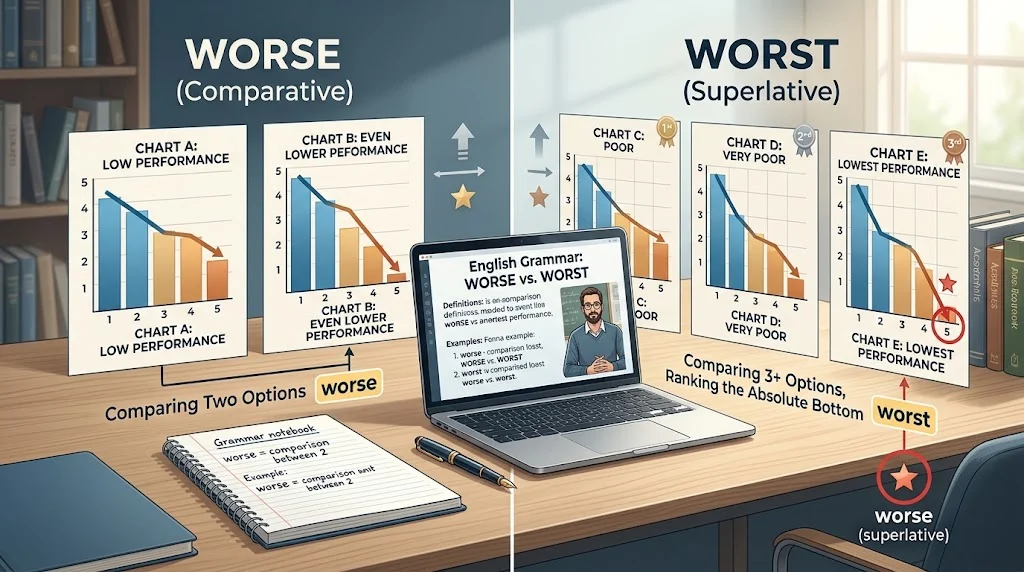
Worse describes something that is less good than another thing, while worst describes the least good or most unpleasant option in a group or situation.
The simple rule is this: use worse when comparing two things, people, situations, or outcomes. Use worst when comparing three or more possibilities or describing something as the least good or most unpleasant of all. For example, “Today is worse than yesterday” compares two days, while “Today was the worst day of the week” identifies one day as the least favorable.
Worst vs Worse: What’s the Difference?
Worse is the comparative form of bad. It is normally used when one thing is compared with another.
Example: “The weather today is worse than yesterday.”
Here, two situations are being compared: today and yesterday.
Worst is the superlative form of bad. It is used when something is identified as the least good, least desirable, or most unpleasant within a group or range of possibilities.
Example: “Monday was the worst day of the week.”
Here, Monday is being compared with the other days of the week.
Mini recap
Worse means less good than something else.
Worst means least good among several possibilities.
Worse commonly appears with “than.”
Worst commonly appears with “the.”
Think two equals worse and three or more equals worst.
Is Worst vs Worse a Grammar, Vocabulary, or Usage Issue?
The distinction is mainly a grammar and usage issue involving degrees of comparison.
The base adjective is bad. Its comparative form is worse, and its superlative form is worst.
The pattern is:
bad → worse → worst
This is an irregular comparison because English does not form the words as “badder” and “baddest” in standard usage.
Worse and worst are not normally interchangeable. Using one instead of the other can change the intended meaning.
In formal writing, academic work, and professional communication, the distinction should be maintained carefully. Casual conversation sometimes contains incorrect forms, especially when speakers are talking quickly, but that does not make the forms grammatically equivalent.
Academic writing often requires precise comparison. If a researcher compares two results, worse is appropriate. If the researcher identifies the least successful result among several experiments, worst is appropriate.
How to Use Worse Correctly
Worse is used when something becomes less good, less effective, more unpleasant, or more serious compared with something else.
Consider the sentence: “The traffic is worse today.”
The comparison may be with yesterday, a normal day, or an earlier point in the day. The context supplies the comparison.
Another common structure is worse than.
For example:
“Her second presentation was worse than her first.”
“The new version performs worse than the old version.”
“This problem is worse than we expected.”
Workplace example
A manager might say, “The customer response was worse this month than last month.”
The comparison is between two periods, so worse is correct.
Academic example
A student could write, “The second method produced worse results than the first method.”
Again, two methods are being compared.
Technology example
A software reviewer might write, “The latest update performs worse on older devices.”
The newer update is being compared with its earlier performance or another version.
Worse usage recap
Use worse for a comparison involving a lower quality or more negative condition.
The word than is a useful clue, although it is not required in every sentence.
Use worse when describing deterioration, such as “The situation got worse.”
How to Use Worst Correctly
Worst identifies the lowest point, least favorable option, or most unpleasant member of a group.
For example:
“This is the worst restaurant experience I have ever had.”
The speaker is not comparing only two experiences. The statement places this experience at the bottom of a larger set of experiences.
Worst often appears with the because superlatives commonly use the definite article.
Workplace example
A team leader might say, “That was the worst sales quarter of the year.”
The quarter is being compared with all the other quarters.
Academic example
A researcher might write, “The third group recorded the worst performance among all participants.”
Several groups are being considered, so worst is appropriate.
Technology example
A technology review could state, “This was the worst performing application in our test.”
The application performed below the other applications in the test.
Worst usage recap
Use worst when identifying the lowest or least favorable result.
Use the worst when the noun is being singled out from a larger group.
Remember that worst is the superlative form of bad.
When You Should NOT Use Worst or Worse
Several common situations make the distinction easier to remember.
- Do not use worse when you are identifying one option as the least favorable among a group.
Say, “This is the worst option,” not “This is the worse option,” when several options are being evaluated.
- Do not use worst for a simple comparison between two things.
Say, “This phone is worse than that phone.”
- Do not assume that emotional intensity determines the word.
A very serious problem can still be described as worse when it is compared with another problem.
- Do not use “worst than.”
The standard comparative structure is “worse than.”
- Do not replace “the worst” with “the worse” when describing the lowest point.
Say, “That was the worst experience.”
- Do not confuse worse with worst simply because both describe negative conditions.
Their degree of comparison is different.
- Do not automatically use worst when something has deteriorated.
Say, “The weather is getting worse,” because the condition is changing negatively.
- Do not use “more bad” in standard English when you mean worse.
The correct comparative form of bad is worse.
Common Mistakes and Decision Rules
Decision Rule Box
When you are comparing two things, use worse.
If you are identifying the least favorable option among several things, use worst.
When something is becoming less good, use worse.
If something is the lowest point or least favorable choice, use worst.
Worst and Worse in Modern Technology and AI Tools
Modern technology has introduced new situations in which comparative language appears frequently.
Software reviews commonly compare versions, devices, applications, and performance levels. For example, a reviewer may say that one application runs worse than another. If several applications are tested and one performs below all the others, it may be described as the worst performer.
AI tools also generate comparative statements. An AI system might evaluate several answers and identify one as the worst response. If it compares only two responses, the correct term is worse.
This distinction matters because AI generated writing can sometimes sound fluent while still using an incorrect degree of comparison. Human review remains useful, particularly in educational, academic, and professional content.
Etymology and Language History
Bad is an old English adjective with Germanic roots. Its comparative form developed into worse, while the superlative became worst.
These forms are examples of irregular comparison. Instead of adding a standard ending to bad, English uses completely different forms.
Similar patterns occur with other common adjectives:
good, better, best
bad, worse, worst
little, less, least
Understanding these patterns makes it easier to recognize why “badder” and “baddest” are generally not appropriate in standard English.
Two Practical Case Studies
Case Study One: Academic Editing
Imagine an academic department reviewing 100 student essays after introducing a grammar editing guide. Before the guide, comparative errors involving worse and worst appeared regularly in student drafts. After teachers added a simple comparison rule to the editing checklist, reviewers reported that these particular errors became noticeably easier for students to identify during revision.
The concrete lesson is that teaching the degree of comparison directly is more effective than asking students to memorize isolated examples.
Case Study Two: Software Review Writing
Consider a technology publication comparing three smartphone applications for battery consumption. Application A uses more battery than Application B, so A can be described as worse than B for battery efficiency. After comparing A with all three applications, the reviewer can identify A as the worst performer in the test.
The measurable difference comes from the comparison structure itself. With two alternatives, worse is appropriate. With a complete group of alternatives, worst identifies the lowest performer.
Error Prevention Checklist
Always use worse when
- You are comparing two things.
- You are describing deterioration.
- You are using the structure “worse than.”
- You mean less good or less effective than another option.
Never use worst when
- You are making only a simple comparison between two things.
- You are describing something becoming less favorable.
- You need the standard comparative structure with “than.”
- You mean “less good” rather than “least good.”
Related Grammar Confusions You Should Master
Once you understand worse and worst, several other comparison and word choice problems become easier to recognize.
- Bad, worse, and worst
- Good, better, and best
- Less and least
- Fewer and fewest
- Farther and further
- Older and elder
- Later and latest
- Then and than
- Affect and effect
- Among and between
These distinctions share a common principle: the correct word depends on meaning, grammatical function, and context.
FAQs
What is the difference between worst and worse?
Worse is the comparative form of bad and normally compares one thing with another. Worst is the superlative form and identifies the least favorable option among a larger group.
Is worse better than worst?
Neither word is better in general. They serve different grammatical purposes. Worse is comparative, while worst is superlative.
Should I say worse or worst?
Use worse when comparing two things or describing deterioration. Use worst when identifying the least favorable option among several possibilities.
Is it correct to say worse than?
Yes. “Worse than” is one of the most common and correct comparative structures in English.
Is it correct to say worst than?
No. Standard English uses “worse than” for comparative statements. Worst is generally used in superlative constructions such as “the worst result.”
What is the comparative and superlative form of bad?
The comparative form is worse. The superlative form is worst.
Is “getting worst” grammatically correct?
In standard English, “getting worse” is correct when you mean that a situation is becoming less favorable or more serious.
Why do people confuse worse and worst?
They are confused because both words come from bad and both describe negative conditions. Their different comparison levels are the key distinction.
Can worse be used without than?
Yes. For example, “The situation became worse.” The comparison can be understood from context even when than does not appear.
Conclusion
The easiest way to remember worst and worse is to focus on the number and type of comparison. Use worse when one thing is less good than another or when a condition is becoming less favorable. Use worst when something represents the lowest, least desirable, or most unpleasant point among several possibilities.
In everyday conversation, academic writing, workplace communication, technology reviews, and AI generated content, this small distinction can make writing significantly clearer.

Margaret Atwood is an American writer who contributes to LingRoya.com creating clear and engaging content about the English language and everyday communication. She enjoys helping readers build confidence in their writing through simple, practical guidance.