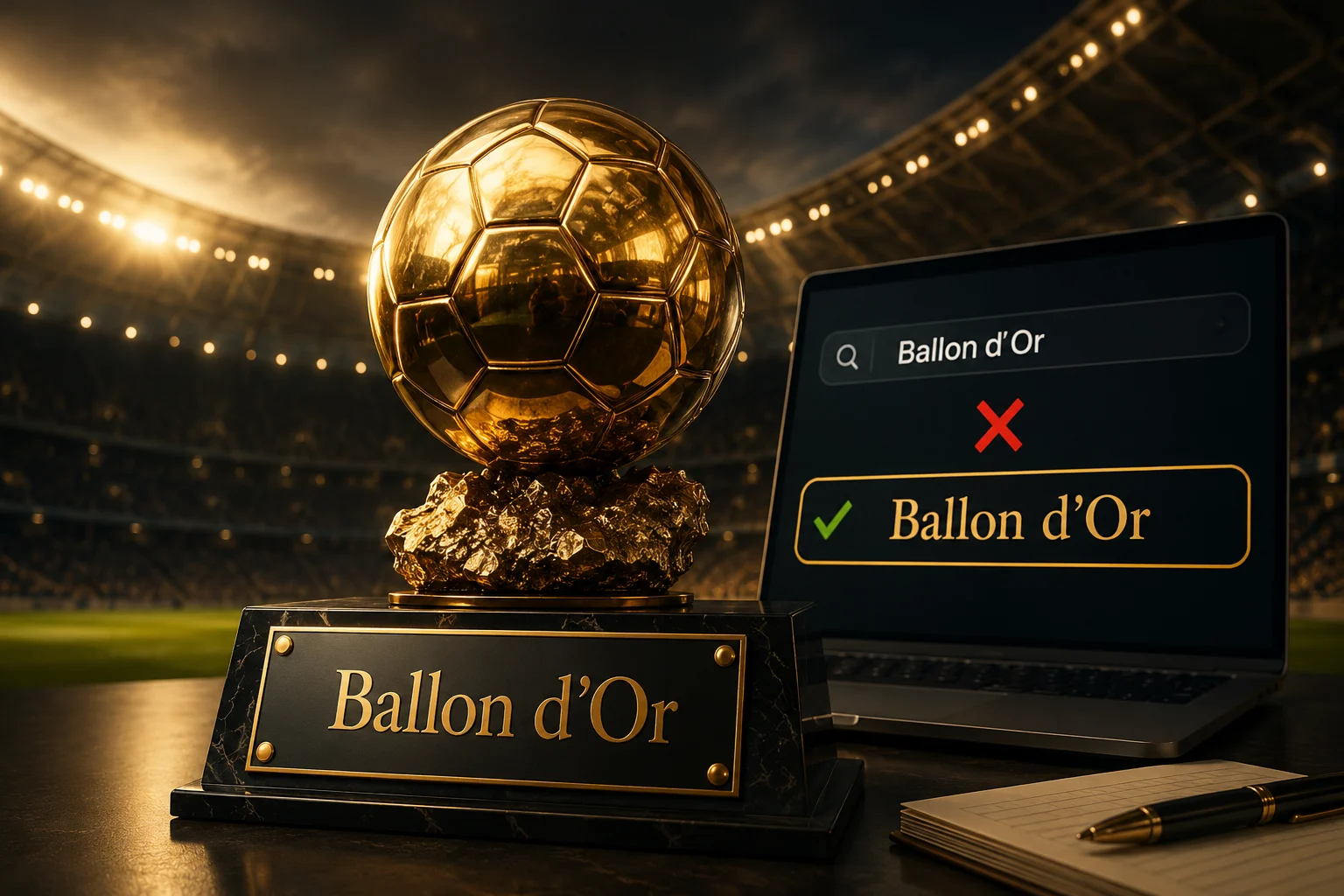
Quick answer: The correct form is Ballon d’Or, the official name of football’s prestigious individual award. It is French for “Golden Ball.” The unaccented form “Ballon d Or” is an informal or incorrect rendering because it omits the apostrophe in d’Or.
If you have ever searched for ballon d or, you may have noticed several versions of the award’s name online, including Ballon d’Or, Ballon d Or, and sometimes Ballon Dor. The confusion is understandable because the expression comes from French rather than English. However, the distinctions are important when accuracy matters.
Ballon d’Or is the established French name of the football award, while ballon d or is a simplified form that removes the apostrophe and capitalization. The award has been presented since 1956 and is now one of football’s most recognized individual honors. Official records list Ousmane Dembélé as the 2025 men’s winner, following Rodri in 2024 and Lionel Messi in 2023.
X vs Y: What’s the Difference?
The main difference is orthographic accuracy, not meaning.
Ballon d’Or is the standard and officially established spelling of the award’s name. It contains the French contraction d’, formed from de plus le, followed by Or, meaning “gold.”
Ballon d Or communicates the same intended reference in most casual searches, but it is not the preferred written form. The missing apostrophe makes the expression less accurate according to standard French spelling and the official presentation of the award.
| Feature | Ballon d’Or | Ballon d Or |
| Language | French | Simplified rendering |
| Meaning | Golden Ball | Intended to mean Golden Ball |
| Apostrophe | Required | Missing |
| Standard spelling | Yes | No |
| Official award name | Yes | No |
| Suitable for formal writing | Yes | Generally avoid |
| Search use | Correct form | Common search variation |
The important point is simple. Ballon d’Or is the correct established name.
Ballon d Or is usually understood, but it drops the apostrophe.
The two forms normally refer to the same football award.
For professional writing, use the official form.
Is X vs Y a Grammar, Vocabulary, or Usage Issue?
This is primarily a spelling and usage issue, rather than a grammar problem.
Grammar concerns how words function and combine within sentences. Here, the central question is how a French expression should be written when it is used as a proper name in English language content.
The two forms are therefore not fully interchangeable in careful writing.
In casual searches, social media posts, text messages, and user generated content, people may omit punctuation. Search engines can usually understand what they mean. However, academic writing, journalism, sports reporting, professional websites, and edited publications should preserve the established spelling.
The distinction becomes especially important when discussing the award as an institution rather than simply referring to it conversationally.
Formal vs informal usage
Formal writing should use Ballon d’Or.
An informal search query might omit the apostrophe because users frequently leave out punctuation when typing into search boxes.
Academic vs casual usage
An academic paper about football history should use the recognized name. A casual social media comment may use a simplified version without causing serious misunderstanding.
Practical rule
When in doubt, follow the official spelling rather than the most convenient keyboard version.
Ballon d’Or: Meaning and Correct Usage
The expression is French. Ballon means “ball,” while or means “gold.” The apostrophe in d’Or represents the French contraction of de and or in the established expression.
The award recognizes outstanding footballing achievement and has a long history associated with France Football. The official historical record begins in 1956 and continues through the modern awards.
Workplace example
A sports editor might write:
The club’s new signing has been nominated for the Ballon d’Or.
This is appropriate because the publication is referring to the official award.
Academic example
A football historian might write:
The Ballon d’Or has played an influential role in the history of individual football awards.
The official spelling is preferable in research and educational writing.
Technology example
A sports application might display:
Ballon d’Or nominees and rankings
Using the official name helps maintain consistency across interfaces, databases, search results, and structured content.
Usage recap: Use Ballon d’Or in articles, reports, academic writing, professional sports content, and official references. A simplified search spelling can be understood, but it shouldn’t replace the standard form in polished content.
Ballon d Or: Meaning and Practical Usage
The form Ballon d Or is generally recognizable because the surrounding words strongly identify the intended football award.
Its biggest problem is not comprehension. It is accuracy.
People often omit apostrophes when typing quickly. This happens with many foreign expressions, names, and titles. Search engines also make it possible for users to find information even when their query contains spelling or punctuation variations.
Workplace example
A journalist might receive a search query containing the simplified spelling. They can understand the topic immediately, but the published article should use the recognized spelling.
Academic example
A student may type the phrase without an apostrophe while searching for sources. In the final assignment, the official spelling should be restored.
Technology example
A user might enter the simplified form into Google or a sports application. The platform may still return results about the award because modern search systems are designed to interpret variations.
Usage recap: This form is understandable as a search variation, but it should generally be corrected when producing edited, professional, or authoritative content.
When You Should NOT Use X or Y
There are several situations where choosing the wrong form can reduce the quality of your writing.
- Do not use the simplified spelling in formal sports journalism. The official award name should be preserved.
- Do not remove the apostrophe in academic writing. Proper names should be reproduced accurately.
- Do not use the simplified form in official looking headings. Readers expect recognized names in professional presentation.
- Do not assume punctuation is irrelevant. An apostrophe can be part of a foreign expression’s established spelling.
- Do not copy an unedited search query directly into published content. Search queries frequently contain spelling shortcuts.
- Do not confuse the award with generic golden football trophies. The name refers to a specific football honor.
- Do not treat every online spelling as equally authoritative. User generated content can contain errors.
- Do not remove the apostrophe simply because English search engines can understand the phrase. Search recognition and editorial correctness are different things.
Common Mistakes and Decision Rules
| Correct sentence | Incorrect sentence | Explanation |
| He won the Ballon d’Or. | He won the Ballon d Or. | The established name contains the apostrophe. |
| She was nominated for the Ballon d’Or. | She was nominated for the Ballon Dor. | The French spelling should be retained. |
| The Ballon d’Or ceremony was held in Paris. | The Ballon d Or ceremony was held in Paris. | Formal references should use the recognized form. |
| Messi has won the Ballon d’Or multiple times. | Messi has won the Ballon Dor multiple times. | The official spelling includes the apostrophe. |
| The article discusses Ballon d’Or history. | The article discusses Ballon d Or history. | Professional content should preserve the proper name. |
Decision Rule
If you mean the official football award, use Ballon d’Or.
If you encounter the unpunctuated version in a search query, understand it as a variation rather than adopting it as your preferred spelling.
This distinction is more useful than thinking of the two forms as completely different words.
Ballon d’Or and Modern Technology and AI Tools
Modern search engines, language models, spell checkers, and sports databases have made spelling variations easier to interpret.
A person can type an incomplete or simplified query and still receive relevant results. This is one reason the unpunctuated form appears frequently online.
AI tools can also infer the intended entity from context. If someone asks about the winner of the award using an imperfect spelling, an AI system can usually understand the reference.
However, recognition is not the same as recommendation.
A search engine may understand a spelling variation, while an editor, journalist, teacher, or professional writer may still expect the standard form. This is particularly important for entity names, structured data, headlines, metadata, and authoritative sports reporting.
The official Ballon d’Or website continues to use the recognized spelling throughout its rankings and award material.
Etymology: Where Does Ballon d’Or Come From?
The expression comes from French.
Ballon means “ball,” while or means “gold.” The phrase therefore carries the literal sense of “Golden Ball.”
The apostrophe is associated with the French form d’Or. It is not decorative punctuation added randomly by English writers. It reflects the grammatical structure of the French expression.
The award was created in 1956 by France Football and has developed substantially over the decades. Its historical winners include some of the most influential players in football history. The official France Football record lists winners from 1956 onward.
Expert style quotation
“In formal writing, an established proper name should be reproduced in its recognized form, even when a simplified search variant remains understandable.”
This principle applies beyond football. It is useful whenever writers deal with foreign names, organizations, awards, publications, or branded entities.
Two Case Studies: Why Accurate Naming Matters
Case Study 1: Rodri and the 2024 award
Rodri won the 2024 Ballon d’Or after a highly successful period with Manchester City and Spain. France Football records his award alongside his 2024 European Championship victory with Spain.
This example shows why accurate naming matters in sports databases. A historical record needs consistent terminology because player names, clubs, years, awards, and rankings may be searched and compared programmatically.
Case Study 2: Ousmane Dembélé and the 2025 award
Ousmane Dembélé won the 2025 Ballon d’Or. The official rankings place him first, followed by Lamine Yamal and Vitinha.
The official Ballon d’Or coverage also describes Dembélé’s 2025 achievement in the context of an outstanding season with Paris Saint Germain, including eight Champions League goals during the 2024 to 2025 competition.
These examples demonstrate how the correct award name functions in historical records, sports journalism, databases, and digital search systems..
Error Prevention Checklist
Always use Ballon d’Or when
Writing a professional sports article
Mentioning the official award
Writing an academic assignment
Creating a headline
Publishing a sports database entry
Writing an authoritative biography
Creating structured website content
Never use Ballon d Or when
You are trying to reproduce the official award name
Writing formal academic content
You are preparing professional sports journalism
Creating an official looking title
You are copying a search query into polished prose
Related Grammar Confusions You Should Master
Understanding this spelling issue can also help you recognize other common language problems.
- Apostrophe vs no apostrophe
- Foreign words used in English
- Proper nouns vs common nouns
- Capitalization of award names
- Formal vs informal spelling
- British vs American English
- Search spelling vs standard spelling
- Brand names vs generic terms
- Loanwords and borrowed expressions
- French expressions used in English
These topics are particularly valuable for writers who want their content to sound authoritative rather than merely understandable.
FAQs
What is the correct spelling of Ballon d’Or?
Ballon d’Or is the standard spelling of the famous football award. The apostrophe is part of the French expression and should normally be retained in professional writing.
Is Ballon d Or grammatically correct?
It is understandable but not the preferred spelling of the official award name. In polished writing, use Ballon d’Or.
What does Ballon d’Or mean in English?
Ballon d’Or literally means “Golden Ball” in English. It is the name of a prestigious football award associated with individual player excellence.
Why does Ballon d’Or have an apostrophe?
The apostrophe reflects the French contraction used in d’Or. Removing it creates a simplified spelling that does not reproduce the established French form accurately.
Is Ballon Dor the same as Ballon d’Or?
Yes, people generally use both expressions to refer to the same football award, but Ballon d’Or is the preferred established spelling.
Who won the 2025 Ballon d’Or?
Ousmane Dembélé won the 2025 men’s Ballon d’Or. The official rankings list Lamine Yamal second and Vitinha third.
Who won the 2024 Ballon d’Or?
Rodri won the 2024 Ballon d’Or. France Football’s player record lists his award for 2024 alongside his European Championship success with Spain.
Who won the 2023 Ballon d’Or?
Lionel Messi won the 2023 Ballon d’Or. France Football’s historical winners list confirms Messi as the 2023 recipient.
Should I write Ballon d’Or in an academic paper?
Yes. If you are referring to the award, the official spelling is the better choice for academic, professional, and editorial writing.
Conclusion
The distinction between Ballon d’Or and the unpunctuated form is straightforward once you understand that this is an established French proper name. The official form preserves the apostrophe and should be your choice in professional writing, journalism, academic work, sports websites, and authoritative online content.
The simplified form may appear in search queries, comments, or informal writing, but recognition does not make it the preferred spelling. When accuracy matters, follow the official form used by France Football and the Ballon d’Or organization.

Margaret Atwood is an American writer who contributes to LingRoya.com creating clear and engaging content about the English language and everyday communication. She enjoys helping readers build confidence in their writing through simple, practical guidance.