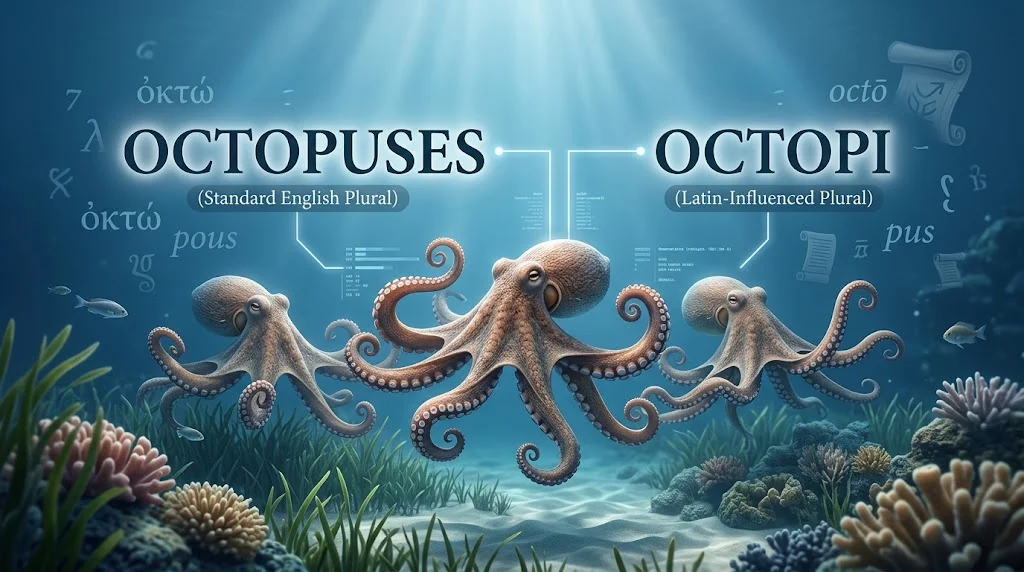
Both octopuses and octopi are accepted plural forms of octopus, but octopuses are generally the clearer and more widely preferred choice in modern English. Octopi comes from applying a Latin style plural ending, even though octopus ultimately comes from Greek. For formal, academic, and scientific writing, octopuses are the safest option.
If you have ever paused before writing about more than one eight armed sea creature, you’re not alone. The question of octopuses or octopi creates confusion because both forms appear in dictionaries, books, scientific writing, and everyday conversation. Octopuses is the regular English plural of the noun octopus, while octopi is an established alternative created by treating the ending as though it came from Latin.
The distinction matters because choosing an unusual plural in an academic paper, workplace report, classroom assignment, or digital publication can make otherwise accurate writing look less polished. Understanding the history and modern usage of these forms makes the choice much easier.
Octopuses or Octopi: What’s the Difference?
The two forms refer to exactly the same thing. The difference is primarily one of plural formation, history, and usage preference rather than meaning.
| Term | Part of speech | Number | Meaning | Typical usage |
| Octopuses | Noun | Plural | More than one octopus | Modern standard English |
| Octopi | Noun | Plural | More than one octopus | Established alternative |
An octopus is a noun referring to a marine cephalopod with eight arms. Its plural can be formed as octopuses, following a familiar English pattern, or as octopi, following a Latin style pattern that isn’t actually based on the original Greek plural formation.
Mini recap
Octopuses and octopi have the same meaning.
Octopuses follow ordinary English plural formation.
Octopi is an established alternative, not an error.
For most modern writing, octopuses are the safest and clearest choice.
Is Octopuses or Octopi a Grammar, Vocabulary, or Usage Issue?
This question is primarily a usage and vocabulary issue, although grammar determines how the plural form functions in a sentence.
Both forms are plural nouns. Neither represents a different species, object, or grammatical category. The important question is which plural form best suits your audience and context.
In casual conversation, either form can be understood immediately. Some speakers prefer octopi because it sounds familiar or because they associate the ending with words such as alumni and cacti. Others prefer octopuses because it follows ordinary English pluralization.
In formal writing, octopuses usually have the advantage. Dictionaries recognize both forms, but modern usage strongly supports the regular English plural. Dictionary.com specifically identifies octopuses as the simpler and more commonly used form.
Academic and scientific writing also tends to favor straightforward terminology. If you’re writing a biology assignment, research article, museum description, or educational resource, octopuses avoid an unnecessary debate about classical language.
Usage Recap
Both forms are grammatically possible.
Neither changes the meaning.
Octopuses are generally the preferred modern form.
Octopi is acceptable but can sound more traditional, playful, or deliberately learned.
How to Use Octopuses Correctly
The form octopuses are particularly useful when clarity and conventional English usage matter.
Consider a workplace report:
The aquarium received three octopuses for its new marine exhibit.
Here, octopuses works naturally because the sentence is straightforward and professional. There’s no reason to introduce an unusual plural when the regular English form communicates the meaning perfectly.
In academic writing, you might write:
Researchers observed several octopuses responding differently to changes in their environment.
This construction is clear and appropriate for scientific discussion.
In technology writing, the word can also appear metaphorically:
The software architecture connects several systems like the arms of multiple octopuses.
The plural remains octopuses because the writer is referring to more than one entity represented by the noun.
Usage Recap
Choose octopuses when you want modern, conventional English.
It works naturally in professional documents.
It fits academic and scientific prose.
It is also a strong choice for educational and technology content.
How to Use Octopi Correctly
Octopi is also recognized as a plural of octopus. You may encounter it in books, journalism, popular science, historical writing, and informal conversation.
For example:
The divers spotted several octopi near the reef.
The sentence is understandable and grammatically accepted in dictionaries.
In a workplace setting, someone might write:
The marine center currently houses five octopi.
In an academic context, you could encounter:
The study examined the problem solving abilities of octopi under controlled conditions.
Technology writing can use the form metaphorically as well:
The network behaves like several octopi reaching into different systems.
None of these examples is grammatically impossible. However, octopi may attract more attention than octopuses, particularly among readers who know that the word has Greek origins.
Usage Recap
Octopi is an accepted plural form.
It means exactly the same thing as octopuses.
It can appear in formal or informal writing.
It is less straightforward than the regular English plural.
When You Should NOT Use Octopuses or Octopi
There are situations where the real problem isn’t choosing between the two forms but using a plural when a singular noun is required.
1. When You Mean One Animal
Incorrect:
I saw three octopus near the rocks.
Better:
I saw three octopuses near the rocks.
2. When the Noun Is Already Singular
Incorrect:
An octopus was hiding under the rock.
Better:
An octopus was hiding under the rock.
3. When You Are Discussing the Animal in General
A singular noun can sometimes be appropriate when discussing a species or concept generally.
The octopus is a highly adaptable marine animal.
You don’t automatically need a plural simply because you’re discussing the animal as a category.
4. When Scientific Precision Requires a Broader Category
Not every eight armed cephalopod should casually be labeled with a species specific term. In scientific contexts, terminology such as octopod or a precise taxonomic name may be more appropriate depending on what is being described. An octopod is a broader classification that includes octopuses and paper nautiluses.
5. When Consistency Matters
If an educational article uses octopuses throughout, suddenly switching to octopi can look inconsistent.
6. When Your Style Guide Prefers Regular English Plurals
Many publications favor familiar English forms. If your organization has a house style, follow it consistently.
7. When You Are Trying to Sound More Scholarly
Using octopi simply to make writing sound sophisticated can have the opposite effect. Correct usage depends on context, not on choosing the form that appears more classical.
Common Mistakes and Decision Rules
| Correct sentence | Incorrect sentence | Explanation |
| We observed several octopuses. | We observed several octopus. | The plural noun is required. |
| An octopus moved under the rock. | An octopuses moved under the rock. | A singular noun follows an. |
| Scientists studied octopuses. | Scientists studied octopiis. | The second form is not a recognized plural. |
| Several octopi were visible. | Several octopi was visible. | A plural subject requires a plural verb. |
| The octopuses escaped the tank. | The octopuses escapeds the tank. | The verb does not take an extra ending. |
Decision Rule Box
If you mean one animal, use: octopus
If you mean more than one and want the clearest modern form, use: octopuses
If you mean more than one and your context permits the alternative, use: octopi
The safest general rule is simple: prefer the regular English plural unless your style or context gives you a reason to choose otherwise.
Why Is Octopi Used If Octopus Comes From Greek?
This is where the history becomes especially interesting.
The word octopus ultimately comes from Greek oktōpous, meaning “eight footed.” Its Greek plural was related to oktōpodes. The modern form entered English through New Latin, which helped create the conditions for later confusion about its plural.
The ending became associated with Latin plurals because many English words borrowed from Latin use that pattern. Consider alumnus and alumni or stimulus and stimuli.
People consequently treated octopus as though it were a Latin noun belonging to the same pattern. That produced octopi.
The irony is that the Greek origin doesn’t naturally justify that Latin plural. A historically motivated Greek based form would be octopodes. However, octopodes are uncommon in ordinary English.
This illustrates an important principle of English: words don’t always retain the plural rules of their original languages.
Expert Perspective on the Plural Debate
A useful principle from modern dictionary guidance is that “both octopuses and octopi are acceptable”, while octopuses are described as the simpler and more commonly used form.
That distinction matters. Calling octopi “wrong” is too strong, but claiming that it is the only correct plural is also inaccurate.
Good language advice recognizes both historical development and actual modern usage.
Two Practical Case Studies
Case Study 1: The Academic Assignment
Imagine a biology student writing:
The experiment compared the behavior of eight octopuses under different lighting conditions.
The regular plural immediately communicates the intended meaning and doesn’t distract the reader. In academic writing, clarity is generally more valuable than displaying an unusual grammatical form.
Result: The regular plural supports a clean, professional sentence without creating a side issue about word history.
Case Study 2: The Museum Website
Suppose a marine museum publishes:
Our aquarium is home to several octopuses from different habitats.
For a public audience, the familiar English form is easy to recognize and understand. It also works well for educational content, search queries, captions, and general informational pages.
Result: The conventional plural provides accessible language for readers with different levels of vocabulary knowledge.
Error Prevention Checklist
Always use octopuses when
You are writing a formal article.
You are preparing an academic assignment.
You are creating educational content.
You want the most straightforward modern English form.
You are writing for a broad general audience.
Never use octopi when
You believe it is the only grammatically correct plural.
You are using it merely to sound sophisticated.
Your publication style guide specifically requires octopuses.
You are actually referring to one octopus.
You are confusing it with the singular form.
Octopuses or Octopi in Modern Technology and AI Tools
Modern technology creates another interesting dimension to this vocabulary question.
Search engines, grammar checkers, writing assistants, and AI tools can encounter both forms because both occur in real English. A writing assistant may therefore recognize octopi as valid rather than automatically marking it as an error.
However, recognition does not necessarily mean recommendation.
If you’re writing website copy, an AI generated article, software documentation, educational material, or an SEO focused page, octopuses are often the more practical choice because it aligns with ordinary modern usage.
AI systems learn from large quantities of human language. Because both forms appear in published material, an AI tool may generate either one depending on context. Human editorial judgment still matters.
Related Grammar Confusions You Should Master
Understanding this plural debate can help you recognize other English questions involving historical plural forms and competing variants.
- Cactus or cacti
- Fungus or fungi
- Syllabus or syllabi
- Focus or foci
- Indexes or indices
- Formula or formulae
- Criterion or criteria
- Phenomenon or phenomena
- Appendix or appendices
- Medium or media
These examples demonstrate why English plurals cannot always be predicted simply by looking at a word’s historical origin. Modern English frequently adopts, regularizes, or develops competing plural patterns.
FAQs
Is octopuses or octopi correct?
Both are accepted plural forms of octopus. However, octopuses are generally the clearer and more commonly preferred form in contemporary English.
Is octopi grammatically correct?
Yes. Octopi is an established plural form of octopus. It isn’t necessary to call it incorrect simply because its historical formation is questionable.
Is octopuses more correct than octopi?
For most modern writing, octopuses are the better practical choice. It follows normal English plural formation and is widely used.
Why do people say octopi?
The form developed because speakers associated the ending with Latin nouns whose plurals end in i. The association is understandable, but octopus ultimately has Greek roots.
What is the plural of octopus in scientific writing?
Octopuses is an appropriate and widely used plural in scientific and educational writing. Dictionary evidence and contemporary examples support its use.
Is octopodes the correct plural?
Octopodes reflects the Greek origin of octopus more closely, but it is uncommon in modern everyday English. It isn’t normally the best choice for general readers.
Should I use octopuses in an academic paper?
Yes. Unless your field or publication specifically prefers another form, octopuses is a clear and conventional choice.
Is octopi more common in American English?
Octopi is familiar in American English, but that does not make it the universally preferred form. Contemporary English uses octopuses extensively, including in scientific and educational contexts.
Can octopuses and octopi be used interchangeably?
Yes. When referring to more than one octopus, the two forms have the same basic meaning. The main difference is stylistic preference and historical formation.
Conclusion
The debate over octopuses or octopi is less about right versus wrong and more about how English develops over time. Both forms are accepted, but octopuses are usually the strongest choice for modern professional, academic, scientific, educational, and general writing. Octopi remains recognizable and established, yet its Latin style ending doesn’t reflect the Greek origin of octopus. When in doubt, choose the familiar English plural: octopuses.

Neil Gaiman is an American writer who contributes educational content to LingRoya.com. His work focuses on helping readers improve their English with clear, practical and easy to follow guidance.