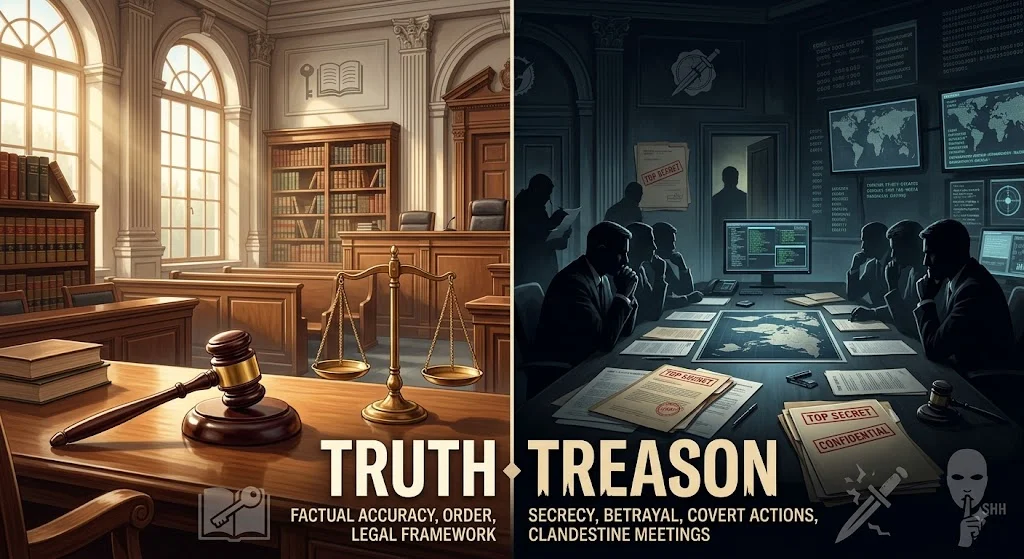
Truth and treason represent two fundamentally opposing forces in human interaction, one rooted in factual reality and the other in betrayal of trust.
Truth and treason are two very different words with completely different meanings. Truth refers to facts, honesty, or something that is genuine and accurate. Treason, on the other hand, refers to a serious act of betrayal against one’s country, government, or a person’s trust.
Understanding the difference between truth and treason is important because the words may appear in discussions about honesty, loyalty, and betrayal. Learning their meanings, uses, and contexts can help you use each term correctly and avoid confusion in English.
Truth vs Treason: What’s the Difference?
At their core, truth and treason could not be more different in meaning, intent, and consequence. Truth is about alignment with facts and reality, while treason involves betrayal of allegiance and trust.
| Aspect | Truth | Treason |
| Part of Speech | Noun (also used as a verb in archaic contexts) | Noun |
| Core Definition | Conformity to fact or reality; a true statement or axiom | The crime of betraying one’s own country; violation of allegiance |
| Primary Context | Philosophy, logic, communication, law, ethics | Criminal law, politics, national security |
| Intent | To inform, clarify, or correct | To betray, undermine, or harm |
| Consequence | Generally positive or neutral; can be uncomfortable but necessary | Severe legal penalties including imprisonment or death |
| Broader Meaning | Accuracy, sincerity, genuineness | Breach of trust, treachery, disloyalty |
The noun “truth” refers to the quality or state of being true, accurate, or in accordance with fact or reality. Philosophers have long debated its nature, with theories ranging from correspondence (truth matches reality) to coherence (truth fits within a consistent system of beliefs). In everyday usage, truth simply means telling it like it is.
“Treason,” by contrast, is a legal and moral concept defined as the betrayal of allegiance toward one’s own country, especially by committing hostile acts against it or aiding its enemies. In the United States, the Constitution defines treason narrowly as “levying War against them, or in adhering to their Enemies, giving them Aid and Comfort”. This precise definition was crafted intentionally to prevent the term from being used loosely for political purposes.
Mini Recap: Truth is about factual accuracy and sincerity. Treason is about betrayal and disloyalty. One informs; the other destroys. One is a virtue; the other is a crime. Understanding this distinction prevents serious miscommunication and legal misunderstandings.
Is “Truth vs Treason” a Grammar, Vocabulary, or Usage Issue?
This is primarily a vocabulary and usage issue rather than a strict grammar problem. The words themselves are not interchangeable, but people sometimes confuse them in context because speaking an uncomfortable truth can be perceived as an act of treason by those in power.
Interchangeable or Not?
Truth and treason are not interchangeable. They belong to entirely different semantic fields. Truth deals with epistemology and communication; treason deals with loyalty and criminal law. Using one in place of the other changes the meaning of a sentence completely.
Formal vs Informal Usage
In formal contexts like legal proceedings or academic writing, both terms carry precise meanings. “Treason” has a specific legal definition that varies by jurisdiction but always involves serious acts against a state or sovereign. “Truth” in formal contexts refers to verifiable facts or philosophical concepts.
In informal usage, people sometimes exaggerate by calling a minor betrayal “treason” or refer to “my truth” as a subjective perspective. This casual usage dilutes the power of both words but does not change their core meanings.
Academic vs Casual Usage
Academic discourse treats truth as a subject of philosophical inquiry, exploring theories of correspondence, coherence, and pragmatism. Treason appears in legal studies, political science, and history. Casual conversation often uses both terms more loosely, with “truth” referring to honesty in personal relationships and “treason” as hyperbole for any perceived disloyalty.
Practical Usage of Truth
Understanding how to use “truth” correctly in various contexts helps you communicate with precision and credibility.
Workplace Example
“The quarterly report must reflect the truth of our financial position, even if the numbers are disappointing.”
In professional settings, truth builds trust and enables sound decision making. Leaders who value truth create cultures of accountability and continuous improvement.
Academic Example
“The researcher’s commitment to truth required her to publish findings that contradicted her initial hypothesis.”
In academia, truth is the highest value. Peer review, replication, and transparency all serve the pursuit of truth. Researchers who suppress inconvenient truths undermine the entire scientific enterprise.
Technology Example
“Algorithmic bias can obscure the truth by systematically misrepresenting certain groups in training data.”
In technology, truth relates to data accuracy, system reliability, and the ethical use of information. Engineers and data scientists must constantly verify that their systems reflect reality rather than perpetuate falsehoods.
Usage Recap: Use “truth” when referring to factual accuracy, sincerity, or reality. It applies across all contexts from personal relationships to scientific research. Truth is about what is, not what someone wishes were true.
Practical Usage of Treason
Treason is a serious term with specific legal and moral implications. Use it carefully and accurately.
Workplace Example
“The executive’s decision to sell proprietary technology to a competitor was viewed as an act of corporate treason.”
While not legally treason in the criminal sense, this usage conveys the gravity of betraying an organization’s trust. It highlights how seriously breaches of confidence can be taken.
Academic Example
“The historical debate questions whether the revolutionary’s actions constituted treason or legitimate resistance against tyranny.”
Historians often grapple with the line between treason and justified rebellion. Context, motivation, and outcome all factor into these judgments.
Technology Example
“Cybersecurity professionals treat insider threats as modern treason, given the potential damage to national infrastructure.”
In the digital age, treason can take new forms. Cyber espionage, data leaks, and sabotage of critical systems all represent betrayals of trust with potentially catastrophic consequences.
Usage Recap: Reserve “treason” for acts of serious betrayal, especially those involving national security or fundamental breaches of trust. Avoid using it casually or as hyperbole for minor disagreements.
When You Should NOT Use Truth or Treason
Misusing these terms can lead to confusion, legal trouble, or damaged relationships. Here are common scenarios to avoid:
- Do not call every lie “treason.” A personal falsehood is not treason. Treason requires betrayal of a nation or sovereign, not just breaking a promise.
- Do not use “treason” for political disagreements. Disagreeing with a leader or policy is not treason, no matter how strongly you feel.
- Do not claim “my truth” as objective fact. Subjective experience differs from verifiable truth. Using “truth” for personal perspective can mislead others.
- Do not equate whistleblowing with treason. Revealing wrongdoing in the public interest is not treason, even if it embarrasses those in power.
- Do not use “truth” when you mean “opinion.” Opinions are subjective; truths are verifiable. Confusing the two undermines credibility.
- Do not accuse someone of treason without legal basis. Treason is a specific crime with a high burden of proof. False accusations can have serious consequences.
- Do not use “truth” to manipulate. Claiming moral authority through “truth” while distorting facts is deceptive and damaging.
- Do not confuse loyalty with truth. Being loyal does not require denying facts. True loyalty includes honesty, even when it is uncomfortable.
Common Mistakes and Decision Rules
| Correct Sentence | Incorrect Sentence | Explanation |
| “The witness swore to tell the truth.” | “The witness swore to tell the treason.” | Treason is a crime, not something you tell. |
| “His actions constituted treason against the state.” | “His actions constituted truth against the state.” | Truth is not an action against anything; treason is. |
| “She valued truth above all else.” | “She valued treason above all else.” | Treason is not a value; it is a betrayal. |
| “The leak was an act of treason.” | “The leak was an act of truth.” | A leak can be either, depending on intent and content. |
| “In a time of universal deceit, telling the truth is a revolutionary act.” | “In a time of universal deceit, telling the treason is a revolutionary act.” | You tell truth, not treason. |
Decision Rule Box
If you mean the action of betraying a nation or trust, use treason.
If you mean factual accuracy or sincerity, use truth.
When in doubt, ask yourself: Am I describing alignment with reality or a violation of allegiance? The answer determines which word to use.
Truth and Treason in Modern Technology and AI Tools
The digital age has complicated both truth and treason in unprecedented ways. Artificial intelligence systems generate convincing but sometimes false information, making truth harder to verify. Meanwhile, cyber espionage and data breaches have created new forms of treason that transcend physical borders.
Social media platforms have become battlegrounds where truth competes with misinformation, and accusations of treason fly freely in political discourse. The phrase “truth is treason in the empire of lies,” popularized by Ron Paul and often attributed to George Orwell, captures this tension perfectly. When deception becomes the norm, telling the truth feels like an act of rebellion.
AI tools themselves raise questions about truth. Large language models can generate plausible falsehoods, requiring human oversight to verify accuracy. On the other hand, AI can also help detect misinformation, serving as a guardian of truth in an age of information overload.
The intersection of truth and treason in technology demands vigilance. We must protect both the integrity of information and the security of systems that depend on trust.
Authority and Trust: Understanding the Origins
The word “truth” comes from Old English “triewth,” meaning faithfulness or constancy. Its roots connect to the concept of trust, suggesting that truth and trust are inherently linked. When we tell the truth, we build trust; when we lie, we destroy it.
“Treason” derives from the Latin “traditio,” meaning a handing over or delivery. The word evolved through Old French “traison” to describe the act of betraying or handing over to an enemy. This etymology reveals treason as a form of surrender or betrayal of what was entrusted to you.
Expert Perspective
“Treason is the easiest crime to understand and the most difficult to prove.” – Legal scholars often note this paradox, highlighting the gap between public perception and legal reality.
Case Study 1: The Whistleblower’s Dilemma
In 2013, Edward Snowden leaked classified information about global surveillance programs. His actions sparked a global debate: was he a truth teller exposing government overreach, or a traitor endangering national security? The case illustrates how the same actions can be viewed through entirely different lenses depending on one’s values and loyalties. Snowden’s disclosures led to significant legal and policy changes, demonstrating the power of truth even when it challenges authority.
Case Study 2: Corporate Transparency
A major technology company faced a crisis when an employee revealed internal documents showing that its products contained security vulnerabilities the company had known about for years. The whistleblower was initially accused of corporate treason but was later vindicated when the company’s stock dropped and regulators imposed fines. The truth, however uncomfortable, ultimately served the public interest and forced the company to improve its practices.
Error Prevention Checklist
Always use truth when:
- Describing factual accuracy
- Referring to sincerity or honesty
- Discussing philosophical concepts of reality
- Verifying information
- Building trust through transparency
Never use treason when:
- Describing a personal disagreement
- Referring to a simple lie or deception
- Discussing political differences of opinion
- Describing whistleblowing in the public interest
- Referring to minor breaches of trust
- Making casual accusations without evidence
Related Grammar Confusions You Should Master
- Lie vs Lay – The classic confusion between reclining and placing objects
- Affect vs Effect – Distinguishing influence from outcome
- Who vs Whom – Subject versus object pronouns
- Its vs It’s – Possessive versus contraction
- Your vs You’re – Possessive versus “you are”
- There vs Their vs They’re – Location, possession, and contraction
- Then vs Than – Time versus comparison
- To vs Too vs Two – Direction, excess, and number
- Advice vs Advise – Noun versus verb
- Principal vs Principle – Leader versus fundamental truth
- Complement vs Compliment – Completion versus praise
- Disinterested vs Uninterested – Impartial versus bored
- Further vs Farther – Metaphorical versus physical distance
- Less vs Fewer – Quantity versus count
- Accept vs Except – Receive versus exclude
FAQs
1. What is the difference between treason and sedition?
Treason involves betraying one’s country, while sedition generally involves encouraging rebellion against the government.
2. Can telling the truth ever be considered treason?
Simply telling the truth is not treason, though revealing classified information may have legal consequences depending on the circumstances.
3. Is whistleblowing treason or truth?
Whistleblowing generally involves exposing wrongdoing, but leaking classified information can lead to legal consequences.
4. How does treason differ from betrayal?
Treason is a specific crime against a country, while betrayal is a broader term for violating someone’s trust or loyalty.
5. Why is truth important in law?
Truth helps courts evaluate evidence and testimony so they can reach fair and accurate decisions
Conclusion
In conclusion, truth and treason represent completely different ideas. Truth is connected with honesty, facts, and what is genuine, while treason describes a serious act of betrayal, particularly against one’s country or government.
Understanding these meanings makes it easier to distinguish between the two terms and use them accurately. Although they may sound somewhat similar, their meanings, contexts, and implications are entirely different.

Neil Gaiman is an American writer who contributes educational content to LingRoya.com. His work focuses on helping readers improve their English with clear, practical and easy to follow guidance.