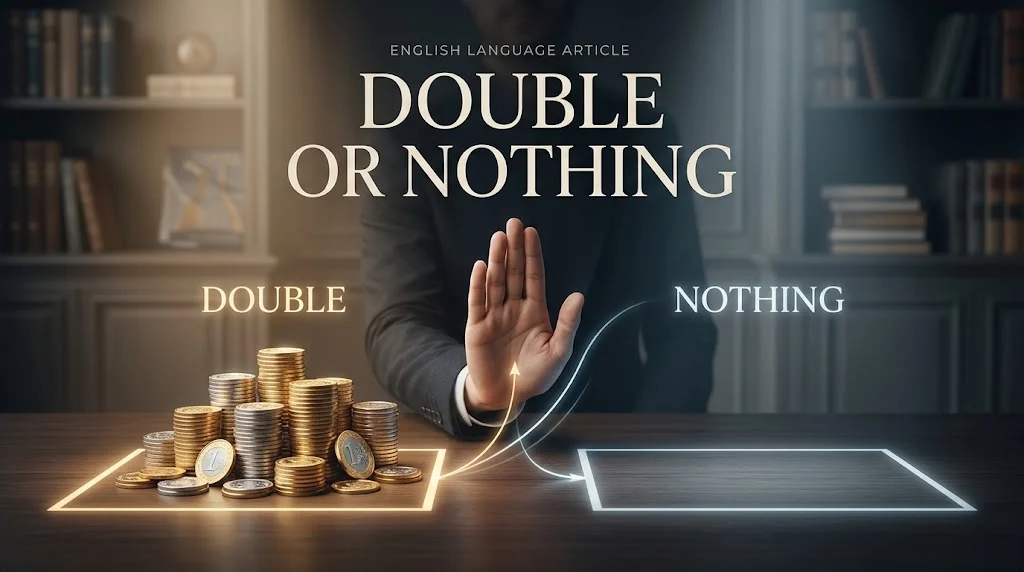
Double or nothing means risking what you currently have in the hope of receiving twice as much, while accepting that you could lose everything if the attempt fails. The phrase is commonly associated with gambling, but it is also used informally when someone wants to take a major risk for a potentially bigger reward.
Have you ever reached a point where playing it safe feels less attractive than taking one final chance? That is exactly the idea behind double or nothing. The expression describes a high risk decision in which someone puts an existing gain or amount at stake for the opportunity to double it. Although the phrase has strong connections to gambling, its modern use extends far beyond betting.
People use it when discussing business opportunities, personal challenges, negotiations, competitions, and technology decisions. Understanding its meaning, grammar, tone, and context helps you recognize when the expression sounds natural and when a more precise phrase would be better.
Double or Nothing: What’s the Difference?
Unlike many common comparison questions, double or nothing does not compare two separate words that have competing meanings. Instead, it is a fixed expression made from two contrasting outcomes.
| Expression | Part of Speech | Meaning | Typical Context |
| Double | Verb or adjective | To make something twice as large or become twice as much | Money, results, size, quantity |
| Nothing | Pronoun or noun | No amount or no thing | Loss, absence, zero result |
| Double or nothing | Idiomatic expression | Risk what you have for the chance to receive twice as much | Gambling, risk taking, decisions |
The word double focuses on multiplication by two.
The word nothing represents the possibility of receiving zero.
Together, the expression presents two extreme outcomes: a larger reward or complete loss.
This contrast is what gives the phrase its strong sense of risk.
Is Double or Nothing a Grammar, Vocabulary, or Usage Issue?
The question is primarily a vocabulary and usage issue, rather than a grammar problem.
The expression is grammatically acceptable when it is used in an appropriate sentence. Its meaning is usually understood from context.
For example:
He accepted the double or nothing challenge.
Here, the phrase functions as a description of the type of challenge.
It can also appear as a noun phrase:
They agreed to a double or nothing arrangement.
In casual conversation, the expression is natural and familiar. In academic writing, however, it may sound too informal unless the subject specifically involves risk, gambling, decision making, or an idiomatic expression.
In formal writing, alternatives such as high risk decision, risking the existing amount, or a chance to double the return may provide greater precision.
Usage Recap
Double or nothing is an established English expression.
It is more common in conversational and informal contexts.
Its meaning depends on a contrast between doubling a gain and losing the existing amount.
Formal writing may require a more precise description of the risk involved.
What Does Double Mean in This Expression?
In this expression, double means to make an amount twice as large.
If someone has $50 and doubles it, the resulting amount is $100.
The word can function as a verb:
She hopes to double her investment.
It can also function as an adjective:
He received double the original reward.
Within the expression, however, double represents the desirable outcome. The person takes a chance because success could produce twice the original amount or benefit.
Workplace Example
The manager offered us a double or nothing deal if we could finish the project early.
The sentence suggests that the employees already have some expected benefit and are being offered an opportunity involving greater risk and reward.
Academic Example
The study examines why people sometimes choose double or nothing decisions when the potential reward is uncertain.
This usage works when an academic discussion is analyzing risk behavior.
Technology Example
The startup treated the new product launch as a double or nothing opportunity.
Here, the phrase is figurative. No literal gambling needs to be involved.
Usage Recap
Use double when the intended idea is an increase to twice the original amount.
In the complete expression, it represents the successful outcome.
It can describe literal amounts or figurative rewards.
What Does Nothing Mean in Double or Nothing?
Nothing represents the losing outcome.
If someone accepts a double or nothing proposition and fails, the original amount or reward is lost.
For example:
You can keep your $100, or you can try for double or nothing.
The person has two possibilities. Success could produce $200, while failure could result in $0.
The word nothing therefore creates the risk that makes the expression powerful.
Workplace Example
The proposal was essentially double or nothing because failure would eliminate the company’s current advantage.
Academic Example
Participants were presented with a choice resembling a double or nothing decision.
Technology Example
The developer described the final software launch as a double or nothing gamble.
Usage Recap
Use nothing to represent complete loss or the absence of a reward.
In this expression, it contrasts directly with double.
The phrase becomes meaningful because the two outcomes are dramatically different.
When You Should NOT Use Double or Nothing
The expression is useful, but it should not be used for every situation involving uncertainty.
1. When there is no possibility of complete loss
If someone might gain a little or gain a lot, but cannot lose everything, double or nothing may exaggerate the situation.
2. When the result is guaranteed
A guaranteed increase is not really a double or nothing situation.
The company will double salaries next year.
This describes a definite result rather than a risk.
3. When the amount will not actually double
Do not use the phrase merely because something is uncertain.
If the possible reward is only slightly larger, another expression may be more accurate.
4. In highly formal writing without explanation
Academic and professional audiences may understand the expression, but a precise description can sometimes communicate the idea better.
5. When discussing ordinary choices
Choosing between two restaurants is not normally a double or nothing decision because the consequences are not significant enough.
6. When there are several possible outcomes
The phrase suggests a sharp contrast between doubling and receiving nothing. It may be misleading when there are many intermediate outcomes.
7. When you mean a gradual increase
A business expecting a steady improvement should not describe its strategy as double or nothing unless the actual decision has extreme outcomes.
8. When the phrase could create the wrong tone
In sensitive professional situations, describing a decision as double or nothing may make it sound reckless or gambling based.
Common Mistakes and Decision Rules
| Correct Sentence | Incorrect Sentence | Explanation |
| He accepted a double or nothing challenge. | He accepted double and nothing challenge. | The standard expression uses or. |
| It was a double or nothing decision. | It was a double nothing decision. | The complete phrase is required. |
| She decided to risk her winnings. | She decided to double or nothing her winnings. | Double or nothing is normally used as an expression, not as a verb in this form. |
| They offered him double or nothing. | They offered him double and nothing. | The two outcomes are alternatives. |
Decision Rule Box
If you mean a choice between doubling an existing amount and losing it, use double or nothing.
If you simply mean increasing something by two times, use double.
If you mean a complete absence or total loss, use nothing.
Double or Nothing in Modern Technology and AI Tools
Modern technology has expanded the contexts in which people use this expression.
A startup might describe an expensive product launch as double or nothing when the company believes success could transform its position while failure could consume its remaining resources.
The expression can also appear in discussions about artificial intelligence. For example:
The company viewed its AI investment as a double or nothing decision.
That sentence does not mean the technology literally involves gambling. Instead, it communicates the speaker’s perception that the potential rewards and risks are unusually large.
Still, writers should be careful. AI projects usually involve multiple outcomes, so the expression may be rhetorical rather than technically precise.
Etymology of Double or Nothing
The expression developed from the language of wagering and gambling. The underlying concept is straightforward: a person puts an existing stake at risk for the opportunity to receive twice that amount.
The structure reflects a very old linguistic pattern in which or presents alternatives. One outcome is a larger reward, while the other is complete loss.
Over time, the phrase moved beyond literal betting. English speakers now use it metaphorically for situations where someone takes a particularly bold risk.
An Expert Style Perspective
“The strength of double or nothing comes from its extreme contrast: success promises a larger reward, while failure threatens complete loss.”
This distinction is important because not every uncertain decision deserves the label. The phrase carries emotional force precisely because the stakes are presented as unusually high.
Two Practical Case Studies
Case Study One: Workplace Negotiation
Imagine an employee negotiating a performance bonus. The employer offers a guaranteed $2,000 bonus or an alternative arrangement that could provide $4,000 if a demanding target is reached, with no bonus if the target is missed.
Calling this a double or nothing arrangement is appropriate because the decision presents two sharply contrasting outcomes.
The practical result is that the phrase immediately communicates the level of risk without requiring a long explanation.
Case Study Two: Product Launch
Consider a small company with limited resources. Management must decide whether to continue selling its existing product or spend its remaining development budget launching a completely new product.
If the new product succeeds, revenue could potentially double. If it fails, the company could lose the money committed to the launch.
Calling the decision double or nothing communicates the perceived stakes quickly. However, in a formal business report, the writer should provide actual financial figures rather than relying entirely on the idiom.
Author Expertise
Written from the perspective of an English language and SEO content specialist with expertise in grammar, vocabulary, usage, and search focused educational content.
Error Prevention Checklist
Always use double or nothing when:
☐ There are two strongly contrasting outcomes.
☐ One outcome involves doubling an existing amount or reward.
☐ The other outcome involves receiving nothing or losing the existing stake.
☐ The context is conversational, figurative, or related to risk.
Never use double or nothing when:
☐ The increase is guaranteed.
☐ There is no meaningful risk.
☐ The amount will not actually double.
☐ Several intermediate outcomes are possible.
☐ A formal context requires precise technical language.
Related Grammar Confusions You Should Master
Once you understand double or nothing, several other commonly confused expressions are worth learning:
- All or nothing vs everything or nothing
- Win or lose vs win or loose
- Risk vs risky
- Affect vs effect
- Lose vs loose
- Then vs than
- Further vs farther
- Everyday vs every day
- Less vs fewer
- Its vs it’s
Understanding these distinctions improves both everyday communication and professional writing.
FAQs
What does double or nothing mean in simple terms?
It means risking what you currently have for the chance to receive twice as much. If the attempt fails, you receive nothing or lose the amount at stake.
Is double or nothing a gambling term?
Yes. The expression has strong roots in gambling and wagering, but modern speakers also use it figuratively for high risk decisions in business, competition, and everyday situations.
Is double or nothing grammatically correct?
Yes. Double or nothing is a standard English expression. Its grammatical role depends on how it appears in a sentence.
Can you use double or nothing in a sentence?
Yes. For example: “He accepted a double or nothing offer because he believed he could win.”
Why do people say double or nothing?
People use the expression to emphasize a decision involving unusually high risk and reward. It creates a clear contrast between a potentially much better result and complete loss.
Conclusion
Double or nothing is a familiar English expression for a high risk proposition in which someone accepts the possibility of receiving twice the original amount while also accepting the possibility of receiving nothing. Its roots are associated with wagering, but its modern use extends to business, competitions, negotiations, technology, and everyday conversation. Use it when the situation genuinely involves a sharp contrast between a doubled reward and complete loss. When the circumstances are more complicated, a precise description of the risks and possible outcomes will usually be clearer.

Philip Pullman is an American writer dedicated to creating clear and easy to follow English content. Through his work at LingRoya.com, he helps readers strengthen their language skills with practical and reliable guidance so that they can easily understand.