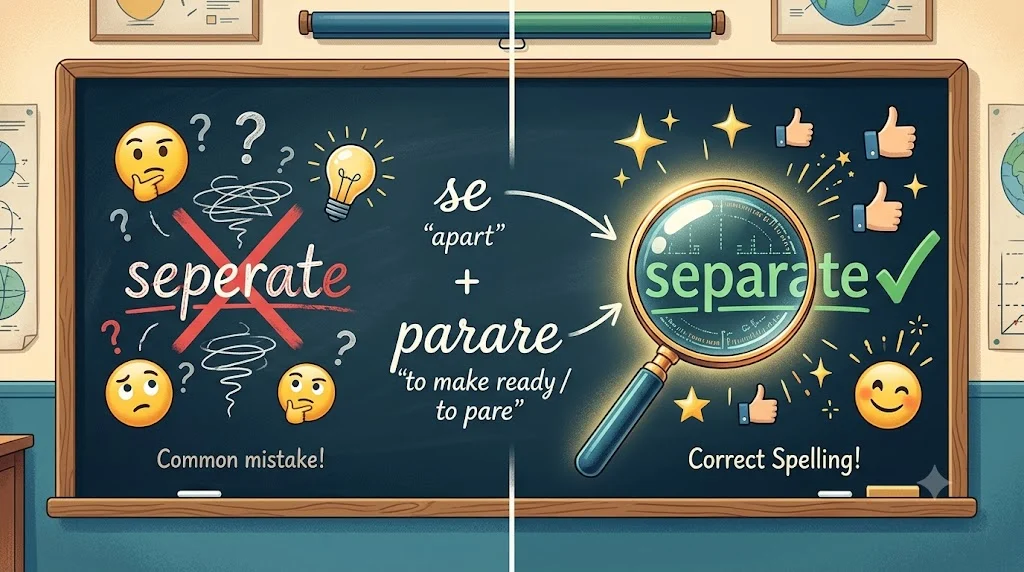
The correct spelling is always separate, with two “a”s. “Seperate” with an “e” in the middle is a common misspelling and is never correct in any form of English.
Few spelling errors are as persistent and widespread as the confusion between separate or seperate. This single word trips up students, professionals, and even experienced writers on a regular basis. You might have caught yourself typing “seperate” in an important email or a crucial report, only to pause and wonder which version is actually correct.
The truth is that this mistake is incredibly common, and there’s a good reason for it. The way we pronounce “separate” often makes it sound as though there should be an “e” in the middle. When we say it quickly, the second syllable can blur into something that resembles “per” rather than “par”. This phonetic trickery leads countless people to spell it with an “e” instead of the correct “a”.
Separate vs Seperate: What’s the Difference?
Definitions
Separate is a legitimate English word that functions as a verb, an adjective, and occasionally a noun. As a verb, it means to set apart, divide, or disconnect things from each other.
Seperate, on the other hand, is not a word at all. It has no definition, no accepted usage, and no place in standard English. It is simply a misspelling of “separate” that has become distressingly widespread.
Comparison Table
| Aspect | Separate | Seperate |
| Status | Correct spelling | InCorrect spelling |
| Part of speech | Verb, adjective, noun | Not applicable |
| Definition | To divide; distinct; not connected | No definition |
| Usage in formal writing | Always acceptable | Never acceptable |
| Usage in informal writing | Always acceptable | Never acceptable |
| Dictionary entry | Found in all dictionaries | Not found in any dictionary |
Mini Recap
To put it simply: separate is the only correct spelling. It can be a verb meaning to divide, an adjective meaning distinct, or a noun referring to individual items. Seperate is a common error that you should never use. If you remember nothing else, remember that “separate” contains the word “rat” in the middle, not “pet”.
Is Separate vs Seperate a Grammar, Vocabulary, or Usage Issue?
This is primarily a spelling and vocabulary issue rather than a grammar question. Grammar deals with how words are structured and arranged in sentences, while spelling concerns the correct sequence of letters in a word. Since “seperate” is not a valid word, it doesn’t qualify as a grammatical alternative.
The confusion between separate or seperate is not about choosing between two acceptable variants. There is no formal versus informal distinction here. Whether you are writing an academic paper, a business proposal, a text message, or a social media post, the correct spelling is always “separate. The misspelling “seperate” is never acceptable in any context.
This is different from cases like “color” versus “colour” or “realize” versus “realise”, where regional variations exist. Those are legitimate differences between American and British English. The separate or seperate question involves a simple error that has no regional or stylistic justification.
In academic writing, using “seperate” would be marked as a spelling error and could undermine your credibility. In professional contexts, it might create a poor impression. Even in casual communication, it’s a mistake that careful writers avoid.
Practical Usage of Separate
Since “separate” is the only correct spelling, let’s focus on how to use it properly in different contexts. Remember that “separate” can function as multiple parts of speech, and its pronunciation changes depending on how it’s used.
Workplace Example
“Please separate the financial records by quarter so we can review each period’s performance independently.”
In this sentence, “separate” is a verb meaning to divide or organize into distinct groups. The manager is asking for a clear division of documents based on time periods.
Academic Example
“The research findings were analyzed as two separate data sets to ensure no cross contamination of results.”
Here, “separate” is an adjective describing the data sets as distinct and independent from each other. The researcher is emphasizing that the two groups of information were kept apart during analysis.
Technology Example
“The new software update will separate user profiles from administrative accounts to enhance security protocols.”
In this tech context, “separate” functions as a verb describing the action of creating distinct access levels and permissions for different types of users.
Usage Recap for Separate
When you use “separate”, you are always correct. Remember that as a verb, it’s pronounced with three syllables (SEP uh rate), while as an adjective, it’s often pronounced with two (SEP rut). The spelling remains the same regardless of how you say it.
When You Should NOT Use Seperate
Since “seperate” is never correct, you should avoid it in every situation. However, understanding the most common scenarios where people mistakenly use “seperate” can help you catch the error before it appears in your writing.
Here are the most common misuse scenarios:
- In professional emails when you’re in a hurry and type “seperate” instead of “separate”. This can make you look careless.
- In academic essays where spell check might not catch the error if you’ve accidentally added it to your custom dictionary.
- In business reports when discussing “separate” departments or divisions. The misspelling undermines the professionalism of your document.
- In job applications where a single spelling error on your resume or cover letter could create a negative impression.
- In social media posts where the mistake might be noticed by grammar conscious followers or potential employers.
- In legal documents where precision matters and any error could be problematic.
- In educational materials where teachers and students should model correct spelling.
- In published content where editing should have caught the error before publication.
The bottom line is simple: “seperate” has no legitimate use case. If you find yourself typing it, stop and correct it immediately.
Common Mistakes and Decision Rules
Correct vs Incorrect Examples
| Correct Sentence | Incorrect Sentence | Explanation |
| Please separate the recycling from the trash. | Please seperate the recycling from the trash. | The verb requires the correct “separate” spelling. |
| They live in separate houses. | They live in seperate houses. | The adjective must be spelled “separate”. |
| The two issues are entirely separate. | The two issues are entirely seperate. | The adjective form follows the same spelling rule. |
| We need to separate the eggs. | We need to seperate the eggs. | The verb form always uses “separate”. |
| The company has separate divisions for each product. | The company has seperate divisions for each product. | The misspelling is never acceptable. |
Decision Rule Box
The action of dividing, disconnecting, or setting apart, use separate (verb).
If something that is distinct, independent, or not connected, use separate (adjective).
You are referring to individual items sold or worn separately, use separates (noun plural).
If you are tempted to type “seperate”, stop and change it to “separate” because “seperate” is always wrong.
Separate in Modern Technology and AI Tools
Spelling errors like the confusion between separate or seperate have become particularly relevant in the age of artificial intelligence and automated writing tools. Modern spell checkers, grammar checkers, and AI writing assistants are generally excellent at catching the “seperate” misspelling and suggesting the correct “separate”.
However, these tools are not foolproof. Some autocorrect systems might not flag “seperate” if you’ve previously added it to your custom dictionary or if the software’s language model is outdated. Moreover, reliance on technology can actually make the problem worse because people may become less attentive to spelling, assuming the software will catch everything.
In AI generated content, maintaining correct spelling is crucial. Search engines like Google prioritize well written, accurate content. Using “seperate” instead of “separate” could signal low quality to both search algorithms and human readers. For businesses using AI for content creation, ensuring that the model consistently uses the correct spelling is essential for maintaining credibility and search visibility.
Voice to text technology also plays a role here. When you dictate “separate”, the software must interpret your pronunciation and choose the correct spelling. Since “separate” and “seperate” sound identical, the software relies on context and its training data to make the right choice. Usually, it gets it right, but you should always double check.
The Etymology of Separate
Understanding where a word comes from can make it easier to remember its correct spelling. The word “separate” has a fascinating history that explains its structure.
“Separate” comes from the Latin word separare, which means “to pull apart”. This Latin term is itself composed of two parts: se meaning “apart” and parare meaning “prepare” or “make ready”. So literally, “separate” means to prepare things apart from each other or to set them aside.
The word entered English in the early 15th century, with the earliest known use recorded before 1475. Over the centuries, the spelling has remained remarkably consistent, always featuring the “par” root from its Latin origins.
This etymology gives us a powerful mnemonic: the “par” in “separate” comes from “parare” meaning “prepare”. If you remember that separate has “par” in the middle (like “prepare”), you’ll never confuse it with “seperate” again.
Expert Perspective
“The most common spelling errors are not usually the result of ignorance but of inattention. Words like ‘separate’ trip us up because our brains process the sound before the spelling. The key to mastery is not memorization alone but understanding the word’s structure and origin.”
This insight from language experts highlights why the separate or seperate confusion is so persistent. It’s not about intelligence or education; it’s about how our brains process language. The sound based approach to spelling works for many words but fails us with words like “separate”.
Case Studies
Case Study 1: The Corporate Email Incident
A marketing manager at a mid sized technology company sent an important email to a potential client, using “seperate” three times in a single paragraph. The client, a senior executive with a background in publishing, noticed the error and mentioned it during a follow up call. While the deal eventually went through, the manager’s credibility was slightly damaged, and the company had to work harder to overcome the initial impression of carelessness. This incident led the marketing department to implement a mandatory proofreading checklist for all external communications.
Case Study 2: The Academic Paper Rejection
A graduate student submitted a research paper to a peer reviewed journal. The paper was otherwise well written and contained valuable original research. However, the student had consistently used “seperate” throughout the manuscript. The reviewers noted this as a significant flaw, and the paper was returned for revision before acceptance. The student had to spend extra time correcting the error, delaying publication by several weeks. This experience taught the student the importance of meticulous proofreading, even for seemingly minor spelling issues.
Error Prevention Checklist
Always use “separate” when:
- You are writing in any formal or professional context
- You are completing academic assignments or research papers
- You are communicating with clients, colleagues, or supervisors
- You are creating content for public consumption
- You are taking a spelling test or language examination
- You are using the word as a verb, adjective, or noun
Never use “seperate” when:
- Writing anything intended for others to read
- Completing official documents or applications
- Creating professional or academic content
- Communicating in any formal setting
- Taking any type of assessment
- Writing in any context where correctness matters
Remember: “seperate” is always incorrect. If you’re unsure, choose “separate”. You’ll never be wrong.
Related Grammar Confusions You Should Master
Understanding the separate or seperate issue is just one step toward mastering English spelling and usage. Here are other common confusions that frequently trip up writers:
- Accept vs Except – knowing when to use each
- Affect vs Effect – the classic verb noun confusion
- Principal vs Principle – person versus rule
- Complement vs Compliment – completing versus praising
- Desert vs Dessert – dry place versus sweet treat
- Lose vs Loose – misplacing versus not tight
- Practice vs Practise – noun versus verb (British English)
- Stationary vs Stationery – still versus writing materials
- Than vs Then – comparison versus time
- Their vs There vs They’re – the possessive, place, and contraction
Each of these pairs presents its own challenges, but the approach to mastering them is similar: understand the definitions, practice regularly, and develop memory aids.
FAQs
Is seperate a word in the dictionary?
No, “seperate” is not a word in any standard English dictionary. It is simply a misspelling of “separate”.
How can I remember the correct spelling of separate?
A helpful mnemonic is to remember that “separate” has a “rat” in the middle (seP A RAT e). Alternatively, remember the Latin root “parare” meaning “prepare”, which gives us the “par” in the middle.
Does separate have different pronunciations?
Yes. As a verb, it is often pronounced with three syllables: SEP uh rate. As an adjective, it is often pronounced with two: SEP rut. The spelling remains the same regardless of pronunciation.
Can separate be used as both a verb and an adjective?
Yes, “separate” functions as both a verb (meaning to divide or set apart) and an adjective (meaning distinct or not connected). It can also be used as a noun in certain contexts.
What is the noun form of separate?
The noun form is “separation”, which means the action or state of being separated. This is also commonly misspelled as “seperation”.
Is seperate ever acceptable in British English?
No, “seperate” is not acceptable in any variety of English. Unlike “color” versus “colour”, there is no regional variation for this word. “Separate” is the only correct spelling worldwide.
What is the past tense of separate?
The past tense is separated, not “seperated”. The same spelling rule applies: it’s always with an “a”.
Conclusion
The confusion between separate or seperate is one of the most common spelling errors in the English language, but it’s also one of the easiest to fix once you understand the rules. The correct spelling is always separate, with two “a”s. The misspelling seperate has no legitimate use and should be avoided in all contexts.
By remembering the word’s Latin roots, using helpful mnemonics, and practicing regularly, you can eliminate this error from your writing permanently. Whether you’re drafting a business email, writing an academic paper, or creating content for the web, using the correct spelling of “separate” will enhance your credibility and ensure your message is taken seriously.

Philip Pullman is an American writer dedicated to creating clear and easy to follow English content. Through his work at LingRoya.com, he helps readers strengthen their language skills with practical and reliable guidance so that they can easily understand.