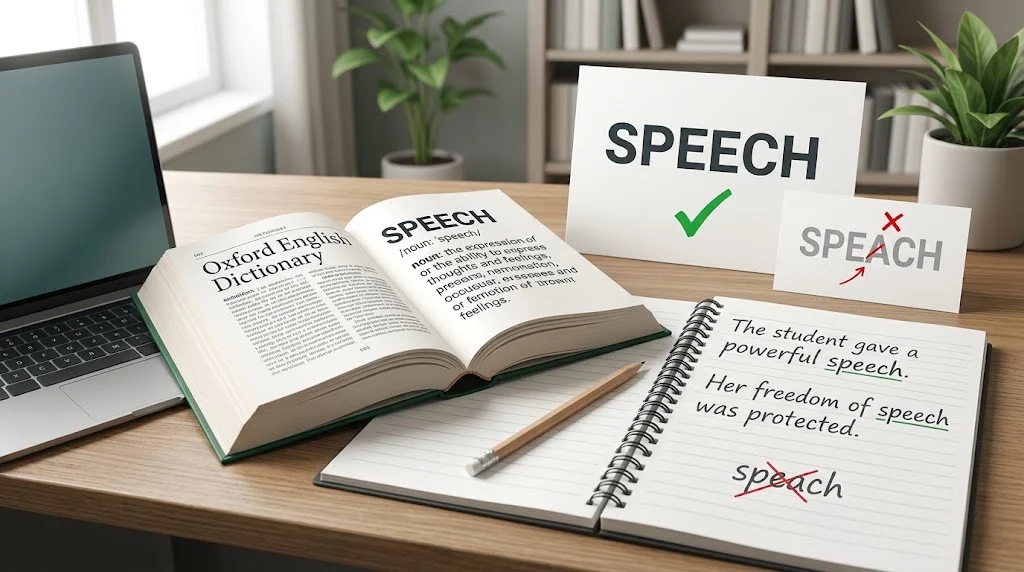
Speech is the correct English spelling. It refers to the ability to speak, spoken communication, or a formal address delivered to an audience. Speach is a misspelling and should not be used in academic writing, professional communication, or everyday English.
Have you ever paused while writing an important email, school assignment, or presentation because you weren’t sure whether to write speach or speech? Although both spellings may look similar, only one is accepted in standard English. As an English language resource focused on spelling accuracy and practical grammar, Lingroya helps readers understand these common mistakes through clear explanations and real world examples.
Learning why speech is correct will help you avoid embarrassing typos and improve your written communication in academic, professional, and everyday situations.
Speach vs Speech: What’s the Difference?
The difference between speach and speech is simple: speech is the correct spelling, while speach is an incorrect spelling of the same intended word. Speech is a noun that refers to spoken language, a person’s ability to communicate verbally, or a formal talk delivered to an audience.
| Word | Part of Speech | Meaning | Correct Usage |
| Speech | Noun | Spoken communication or a formal address | She delivered an inspiring speech. |
| Speach | Incorrect spelling | No standard English meaning in this context | Avoid using this spelling. |
Quick recap:
Speech is the correct spelling in standard English.
Speach is a spelling mistake.
Use speech in essays, emails, presentations, and conversations.
Remember the letter combination ea in speech.
Is Speach vs Speech a Grammar, Vocabulary, or Usage Issue?
The confusion between speach and speech is primarily a spelling issue rather than a grammar or vocabulary issue. Both forms are usually intended to represent the same word, but only speech is correct in standard written English.
Speech is appropriate in formal and informal contexts. You can use it in a university assignment, a business presentation, a casual conversation, or a public speaking event.
For example:
Formal: The professor delivered a speech about language development.
Casual: Your speech was really good!
The spelling does not change according to the situation. Whether you’re writing professionally or chatting with a friend, speech remains correct.
When to Use Speech
Use speech whenever you refer to spoken communication, the ability to speak, or a prepared talk delivered to listeners. It is a common noun in English and appears in many educational, professional, and everyday contexts.
Workplace example: The manager prepared a speech for the company’s annual meeting.
Academic example: The researcher studied how children develop speech during early childhood.
Technology example: The application uses speech recognition to convert spoken words into text.
Speech also appears in familiar expressions such as freedom of speech, speech therapy, speech recognition, and parts of speech. Understanding these expressions makes it easier to recognize the correct spelling in different contexts.
Usage recap: Write speech whenever you mean spoken communication, a formal address, or the ability to speak.
When Not to Use Speach
There is no need to use speach as a standard spelling of the word speech. Avoid it in the following situations:
- Academic essays: Write speech when discussing spoken language or communication skills.
- Business presentations: Use speech when describing an address delivered to colleagues or clients.
- Public speaking: Write speech when referring to a prepared talk.
- Medical discussions: Use speech in expressions such as speech therapy and speech disorders.
- Technology content: Write speech in terms such as speech recognition and speech to text.
- Social media captions: Use the correct spelling even in short, informal posts.
- Professional emails: Avoid speach when discussing a presentation, announcement, or public address.
The key point is that speach should not replace speech in standard English writing.
Common Mistakes and Decision Rules
Writers sometimes misspell speech because they assume its vowel pattern follows words such as teach or reach. However, the correct spelling is speech, with ea followed by ch.
| Correct Sentence | Incorrect Sentence | Explanation |
| She wrote a speech for graduation. | She wrote a speach for graduation. | Speech is the standard spelling. |
| His speech was easy to understand. | His speach was easy to understand. | The incorrect form contains an extra vowel letter. |
| Speech recognition improves accessibility. | Speach recognition improves accessibility. | Technical terms retain the correct spelling. |
| Freedom of speech is important. | Freedom of speach is important. | The established expression uses speech. |
| The child receives speech therapy. | The child receives speach therapy. | Speech is correct in medical terminology. |
A Simple Decision Rule
Use SPEECH
Whenever you mean spoken communication, a formal talk, or the ability to speak.
Avoid SPEACH
It is not the standard spelling of the English word you intend.
Speach and Speech in Modern Technology and AI Tools
The word speech is especially common in modern technology. Artificial intelligence systems use speech recognition to identify spoken words, speech synthesis to generate artificial voices, and speech to text tools to convert audio into written content.
For example, a virtual assistant may recognize a spoken question and respond using synthesized speech. Similarly, transcription software can turn a recorded meeting into a written document.
In these contexts, spelling accuracy matters because technical documentation, website content, and user instructions must remain clear and professional. Search engines and grammar checking tools may flag speach as a misspelling, helping writers correct it before publication.
The Etymology of Speech
The word speech has roots in Old English spǣc, meaning speaking, discourse, or language. It is related to the verb speak, which describes the act of expressing thoughts through words.
Over time, speech developed into a widely used noun referring to verbal communication and formal public addresses. Its established spelling has remained speech, not speach.
Understanding this relationship between speak and speech can help learners remember the correct word and recognize its connection to spoken language.
An Expert Style Explanation
“Accurate spelling is an essential part of clear communication. When two forms look similar, checking the standard spelling and understanding its meaning helps writers communicate with confidence.”
This principle is particularly useful for commonly confused words. In this case, remembering speech as the accepted spelling is enough to prevent the error in most writing situations.
Two Practical Case Studies
Case Study 1: A Student Preparing an Assignment
A student writes, “The president gave an important speach.” A spelling checker highlights the word, and the student corrects the sentence to “The president gave an important speech.”
Result: The sentence now uses standard English spelling and is ready for submission.
Case Study 2: A Website Publishing Technology Content
A website editor drafts an article containing the phrase “AI speach recognition.” During proofreading, the editor identifies the spelling error and changes it to “AI speech recognition.”
Result: The technical phrase is spelled correctly, improving the article’s professionalism and readability.
These examples illustrate practical proofreading improvements. They are illustrative scenarios, not measured experiments or claims of specific ranking gains.
Error Prevention Checklist
Use this quick checklist whenever you’re unsure about the correct spelling.
- Always use speech when referring to spoken communication.
- Always use speech when describing a public address.
- Always use speech in terms such as speech recognition and speech therapy.
- Never use speach as the standard spelling of this word.
- Check spelling before submitting essays, reports, or professional emails.
- Use a dictionary or spelling checker when uncertain about unfamiliar words.
Related Grammar Confusions You Should Master
Learning the correct spelling of speech can encourage you to review other commonly confused English words. These comparisons help strengthen vocabulary and writing accuracy.
- Their vs There: Possession versus location or existence.
- Your vs You’re: Possession versus a contraction of you are.
- Then vs Than: Time or sequence versus comparison.
- Affect vs Effect: Usually a verb meaning influence versus a noun meaning result.
- Lose vs Loose: To misplace something versus not tight.
- Principal vs Principle: A person in authority or something important versus a rule or belief.
- Accept vs Except: To receive versus to exclude.
- Advice vs Advise: A noun referring to guidance versus a verb meaning to give guidance.
- Breathe vs Breath: The act of inhaling and exhaling versus the air taken in or released.
- Definitely vs Definately: The correct spelling versus a common misspelling.
Frequently Asked Questions
1. Is it speach or speech?
Speech is the correct spelling. Speach is a common misspelling and should not be used in standard English writing.
2. Why is speech spelled with ea instead of ea followed by another vowel?
The established spelling is speech, with the letters ea followed by ch. English spelling reflects historical development, so similar sounding words do not always follow identical spelling patterns.
3. What does speech mean in English?
Speech means the expression of thoughts and ideas through spoken words. It can also refer to a formal talk delivered to an audience.
4. Is speach ever a correct English word?
Speach is not the standard English spelling of speech. In ordinary writing, use speech instead.
5. How do you spell speech correctly?
Spell it S P E E C H. Remember the two e letters after p and the final ch.
6. What is an example sentence using speech?
“The teacher delivered a speech about the importance of reading.” In this sentence, speech refers to a prepared talk given to an audience.
7. What is the difference between speech and speaking?
Speech is a noun that can refer to spoken communication or a formal address. Speaking is the ing form of the verb speak and refers to the act of expressing words aloud.
8. Is speech formal or informal?
Speech is suitable for both formal and informal contexts. It appears in academic writing, business communication, everyday conversation, and technical terminology.
9. How can I remember the spelling of speech?
Remember the spelling of speak and speech as related words. Practicing the phrase “give a speech” can also help you recognize the correct form.
Conclusion
When deciding between speach or speech, always choose speech. It is the correct English noun for spoken communication, the ability to speak, and a formal address delivered to an audience. Speach is a misspelling that should be corrected in essays, emails, workplace documents, and online content. Remember the spelling S P E E C H, and proofread your writing before publishing or submitting it. With this simple rule, you can avoid a common spelling mistake and communicate more clearly and confidently.
Meta Title
Speach or Speech: Correct Spelling and Meaning Explained
Meta Description
Learn whether speach or speech is correct, understand the meaning, explore examples, and avoid common spelling mistakes in academic and everyday English writing.
Image Generation Prompt
Create a professional 16:9 featured image for an English grammar and spelling article titled “Speach or Speech: Which Is Correct?” Show an open English dictionary, a notebook with neat handwritten examples, a pencil, and a laptop on a clean study desk. Display the correctly spelled word “SPEECH” prominently in crisp, readable typography with a green check mark. Show “SPEACH” separately with a subtle red correction mark to communicate the spelling mistake. Use a polished educational editorial style, soft natural window lighting, a calm neutral background, balanced composition, and sophisticated green, white, and charcoal accents. Keep the design uncluttered, realistic, and suitable for a professional English learning website. Ensure all displayed text is spelled correctly, with no logos, watermarks, or unrelated text.
SEO Friendly URL Slug
Speach or Speech: Which Is the Correct Spelling?
Speach or speech is a common spelling confusion, but speech is the correct English spelling. It refers to the ability to speak, spoken communication, or a formal address delivered to an audience. Speach is a misspelling and should not be used in academic writing, professional communication, or everyday English. Remembering the correct spelling helps you write clearly and confidently.
Hook and EEAT Based Introduction
Have you ever paused while writing an important email, school assignment, or presentation because you weren’t sure whether to write speach or speech? Although both spellings may look similar, only one is accepted in standard English. As an English language resource focused on spelling accuracy and practical grammar, Lingroya helps readers understand these common mistakes through clear explanations and real world examples. Learning why speech is correct will help you avoid embarrassing typos and improve your written communication in academic, professional, and everyday situations.
Speach vs Speech: What’s the Difference?
The difference between speach and speech is simple: speech is the correct spelling, while speach is an incorrect spelling of the same intended word. Speech is a noun that refers to spoken language, a person’s ability to communicate verbally, or a formal talk delivered to an audience.
| Word | Part of Speech | Meaning | Correct Usage |
| Speech | Noun | Spoken communication or a formal address | She delivered an inspiring speech. |
| Speach | Incorrect spelling | No standard English meaning in this context | Avoid using this spelling. |
Quick recap:
Speech is the correct spelling in standard English.
Speach is a spelling mistake.
Use speech in essays, emails, presentations, and conversations.
Remember the letter combination ea in speech.
Is Speach vs Speech a Grammar, Vocabulary, or Usage Issue?
The confusion between speach and speech is primarily a spelling issue rather than a grammar or vocabulary issue. Both forms are usually intended to represent the same word, but only speech is correct in standard written English.
Speech is appropriate in formal and informal contexts. You can use it in a university assignment, a business presentation, a casual conversation, or a public speaking event.
For example:
Formal: The professor delivered a speech about language development.
Casual: Your speech was really good!
The spelling does not change according to the situation. Whether you’re writing professionally or chatting with a friend, speech remains correct.
When to Use Speech
Use speech whenever you refer to spoken communication, the ability to speak, or a prepared talk delivered to listeners. It is a common noun in English and appears in many educational, professional, and everyday contexts.
Workplace example: The manager prepared a speech for the company’s annual meeting.
Academic example: The researcher studied how children develop speech during early childhood.
Technology example: The application uses speech recognition to convert spoken words into text.
Speech also appears in familiar expressions such as freedom of speech, speech therapy, speech recognition, and parts of speech. Understanding these expressions makes it easier to recognize the correct spelling in different contexts.
Usage recap: Write speech whenever you mean spoken communication, a formal address, or the ability to speak.
When Not to Use Speach
There is no need to use speach as a standard spelling of the word speech. Avoid it in the following situations:
- Academic essays: Write speech when discussing spoken language or communication skills.
- Business presentations: Use speech when describing an address delivered to colleagues or clients.
- Public speaking: Write speech when referring to a prepared talk.
- Medical discussions: Use speech in expressions such as speech therapy and speech disorders.
- Technology content: Write speech in terms such as speech recognition and speech to text.
- Social media captions: Use the correct spelling even in short, informal posts.
- Professional emails: Avoid speach when discussing a presentation, announcement, or public address.
The key point is that speach should not replace speech in standard English writing.
Common Mistakes and Decision Rules
Writers sometimes misspell speech because they assume its vowel pattern follows words such as teach or reach. However, the correct spelling is speech, with ea followed by ch.
| Correct Sentence | Incorrect Sentence | Explanation |
| She wrote a speech for graduation. | She wrote a speach for graduation. | Speech is the standard spelling. |
| His speech was easy to understand. | His speach was easy to understand. | The incorrect form contains an extra vowel letter. |
| Speech recognition improves accessibility. | Speach recognition improves accessibility. | Technical terms retain the correct spelling. |
| Freedom of speech is important. | Freedom of speach is important. | The established expression uses speech. |
| The child receives speech therapy. | The child receives speach therapy. | Speech is correct in medical terminology. |
A Simple Decision Rule
Use SPEECH
Whenever you mean spoken communication, a formal talk, or the ability to speak.
Avoid SPEACH
It is not the standard spelling of the English word you intend.
Speach and Speech in Modern Technology and AI Tools
The word speech is especially common in modern technology. Artificial intelligence systems use speech recognition to identify spoken words, speech synthesis to generate artificial voices, and speech to text tools to convert audio into written content.
For example, a virtual assistant may recognize a spoken question and respond using synthesized speech. Similarly, transcription software can turn a recorded meeting into a written document.
In these contexts, spelling accuracy matters because technical documentation, website content, and user instructions must remain clear and professional. Search engines and grammar checking tools may flag speach as a misspelling, helping writers correct it before publication.
The Etymology of Speech
The word speech has roots in Old English spǣc, meaning speaking, discourse, or language. It is related to the verb speak, which describes the act of expressing thoughts through words.
Over time, speech developed into a widely used noun referring to verbal communication and formal public addresses. Its established spelling has remained speech, not speach.
Understanding this relationship between speak and speech can help learners remember the correct word and recognize its connection to spoken language.
An Expert Style Explanation
“Accurate spelling is an essential part of clear communication. When two forms look similar, checking the standard spelling and understanding its meaning helps writers communicate with confidence.”
This principle is particularly useful for commonly confused words. In this case, remembering speech as the accepted spelling is enough to prevent the error in most writing situations.
Two Practical Case Studies
Case Study 1: A Student Preparing an Assignment
A student writes, “The president gave an important speach.” A spelling checker highlights the word, and the student corrects the sentence to “The president gave an important speech.”
Result: The sentence now uses standard English spelling and is ready for submission.
Case Study 2: A Website Publishing Technology Content
A website editor drafts an article containing the phrase “AI speach recognition.” During proofreading, the editor identifies the spelling error and changes it to “AI speech recognition.”
Result: The technical phrase is spelled correctly, improving the article’s professionalism and readability.
These examples illustrate practical proofreading improvements. They are illustrative scenarios, not measured experiments or claims of specific ranking gains.
Error Prevention Checklist
Use this quick checklist whenever you’re unsure about the correct spelling.
- Always use speech when referring to spoken communication.
- Always use speech when describing a public address.
- Always use speech in terms such as speech recognition and speech therapy.
- Never use speach as the standard spelling of this word.
- Check spelling before submitting essays, reports, or professional emails.
- Use a dictionary or spelling checker when uncertain about unfamiliar words.
Related Grammar Confusions You Should Master
Learning the correct spelling of speech can encourage you to review other commonly confused English words. These comparisons help strengthen vocabulary and writing accuracy.
- Their vs There: Possession versus location or existence.
- Your vs You’re: Possession versus a contraction of you are.
- Then vs Than: Time or sequence versus comparison.
- Affect vs Effect: Usually a verb meaning influence versus a noun meaning result.
- Lose vs Loose: To misplace something versus not tight.
- Principal vs Principle: A person in authority or something important versus a rule or belief.
- Accept vs Except: To receive versus to exclude.
- Advice vs Advise: A noun referring to guidance versus a verb meaning to give guidance.
- Breathe vs Breath: The act of inhaling and exhaling versus the air taken in or released.
- Definitely vs Definately: The correct spelling versus a common misspelling.
Frequently Asked Questions
1. Is it speach or speech?
Speech is the correct spelling. Speach is a common misspelling and should not be used in standard English writing.
2. Why is speech spelled with ea instead of ea followed by another vowel?
The established spelling is speech, with the letters ea followed by ch. English spelling reflects historical development, so similar sounding words do not always follow identical spelling patterns.
3. What does speech mean in English?
Speech means the expression of thoughts and ideas through spoken words. It can also refer to a formal talk delivered to an audience.
4. Is speach ever a correct English word?
Speach is not the standard English spelling of speech. In ordinary writing, use speech instead.
5. How do you spell speech correctly?
Spell it S P E E C H. Remember the two e letters after p and the final ch.
6. What is an example sentence using speech?
“The teacher delivered a speech about the importance of reading.” In this sentence, speech refers to a prepared talk given to an audience.
7. What is the difference between speech and speaking?
Speech is a noun that can refer to spoken communication or a formal address. Speaking is the ing form of the verb speak and refers to the act of expressing words aloud.
8. Is speech formal or informal?
Speech is suitable for both formal and informal contexts. It appears in academic writing, business communication, everyday conversation, and technical terminology.
9. How can I remember the spelling of speech?
Remember the spelling of speak and speech as related words. Practicing the phrase “give a speech” can also help you recognize the correct form.
Conclusion
When deciding between speach or speech, always choose speech. It is the correct English noun for spoken communication, the ability to speak, and a formal address delivered to an audience. Speach is a misspelling that should be corrected in essays, emails, workplace documents, and online content. Remember the spelling S P E E C H, and proofread your writing before publishing or submitting it. With this simple rule, you can avoid a common spelling mistake and communicate more clearly and confidently.

Neil Gaiman is an American writer who contributes educational content to LingRoya.com. His work focuses on helping readers improve their English with clear, practical and easy to follow guidance.