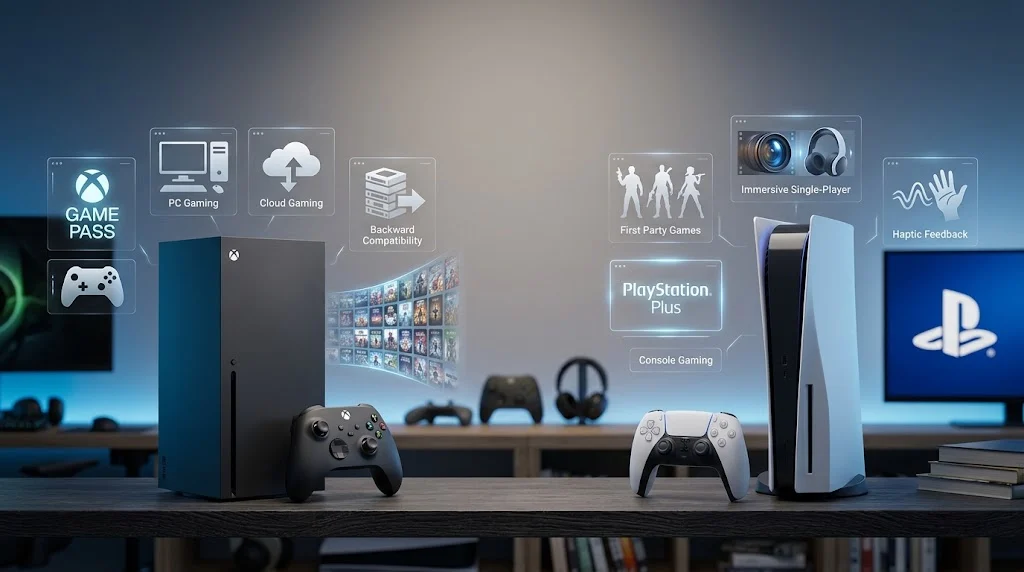
Xbox emphasizes Game Pass, backward compatibility, PC integration, and broader device access, while PlayStation is strongly associated with its first party games, DualSense controller, and PlayStation Plus ecosystem.
Xbox is often the better choice for gamers who value Game Pass, backward compatibility, PC integration, cloud gaming, and access to a large subscription library. PlayStation is often the better choice for players who prioritize its first party games, DualSense features, and PlayStation Plus catalog. Neither platform is universally better, because the right choice depends on how you play.
Introduction: Xbox or PlayStation and the Real Buying Decision
The question of Xbox or PlayStation is no longer simply about which console has more power. Modern gaming platforms have developed into broader ecosystems involving subscription services, digital libraries, online multiplayer, PC gaming, cloud streaming, accessories, and cross platform experiences.
Xbox is Microsoft’s gaming brand, while PlayStation is Sony’s gaming platform. The original Xbox launched in 2001, while the first PlayStation launched in Japan in 1994. Microsoft’s platform has increasingly expanded beyond the traditional console, while Sony has continued developing PlayStation around console hardware, games, services, and connected entertainment experiences.
That difference matters when choosing a console. Someone who wants a large subscription library and regularly plays on PC may have different priorities from someone who wants PlayStation’s major first party experiences. Price, game availability, storage, controller design, online services, and existing friends can also influence the decision.
The best comparison therefore isn’t simply about specifications. It is about which ecosystem fits your gaming habits.
Xbox vs PlayStation: What’s the Difference?
Xbox and PlayStation are competing gaming platforms rather than interchangeable products. Each combines hardware, software, online services, digital stores, controllers, accessories, and games.
Xbox is Microsoft’s gaming platform. Current Xbox hardware includes the Xbox Series X and Series S, while the broader Xbox ecosystem also extends to Windows PCs, supported mobile devices, browsers, smart TVs, and cloud gaming. Microsoft’s current Game Pass offerings provide access to different game libraries and services depending on the selected plan.
PlayStation is Sony’s gaming platform. The current generation centers on PlayStation 5 hardware and the PlayStation Plus subscription service. PlayStation Plus offers different membership tiers, with features including online multiplayer, monthly games, cloud storage, discounts, and access to a larger game catalog on higher tiers.
| Category | Xbox | PlayStation |
| Company | Microsoft | Sony |
| Current main console family | Xbox Series X and Series S | PlayStation 5 family |
| Subscription ecosystem | Xbox Game Pass | PlayStation Plus |
| Major strength | Game library, PC integration, backward compatibility | First party games and console focused experiences |
| PC integration | Extensive | Growing |
| Cloud gaming | Xbox Cloud Gaming on supported plans and devices | Cloud streaming available through supported PlayStation Plus offerings |
| Controller | Xbox Wireless Controller | DualSense |
| Digital ecosystem | Microsoft Store and Xbox ecosystem | PlayStation Store |
| Backward compatibility | Strong support across selected generations | Support varies by generation and title |
| Best suited to | Subscription focused and cross device gamers | Players focused on PlayStation experiences |
Mini Recap
Xbox places considerable emphasis on flexibility and ecosystem integration.
PlayStation places strong emphasis on console experiences and first party software.
Game Pass is one of Xbox’s biggest advantages.
PlayStation Plus provides multiple subscription tiers and a large game catalog.
The better platform depends on what you actually want to play.
Is Xbox vs PlayStation a Hardware, Software, or Usage Issue?
The Xbox or PlayStation debate involves all three.
From a hardware perspective, the two platforms offer high performance, fast storage, modern graphics features, and support for contemporary televisions and displays. However, specifications alone don’t determine the better gaming experience.
From a software perspective, exclusive games and first party studios can be more important. A player who strongly prefers games available on one platform may naturally choose that ecosystem.
From a usage perspective, subscription services can make an enormous difference. Xbox Game Pass currently offers multiple plans, including options with large game libraries, day one Xbox releases on eligible plans, PC access, and cloud streaming on supported devices.
PlayStation Plus also offers multiple tiers. PlayStation Plus Extra, for example, includes a Game Catalog with hundreds of games, while Essential includes monthly games, online multiplayer, discounts, cloud storage, and other benefits.
Formal and Casual Gaming
There is no formal versus informal distinction here because Xbox and PlayStation are proper brand names. The real distinction is between different gaming ecosystems.
In casual gaming discussions, people often say, “Xbox or PlayStation?” as shorthand for a much larger question about games, hardware, subscriptions, and community.
In technical comparisons, however, it is better to specify exactly what you are comparing.
How Xbox Works for Different Types of Gamers
Xbox’s biggest advantage is that Microsoft has increasingly treated Xbox as an ecosystem rather than only a console.
The Xbox Series X is designed for high performance gaming, while the Series S provides a smaller, digital only option. Microsoft states that Series X and Series S support features such as Quick Resume, variable refresh rate, Auto Low Latency Mode, and backward compatibility with thousands of games across four generations.
Xbox Game Pass is another major differentiator. Microsoft’s current Game Pass offerings include multiple plans with different combinations of games, online multiplayer, PC access, cloud streaming, and additional benefits.
Workplace Example
For a professional who works on Windows and also games on PC, Xbox can be attractive because Microsoft’s gaming ecosystem connects console and PC experiences more closely than traditional console only models.
Academic Example
For someone researching digital entertainment ecosystems, Xbox provides an interesting example of how a console brand can expand into PC, cloud, subscription, and mobile experiences.
Technology Example
Xbox’s cloud gaming service allows supported games to be streamed to compatible devices, while Game Pass also extends beyond the console to PC and selected other platforms.
Xbox Usage Recap
Choose Xbox if you value Game Pass, PC integration, backward compatibility, cloud gaming, and flexibility across devices.
How PlayStation Works for Different Types of Gamers
PlayStation takes a somewhat different approach, with its console hardware and first party software forming a major part of its identity.
The original PlayStation launched in Japan in December 1994 and eventually became a landmark console. Sony’s official history records more than 102 million original PlayStation consoles sold worldwide from 1994 through 2006.
Modern PlayStation remains strongly associated with major single player experiences and Sony’s first party studios. The DualSense controller also provides features such as adaptive triggers and advanced haptic feedback in supported games.
PlayStation Plus forms the subscription side of the ecosystem. Its Essential tier includes online multiplayer, monthly games, discounts, cloud storage, and related benefits, while Extra adds access to the Game Catalog.
Workplace Example
A designer or creative professional interested in visually ambitious single player games may find PlayStation particularly appealing because of its strong association with cinematic game experiences.
Academic Example
PlayStation provides a useful case study for examining how exclusive software can influence consumer decisions and establish a platform identity.
Technology Example
The DualSense controller demonstrates how hardware can contribute to immersion through haptic feedback and adaptive triggers rather than relying exclusively on visual improvements.
PlayStation Usage Recap
Choose PlayStation if you prioritize its first party experiences, DualSense features, console focused ecosystem, and PlayStation Plus.
When You Should NOT Choose Xbox or PlayStation
There are several situations where choosing a platform simply because it is popular can lead to disappointment.
- Do not buy Xbox if the games you most want to play are unavailable on Xbox.
- Do not buy PlayStation simply because friends recommend it without checking the games you actually play.
- Do not choose a console without considering subscription costs.
- Do not assume the most powerful hardware automatically provides the best experience for you.
- Do not ignore whether you already own a large digital library on another platform.
- Do not overlook storage requirements when purchasing a console.
- Do not choose based entirely on internet arguments between fan communities.
- Do not forget to check whether your preferred accessories and multiplayer friends are supported on the platform you choose.
Common Xbox and PlayStation Comparison Mistakes
| Correct statement | Incorrect assumption | Explanation |
| Xbox Game Pass offers a large subscription library. | Every new game is automatically included forever. | Libraries and availability can change. |
| PlayStation Plus offers different membership tiers. | Every PlayStation game is included with Plus. | Games depend on the specific plan and catalog. |
| Xbox supports selected backward compatible games. | Every old Xbox game works automatically. | Compatibility varies by title. |
| PlayStation has major first party games. | Every PlayStation exclusive is permanently exclusive. | Platform strategies and release policies can change. |
| Series S is digital only. | Series S plays physical discs. | Microsoft states that Series S does not support game discs. |
| Both platforms support modern gaming features. | The consoles provide exactly the same experience. | Hardware, software, services, and game optimization differ. |
Decision Rule
If you mean subscription value, PC integration, backward compatibility, and cross device flexibility, Xbox may be the better fit. If you mean PlayStation first party games, DualSense features, and a console focused experience, PlayStation may be the better fit.
Xbox and PlayStation in Modern Technology and AI Tools
AI and advanced analytics are increasingly influencing game development, accessibility, recommendation systems, testing, personalization, and player behavior analysis.
Modern gaming platforms already operate as sophisticated digital ecosystems. Game recommendations, cloud infrastructure, automatic updates, online services, streaming technology, and personalized storefronts all depend on large software systems.
Xbox has particularly emphasized gaming across devices. Microsoft has described Xbox as a gaming brand spanning console, PC, and other devices, while current Game Pass offerings extend across console, PC, and supported cloud devices.
PlayStation is also expanding beyond traditional console boundaries through services and connected gaming experiences. Its PlayStation Plus ecosystem demonstrates how modern console ownership increasingly involves subscriptions and digital services rather than only physical hardware.
Etymology and Brand History
The name Xbox comes from Microsoft’s development of a gaming system built around DirectX technology. The original Xbox launched in North America on November 15, 2001, marking Microsoft’s entry into the console market.
PlayStation’s history began earlier. Sony launched the first PlayStation in Japan on December 3, 1994. The platform quickly established itself as a major force in 3D home gaming.
The two brands therefore developed from different starting points. PlayStation grew from Sony’s push into dedicated gaming hardware, while Xbox entered an established market with Microsoft’s software and technology background.
An Expert Perspective
“The best gaming platform is not necessarily the one with the highest specification. It is the one whose games, services, ecosystem, and controller experience match the way you actually play.”
That principle is useful because console comparisons often become too focused on isolated technical specifications.
Two Practical Case Studies
Case Study 1: The Subscription Focused Gamer
Imagine a player who regularly plays several different genres and also owns a Windows PC. Instead of purchasing every game individually, that player values access to a large subscription library.
Xbox becomes particularly compelling in this situation. Microsoft’s current Game Pass Ultimate offering includes a large library across Xbox console, PC, and supported devices, along with day one releases and cloud streaming.
The concrete advantage is flexibility: the player can access a broader gaming ecosystem without restricting gaming to one device.
Case Study 2: The Console Focused Gamer
Now consider someone who primarily plays on a television and strongly prefers PlayStation’s first party experiences.
For this user, PlayStation can make more sense. PlayStation Plus provides online multiplayer and monthly games at the Essential level, while Extra adds a large Game Catalog.
The concrete result is a platform choice based on preferred games and ecosystem rather than raw hardware specifications.
Error Prevention Checklist
Always consider Xbox when:
You play on both console and PC.
You want a large subscription library.
Backward compatibility matters to you.
You want cloud gaming options.
You prefer the Xbox controller and ecosystem.
Never choose Xbox without checking:
Whether your favorite games are available.
Whether your preferred multiplayer community is there.
Whether the subscription tier you want fits your budget.
Whether Series S’s digital only design suits your buying habits.
Always consider PlayStation when:
You value PlayStation first party games.
You prefer the DualSense controller.
You mainly play on console.
You want access to PlayStation Plus.
You prefer Sony’s gaming ecosystem.
Never choose PlayStation without checking:
Whether your favorite games are available.
Whether your friends play on the same platform.
Whether the PlayStation Plus tier you want provides sufficient value.
Whether the available storage meets your needs.
Related Gaming Comparisons You Should Understand
The Xbox or PlayStation debate connects to several other useful comparisons:
- Xbox Series X vs PlayStation 5
- Xbox Series S vs PlayStation 5
- Game Pass vs PlayStation Plus
- Xbox controller vs DualSense
- Xbox exclusives vs PlayStation exclusives
- Xbox cloud gaming vs PlayStation cloud streaming
- Digital games vs physical games
- Console gaming vs PC gaming
- Backward compatibility on Xbox and PlayStation
- Console subscription services
Understanding these comparisons can make the purchasing decision much clearer.
FAQs
Is Xbox or PlayStation better for families?
Both offer family friendly games and parental controls, so the better choice depends on your family’s gaming preferences.
Which console has better graphics, Xbox or PlayStation?
Both offer excellent graphics, with differences depending on the specific console model and game.
Is Xbox or PlayStation better for multiplayer?
Both are great for multiplayer gaming, but your choice may depend on where your friends play.
Is Xbox or PlayStation better for casual gamers?
Xbox may appeal to casual gamers because of its subscription options and broad game library, while PlayStation offers a strong selection of accessible games.
Which has better controllers, Xbox or PlayStation?
Controller preference is subjective, as Xbox and PlayStation use different designs, layouts, and features.
Is Xbox or PlayStation better for long term gaming?
Both can provide years of gaming, but backward compatibility, subscriptions, exclusive games, and hardware support may influence your decision.
Conclusion
The Xbox or PlayStation decision is ultimately about choosing an ecosystem rather than simply choosing a box under your television. Xbox has a particularly strong case for players who value Game Pass, PC integration, backward compatibility, cloud gaming, and flexibility across supported devices.
PlayStation is a compelling option for gamers who prioritize Sony’s first party experiences, DualSense controller technology, and the PlayStation Plus ecosystem.

Neil Gaiman is an American writer who contributes educational content to LingRoya.com. His work focuses on helping readers improve their English with clear, practical and easy to follow guidance.