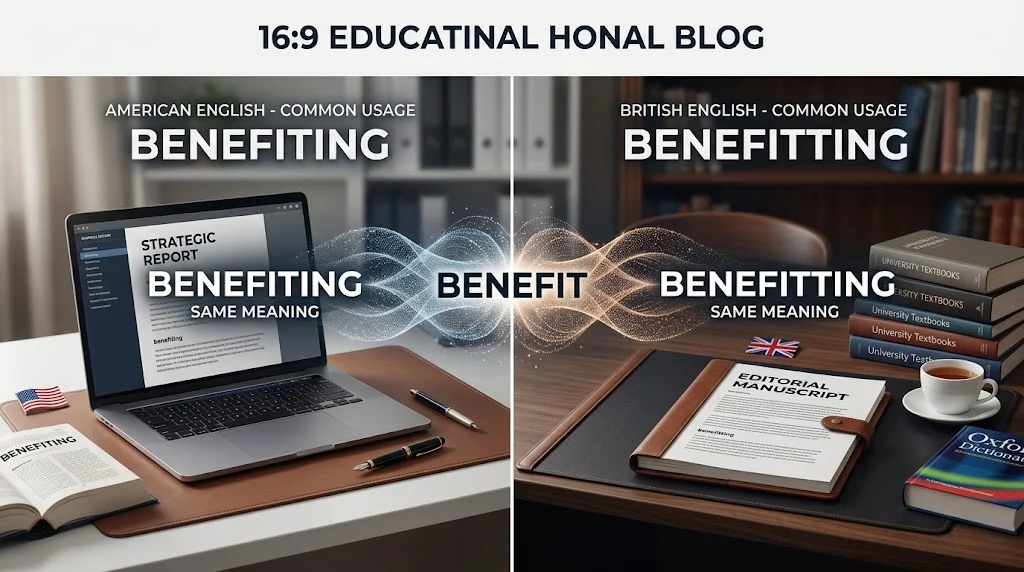
Benefiting and benefitting are both accepted English spellings. Benefiting is generally preferred in American English, while benefitting is widely used in British English and other varieties that follow British spelling conventions.
The question of benefiting or benefitting is a classic spelling variation rather than a simple case of one word being right and the other being wrong. Both forms come from the verb benefit, meaning to receive an advantage or to provide an advantage. The difference appears when the final consonant is handled before the suffix ing is added.
This creates genuine uncertainty because English uses different spelling conventions for words ending in a consonant. In American English, benefiting is normally written with one t. In British English, benefitting with two t’s is also well established.
Benefiting vs Benefitting: What’s the Difference?
Both forms are present participles of the verb benefit.
| Spelling | Part of speech | Common usage | Meaning | Example |
| Benefiting | Verb form | Especially American English | Receiving or providing a benefit | Students are benefiting from the program. |
| Benefitting | Verb form | Especially British English | Receiving or providing a benefit | Students are benefitting from the program. |
The two spellings have the same basic meaning.
Benefiting is the more common American spelling.
Benefitting is widely used in British English.
Neither form represents a different action.
The main distinction is regional spelling convention.
Is Benefiting vs Benefitting a Grammar, Vocabulary, or Usage Issue?
This is primarily a spelling and usage issue, not a difference in grammar or meaning.
Both forms are derived from the verb benefit and can function as present participles or gerunds.
For example:
“The company is benefiting from the investment.”
“The company is benefitting from the investment.”
Both sentences communicate the same idea.
The difference becomes important when considering regional English.
American English generally favors benefiting.
British English commonly accepts and uses benefitting.
Canadian, Australian, and other varieties of English may show variation depending on the publication, dictionary, institution, or style guide being followed.
Formal vs Informal Usage
Both forms can appear in formal writing. Neither is inherently informal.
A business report written in American English would normally use benefiting.
A British academic publication may use benefitting.
The important issue is consistency rather than choosing one spelling simply because it looks more formal.
Academic vs Casual Usage
Academic writers should follow the spelling conventions required by their institution, publisher, or chosen style guide.
In casual communication, either form may appear depending on the writer’s regional English.
For international audiences, benefiting can sometimes be easier to recognize because it is especially common in American English and is widely encountered online.
How to Use Benefiting Correctly
Benefiting is the spelling commonly preferred in American English.
It is the present participle of benefit and can describe someone receiving an advantage or something producing an advantage.
Workplace Example
“Employees are benefiting from the company’s new training program.”
The employees are receiving an advantage from the program.
Another example is:
“The organization is benefiting from improved communication.”
Here, the organization is receiving a positive result.
Academic Example
“Students are benefiting from access to digital learning resources.”
The sentence describes students receiving an educational advantage.
Technology Example
“Small businesses are benefiting from advances in artificial intelligence.”
The businesses are gaining advantages from technological developments.
Usage Recap for Benefiting
Use benefiting confidently in American English.
It is appropriate for academic, professional, technical, and everyday writing.
Its meaning is identical to benefitting.
If your publication follows American spelling conventions, this is usually the preferred form.
How to Use Benefitting Correctly
Benefitting is also a correct spelling and is particularly associated with British English.
It is used in exactly the same grammatical contexts as benefiting.
Workplace Example
“Employees are benefitting from flexible working arrangements.”
The employees are gaining an advantage from the arrangements.
Academic Example
“Researchers are examining whether local communities are benefitting from the new policy.”
The communities are receiving potential advantages from the policy.
Technology Example
“Consumers are benefitting from faster and more reliable internet services.”
The consumers are gaining advantages from technological improvements.
Usage Recap for Benefitting
Use benefitting when following British English spelling conventions.
It is acceptable in formal writing.
It has the same pronunciation and meaning as benefiting.
Consistency with the rest of your document matters more than treating one form as universally superior.
Why Does Benefit Become Benefiting or Benefitting?
The spelling variation comes from different approaches to handling the final consonant when adding a suffix.
The base word is benefit.
Add ing and you get the forms benefiting or benefitting, depending on the spelling convention being followed.
This differs from some familiar examples in English where the final consonant is doubled in certain circumstances.
For instance, British English often doubles a final consonant in words such as travelling and cancelling, while American English commonly uses traveling and canceling.
However, spelling rules involving consonant doubling are not always perfectly predictable across varieties of English. Historical usage, stress patterns, pronunciation, and established conventions all play a role.
That is why it is safer to learn the accepted spelling of common words rather than trying to create a universal rule from one example.
When You Should NOT Use Benefiting or Benefitting
There are several situations where writers can avoid unnecessary confusion.
1. Do not switch between forms randomly
If one paragraph uses benefiting and another uses benefitting without a reason, your document may look inconsistent.
2. Do not call benefitting an outright spelling error
It is an accepted spelling, particularly in British English.
3. Do not call benefiting an American only mistake
Benefiting is a standard spelling and is especially common in American English.
4. Do not change spelling halfway through a formal document
Choose the regional convention required by your audience or style guide.
5. Do not assume British and American spelling must always match
Many English words have regional spelling differences.
6. Do not confuse spelling variation with a change in meaning
The two forms mean the same thing.
7. Do not use a regional form against an explicit style guide
If a publisher requires American English, follow its preferred spelling. If it requires British English, follow that convention.
8. Do not rely solely on spell checking software
A spell checker may prefer one form because of its regional dictionary settings. That does not necessarily mean the other form is incorrect.
Common Mistakes and Decision Rules
| Correct sentence | Incorrect sentence | Explanation |
| American readers are benefiting from the change. | American readers are benefitting from the change. | The first form follows common American spelling. |
| British readers are benefitting from the change. | British readers are benefiting from the change. | The first form follows a common British spelling convention. |
| Students are benefiting from the course. | Students are benefittting from the course. | Benefit has only one t before ing in the accepted forms. |
| The company is benefitting from the investment. | The company is benefittting from the investment. | The spelling does not use three t’s. |
| The program is benefiting local communities. | The program is benefitting local communities. | In American English, benefiting is generally preferred. |
| The program is benefitting local communities. | The program is benefittting local communities. | Benefitting uses two t’s, not three. |
Decision Rule Box
If you are writing American English, use benefiting.
When you are writing British English, benefitting is widely accepted and commonly used.
If your organization has a style guide, follow its spelling preference.
Most importantly, stay consistent throughout the document.
Benefiting and Benefitting in Modern Technology and AI Tools
Digital publishing has made regional spelling differences more visible than ever.
Search engines, AI writing assistants, grammar checkers, word processors, and content management systems may use different language settings. An American English setting may favor benefiting, while a British English setting may recognize or recommend benefitting.
This can matter for content creators who publish for international audiences.
For example:
“Businesses are benefiting from AI automation.”
An American English system may consider this the natural choice.
A British English publication might instead write:
“Businesses are benefitting from AI automation.”
Neither sentence expresses a different idea.
AI tools can also help maintain consistency by applying a selected language variety across a document. However, writers should still understand the underlying distinction so they can make informed editorial decisions.
Etymology: Where Does Benefit Come From?
The word benefit entered English through Anglo French and Old French, ultimately tracing back to Latin beneficium, meaning a favor, service, kindness, or benefit.
The related Latin roots are associated with the idea of doing good or providing something advantageous.
Over centuries, benefit developed into both a noun and a verb in English. Modern English then developed regional spelling preferences for forms created by adding suffixes.
The variation between benefiting and benefitting is therefore part of the broader history of English spelling rather than evidence that one form has a completely different meaning.
A useful expert style rule is:
“Choose the spelling that matches your English variety, then use it consistently.”
That principle is especially valuable for editors working with international audiences.
Two Practical Case Studies
Case Study 1: An American Business Report
Imagine an American company preparing an annual report containing the sentence:
“Our employees are benefitting from expanded professional development opportunities.”
The sentence is understandable, but the company uses American English throughout the report.
An editor changes it to:
“Our employees are benefiting from expanded professional development opportunities.”
The concrete result is improved consistency with the organization’s American spelling convention.
The meaning remains unchanged.
Case Study 2: A British University Publication
Now consider a British university publishing research about educational programs. Its editorial style follows British English and uses forms such as travelling and cancelling.
The publication writes:
“Students are benefitting from improved access to digital resources.”
In this context, benefitting fits the publication’s established spelling convention.
The result is a consistent editorial voice rather than an unnecessary mixture of regional forms.
Error Prevention Checklist
Always use benefiting when
You are following American English.
Your organization uses American spelling.
Target publication follows American English.
Your document already uses American forms such as traveling and canceling.
You want consistency with an American English style guide.
Never use benefitting when
Your style guide specifically requires the American form benefiting.
You are deliberately maintaining American spelling throughout a document.
Mixing British and American spellings without an editorial reason.
You are assuming that the double t changes the meaning.
Related Grammar Confusions You Should Master
Understanding benefiting and benefitting can lead naturally to other common British and American spelling differences.
- Traveling or travelling
- Canceling or cancelling
- Labeling or labelling
- Modeling or modelling
- Realize or realise
- Color or colour
- Favorite or favourite
- Center or centre
- Practice or practise
- Organize or organise
These examples demonstrate that English spelling varies across regions. Good writing is not always about finding one spelling that everyone must use. It is often about recognizing accepted alternatives and choosing the one appropriate for your audience.
FAQs
Is benefiting or benefitting correct?
Both benefiting and benefitting are accepted spellings. Benefiting is especially common in American English, while benefitting is widely used in British English.
Is benefiting correct in American English?
Yes. Benefiting is the standard and commonly preferred spelling in American English.
Is benefitting correct in British English?
Yes. Benefitting is a widely accepted British English spelling.
Why does benefiting have one t?
Benefiting follows a spelling convention in which the final t of benefit is not doubled before the ing ending in the common American form.
Why does British English spell it benefitting?
British English commonly uses benefitting as an established spelling with a doubled t. This is part of broader British spelling conventions involving consonant doubling.
Do benefiting and benefitting have different meanings?
No. They have the same meaning and grammatical function. The difference is primarily regional spelling preference.
Which spelling should I use in academic writing?
Use the spelling required by your university, publisher, journal, or style guide. If no specific requirement exists, choose the English variety appropriate for your intended audience and remain consistent.
Is benefitting more formal than benefiting?
No. Neither form is inherently more formal. The difference mainly reflects regional spelling conventions.
Conclusion
The choice between benefiting or benefitting is mainly a matter of regional spelling rather than meaning. Both forms are accepted, and both come from the verb benefit. American English generally prefers benefiting, while British English commonly uses benefitting. Neither spelling should automatically be labeled wrong.
The best approach is to identify your target audience, follow the relevant style guide, and remain consistent. Once you understand this regional distinction, choosing the appropriate form becomes much easier in academic writing, business communication, technology content, and everyday English.

Margaret Atwood is an American writer who contributes to LingRoya.com creating clear and engaging content about the English language and everyday communication. She enjoys helping readers build confidence in their writing through simple, practical guidance.