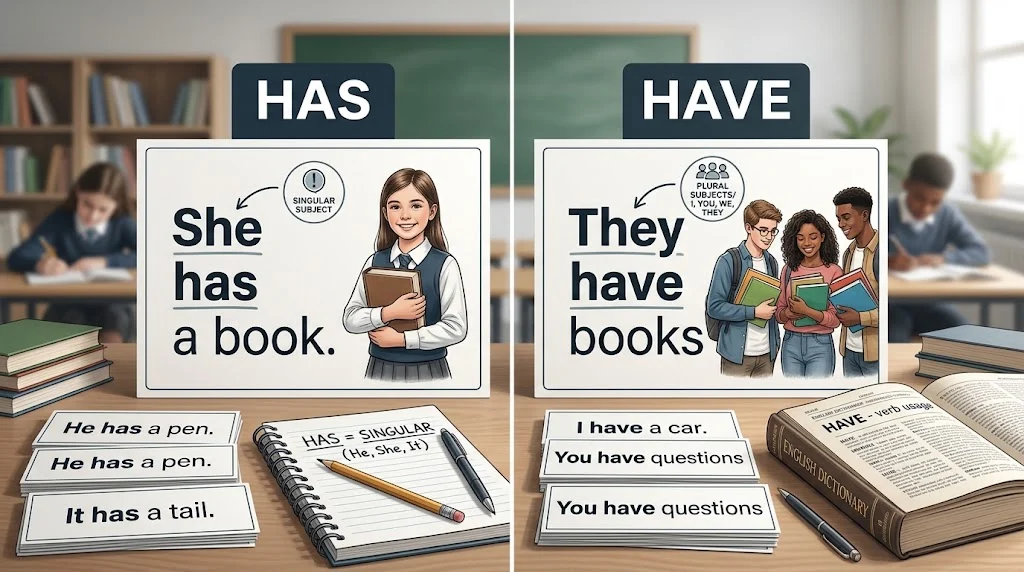
Has or have depends mainly on the subject of a sentence and whether that subject is singular or plural. Has is generally used with singular third person subjects such as he, she, and it, while have is used with I, you, we, they, and plural nouns.
Choosing between these two forms looks simple until a sentence contains a compound subject, an auxiliary verb, or an indefinite pronoun. In standard English, has normally agrees with a singular third person subject, while have agrees with I, you, we, they, and plural subjects. This small agreement rule matters in emails, academic writing, workplace communication, websites, and everyday conversation because an incorrect verb can make otherwise strong writing appear careless. Understanding subject verb agreement, rather than memorizing isolated examples, gives you a reliable way to make the right choice.
Has vs Have: What’s the Difference?
Has and have are forms of the verb to have. They can function as main verbs showing possession, relationships, experiences, conditions, or actions. They can also function as auxiliary verbs when forming perfect tenses.
The key difference is subject agreement.
| Form | Part of speech | Common subjects | Example | Main function |
| Has | Verb | He, she, it, singular nouns | She has a new laptop. | Possession or auxiliary use |
| Have | Verb | I, you, we, they, plural nouns | They have a new laptop. | Possession or auxiliary use |
The important point is that has and have are not interchangeable in every sentence.
Use has with a singular third person subject in the present tense.
Use have with I, you, we, they, and plural subjects.
Both forms can also help create the present perfect tense.
Mini Recap
A singular third person subject normally takes has.
I, you, we, and they normally take have.
Plural nouns normally take have.
Auxiliary verbs can change which form is required.
The subject, not the nearest noun, determines the correct verb.
Is Has vs Have a Grammar, Vocabulary, or Usage Issue?
This is primarily a grammar and subject verb agreement issue rather than a vocabulary issue.
The two words belong to the same verb family, but they have different grammatical forms. Their meanings are closely related, and in many situations they express the same basic idea. The difference comes from the subject and grammatical construction.
For example:
She has a new phone.
But:
They have a new phone.
The meaning of possession is similar. The subject changes, so the verb changes.
In formal writing, correct agreement is important. Academic papers, business reports, applications, professional emails, and published articles generally require standard subject verb agreement.
In casual conversation, speakers may occasionally produce nonstandard forms, particularly in regional dialects or rapid speech. That doesn’t make those forms appropriate for formal writing.
Are Has and Have Interchangeable?
Not normally.
You cannot freely replace one with the other when the subject remains unchanged.
He has a meeting today.
is standard.
He have a meeting today.
is not standard English.
Likewise:
They have a meeting today.
is correct.
They has a meeting today.
is incorrect in standard English.
How to Use Has Correctly
Use has with third person singular subjects in the simple present tense.
Common subjects include:
He has
She has
It has
The company has
My brother has
The computer has
For example:
Maria has an important presentation tomorrow.
The subject Maria is singular and third person, so has is appropriate.
Workplace Example
The marketing department has a new strategy for the upcoming campaign.
The subject is department, which is singular. Even though a department contains many people, the grammatical subject is singular.
Academic Example
The research has several important limitations.
The subject research is treated as singular, so has is required.
Technology Example
This application has a built in reporting feature.
The subject application is singular, so has is correct.
Usage Recap
Use has with singular third person subjects.
Don’t choose the verb merely because another noun appears nearby.
Words such as company, system, application, research, and student are singular when they function as singular subjects.
How to Use Have Correctly
Use have with I, you, we, they, and plural nouns.
Examples include:
I have enough information.
You have several options.
We have a meeting at noon.
They have two children.
The students have completed the assignment.
Notice that you takes have, whether it refers to one person or several people.
Workplace Example
We have several projects that need immediate attention.
The subject we always takes have in the present tense.
Academic Example
The researchers have identified three major patterns.
The subject researchers is plural, so have is correct.
Technology Example
Modern smartphones have powerful processors.
The subject smartphones is plural, which requires have.
Usage Recap
Use have with I, you, we, and they.
Use have with plural nouns.
Don’t let a singular noun inside a longer phrase trick you into using has.
Has or Have With Compound Subjects
Compound subjects can cause confusion because the sentence may contain several nouns.
When two subjects are joined by and, the resulting subject is generally plural.
Sarah and David have a new project.
Not:
Sarah and David has a new project.
The two people together form a plural subject.
However, when subjects are connected by or or nor, the agreement can depend on the construction and the subject closest to the verb.
Either the manager or the employees have the information.
Either the employees or the manager has the information.
This is why simply looking at the first noun isn’t always enough.
Has or Have After Auxiliary Verbs
One of the most important rules involves auxiliary verbs.
After does, use the base form have, not has.
Correct:
Does she have a car?
Incorrect:
Does she has a car?
The reason is that does already carries the present tense and third person singular marking. The following verb stays in its base form.
The same principle applies to did.
Did he have enough time?
Not:
Did he has enough time?
After modal verbs such as will, can, could, should, and might, use have.
She will have enough time.
He might have the answer.
The company should have better records.
This is one of the most useful rules for preventing mistakes.
When You Should NOT Use Has or Have
Several common situations cause writers to choose the wrong form.
1. Don’t Use Has With I
Incorrect:
I has a question.
Correct:
I have a question.
2. Don’t Use Has With You
Incorrect:
You has a good opportunity.
Correct:
You have a good opportunity.
3. Don’t Use Have With He
Incorrect:
He have a new position.
Correct:
He has a new position.
4. Don’t Use Has After Does
Incorrect:
Does she have experience?
Correct:
Does she have experience?
5. Don’t Use Has After Did
Incorrect:
Did he have enough money?
Correct:
Did he have enough money?
6. Don’t Use Has After a Modal Verb
Incorrect:
She will have another opportunity.
Correct:
She will have another opportunity.
7. Don’t Judge Agreement by the Closest Noun
Incorrect:
The list of available options have changed.
Correct:
The list of available options has changed.
The subject is a list, not options.
Common Mistakes and Decision Rules
| Correct sentence | Incorrect sentence | Explanation |
| She has a new job. | She have a new job. | She is singular third person. |
| They have a new job. | They has a new job. | They takes have. |
| I have an idea. | I has an idea. | I takes have. |
| The company has a policy. | The company have a policy. | Company is singular. |
| The companies have policies. | The companies has policies. | Companies is plural. |
| Does he have experience? | Does he has experience? | Does is followed by the base form. |
| She will have time. | She will has time. | Modal and auxiliary constructions use have. |
| The list has several items. | The list have several items. | List is the singular subject. |
Decision Rule Box
If the subject is he, she, it, or another singular third person noun, use has in the simple present.
If the subject is I, you, we, they, or a plural noun, use have.
After does, did, will, can, could, should, would, may, or might, use have.
Has and Have in the Present Perfect Tense
Both forms are essential when forming the present perfect.
Use has with singular third person subjects:
She has finished the report.
The company has announced the results.
Use have with I, you, we, they, and plural subjects:
I have finished the report.
They have announced the results.
The structure is:
Subject + has or have + past participle
Examples include:
He has completed the task.
We have completed the task.
The students have submitted their papers.
This distinction becomes particularly important in professional and academic writing because present perfect constructions appear frequently in reports, research discussions, and progress updates.
Has and Have With Collective Nouns
Collective nouns can create additional difficulty because their treatment varies between varieties of English.
In American English, collective nouns such as team, company, and government are commonly treated as singular when the group is viewed as one unit.
The team has a new coach.
British English can sometimes use a plural construction when the members of the group are being emphasized.
The team have agreed among themselves.
For international professional writing, consistency and awareness of the intended variety of English are important.
Has and Have in Modern Technology and AI Tools
Grammar checking software and AI writing assistants frequently identify subject verb agreement errors automatically. However, automated suggestions aren’t always sufficient for complicated sentences.
Consider:
The collection of documents has been updated.
A basic system might focus on documents and incorrectly flag the construction if its analysis is weak. More advanced language technology considers the grammatical subject, which is collection.
AI tools can also help writers identify patterns in repeated mistakes. For example, someone who regularly writes they may benefit from reviewing subject verb agreement rather than correcting individual sentences one at a time.
The best approach is to use technology as an editing aid while understanding the underlying grammar rule yourself.
The Etymology of Has and Have
Both forms come from the Old English verb habban, meaning to have, hold, or possess. Over centuries, English developed different present tense forms according to grammatical person and number.
The modern distinction between has and have reflects this historical development. English once had a much richer system of verb endings, but most of those endings disappeared over time. The distinction between has and have survived as one of the important irregular patterns in modern English.
Expert Style Insight
A useful principle for understanding these forms is this:
“The verb agrees with the grammatical subject, not simply with the noun closest to it.”
That principle explains a surprisingly large number of subject verb agreement mistakes.
Two Practical Case Studies
Case Study One: Workplace Communication
Consider a project manager writing:
The group of developers has completed the update.
A common mistake is to write have because developers is plural. However, the grammatical subject is group, which is singular.
Result: Identifying the head noun prevents an agreement error and produces a more professional sentence.
Case Study Two: Academic Writing
Consider this sentence:
The results of the experiment have revealed an unexpected pattern.
Here, results is the grammatical subject and is plural. Therefore, have is correct.
If the sentence were:
The analysis of the results has revealed an unexpected pattern.
The subject becomes analysis, which is singular.
Result: Looking at the main subject rather than the nearest noun makes the correct choice immediately clear.
Error Prevention Checklist
Always use has when
The subject is he.
The subject is she.
Subject is it.
The subject is a singular noun.
The sentence is in the simple present and has no auxiliary that changes the construction.
Never use have when
A singular third person subject requires the simple present form has.
You are writing in standard English.
You are writing it without an appropriate auxiliary construction.
Always use have when
The subject is I.
The subject is you.
Subject is we.
The subject is they.
The subject is plural.
The verb follows does, did, or a modal auxiliary.
Related Grammar Confusions You Should Master
If you want stronger control over English grammar, these related topics are worth studying:
- Has versus had
- Have versus had
- Do versus does
- Is versus are
- Was versus were
- Has been versus have been
- There is versus there are
- Each is versus each are
- Subject verb agreement
- Singular versus plural nouns
These topics are closely connected because they all involve understanding the relationship between grammatical subjects and verb forms.
FAQs
When should I use has instead of have?
Use has with he, she, it, and singular third person nouns in the simple present tense. For example, “The company has a new policy.”
When should I use have instead of has?
Use have with I, you, we, they, and plural nouns. For example, “The employees have new responsibilities.”
Is it correct to say he have?
Not in standard English when have is being used as the simple present main verb. The correct sentence is “He has a car.”
Is it correct to say she have?
Normally, no. Standard English requires “She has” in the simple present. However, have can appear after an auxiliary, as in “Does she have a car?”
Do you say does he has or does he have?
The correct form is “Does he have?” After does, the main verb returns to its base form, so have is required.
Do you say everyone has or everyone have?
Use “Everyone has.” Although everyone refers to multiple people conceptually, it is grammatically singular.
Do you say the team has or the team have?
Both constructions can occur depending on the variety of English and whether the team is viewed as one unit or as individual members. American English generally favors “the team has,” while British English can use either depending on meaning and context.
Should I say I have or I has?
Always use “I have” in standard English. The first person singular subject I takes have.
Conclusion
The choice between has or have becomes straightforward once you identify the grammatical subject. Use has with he, she, it, and singular third person nouns in the simple present. Use have with I, you, we, they, and plural nouns. After auxiliary verbs such as does, did, and modal verbs, use the base form have. When you’re unsure, find the true subject first, then check whether the sentence contains an auxiliary verb. This simple habit eliminates many common subject verb agreement mistakes.

Margaret Atwood is an American writer who contributes to LingRoya.com creating clear and engaging content about the English language and everyday communication. She enjoys helping readers build confidence in their writing through simple, practical guidance.