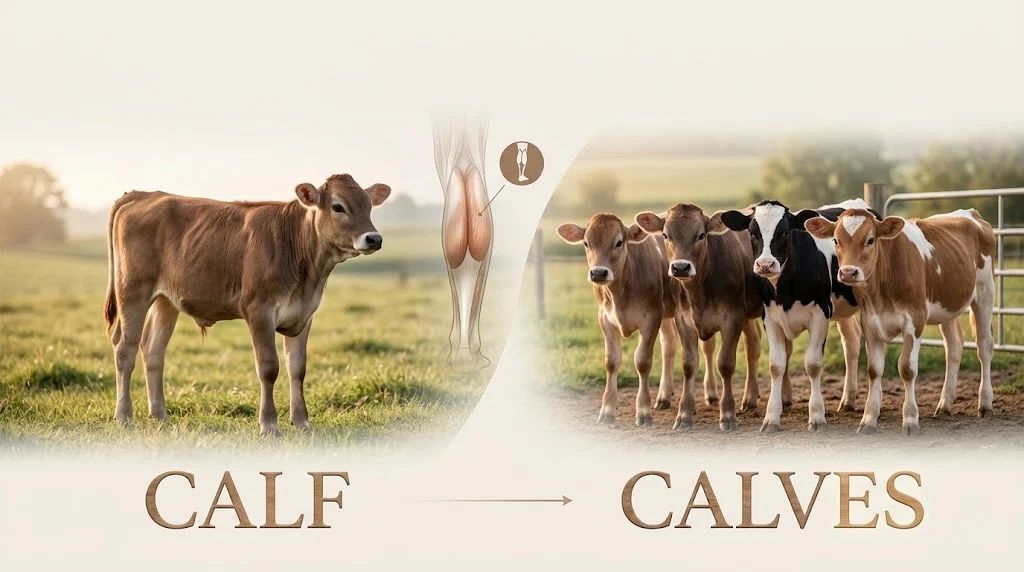
Calves is the correct standard plural of calf. The word calf can refer to a young cow or another young animal, or to the muscular part at the back of the lower leg. When talking about more than one calf, use calves. Calfs is generally considered an incorrect plural spelling in standard modern English.
The question of calfs or calves usually comes from an understandable spelling assumption. Many English nouns form their plurals simply by adding s, so learners may naturally expect calf to become calfs. English, however, contains several older plural patterns that change the spelling of the original word.
This spelling can cause real mistakes in school assignments, fitness articles, veterinary writing, workplace documents, and everyday communication. The good news is that the rule is straightforward once you recognize the pattern.
Calfs vs Calves: What’s the Difference?
Calf is a singular countable noun. It refers to one young animal or one lower leg muscle.
Calves is the plural form of calf. It refers to two or more young animals or two or more lower leg muscles.
Calfs is not the standard plural spelling of calf in modern English.
| Word | Part of speech | Number | Meaning | Example |
| Calf | Noun | Singular | One young animal or one lower leg muscle | The calf is sleeping. |
| Calves | Noun | Plural | More than one young animal or lower leg muscle | The calves are sleeping. |
| Calfs | Noun | Incorrect standard plural | Nonstandard spelling of the plural | The calfs are sleeping. |
Mini Recap
Calf means one.
Calves means more than one.
Calfs is not the standard plural form.
The spelling changes from f to ves.
Is Calfs or Calves a Grammar, Vocabulary, or Usage Issue?
The confusion is primarily a grammar and spelling issue involving the formation of an irregular plural noun.
The words are not interchangeable. Calf is singular, while calves is plural. Calfs should generally not be used in standard written English.
This is not a matter of formal versus informal usage. In academic, professional, medical, fitness, veterinary, and casual writing, calves is the accepted plural.
For example:
“The athlete strengthened his calves.”
“The farmer moved the calves into another enclosure.”
“The veterinarian examined several calves.”
In all three sentences, calves is correct because the writer is referring to more than one calf.
English has many nouns that do not form their plurals simply by adding s. Understanding these patterns is particularly important for English learners because the plural form cannot always be predicted from the singular spelling.
How to Use Calf Correctly
Calf is the singular form.
When discussing animals, it can refer to a young animal, especially a young cow, although the term is also used for young animals such as elephants, whales, and other mammals.
For example:
“The farmer found a newborn calf.”
“The elephant stayed close to her calf.”
“The whale was swimming beside its calf.”
Calf also has an anatomical meaning. It refers to the muscular area at the back of the lower leg.
For example:
“My left calf hurts after the workout.”
“The runner stretched his calf before the race.”
Workplace Example
“The veterinarian examined the calf before recommending treatment.”
Here, calf refers to one young animal.
Academic Example
“The study examined the development of the calf during its first year.”
The noun is singular because the study refers to one animal.
Technology Example
In sports technology, a fitness application might display information about calf activity during running or walking. The word calf remains singular when discussing the muscle as a general body area.
Usage Recap
Use calf when referring to one young animal or one lower leg muscle.
If the sentence contains one subject or refers to a single animal or leg muscle, calf is usually the correct form.
How to Use Calves Correctly
Calves is the standard plural of calf.
Use it when referring to more than one young animal:
“The calves were feeding in the field.”
You can also use calves when discussing both lower legs:
“Her calves were sore after the hike.”
The meaning is determined by context. A sentence about exercise probably refers to leg muscles, while a sentence about farming may refer to young cattle.
Workplace Example
“The farm workers vaccinated the calves before winter.”
The plural noun refers to multiple young animals.
Academic Example
“The researchers measured the calves at regular intervals.”
The context determines whether calves refers to young animals or anatomical structures.
Technology Example
“A fitness tracker can monitor movement patterns involving the calves during exercise.”
Here, calves refers to the muscles in the lower legs.
Usage Recap
Use calves whenever you mean more than one calf.
The same plural spelling applies to both major meanings of calf.
When You Should NOT Use Calfs or Calves
Knowing when not to use each form can prevent common errors.
- Do not use calfs as the standard plural of calf.
- Do not use calves when referring to only one calf.
- Do not write “one calves.” The singular form is calf.
- Do not assume every noun ending in f forms its plural by simply adding s.
- Do not use “calfs” in formal academic or professional writing when you mean multiple calves.
- Do not confuse the animal meaning of calf with the anatomical meaning of calf.
- Do not assume that pronunciation determines the spelling of the plural.
- Do not change calves back to calf when the sentence clearly refers to multiple animals or muscles.
Common Mistakes With Calf and Calves
| Correct sentence | Incorrect sentence | Explanation |
| The calf is young. | The calves is young. | One animal requires the singular noun. |
| The calves are young. | The calfs are young. | Calves is the correct plural spelling. |
| My calf is sore. | My calves is sore. | One leg muscle is singular. |
| My calves are sore. | My calfs are sore. | Two or more leg muscles require calves. |
| The farmer raised several calves. | The farmer raised several calfs. | Calves is the standard plural. |
| The calf needs attention. | The calves needs attention. | Singular calf takes a singular verb. |
Decision Rule
If you mean one young animal or one lower leg muscle, use calf. If you mean two or more, use calves. Never use calfs as the standard plural form.
A useful memory trick is to connect calf with calves, just as you connect leaf with leaves.
Calves in Modern Technology and AI Tools
Modern technology frequently uses the word calves in fitness applications, sports science platforms, medical software, and educational resources.
Fitness applications may discuss calf raises, calf strength, muscle activation, and recovery. Wearable devices can collect movement and exercise information that researchers or coaches use to evaluate lower leg performance.
AI writing tools can also identify obvious spelling errors such as calfs, but automated tools should not replace basic grammatical knowledge. Understanding why calves is correct helps writers make better decisions when proofreading and editing.
This distinction is particularly important for health, fitness, veterinary, and educational content, where incorrect terminology can reduce credibility.
Etymology of Calf and Calves
The word calf has very old Germanic roots and can be traced through Old English forms. Its plural development reflects historical changes in English rather than a simple modern spelling rule.
The change from f to v is not unique to calf. English has several words in which a final f or fe changes to ves in the plural, although the pattern is not completely predictable.
Examples include:
“leaf” becomes “leaves”
“knife” becomes “knives”
“wife” becomes “wives”
“wolf” becomes “wolves”
“life” becomes “lives”
Because English has exceptions, learners should treat these words as familiar plural forms rather than assuming that every word ending in f follows exactly the same pattern.
An Expert Perspective
“The safest way to learn irregular plurals is to remember the complete singular and plural pair rather than applying a spelling rule mechanically.”
This approach is especially useful with words such as calf, leaf, knife, and wolf, where standard plural spelling involves a change in the final consonant.
Two Practical Case Studies
Case Study 1: Fitness Writing
Imagine a fitness article stating:
“Calfs can become sore after intense running.”
The spelling immediately reduces the article’s credibility because calfs is not the standard plural.
The corrected sentence is:
“Calves can become sore after intense running.”
The result is a more accurate and professional sentence suitable for fitness education.
Case Study 2: Veterinary Writing
Consider a farm report that says:
“The farmer inspected twelve calfs.”
The correct version is:
“The farmer inspected twelve calves.”
The correction matters because the report concerns multiple young animals. Using the accepted plural makes the document clearer and grammatically correct.
Error Prevention Checklist
Always use calf when:
You mean one young animal.
You mean one lower leg muscle.
The noun follows “a” or “one.”
The sentence clearly describes a single subject.
Always use calves when:
You mean multiple young animals.
You mean both lower leg muscles.
The noun follows numbers greater than one.
The noun follows words such as several, many, or numerous.
Never use calfs when:
You are writing standard English.
Referring to multiple calves.
You are preparing academic work.
You are writing professional, medical, fitness, or veterinary content.
Related Grammar Confusions You Should Master
Learning calf and calves can lead naturally to other frequently confused plural forms.
- Leaf or leaves
- Knife or knives
- Wolf or wolves
- Life or lives
- Wife or wives
- Half or halves
- Loaf or loaves
- Shelf or shelves
- Self or selves
- Thief or thieves
These examples show why English plural formation requires attention to established usage rather than relying exclusively on a single spelling rule.
FAQs
Is calfs or calves correct?
Calves is correct. Calfs is not the standard plural spelling of calf.
What is the plural of calf?
The standard plural of calf is calves.
Why is the plural of calf calves instead of calfs?
Calf follows a historical English spelling pattern in which the final f changes to v before the plural ending. The result is calves.
Is calfs ever correct in English?
Calfs is generally not accepted as the standard plural of calf in modern English. In normal academic, professional, and everyday writing, use calves.
What is the difference between calf and calves?
Calf is singular and refers to one young animal or one lower leg muscle. Calves is plural and refers to two or more.
Is it calf muscles or calves muscles?
The usual phrase is calf muscles when referring generally to the muscles of the lower leg. You can also say calves when using the plural noun by itself, as in “My calves are sore.”
Is calves only used for cows?
No. Calf can refer to the young of several large mammals, including cows, elephants, and whales. The plural is calves.
How do you pronounce calves?
Calves is generally pronounced with a sound similar to “cavz,” although pronunciation can vary somewhat by accent.
What are other words like calf and calves?
Similar plural patterns include leaf and leaves, knife and knives, wolf and wolves, wife and wives, and life and lives.
How do I remember calves is correct?
Remember the pattern calf, calves, similar to leaf, leaves. The plural changes the final f sound to a v sound before the plural ending.
Conclusion
The correct answer to the calfs or calves question is simple: calves is the standard plural of calf. Use calf when referring to one young animal or one lower leg muscle, and use calves when referring to more than one.
The spelling may initially seem unusual because many English nouns form plurals by adding s. However, calves belongs to a group of words with historical plural patterns that change f to v. Once you remember the pair calf and calves, the correct spelling becomes much easier to use.

Philip Pullman is an American writer dedicated to creating clear and easy to follow English content. Through his work at LingRoya.com, he helps readers strengthen their language skills with practical and reliable guidance so that they can easily understand.