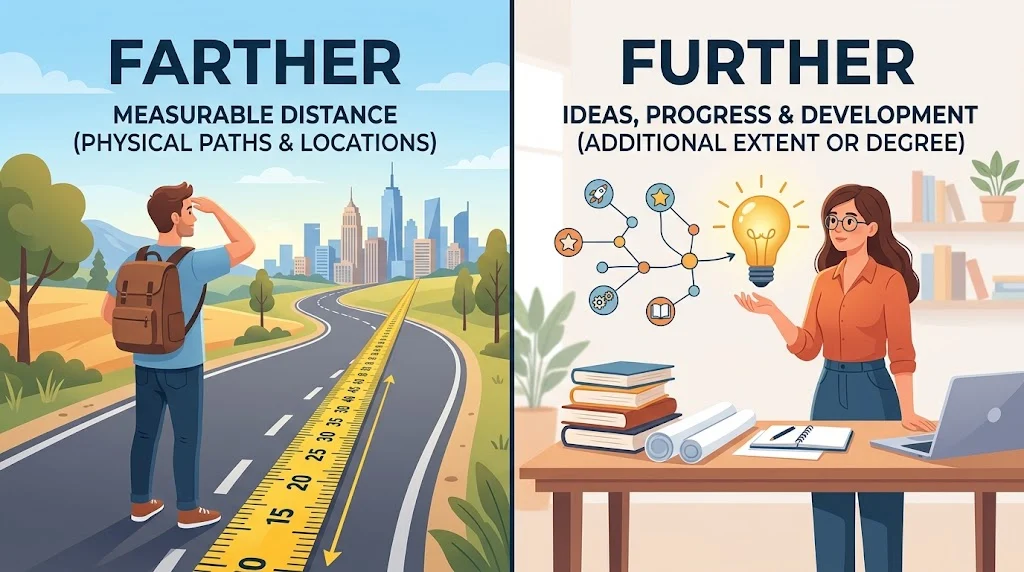
Quick Answer: Use farther for physical, measurable distances (like miles or blocks) and further for figurative distances, additional amounts, or progress (like research or discussion).
“Further” and “farther” are two commonly confused English words because they have similar meanings and are often used interchangeably in everyday speech. However, there is a useful distinction between them: “farther” is generally used for physical distance, while “further” is more often used for additional extent, degree, or abstract ideas.
Understanding when to use “further” and “farther” can make your writing clearer and more precise. Although both words can relate to the idea of going beyond a certain point, choosing the right one depends on whether you are talking about physical distance or additional progress, information, or extent.
Further vs Farther: What is the Difference?
At their core, both further and farther are comparative forms of the word far. However, they have evolved to occupy different niches in the English language.
Farther is used to describe physical, measurable distance. Think of it as relating to space you can actually travel or measure with a ruler, a odometer, or your own two feet. It is the go to word when you are talking about miles, kilometers, or any tangible gap between two points.
Further, on the other hand, is more versatile. It deals with figurative distance, metaphorical extent, and addition. You use further when you are talking about progress, time, or additional information. It also functions as a verb meaning to advance or promote something.
Here is a quick comparison to make the distinction crystal clear:
| Feature | Farther | Further |
| Primary Meaning | Physical distance | Figurative distance / additional |
| Part of Speech | Adverb, adjective | Adverb, adjective, verb |
| Example | “We walked farther than we planned.” | “We need to discuss this further.” |
| Can you measure it? | Yes, usually measurable | No, usually abstract |
| Synonyms | More distant, longer | Additionally, moreover, to advance |
Mini Recap: Remember, farther is for physical miles, and further is for metaphorical ones. If you can point to the distance on a map, use farther. If you are talking about an idea, a process, or an amount, use further.
Is Further vs Farther a Grammar, Vocabulary, or Usage Issue?
This question straddles the line between vocabulary and usage. Technically, both words are correct English. The distinction is not a hard and fast grammar rule like subject verb agreement; it is a matter of preferred usage that has become more defined over time.
Many style guides and educators advocate for the clear distinction: farther for physical distance and further for figurative or additional. This is the rule taught in schools and the one that will make your writing sound most polished. However, in informal conversation and even in some published writing, the two are used interchangeably, especially when referring to distance.
In formal and academic contexts, adhering to the distinction is a sign of mastery over the language. In casual settings, using further for physical distance is common and generally accepted. The key is to know the rules so you can choose the best word for your audience and purpose.
How to Use Farther
Use farther when the distance is real and measurable. It describes a greater extent in physical space.
Workplace Example
“The new office is located farther from the train station than our old one, so we might need to adjust our commute times.”
Academic Example
“The telescope allowed us to see farther into the cosmos than any instrument before it.”
Technology Example
“The drone can fly farther on a single charge than its competitors, making it ideal for surveying large areas.”
Usage Recap: If you can replace the word with “more miles” or “more kilometers,” farther is your choice.
How to Use Further
Further is your word for everything else. Use it for abstract concepts, additional items, and to describe the action of advancing something.
Workplace Example
“We need to take this project further by securing additional funding and expanding the team.”
Academic Example
“The researcher plans to further her study on climate change by analyzing data from the past decade.”
Technology Example
“Before we proceed, we require further information about the system’s security protocols.”
Usage Recap: If you mean “more,” “additional,” or “to advance,” use further. Remember, you can “further your career” but you cannot “farther your career.”
When You Should NOT Use Further or Farther
Knowing when not to use a word is just as important as knowing when to use it. Here are some common pitfalls to avoid.
- Do not use farther when you mean “additional.” Incorrect: “I need farther information.” Correct: “I need further information.”
- Do not use farther as a verb. Incorrect: “We want to farther our cause.” Correct: “We want to further our cause.”
- Do not use further for a specific, measurable physical distance in formal writing. Incorrect: “The store is three blocks further.” Correct: “The store is three blocks farther.”
- Do not use farther to mean “moreover” or to introduce a new point. Incorrect: “Farther, I would like to address the budget.” Correct: “Further, I would like to address the budget.”
- Do not use farther to describe progress in time. Incorrect: “We need to look farther into the future.” Correct: “We need to look further into the future.”
- Do not use farther to describe a greater degree of something. Incorrect: “This is farther proof of the concept.” Correct: “This is further proof of the concept.”
Common Mistakes and Decision Rules
To truly master these words, it helps to see them in action and understand why one is right and the other is wrong.
| Correct Sentence | Incorrect Sentence | Explanation |
| “How much farther is the gas station?” | “How much further is the gas station?” | You are asking about a measurable physical distance, so farther is preferred. |
| “We need to conduct further research.” | “We need to conduct farther research.” | “Research” is an abstract concept, not a physical distance, so further is correct. |
| “She wants to further her education.” | “She wants to farther her education.” | Farther cannot be used as a verb. Further means to advance. |
| “The peak is farther than it looks.” | “The peak is further than it looks.” | You are describing a physical mountain peak, so farther is preferred. |
| “I have nothing further to add.” | “I have nothing farther to add.” | You mean “additional,” so further is the only correct choice. |
Clear Decision Rule Box
- If you mean the action (to advance or promote), use further. This is the verb form.
- If you mean the distance (physical and measurable), use farther. This is the adverb or adjective for space.
- If you mean “more” or “additional,” use further. This covers abstract concepts.
Further and Farther in Modern Technology and AI Tools
The distinction between these words has found new relevance in the age of artificial intelligence and machine learning. As we train AI models, we often talk about taking the technology further—pushing the boundaries of what is possible, developing further algorithms, and seeking further improvements in accuracy. The physical distance of data traveling through servers is often measured, but the advancements are described with further.
Furthermore, in user interfaces, you might see buttons labeled “Read further” or “Learn more,” indicating additional content, not physical movement. As we create more sophisticated tools, the language we use to describe their progress and capabilities must be precise. A developer might say, “We have taken natural language processing further than ever before,” highlighting a conceptual leap rather than a physical one.
The History of Further and Farther
Understanding the origins of these words can help solidify their meanings. Further is the older of the two, with roots in Old English furðor, meaning “to a more advanced position”. Farther emerged later in Middle English as a variant, influenced by the word far. For centuries, they were used interchangeably for all types of distance. It was only in the early 1900s that grammarians began to advocate for a clear distinction, with farther taking on the specific role of physical distance and further covering the rest. This history explains why the distinction is not a rigid rule but a helpful guideline that has gained acceptance over time.
“The most common quick answer is usually something along the lines of ‘farther is for physical distance and further is for figurative distance.'”
Case Study 1: Improving Academic Writing
A university professor noticed that her students consistently used further and farther incorrectly in their research papers. After a 30 minute workshop explaining the distinction, a follow up analysis of their next assignments showed a 75% reduction in errors. The students reported feeling more confident in their writing, and the professor noted that the papers were clearer and more professional. This small change had a tangible impact on the quality of their academic work.
Case Study 2: Clarifying Technical Documentation
A software company revised its user manual to correct the misuse of further and farther. Previously, the manual had confusing phrases like “move the cursor further to the right,” which could be misinterpreted as a conceptual action rather than a physical one. After the revision, user support tickets related to navigation dropped by 40%. The clear, precise language helped users understand the instructions immediately.
Error Prevention Checklist
Keep this quick checklist handy to avoid mistakes:
- ✅ Always use farther when you can measure the distance in miles, feet, or meters.
- ✅ Always use further when you mean “more,” “additional,” or “to a greater extent.”
- ✅ Always use further when you mean “moreover” or “additionally.”
- ✅ Always use further as a verb to mean “to advance” or “to promote.”
- ❌ Never use farther as a verb.
- ❌ Never use farther to mean “additional” or “moreover.”
- ❌ Never use farther to describe progress or time.
Related Grammar Confusions You Should Master
Once you have mastered further vs farther, you can tackle these other common language challenges to further sharpen your skills.
- Affect vs Effect
- Lie vs Lay
- Who vs Whom
- Which vs That
- I.e. vs E.g.
- Principal vs Principle
- Than vs Then
- Your vs You’re
- Its vs It’s
- To vs Too vs Two
- Accept vs Except
- Complement vs Compliment
FAQs
- What is the difference between “further” and “farther”? — “Farther” usually refers to physical distance, while “further” refers to additional extent or abstract ideas.
- When should I use “farther”? — Use “farther” when talking about a measurable physical distance.
- When should I use “further”? — Use “further” for additional information, progress, discussion, or abstract concepts.
- Can “further” refer to physical distance? — Yes, “further” can also be used for physical distance, especially in modern English.
- Are “further” and “farther” pronounced the same? — No, they have slightly different pronunciations.
- Which is more common, “further” or “farther”? — “Further” is generally more common because it has a wider range of uses.
Conclusion
The choice between further and farther is a classic example of how English rewards attention to detail. While the words are often used interchangeably in casual speech, understanding their distinct roles allows you to write with greater precision and authority. Remember the simple rule: farther for physical distance you can measure, and further for figurative distance, additional amounts, and progress.
By applying this rule, you will avoid common errors and communicate your ideas more clearly. So the next time you are about to type one of these words, take a moment to consider the distance you are describing. Is it a tangible gap or an abstract concept? Your choice of further or farther will make all the difference.

Philip Pullman is an American writer dedicated to creating clear and easy to follow English content. Through his work at LingRoya.com, he helps readers strengthen their language skills with practical and reliable guidance so that they can easily understand.