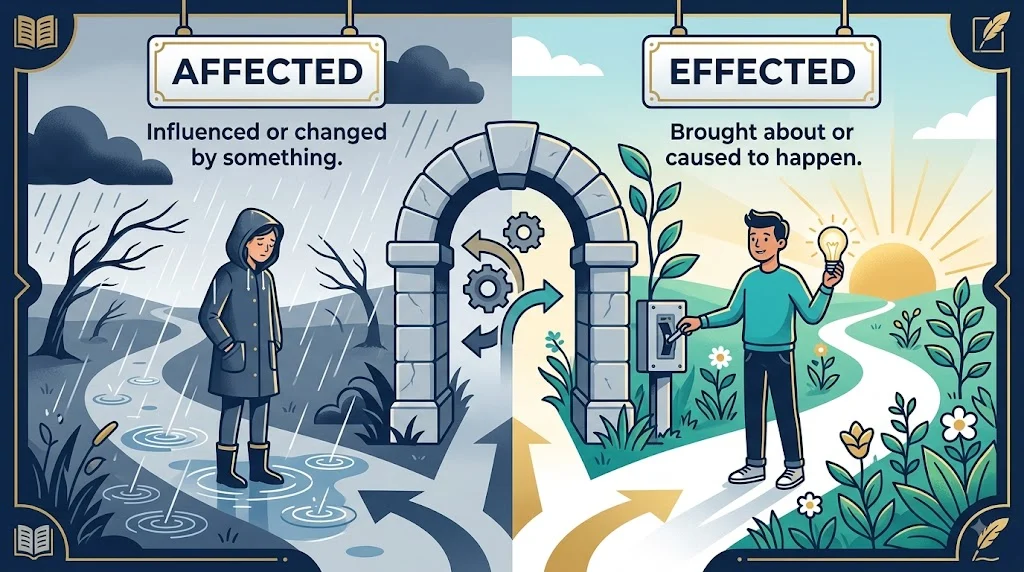
Affected means influenced or changed by something, while effected means brought about or made to happen.
Affected vs. Effected are two commonly confused English words that sound similar but have different meanings. Affected is usually used as a verb to mean “influenced or impacted,” while effected means “caused or brought about.” Understanding this simple difference can help you use both words correctly in writing and everyday communication.
Although affected is much more common, effected is also correct in certain situations. For example, “The weather affected my mood” means the weather influenced my mood, while “The new policy effected major changes” means the policy brought about major changes. Knowing the context makes it easier to choose the right word.
Affected vs Effected: What’s the Difference?
Affected is the past tense of the verb affect, which means to influence, impact, or produce a change in something that already exists. When you affect something, you’re acting upon it, but the thing itself was already there.
Effected is the past tense of the verb effect, which means to bring about, cause, or make something happen. When you effect something, you’re creating or initiating it. The thing you effect didn’t exist before you brought it into being.
Here’s a quick comparison to make the distinction crystal clear:
| Aspect | Affected | Effected |
| Base Verb | Affect | Effect |
| Core Meaning | To influence or impact | To bring about or cause |
| Part of Speech | Verb (past tense); also adjective | Verb (past tense) |
| Action Type | Acting upon something existing | Creating or initiating something new |
| Example | The storm affected the crops. | The new policy effected real change. |
| Test | Can you replace it with “influenced”? | Can you replace it with “brought about”? |
Is Affected vs Effected a Grammar, Vocabulary, or Usage Issue?
This is a usage issue more than a strict grammar rule, though it sits at the intersection of grammar and vocabulary. The words themselves are grammatically correct in their respective forms. The problem isn’t that one is “wrong” and the other “right” in an absolute sense. The problem is choosing the wrong one for your intended meaning.
The confusion arises because affect and effect are related in meaning but serve different grammatical roles. Most of the time, affect is a verb and effect is a noun. But when you move into past tense territory, both become verbs: affected and effected. That’s where things get sticky.
Formal versus informal usage: In formal writing, the distinction matters greatly. Academic papers, business reports, and professional correspondence demand precision. Using “effected” when you mean “affected” in a formal context can make you look careless or poorly educated. In informal writing, the stakes are lower, but the distinction still exists. Your friends might not correct you, but they’ll notice something feels off.
Academic versus casual usage: In academic writing, effected appears more frequently in discussions of policy, reform, and institutional change. Scholars talk about “effected transformations” and “effected improvements.” Casual conversation rarely requires effected at all. Most people go their entire lives using only affected and never miss effected. But when you need it, you really need it.
The bottom line? This is a usage distinction that matters most in professional, academic, and formal contexts. Mastering it signals that you pay attention to detail and care about precision in your writing.
When to Use Affected
Affected describes something that has been influenced, changed, or impacted by an external force. The key is that the thing being affected already existed before the influence occurred.
Think of it this way: if you’re describing a reaction or a response to something, you want affected. The subject is receiving an impact, not creating one.
Workplace Example
“The quarterly budget cuts affected every department in the company.”
Here, the departments already existed. The budget cuts influenced them. They didn’t come into being because of the cuts; they were simply impacted by them.
“Employee morale was affected by the announcement of layoffs.”
Morale existed before the announcement. The announcement changed it.
Academic Example
“The study’s results were significantly affected by the small sample size.”
The results existed as data points. The sample size influenced what those results showed.
“Student performance was affected by the transition to online learning.”
Performance was already being measured. The transition changed it.
Technology Example
“The software update affected the system’s processing speed.”
The system existed. The update influenced how fast it ran.
“User behavior was affected by the new interface design.”
Users were already interacting with the platform. The design change influenced their actions.
Quick Recap for Affected
Use affected when:
- Something existing is influenced or changed
- You mean “impacted” or “altered”
- You’re describing a reaction or response
- The subject receives an action
When to Use Effected
Effected describes something that has been brought about, caused, or made to happen. The key is that the thing being effected didn’t exist before the action occurred. You’re describing creation or initiation, not mere influence.
Think of it this way: if you’re describing a result that was deliberately achieved or a change that was actively caused, you want effected. The subject is producing an outcome, not just reacting to one.
Workplace Example
“The new CEO effected a complete overhaul of the company culture.”
The overhaul didn’t exist before. The CEO brought it into being. This wasn’t just an influence; it was a deliberate creation.
“The task force effected meaningful changes to the hiring process.”
The changes were new. The task force made them happen.
Academic Example
“The researcher effected a breakthrough in quantum computing.”
The breakthrough was new. The researcher achieved something that hadn’t existed before.
“The policy effected a noticeable improvement in graduation rates.”
The improvement was a new outcome. The policy caused it to happen.
Technology Example
“The update effected a significant reduction in load times.”
The reduction was a new result. The update brought it about.
“The new algorithm effected a transformation in how data is processed.”
The transformation was a new state. The algorithm caused it.
Quick Recap for Effected
Use effected when:
- You mean “brought about” or “caused to happen”
- Something new is created or initiated
- You’re describing achievement or accomplishment
- The subject produces an outcome
When You Should NOT Use Affected or Effected
Even when you understand the difference, there are situations where neither word is the right choice. Here are common scenarios where writers reach for affected or effected but should use something else entirely.
1. When you mean “changed” but the change is neutral or positive. Affected often carries a negative connotation, implying harm or detriment. If you mean simply “changed” without any negative implication, consider using altered, modified, or transformed instead.
2. When you mean “result” or “consequence.” If you need a noun, you want effect, not affected or effected. “The effect of the policy” is correct. “The affected of the policy” is not.
3. When you mean “influenced” but the influence is indirect. Affected implies a direct impact. For indirect or subtle influence, influenced or shaped might be more appropriate.
4. When you mean “implemented” rather than “brought about.” Effected means to cause something to happen. If you mean to carry out or put into practice, implemented or executed is clearer.
5. When you mean “pretended” or “put on a false appearance.” The verb affect has a secondary meaning: to pretend or feign. But in this sense, you’d use affected as an adjective, not a past tense verb. “She spoke in an affected accent” means she put on a fake accent. This is a different usage entirely.
6. When you mean “emotionally moved.” If you’re describing an emotional response, affected can work, but moved or touched is often more precise and less ambiguous.
7. When you’re describing a person rather than a thing. “The affected individuals” means people who were impacted. But “the effected individuals” is almost always wrong because you don’t “bring about” people.
8. When you’re unsure which one to use. If you’re uncertain, rephrase the sentence. There’s almost always a simpler, clearer way to say what you mean without forcing a choice between these two tricky words.
Common Mistakes and Decision Rules
Knowing the rules is one thing. Applying them in real time is another. Here are common mistakes and a foolproof decision framework.
Common Mistakes
| Correct Sentence | Incorrect Sentence | Explanation |
| The weather affected our travel plans. | The weather effected our travel plans. | Weather influences existing plans; it doesn’t bring them into being. |
| The new law effected significant changes. | The new law affected significant changes. | The law created new changes; it didn’t just influence existing ones. |
| Her speech affected the audience deeply. | Her speech effected the audience deeply. | The speech influenced the audience; it didn’t create them. |
| The committee effected a new policy. | The committee affected a new policy. | The committee brought the policy into existence. |
| The drought affected crop production. | The drought effected crop production. | The drought influenced existing production; it didn’t create production itself. |
| The reform effected real improvement. | The reform affected real improvement. | The reform brought about improvement; it didn’t just influence it. |
The Decision Rule Box
If you mean the action of influencing something that already exists, use affected.
If you mean the action of bringing something new into being, use effected.
Quick test: Try replacing your word with “influenced.” If it makes sense, use is affected. Try replacing it with “brought about.” If that makes sense, use effected. If both seem wrong, you probably need a different word entirely.
Another helpful rule of thumb: Affected is about impact. Effected is about accomplishment.
Affected and Effected in Modern Technology and AI Tools
The rise of AI writing assistants has made the affected versus effected distinction more relevant than ever. Grammar checkers like Grammarly, ProWritingAid, and LanguageTool can flag incorrect usage and suggest corrections. But they’re not perfect.
AI tools excel at catching rule based errors, including the affect versus effect distinction. However, they sometimes miss contextual nuances. An AI might not recognize that you intentionally used effected in a formal context or that affected works better for emotional impact.
The real value of AI tools isn’t in blindly accepting their suggestions. It’s in using them as a second pair of eyes while you develop your own understanding. When an AI flags your usage, pause and ask yourself: “Does this match the decision rule?” If you understand why you made your choice, you can override the AI when it’s wrong.
There’s also a growing concern that overreliance on AI grammar tools may reduce writers’ confidence and independent editing skills. The best approach is to learn the rules yourself and use AI as a supplement, not a crutch.
Authority and Trust: Why This Distinction Matters
A Brief Etymology
Affect comes from the Latin afficere, meaning “to act upon” or “to do to”. It combines ad (to) and facere (to do). The core meaning has always been about acting on something.
Effect also comes from Latin, from effectus, meaning “accomplishment” or “performance.” It shares the same root facere but carries the sense of completion and result.
These origins reveal the fundamental difference: affect is about the action itself; effect is about the outcome.
Expert Insight
“Affect is usually a verb meaning ‘to produce an effect upon,’ as in ‘the weather affected his mood.’ Effect is usually a noun meaning ‘a change that results when something is done or happens.'”
This guidance from Merriam Webster captures the essence. When you understand that affect produces an effect, the distinction between affected and effected becomes much clearer.
Case Study 1: The Policy Reform
A government agency drafted a report on education reform. The original draft read: “The new standards affected significant improvements in student outcomes.” A sharp editor changed it to “effected significant improvements.” The difference was subtle but crucial. The standards didn’t just influence existing improvements; they brought about new ones. The correction elevated the report’s precision and authority.
Case Study 2: The Business Memo
A manager wrote to her team: “The restructuring effected our department’s workflow.” A colleague pointed out that the restructuring didn’t create the workflow; it changed an existing one. The correct version was “affected our department’s workflow.” The manager’s credibility improved because she demonstrated attention to detail.
Error Prevention Checklist
Before you hit send on that email or publish that article, run through this quick checklist:
Always use affected when:
- You mean influenced, changed, or impacted
- The thing being described already existed
- You can substitute “influenced” and the sentence still makes sense
- You’re describing a reaction or response to an external force
- The subject is receiving an action, not creating one
Never use effected when:
- You mean influenced or impacted
- The thing being described already exists
- You’re describing an emotional response
- You’re talking about people or things that weren’t created by the action
- You can substitute “influenced” and the sentence makes sense
When in doubt:
- Try “influenced” → if it fits, use affected
- Try “brought about” → if it fits, use effected
- If neither fits, choose a different word entirely
Related Grammar Confusions You Should Master
Once you’ve conquered affected versus effected, consider tackling these related challenges:
- Affect versus effect (the noun and verb distinction)
- Accept versus except
- Advice versus advise
- Complement versus compliment
- Principal versus principle
- Stationary versus stationery
- Your versus you’re
- Its versus it’s
- Then versus than
- Who versus whom
Each of these pairs causes similar confusion. Mastering them will dramatically improve your writing precision.
FAQs
1. What is the main difference between affected and effected?
Affected means influenced or impacted, while effected means caused or brought about.
2. When should I use affected?
Use affected when something is influenced, changed, or impacted by something else.
3. When should I use effected?
Use effected when something is caused, created, or brought into existence.
4. Can affected and effected be used interchangeably?
No, they have different meanings and should be used according to context.
5. Is affected always a verb?
No, affected can also be an adjective, depending on how it is used.
6. What is an easy way to remember the difference?
Think affected = influenced and effected = brought about
Conclusion
In conclusion, affected and effected have different meanings and should not be used interchangeably. Affected generally means influenced or impacted, while effected means caused or brought about. Understanding this simple difference can help you avoid common grammar mistakes and use both words correctly in your writing.

Philip Pullman is an American writer dedicated to creating clear and easy to follow English content. Through his work at LingRoya.com, he helps readers strengthen their language skills with practical and reliable guidance so that they can easily understand.