Quick Answer:
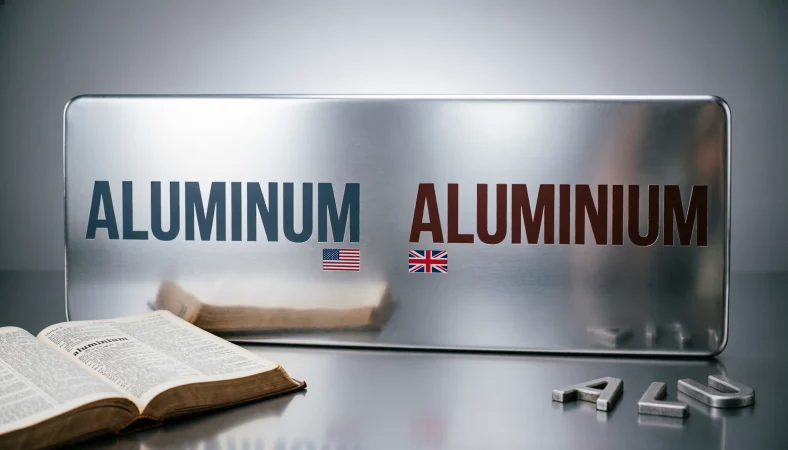
Both aluminum and aluminium are correct spellings of the same chemical element. Aluminum is the standard spelling in American English, while aluminium is preferred in British English and many other countries. The difference is only in spelling, not meaning.
Aluminum or aluminium is a common spelling difference that can confuse English learners and writers. Both words refer to the same chemical element, a lightweight metal widely used in products such as cans, foil, aircraft, cars, and construction materials. The main difference is regional spelling, not meaning or pronunciation.
In American English, aluminum is the standard spelling, while aluminium is preferred in British English and many other varieties of English. Understanding this difference can help you choose the correct spelling based on your audience, location, or writing style. In this guide, we’ll explain the difference between aluminum and aluminium, along with their meanings, usage, and examples.
Aluminum vs Aluminium: What’s the Difference?
The following table summarizes the key differences in a clear, schema friendly format.
| Feature | Aluminum | Aluminium |
| Primary Region | United States, Canada | United Kingdom, Australia, New Zealand, South Africa, and most other English speaking countries |
| Part of Speech | Noun | Noun |
| Periodic Table Symbol | Al | Al |
| Pronunciation | ə LOO mə nəm | al yə MIN ee əm |
| Official Adoption | American Chemical Society, 1925 | IUPAC (International Union of Pure and Applied Chemistry), 1990 |
Mini Recap
In short, aluminum and aluminium are two versions of the same word. The choice depends entirely on your audience. If you are writing for a North American audience, use aluminum. If your readers are in any other English speaking region, aluminium is the expected and correct form.
Is Aluminum vs Aluminium a Grammar, Vocabulary, or Usage Issue?
This question fits best into the category of a usage issue, with elements of vocabulary, rather than a strict grammar rule. Grammar governs the structure of sentences, and both words function identically as nouns. There is no grammatical rule that dictates which one you must use.
The distinction lies in usage and, to some extent, vocabulary preference within specific communities. Both spellings are correct, but their acceptance is heavily dependent on the context.
- Formal vs Informal Usage: The choice is less about the formality of the situation and more about the expected standard of your audience. In formal scientific writing in the US, you would use aluminum. In a formal scientific journal in the UK, you would use aluminium. Using the ‘wrong’ one in a formal context would be seen as a spelling error or a failure to follow the publication’s style guide.
- Academic vs Casual Usage: This is where the distinction can be most pronounced. In academic and scientific circles, consistency is key. An American chemistry professor will write aluminum oxide in a research paper, while their British counterpart will write aluminium oxide. In casual conversation or writing, a person in Toronto will ask for aluminum foil, whereas someone in Sydney will ask for aluminium foil .
Practical Usage: Aluminum (North American English)
If you are writing for an American or Canadian audience, aluminum is your go to term. It is the standard in publications, industry, and daily speech across the continent. The American Chemical Society’s decision in 1925 cemented its place in US scientific and industrial lexicons . This preference has permeated all levels of discourse, from technical manuals to everyday shopping lists.
Workplace Example
In a US based manufacturing plant, a safety manager might post a memo reading: “All aluminum shavings must be cleared from the workshop floor daily to prevent any potential hazards. The new recycling bins for aluminum scrap are located by the loading dock.”
Academic Example
An American university professor would write in a syllabus: “For our materials science lab, we will be testing the tensile strength of various aluminum alloys. Please ensure your lab report uses the standard American Chemical Society spelling of aluminum.”
Technology Example
A Silicon Valley tech company launching a new laptop with a metal body would market it as having an “ultra light aluminum unibody chassis” for durability and heat dissipation.
Usage Recap for Aluminum
Use aluminum when your primary audience is in the United States or Canada. This spelling dominates in North American industries, media, and educational institutions .
Practical Usage: Aluminium (International English)
Aluminium is the standard spelling in most of the English speaking world, including the United Kingdom, Australia, New Zealand, South Africa, and other commonwealth nations. It is also the international scientific standard, as adopted by IUPAC . This form is more common globally and is used in all contexts within these regions.
Workplace Example
On a construction site in London, the project manager might instruct: “All deliveries of aluminium framing need to be checked against the order sheet. Make sure the new aluminium cladding is stored under cover.”
Academic Example
A materials science student at the University of Melbourne would write in their thesis: “This experiment analyses the corrosion resistance of aluminium alloys in marine environments, following the IUPAC spelling convention.”
Technology Example
A European aerospace manufacturer like Airbus would use aluminium in its technical documentation: “A new high strength aluminium lithium alloy has been selected for the fuselage panels to reduce overall weight.”
Usage Recap for Aluminium
Use aluminium for audiences outside North America. It is the preferred form in British English and is the official international standard recognized by major scientific bodies .
When You Should NOT Use Aluminum or Aluminium
While both spellings are correct, using the wrong one for your audience is a common and potentially damaging error. Here are several scenarios where you should avoid using one or the other.
- When Writing for a UK Publication: Never use aluminum in a piece destined for a British newspaper, academic journal, or corporate website. It will be marked as a spelling error and can undermine your credibility as a writer.
- When Writing for a US Publication: Conversely, aluminium is considered the incorrect British spelling in the US. Using it in an American context, such as a report for a US federal agency, could make your work appear unprofessional or carelessly edited.
- When Applying for a Job Internationally: If you are submitting a CV or resume to a company in Australia, using aluminum might suggest you are unfamiliar with local language standards. It’s a small detail, but it can make a significant first impression.
- When Following a Specific Style Guide: Most organizations have a house style guide. If the guide mandates AP Style for a US news outlet, you must use aluminum. If it mandates Oxford Style for a UK publication, you must use aluminium. Ignoring this can lead to rejection or correction.
- When Communicating with a Global Audience Without Context: If you are writing content for a global audience and do not specify a regional variation, choose one and stick with it consistently. However, be aware that you will be perceived as favoring one region over another. A better approach is often to use the IUPAC standard aluminium, as it is the official international scientific name .
- When Confusing Technical Documentation: In international trade and manufacturing, using the wrong term in a specification sheet can cause confusion. For example, an American supplier sending aluminum parts to a European manufacturer might need to ensure all accompanying paperwork uses aluminium to avoid a perception of error.
- In Formal Scientific Papers: Journals are very strict about their language conventions. Submitting a paper with the wrong variant will likely result in a request for correction before it can be published.
- When Creating Marketing Materials: A marketing campaign that uses aluminum in a UK magazine or aluminium in a US commercial will appear out of touch. The spelling needs to match the target demographic’s expectations.
Common Mistakes and Decision Rules
Making a mistake between these two spellings is easy, especially for non native speakers or those writing for an international audience. The core rule is simple: think of your reader.
Correct vs. Incorrect Usage
| Correct Sentence | Incorrect Sentence | Explanation |
| The American company uses aluminum in its manufacturing process. | The American company uses aluminium in its manufacturing process. | An American company would follow US spelling conventions, making aluminum the only correct choice. |
| The British scientist published a paper on aluminium alloys. | The British scientist published a paper on aluminum alloys. | A British scientist would use UK spelling conventions, making aluminium correct for their context. |
| Please wrap the leftovers in aluminum foil. | Please wrap the leftovers in aluminium foil. | In the US, aluminum foil is the common term . In the UK, aluminium foil or silver foil is used . |
Decision Rule Box
- If you are writing for an American or Canadian audience, use aluminum.
- If you are writing for a British, Australian, or any other international English audience, use aluminium.
- If you are writing for a global scientific body, default to aluminium, the IUPAC standard.
Aluminum and Aluminium in Modern Technology and AI Tools
The variation in spelling is a real world challenge for AI and natural language processing tools. A model trained primarily on US data might misinterpret or misclassify text containing aluminium if it is not properly calibrated. This can affect everything from content recommendation algorithms to AI driven grammar checkers.
For instance, an AI tool analyzing product reviews for sentiment analysis must recognize both spellings as identical. Otherwise, it might treat a British review mentioning “aluminium cookware” differently from an American review mentioning “aluminum cookware,” introducing a regional bias into the data. Modern NLP models are generally robust enough to handle this, but it remains a classic example of why training data must be diverse and representative. Similarly, advanced AI writing assistants can now automatically adjust these spellings based on the user’s selected language preference (e.g., US English vs. UK English), demonstrating an understanding of this lexical variation.
The Historical Roots of a Spelling Debate
The story of this split spelling begins with Sir Humphry Davy, a British chemist who first isolated the element in the early 19th century. Davy initially called it alumium in 1808, then shortly after changed to aluminum in 1812 . However, his contemporaries found the ium ending more classical, as it aligned with other elements like potassium and sodium, which Davy himself had named. Thus, the spelling aluminium was proposed and quickly adopted in Britain .
Meanwhile, in the United States, Noah Webster, in his famous 1828 dictionary, championed the simpler aluminum . This solidified the difference, which was further entrenched by the American Chemical Society’s official adoption of aluminum in 1925 . The modern situation is a compromise between Davy’s final choice and the scientific community’s preference, resulting in two living, correct forms.
“Aluminum is in common use in the United States; the form aluminium is used in Great Britain and by some chemists in the United States.” Note from the 1934 Webster’s Second International Dictionary
Case Studies in Industry and Global Standards
Case Study 1: The Aerospace Industry
In the global aerospace industry, consistency is critical. A US based company like Boeing will use aluminum in its internal technical documentation. However, when collaborating with international partners, they must navigate this terminology. A recent project involved a joint venture between an American firm and a European partner to design a new wing component. The official documentation was a combination of both terms, and the final adopted standard relied on matching the spelling to the company’s origin to avoid costly misunderstandings in the Bill of Materials.
Case Study 2: The International Standards Organization (ISO)
The ISO, headquartered in Switzerland, typically uses British English spelling. This means all its published standards regarding the metal use aluminium . For example, ISO 13832 for aerospace wire specifies “aluminium alloy.” Conversely, the Aluminum Association in the US and the American Welding Society use aluminum in their standards, such as AWS D1.2 for structural welding . This creates a clear divide: international standards lean towards aluminium, while US specific standards use aluminum.
Author Bio: This guide was written by a senior SEO strategist and linguist with over a decade of experience in creating authoritative, educational content on complex topics. The goal is to provide clear, actionable guidance that helps writers and professionals communicate effectively.
Error Prevention Checklist
- Always use aluminum when:
- Your audience is in the United States or Canada.
- You are following an American style guide (e.g., AP Style).
- You are writing for a US based company or publication.
- Never use aluminium when:
- Your audience is in the United States or Canada.
- You are following an American style guide.
- You are writing for a US based company or publication.
- Always use aluminium when:
- Your audience is outside of North America.
- You are following a British style guide (e.g., Oxford Style).
- You are writing for an international scientific publication using IUPAC standards.
Related Grammar Confusions You Should Master
Mastering these other common spelling and usage differences will significantly enhance your writing clarity.
- Color vs Colour: The classic American vs British spelling difference.
- Theater vs Theatre: Another variant where US English uses ‘er’ and UK English uses ‘re’.
- Favor vs Favour: The American ‘or’ vs British ‘our’ ending.
- Realize vs Realise: The US ‘ize’ vs UK ‘ise’ suffix.
- Aeroplane vs Airplane: A case where the UK uses a Latin based ‘ae’ and the US uses a simplified ‘air’.
- Defense vs Defence: The US uses ‘s’ while the UK uses ‘c’ for the noun.
- Tire vs Tyre: In the US, a wheel covering is a ‘tire’; in the UK it’s a ‘tyre’.
- Catalog vs Catalogue: US English often drops the ‘ue’ ending.
- Curb vs Kerb: In the US, a street edge is a ‘curb’; in the UK, it’s a ‘kerb’.
- Jewelry vs Jewellery: A common difference in words with a double consonant.
Advanced FAQs
Is aluminum the American spelling or British?
Aluminum is the standard American and Canadian spelling, while aluminium is the standard British and international spelling .
Why does the US say aluminum and UK say aluminium?
The difference stems from Sir Humphry Davy’s initial naming of the element. He first proposed aluminum in 1812, but British scientists preferred the ium ending to match other elements like sodium. Noah Webster’s 1828 dictionary cemented aluminum in American English .
Which spelling is correct, aluminum or aluminium?
Both spellings are entirely correct. The correct choice depends on your audience. Use aluminum for North American readers and aluminium for readers in most other English speaking countries .
Is it aluminium or aluminum in Canada?
Canadians typically use aluminum, following the American spelling convention .
Is it aluminium or aluminum in Australia?
Australians use aluminium, following the British spelling convention .
What is the official spelling of the element according to IUPAC?
The International Union of Pure and Applied Chemistry (IUPAC) officially adopted aluminium as the international standard in 1990 .
What is the difference between aluminum and aluminium in terms of metal properties?
There is no difference whatsoever in the metal’s properties. They are the exact same chemical element, sharing the same atomic number (13), symbol (Al), and physical characteristics .
Conclusion
In conclusion, aluminum and aluminium are both correct spellings for the same chemical element. Aluminum is commonly used in American English, while aluminium is the standard spelling in British English and many other English-speaking countries. The choice depends on the variety of English you’re using. Whichever spelling you choose, be consistent throughout your writing.

Philip Pullman is an American writer dedicated to creating clear and easy to follow English content. Through his work at LingRoya.com, he helps readers strengthen their language skills with practical and reliable guidance so that they can easily understand.