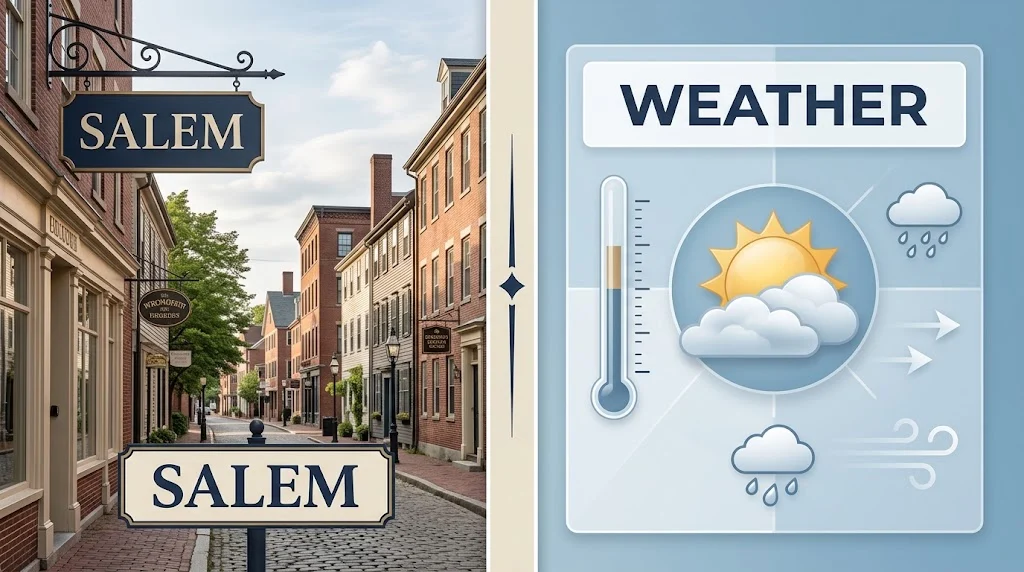
Salem is a proper noun, commonly used as the name of places such as Salem, Massachusetts, while weather is a noun referring to atmospheric conditions such as rain, sunshine, wind, and temperature.
Have you searched for “salem or weather” and wondered what the phrase means? The wording may reflect a comparison, a spelling confusion, or a search for weather conditions in Salem. From a language perspective, these terms are not interchangeable. Salem is a place name, while weather describes conditions in the atmosphere. Understanding the context behind the phrase is important for students, writers, and anyone searching for local forecasts. This guide explains their meanings, practical usage, common mistakes, and how to choose the right wording for clear, accurate communication.
Salem vs Weather: What’s the Difference?
The main difference between Salem and weather is that they belong to different categories of words. Salem is a proper noun, while weather is a common noun. They do not share the same meaning, spelling pattern, or grammatical function.
| Feature | Salem | Weather |
|---|---|---|
| Part of speech | Proper noun | Common noun |
| Meaning | A name used for places and other entities | Atmospheric conditions at a particular time and place |
| Capitalization | Usually begins with a capital letter | Usually lowercase |
| Example | Salem is a historic city in Massachusetts. | The weather is sunny today. |
| Common context | Geography, travel, history, place names | Forecasts, climate, outdoor activities |
| Can the words replace each other? | No | No |
Quick Recap
Salem is a name, often referring to a city or town.
Weather describes atmospheric conditions, including temperature, rain, and wind.
The two words have different meanings and grammatical roles.
The phrase “Salem or weather” does not express a standard English comparison without additional context.
If you’re searching for a forecast, a clearer phrase is “weather in Salem.”
What Does Salem Mean?
Salem is a proper noun used as the name of several places and other entities. One well known example is Salem, Massachusetts, a city associated with the 1692 witch trials. Other places named Salem exist in the United States and elsewhere.
Because Salem is a proper noun, it is normally capitalized in written English.
Examples:
- Salem attracts visitors interested in American history.
- My relatives live in Salem, Oregon.
- We are planning a trip to Salem next summer.
The precise meaning depends on the context. If someone mentions Salem in a travel article, they may mean a particular city. In a historical discussion, the name may refer to Salem, Massachusetts, or another location associated with a specific event.
Salem in Everyday Communication
In conversation, people often use a place name without including the state or country. This works when the location is already clear.
However, when writing for a broad audience or using a search engine, adding the state or country can prevent confusion.
For example, “Salem, Oregon weather” and “Salem, Massachusetts weather” identify different locations. The additional geographic information helps readers find the correct forecast.
What Does Weather Mean?
Weather is a common noun describing the condition of the atmosphere at a particular place and time. It includes temperature, humidity, wind speed, cloud cover, precipitation, and other atmospheric conditions.
Weather can change within minutes or hours. Climate, by contrast, describes longer term patterns observed over many years.
Examples:
- The weather is warm and sunny today.
- Heavy rain could affect tomorrow’s weather.
- We checked the weather before leaving home.
The word weather is also used in expressions such as “weather forecast,” “weather conditions,” and “weather report.”
Weather in Everyday Communication
Weather information helps people plan daily activities, travel, work, and outdoor events.
For instance, a construction manager may check a forecast before scheduling roof repairs. A student might check the weather before walking to school. A traveler may review expected rainfall before booking an outdoor excursion.
Usage recap: Salem identifies a place or entity, while weather describes atmospheric conditions. When discussing forecasts for a location, combine the two ideas by writing “weather in Salem.”
Is Salem vs Weather a Grammar, Vocabulary, or Usage Issue?
The difference between Salem and weather is primarily a vocabulary and meaning issue. It is not a standard grammatical comparison because the words do not serve the same purpose.
Are Salem and Weather Interchangeable?
No. Salem is a proper noun, whereas weather is a common noun.
You cannot replace one with the other without changing the meaning of a sentence.
Correct: “The weather in Salem is pleasant.”
Incorrect: “The Salem in Salem is pleasant,” if you intend to describe atmospheric conditions.
The first sentence identifies a place and describes its weather. The second does not communicate that meaning naturally.
Formal vs Informal Usage
Both words are appropriate in formal and informal English.
In a formal report, you might write, “Weather conditions in Salem affected transportation.” In casual conversation, you might say, “What’s the weather like in Salem?”
The difference lies in sentence structure and context, not formality.
Academic vs Casual Usage
Academic writing may use Salem in historical, geographical, or sociological discussions. Weather may appear in environmental science, geography, and meteorology.
In casual conversation, people commonly use both words when discussing travel plans or local conditions.
The essential rule is to use Salem when identifying the place and weather when discussing atmospheric conditions.
When to Use Salem
Use Salem when you need to identify a specific place, person, institution, or other entity named Salem. In geographical writing, provide additional details when multiple locations could be relevant.
Workplace Example
A travel agency might write:
“Our team organizes historical walking tours in Salem, Massachusetts.”
Here, Salem identifies the destination.
Academic Example
A history student might write:
“Salem became widely associated with the witch trials of 1692.”
In this sentence, Salem functions as a proper noun referring to a historical location.
Technology Example
A travel application might display:
“Salem, Oregon: Local attractions and travel information.”
The application uses the name to identify a geographic destination.
Usage recap: Use Salem to name a location or entity. Capitalize it appropriately and add geographic details when necessary.
When to Use Weather
Use weather when discussing atmospheric conditions, forecasts, or their effects on daily life.
Workplace Example
A construction supervisor might write:
“Please check the weather forecast before scheduling the outdoor installation.”
Weather refers to conditions that may affect the work.
Academic Example
A geography student might write:
“Changes in weather can influence agriculture, transportation, and human activities.”
The word describes atmospheric conditions.
Technology Example
A mobile application might display:
“Today’s weather in Salem includes the expected temperature, wind speed, and chance of rain.”
Here, weather describes the forecast, while Salem identifies the location.
Usage recap: Use weather when describing temperature, rain, wind, and other atmospheric conditions. Add a place name to make the forecast location specific.
When You Should NOT Use Salem or Weather
The two words are not synonyms, so choosing between them requires understanding what you want to communicate.
1. Do not use Salem when you mean atmospheric conditions. Write “The weather is cold,” not “The Salem is cold.”
2. Do not use weather when you mean a city name. If you’re identifying a destination, write “We visited Salem.”
3. Do not capitalize weather unnecessarily. In an ordinary sentence, write “The weather is changing,” unless the word begins a sentence or appears in a title.
4. Do not write Salem without context when several locations are possible. Specify Salem, Oregon, or Salem, Massachusetts when relevant.
5. Do not confuse weather with climate. Weather describes short term atmospheric conditions, while climate describes long term patterns.
6. Do not treat “Salem or weather” as a standard phrase. The intended meaning may depend on the original search, missing punctuation, or surrounding words.
7. Do not assume a forecast applies to every place named Salem. Confirm the correct location before using the information.
8. Do not confuse a place name with a forecast category. A search for “Salem weather” normally requests weather information for a place called Salem, not a definition of the word Salem.
Common Mistakes and Correct Usage
| Correct sentence | Incorrect sentence | Explanation |
|---|---|---|
| The weather in Salem is sunny. | The Salem in Salem is sunny. | Weather describes atmospheric conditions. |
| Salem is located in Oregon. | Weather is located in Oregon. | Salem is the place name. |
| We checked the weather forecast. | We checked the Salem forecast, when no place specific meaning is intended. | Weather is the appropriate general term. |
| Salem, Massachusetts, has a rich history. | salem, Massachusetts, has a rich history. | Proper nouns require capitalization. |
| The weather changed overnight. | The weather changed overnight in Salem, when the intended meaning is that Salem itself changed. | The sentence must express the intended event clearly. |
Decision Rule
If you mean a place or named entity, use Salem.
When you mean atmospheric conditions, use weather.
If you want a forecast for a place named Salem, use the combined phrase “weather in Salem” and specify the state or country when needed.
Salem and Weather in Modern Technology and AI Tools
Search engines, mapping services, weather applications, and AI assistants interpret words according to their context.
For example, entering “Salem weather” into a search engine will commonly be understood as a request for a local forecast. However, the results may vary depending on which Salem is intended and the location information available to the service.
AI writing tools can also explain the distinction between the words, suggest clearer search phrases, and help correct sentences. Still, users should verify the selected location before relying on a forecast.
For the most useful results, try specific queries such as:
- Weather in Salem, Oregon
- Salem, Massachusetts, weather forecast
- Current temperature in Salem, Oregon
- Seven day weather forecast for Salem, Massachusetts
These queries make your intention clearer and reduce the likelihood of receiving information for the wrong location.
Etymology: Where Do Salem and Weather Come From?
The words have different histories.
Salem is commonly associated with a Hebrew word related to peace, often discussed alongside shalom. The name appears in various historical and geographical contexts, and its specific origin may depend on the place being discussed.
Weather comes from Old English weder, which referred to weather or atmospheric conditions. The word developed into its modern form over centuries and is now used to describe atmospheric states such as sunshine, rain, snow, and wind.
Their different origins reflect their different functions in English. Salem is primarily a name, while weather describes a natural phenomenon.
Expert Insight: Understanding the Phrase “Salem or Weather”
A useful language principle is that the meaning of a search phrase depends on both the words and their context.
“Salem or weather” is not a conventional English expression that compares two equivalent things. If the intended search concerns local atmospheric conditions, “weather in Salem” is more natural and precise.
This distinction matters in SEO writing because search intent should guide the wording of a title, heading, and introduction. A page about local forecasts should clearly identify the location and provide relevant weather information rather than treating a place name and a common noun as competing alternatives.
Two Practical Case Studies
Case Study 1: A Travel Website
Imagine a travel website publishing information about Salem, Oregon. Its editor writes a heading called “Salem or Weather” when the page is actually intended to help visitors check local forecasts.
The wording creates confusion because it does not clearly communicate the page’s purpose. The editor changes the heading to “Salem Weather: Local Forecast and Travel Tips.”
Result: The new heading communicates the topic more clearly to readers and better reflects the likely search intent. This is an illustrative example, not a measured SEO outcome.
Case Study 2: A Student’s Geography Assignment
Imagine a student writing a report about how atmospheric conditions affect tourism in Salem, Massachusetts. The student repeatedly uses Salem when discussing rain, temperature, and wind.
A teacher recommends distinguishing the place name from the weather conditions. The student revises the sentences to say, “Weather in Salem can influence outdoor tourism,” and “Salem attracts visitors interested in local history.”
Result: The revised report communicates the intended meaning more accurately and separates geographical information from atmospheric descriptions. This is an illustrative example rather than a documented study.
Error Prevention Checklist
Always Use Salem When
- Naming a specific city, town, or other entity.
- Discussing the history or geography of a place named Salem.
- Writing a travel guide or location description.
- Identifying the place for which a forecast is being requested.
Never Use Weather When
- You intend to name a location rather than describe atmospheric conditions.
- You are referring to Salem as a proper noun.
- The sentence requires a place name instead of a general noun describing atmospheric conditions.
Remember that weather is perfectly appropriate when discussing a forecast for Salem. The words can appear together naturally, even though they cannot replace one another.
Related Grammar Confusions You Should Master
Understanding commonly confused words improves spelling, vocabulary, and sentence clarity. These related topics are useful for students and English learners.
- Weather vs Whether: Atmospheric conditions compared with a word introducing alternatives or possibilities.
- Climate vs Weather: Long term patterns compared with short term atmospheric conditions.
- There vs Their: Location or existence compared with possession.
- Its vs It’s: Possession compared with the contraction of “it is” or “it has.”
- Affect vs Effect: Commonly confused verb and noun uses.
- City vs Town: Differences in geographical terminology.
- Capital vs Capitol: A city or financial concept compared with a legislative building.
- Your vs You’re: Possession compared with a contraction.
- Then vs Than: Time or sequence compared with comparison.
- Proper Nouns vs Common Nouns: Names of specific entities compared with general categories.
Frequently Asked Questions
1. What does Salem or weather mean?
The phrase does not have one established meaning in standard English. It may refer to a search for weather conditions in Salem or result from an unclear comparison or incomplete query.
2. Is Salem a place or a weather term?
Salem is a proper noun used for several places and other entities. It is not a standard meteorological term.
3. What does weather mean in English?
Weather refers to atmospheric conditions at a particular time and place, including temperature, precipitation, wind, humidity, and cloud cover.
4. Should I write Salem weather or weather in Salem?
Both can be appropriate. “Weather in Salem” is a natural phrase in a sentence, while “Salem weather” is common in search queries and headings.
5. Is Salem or weather a grammar mistake?
The phrase is not necessarily a grammatical error, but it is unclear without context. If you mean a local forecast, “weather in Salem” expresses the idea more naturally.
6. How do I search for the weather in Salem?
Enter “weather in Salem” along with the state or country, such as “weather in Salem, Oregon,” to help identify the intended location.
7. What is the difference between Salem and climate?
Salem is a proper noun, often identifying a place. Climate refers to long term patterns of weather in a particular region.
8. Should Salem be capitalized in a sentence?
Yes. Salem is a proper noun and should normally begin with a capital letter. Weather is generally lowercase unless it begins a sentence or appears in a title.
9. Can Salem and weather be used in the same sentence?
Yes. For example, “The weather in Salem is expected to improve tomorrow.” Salem identifies the location, while weather describes atmospheric conditions.
Conclusion
The difference between Salem or weather becomes clear when you understand what each word represents. Salem is a proper noun commonly used as a place name, while weather describes atmospheric conditions such as rain, sunshine, wind, and temperature. They are not interchangeable, but they can be used together naturally when discussing a local forecast.

Margaret Atwood is an American writer who contributes to LingRoya.com creating clear and engaging content about the English language and everyday communication. She enjoys helping readers build confidence in their writing through simple, practical guidance.