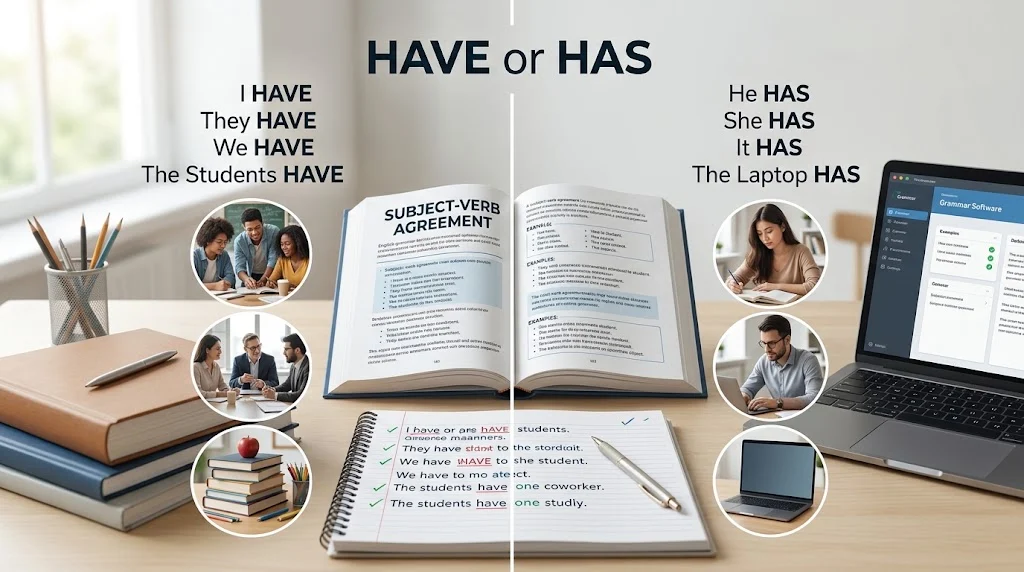
Have and has are present tense forms of the verb “to have.” Use have with I, you, we, they, and plural subjects. Use has with he, she, it, and singular third person subjects. For example, “They have a car” is correct, while “She has a car” is correct.
Few English grammar rules are as common as the difference between have and has, yet mistakes still appear in emails, essays, reports, websites, and everyday conversations. The reason is simple: both words express possession, relationships, experiences, and actions, but the correct form changes according to the subject.
Understanding this subject verb agreement rule gives writers a reliable foundation for using the present tense accurately. Whether you are an English learner, student, teacher, professional writer, or content creator, knowing when to use have and when to use has can make your sentences sound clearer and more polished.
Have vs Has: What’s the Difference?
Has and have are present tense forms of the verb to have.
Have is used with the pronouns I, you, we, and they, as well as plural nouns.
Examples:
“I have a question.”
“You have enough time.”
“We have two meetings today.”
“They have several options.”
“The students have new books.”
Has is used with he, she, and it, as well as singular third person nouns.
Examples:
“He has a question.”
“She has enough time.”
“It has a useful feature.”
“The student has a new book.”
| Form | Used With | Number | Example |
| Have | I, you, we, they | Singular or plural depending on subject | They have a car. |
| Has | He, she, it | Singular third person | She has a car. |
| Have | Plural nouns | Plural | The employees have laptops. |
| Has | Singular nouns | Singular | The employee has a laptop. |
Mini Recap
Use have with I, you, we, and they.
You can use have with plural nouns.
Use has with he, she, and it.
Use has with singular third person nouns.
The subject determines the correct form.
Is Have vs Has a Grammar, Vocabulary, or Usage Issue?
The difference between have and has is primarily a grammar issue involving subject verb agreement.
The two words have the same basic meaning and come from the same verb, but they are not freely interchangeable.
Compare:
“She has a new phone.”
“They have new phones.”
The meaning is similar, but the subject changes from singular to plural, so the verb form changes as well.
Formal vs Informal Usage
The same rule applies in both formal and informal English.
In casual conversation, native speakers generally use have and has naturally without consciously thinking about the grammar rule.
Formal writing requires the same agreement:
“The company has a new policy.”
“The employees have new responsibilities.”
Using “have” with a singular third person subject or “has” with a plural subject is considered a grammatical error.
Academic vs Casual Usage
Academic writing frequently uses have and has to describe research findings, evidence, studies, and observations.
For example:
“The study has several limitations.”
“The researchers have identified three important factors.”
The distinction remains exactly the same in casual writing, although errors may be overlooked when the meaning is obvious.
How to Use Have Correctly
Use have with I, you, we, and they.
Examples:
“I have a meeting at nine.”
“You have a good opportunity.”
“We have enough information.”
“They have several questions.”
Have is also used with plural nouns:
“The students have completed their assignments.”
“The companies have introduced new products.”
Workplace Example
“We have a meeting with the client this afternoon.”
The subject is “we,” so have is correct.
Academic Example
“The researchers have examined several possible explanations.”
The subject “researchers” is plural, so have is required.
Technology Example
“Most smartphones have advanced security features.”
The subject “smartphones” is plural, so have is correct.
Usage Recap for Have
Use have with I, you, we, and they.
You can use have with plural nouns.
Use have after modal verbs such as can, could, should, and will.
Examples include:
“She can have another opportunity.”
“They should have enough time.”
“He will have more information tomorrow.”
How to Use Has Correctly
Use has with he, she, it, and singular third person nouns.
Examples:
“He has a new job.”
“She has an appointment.”
“It has several useful features.”
“The company has a new website.”
“The student has an important question.”
Has is especially common when describing possession, conditions, characteristics, and experiences.
Workplace Example
“The manager has a meeting at ten.”
The subject manager is singular, so has is correct.
Academic Example
“The article has several important findings.”
Article is singular, so has is required.
Technology Example
“The application has a built in security system.”
Application is singular, so has is correct.
Usage Recap for Has
Use has with he, she, it, and singular third person nouns.
Use has when one person, animal, organization, object, or other singular subject possesses or experiences something.
Remember that a singular noun normally requires has in the simple present.
Have and Has in Questions and Negative Sentences
The distinction becomes especially important when forming questions and negatives.
With do and does, the main verb returns to its base form have.
Correct:
“Does she have a car?”
Not:
“Does she has a car?”
Correct:
“Do they have enough money?”
Not:
“Do they has enough money?”
The same principle applies to negative sentences.
Correct:
“She does not have a car.”
Correct:
“They do not have a car.”
Incorrect:
“She does not has a car.”
The auxiliary verb does already carries the third person singular marking, so the main verb remains have.
When You Should NOT Use Have or Has
Several common situations create unnecessary mistakes.
- Do not use has with I.
Correct: “I have a question.” - Do not use has with you.
Correct: “You have enough time.” - Do not use have with he in a simple present affirmative sentence.
Correct: “He has a new phone.” - Do not use have with a singular third person noun.
Correct: “The company has a new policy.” - Do not use has after does.
Correct: “Does she have a car?” - Do not use has after modal verbs.
Correct: “She can have another opportunity.” - Do not use have with a singular subject simply because another noun nearby is plural.
- Do not decide based on the nearest noun. Identify the actual subject first.
Common Mistakes and Decision Rules
| Correct Sentence | Incorrect Sentence | Explanation |
| She has a new laptop. | She have a new laptop. | She is singular third person. |
| They have a new laptop. | They has a new laptop. | They takes have. |
| I have a question. | I has a question. | I takes have. |
| The company has a website. | The company have a website. | Company is singular. |
| The companies have websites. | The companies has websites. | Companies is plural. |
| Does he have a car? | Does he has a car? | After does, use the base form have. |
| She can have another chance. | She can has another chance. | After can, use have. |
Decision Rule Box
If the subject is I, you, we, they, or a plural noun, use HAVE.
If the subject is he, she, it, or a singular third person noun, use HAS.
A useful shortcut is to identify the subject before looking at the rest of the sentence.
Have and Has in Modern Technology and AI Tools
Have and has appear constantly in technology writing.
For example:
“The application has an AI assistant.”
“The applications have AI assistants.”
The first sentence uses has because application is singular. The second uses have because applications is plural.
AI generated writing can sometimes produce agreement errors when sentences contain long or complicated subjects. Writers should identify the true subject rather than relying on the noun closest to the verb.
For example:
“The collection of digital tools has several useful features.”
The word “tools” is plural, but the main subject is “collection,” which is singular. Therefore, has is correct.
This is an important lesson for both human writers and AI assisted writing: grammatical agreement depends on the actual subject, not simply the nearest noun.
Etymology of Have and Has
Have comes from Old English forms related to possession, holding, or having something. Over centuries, English developed different present tense forms depending on the grammatical subject.
Has developed as the third person singular present form of have.
Similar patterns appear in other common English verbs:
I have, she has.
I do, she does.
She is, i am
I go, she goes.
These forms reflect the broader English pattern in which third person singular subjects often require a distinct present tense form.
An Expert Style Principle
“Choose the verb according to the subject, not according to the noun that happens to appear closest to it.”
This principle prevents many subject verb agreement errors, especially in long sentences.
Two Practical Case Studies
Case Study 1: Workplace Communication
Consider this sentence:
“The team members has completed the report.”
The subject is “team members,” which is plural. Therefore, has should be changed to have.
Correct:
“The team members have completed the report.”
Result: The correction creates proper subject verb agreement and makes the sentence suitable for professional communication.
Case Study 2: Academic Writing
Consider:
“The collection of studies have several limitations.”
Although “studies” is plural, the main subject is “collection,” which is singular.
The correct sentence is:
“The collection of studies has several limitations.”
Result: Identifying the actual subject prevents a common agreement error caused by a nearby plural noun.
Error Prevention Checklist
Always use Have when
The subject is I.
Subject is you.
The subject is we.
Subject is they.
The subject is a plural noun.
The verb follows a modal such as can, could, should, or will.
Never use Has when
The subject is I.
Subject is you.
The subject is we.
The subject is they.
Subject is a plural noun.
The verb follows does or another auxiliary that requires the base form.
Related Grammar Confusions You Should Master
To strengthen your understanding of subject verb agreement, study these related topics:
- Is vs are
- Was vs were
- Do vs does
- Has vs had
- Have vs had
- He has vs they have
- There is vs there are
- Everyone has vs everyone have
- Each has vs each have
- Subject verb agreement
These distinctions will help you recognize patterns rather than memorize isolated sentences.
FAQs
When should I use have instead of has?
Use have with I, you, we, they, and plural nouns in the simple present tense.
When should I use has instead of have?
Use has with he, she, it, and singular third person nouns in affirmative simple present sentences.
Is it “she have” or “she has”?
The correct form is she has because she is a singular third person pronoun.
Is it “they have” or “they has”?
The correct form is they have because they is plural.
Is it “does she have” or “does she has”?
The correct form is does she have. After does, the main verb stays in its base form.
Is it “everyone have” or “everyone has”?
The correct form is everyone has because everyone is grammatically singular, even though it refers to multiple people collectively.
Can have and has be used for possession?
Yes. Both can express possession, but the subject determines which form is required. For example, “I have a car” and “She has a car.”
Why does “does he have” use have instead of has?
Does already carries the third person singular marking, so the main verb returns to its base form: “Does he have?”
How can I remember have vs has?
Remember this simple rule: I, you, we, they have. He, she, it has.
Conclusion
The difference between have or has is mainly determined by the subject of the sentence. Use have with I, you, we, they, and plural nouns. Use has with he, she, it, and singular third person nouns. When do, does, or a modal verb appears, use the base form have rather than has.
The easiest way to avoid mistakes is to identify the subject first and then choose the correct verb form. Mastering this small rule can significantly improve accuracy in everyday, academic, workplace, and digital writing.

Margaret Atwood is an American writer who contributes to LingRoya.com creating clear and engaging content about the English language and everyday communication. She enjoys helping readers build confidence in their writing through simple, practical guidance.