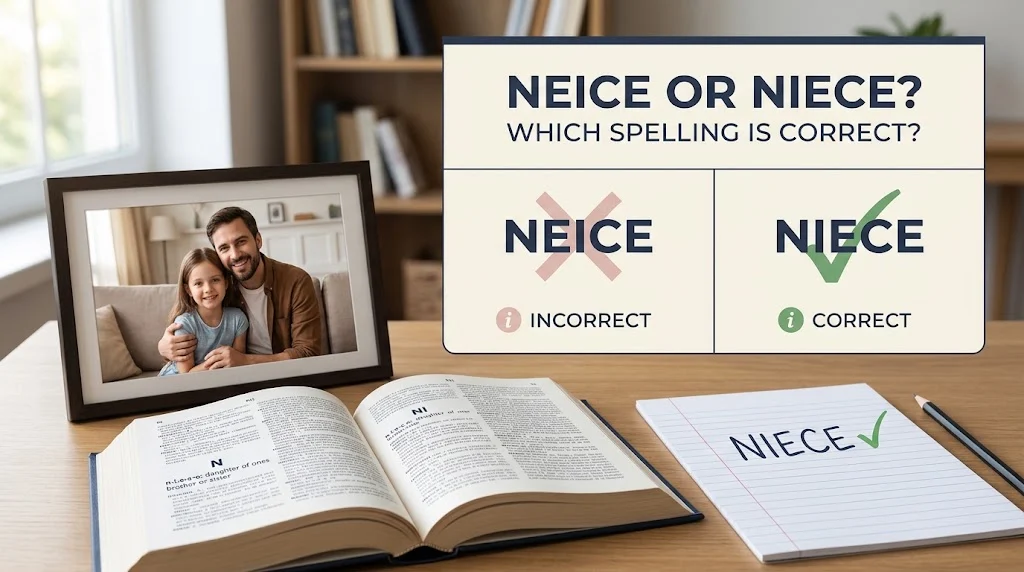
Niece is the correct spelling in standard English, while neice is a common spelling mistake. A niece is the daughter of your brother or sister, or of your spouse’s sibling. Although both spellings may sound identical when spoken, only niece is accepted as the standard spelling.
Have you ever paused while writing a birthday message and wondered whether neice or niece is correct? It is an easy mistake because English spelling doesn’t always follow predictable patterns. However, niece is the only correct standard spelling for the daughter of your sibling.
The word neice is a misspelling, not an alternative British or American English form. Understanding the correct spelling, meaning, pronunciation, and usage can help students, professionals, and English learners communicate more confidently. A simple memory trick can also make this commonly confused word easier to remember.
Neice vs Niece: What’s the Difference?
The difference between neice and niece is straightforward. Niece is a correctly spelled noun, while neice is an incorrect spelling that commonly occurs when writers place the letters e and i in the wrong order.
| Feature | Niece | Neice |
| Spelling status | Correct | Incorrect |
| Part of speech | Noun | Misspelling of a noun |
| Meaning | Daughter of a sibling | No standard English meaning |
| Pronunciation | /niːs/ | Usually intended to sound like niece |
| Formal writing | Accepted | Should be corrected |
| Academic writing | Correct choice | Spelling error |
| Example | My niece loves reading. | My neice loves reading. |
Quick Recap
Niece is the correct spelling in standard English.
Neice is a common spelling error.
The correct word refers to a female relative in the next generation of a family.
Both forms are often intended to represent the same spoken word, but only niece is standard.
Remember the correct spelling whenever you’re writing about family relationships.
What Does Niece Mean?
A niece is a noun that refers to the daughter of someone’s brother or sister. In common usage, it can also refer to the daughter of a spouse’s sibling.
For example, if your sister has a daughter, that girl is your niece. Likewise, if your brother has a daughter, she is also your niece.
Here are some examples:
- My niece is visiting us during the summer holidays.
- I bought a beautiful birthday present for my niece.
- His niece recently graduated from university.
- My wife’s niece enjoys drawing and painting.
The word identifies a specific family relationship. It is commonly used in everyday conversations, family histories, formal correspondence, and personal writing.
The corresponding masculine term is nephew, which refers to the son of your brother or sister.
What Does Neice Mean?
Neice is not a standard English word for a family member. It is a misspelling of niece, usually caused by confusion about the order of the letters i and e.
For example:
Incorrect: My neice is coming to dinner tonight.
Correct: My niece is coming to dinner tonight.
Although readers can often understand the intended meaning, the incorrect spelling can make a message appear poorly proofread. In school assignments, professional emails, and published articles, it should always be corrected.
Unlike some commonly confused English words, neice and niece aren’t two valid words with different meanings. This is a spelling mistake rather than a difference in vocabulary.
Is Neice vs Niece a Grammar, Vocabulary, or Usage Issue?
The confusion between neice and niece is a spelling issue, not a grammatical or vocabulary distinction.
Grammar concerns how words function together in sentences. Vocabulary concerns the words and meanings available in a language. In this case, the intended vocabulary item is niece, but its letters are sometimes written incorrectly.
Are Neice and Niece Interchangeable?
No. Although readers may understand both forms in context, they aren’t interchangeable in standard writing.
Use niece when referring to a female relative who is the daughter of your sibling or, in common extended family usage, your spouse’s sibling.
Avoid neice because it isn’t an accepted alternative spelling.
Formal vs Informal Usage
The correct spelling remains niece in both formal and informal English.
In a casual text message, someone might accidentally type neice and still be understood. However, informal communication doesn’t make the spelling correct.
In a job application, business email, official letter, or published article, proofreading the word is especially important.
Academic vs Casual Usage
Students should use niece in essays, examinations, and assignments. Teachers may mark neice as a spelling error because it doesn’t follow standard English conventions.
In casual conversation, the distinction is less noticeable because both spellings are usually intended to represent the same pronunciation. Spoken English, however, doesn’t change the correct written form.
When to Use Niece Correctly
Use niece whenever you refer to the appropriate family relationship. The word works naturally in personal communication, workplace correspondence, academic writing, and digital content.
Workplace Example
“I’m taking Friday afternoon off to attend my niece’s graduation ceremony.”
This sentence correctly uses niece to explain a family commitment in a professional setting.
Academic Example
“My niece is researching family relationships for her sociology assignment.”
The spelling is correct in an educational context.
Technology Example
“I shared the photographs of my niece’s birthday party in our family group chat.”
Whether you’re writing a social media caption, sending an email, or entering information into a digital form, niece remains the correct spelling.
Usage recap: Write niece in every standard English context. Its spelling doesn’t change according to the formality of the message or the type of document.
When You Should NOT Use Neice or Niece
Understanding the correct spelling also means knowing when the word itself isn’t appropriate.
1. Don’t write neice in formal documents. Use niece instead.
2. Don’t use niece for a male relative. The appropriate term is nephew.
3. Don’t use niece for your own daughter. Your daughter is your child, not your niece.
4. Don’t confuse niece with cousin. A niece is the daughter of your sibling, while a cousin is generally the child of your aunt or uncle.
5. Don’t assume niece means any younger female relative. The word describes a specific family relationship.
6. Don’t change the spelling to match pronunciation. The word is pronounced like “nees,” but its standard spelling includes the letters ie.
7. Don’t treat neice as a regional spelling. It isn’t the accepted British or American spelling.
8. Don’t overlook possessive forms. Write niece’s birthday when referring to one niece’s birthday, and nieces’ birthdays when referring to multiple nieces.
Common Mistakes and Correct Spelling Rules
The examples below show how to distinguish the correct spelling from common errors.
| Correct sentence | Incorrect sentence | Explanation |
| My niece lives in London. | My neice lives in London. | Niece is the correct spelling. |
| I bought my niece a gift. | I bought my neice a gift. | The letters must appear in the correct order. |
| My niece’s birthday is tomorrow. | My neices birthday is tomorrow. | The apostrophe marks the possessive form. |
| My two nieces are visiting. | My two niece are visiting. | The plural form is nieces. |
| My nephew and niece attended the event. | My neice and nephew attended the event. | Niece must be spelled correctly. |
| My sister’s daughter is my niece. | My sister’s daughter is my cousin. | Niece describes the correct family relationship. |
The Decision Rule
Use NIECE
When referring to the daughter of your brother or sister, or commonly your spouse’s sibling.
Avoid NEICE
It is a misspelling and should be corrected to niece.
A useful memory trick is to remember that niece contains “nie,” not “nei.” Practising the spelling in a short sentence, such as “My niece is kind,” can help you remember the correct letter order.
Neice and Niece in Modern Technology and AI Tools
Digital communication has made spelling accuracy more visible than ever. A misspelled word can appear in emails, social media captions, messaging apps, blog posts, and online family records.
Spellcheckers and AI writing assistants can usually identify neice as a spelling error and suggest niece as the correction. However, automated tools don’t always catch every error, particularly when the incorrect form appears in a name, username, or unusual context.
For reliable results, check the word manually before publishing. If you’re writing an article about family relationships, use the correct spelling in headings, examples, metadata, and image text.
Search engines may still recognize a misspelled query and show results for the intended word. That doesn’t make the misspelling correct. For SEO content, it’s helpful to address the search phrase neice or niece while consistently using niece in the article itself.
Etymology: Where Does the Word Niece Come From?
The word niece entered English through Anglo French, from a form related to Old French niece. Its history can be traced further to Latin neptia, associated with neptis, meaning granddaughter or female descendant.
Over time, niece developed its modern meaning as the daughter of one’s brother or sister.
The spelling can be difficult because English has several words in which the letters ie and ei don’t follow one simple pronunciation rule. In niece, the correct sequence is ie. Remembering the word’s established spelling is more reliable than trying to guess it from sound alone.
An Expert Style Rule for Remembering Niece
A useful proofreading principle is simple: learn the correct letter sequence rather than relying entirely on pronunciation. English contains many words whose spelling cannot be predicted from sound alone.
For niece, remember the sequence n + i + e + c + e. Reading the word, writing it from memory, and using it in a sentence can reinforce the spelling more effectively than repeatedly comparing the two forms.
Two Practical Case Studies
The following examples illustrate how correcting this spelling can improve everyday writing. They are hypothetical scenarios rather than documented research studies.
Case Study 1: A Student’s English Assignment
A student writes a paragraph about family relationships and uses neice several times. During proofreading, the student checks a dictionary and learns that niece is the standard spelling.
The student corrects each occurrence and reviews related words, including nephew, cousin, and sibling.
Result: The final assignment uses the correct spelling consistently and describes each family relationship accurately.
Case Study 2: A Family Blog Post
A blogger writes a birthday article for a young relative and accidentally types neice in the heading and image caption. Before publishing, the blogger runs a spelling check and corrects both instances to niece.
The blogger also reviews the article’s title, metadata, and social media description.
Result: The published content uses consistent spelling across its main text and supporting elements, creating a more polished reading experience.
Error Prevention Checklist
Use this quick checklist whenever you write the word.
Always Use Niece When
- Referring to the daughter of your brother or sister.
- Writing formal letters, school assignments, and professional emails.
- Preparing family stories, greeting cards, or blog posts.
- Using standard English spelling in British or American English.
- Writing the plural nieces or the possessive niece’s.
Never Use Neice When
- You intend to write the standard English word for a female relative.
- You’re preparing a document that requires correct spelling.
- You’re editing published content or academic work.
- You’re using it as an alternative to niece.
Remember that niece is the standard spelling regardless of where you live or which English variety you speak.
Related Grammar Confusions You Should Master
If you frequently confuse the spelling of niece, these related topics can help strengthen your English skills.
- Nephew vs Niece: Understanding male and female family terms.
- Their vs There: Distinguishing possession from location.
- Your vs You’re: Understanding possessive forms and contractions.
- Definitely vs Definately: Avoiding a common spelling mistake.
- Receive vs Recieve: Remembering the correct letter order.
- Believe vs Beleive: Learning another commonly misspelled word.
- Principal vs Principle: Distinguishing words with different meanings.
- Affect vs Effect: Understanding grammar and word usage.
- Cousin vs Niece: Identifying different family relationships.
- Its vs It’s: Separating possession from a contraction.
Studying these distinctions can improve spelling accuracy, vocabulary, and confidence in everyday writing.
Frequently Asked Questions
1. Is it neice or niece?
Niece is correct. Neice is a misspelling and isn’t accepted as the standard spelling of the word.
2. How do you spell niece correctly?
Spell it N I E C E. The letters i and e appear in that order after the initial letter n.
3. What does niece mean in English?
A niece is the daughter of your brother or sister. The word is also commonly used for the daughter of your spouse’s sibling.
4. Is neice ever correct in British English?
No. Niece is the standard spelling in British English as well as American English. Neice isn’t a recognized regional alternative.
5. Why do people spell niece as neice?
People often confuse the order of i and e because English spelling patterns aren’t always predictable. Familiarity with the correct spelling helps prevent this mistake.
6. What is the plural of niece?
The plural is nieces. For example, “My nieces are visiting this weekend.”
7. What is the difference between niece and nephew?
A niece is a female relative who is the daughter of your sibling, while a nephew is the corresponding male relative.
8. How do you use niece in a sentence?
You can write, “My niece loves reading books.” In this sentence, niece identifies the female child of the speaker’s sibling.
9. Is niece spelled differently in American and British English?
No. Niece has the same standard spelling in both American and British English, unlike words such as colour and color.
Conclusion
When deciding between neice or niece, always choose niece. It is the correct standard English spelling for the daughter of your brother or sister, while neice is a common spelling error. The word is spelled the same way in British and American English, so there is no regional variation to remember.
To avoid mistakes, learn the sequence of letters in niece and practise using it in everyday sentences. Remember its relationship to nephew, check possessive and plural forms carefully, and proofread your writing before publishing. Whether you’re writing a birthday card, completing a school assignment, sending a professional email, or creating SEO content, the correct spelling helps your message look clear, accurate, and polished.

Philip Pullman is an American writer dedicated to creating clear and easy to follow English content. Through his work at LingRoya.com, he helps readers strengthen their language skills with practical and reliable guidance so that they can easily understand.