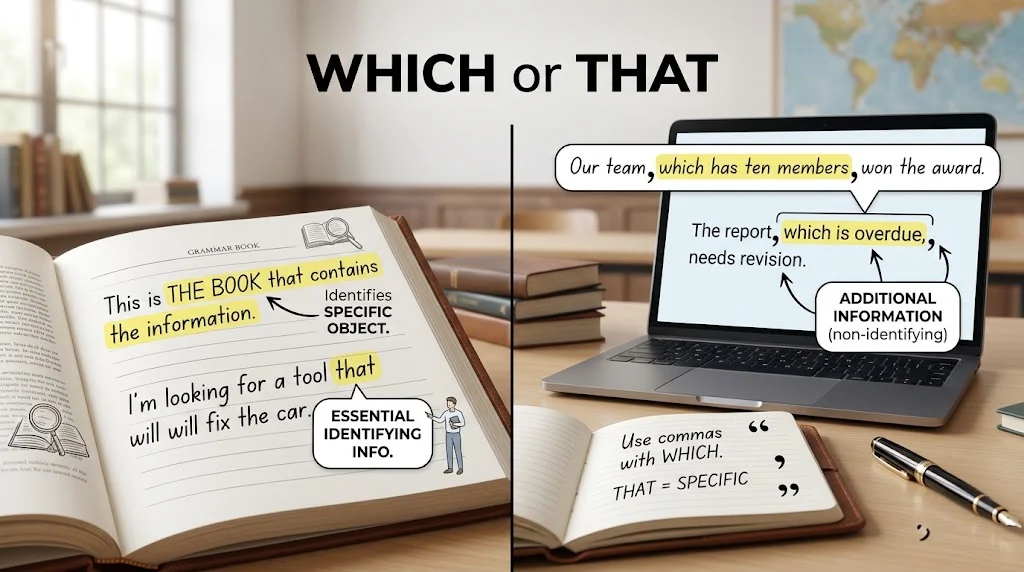
The main difference between which and that is whether the information is essential to identifying the noun. That is commonly used for restrictive relative clauses, where the information is necessary to the meaning. Which is commonly used for nonrestrictive clauses, where the information is additional and usually separated by commas.
Choosing between which and that may seem like a tiny grammar decision, but it can change the meaning of an entire sentence. The confusion is especially common because both words can introduce relative clauses and connect additional information to a noun.
In professional emails, academic papers, reports, websites, and everyday writing, knowing when to use each form helps make relationships between ideas much clearer. The distinction is particularly important in careful edited English, where punctuation and clause structure work together to show whether information is essential or simply additional.
Which vs That: What’s the Difference?
Which and that can both function as relative pronouns, but their traditional grammatical roles differ.
That is commonly used to introduce a restrictive relative clause. A restrictive clause provides information that helps identify exactly which person, thing, or group is being discussed.
Example:
“The book that I bought yesterday is on the desk.”
The phrase “that I bought yesterday” identifies which book is being discussed.
Which is commonly used to introduce a nonrestrictive relative clause. A nonrestrictive clause adds information that is not essential to identifying the noun.
Example:
“My laptop, which I bought last year, still works perfectly.”
The phrase “which I bought last year” provides additional information. The commas show that the information is nonessential.
| Word | Typical Function | Clause Type | Punctuation | Example |
| That | Relative pronoun | Restrictive | Usually no commas | The phone that I bought is new. |
| Which | Relative pronoun | Nonrestrictive | Usually commas | My phone, which I bought yesterday, is new. |
Mini Recap
Use that when the clause identifies the specific noun you mean.
Use which when the clause adds extra information.
Restrictive clauses normally do not use commas.
Nonrestrictive clauses normally use commas.
Meaning and punctuation work together to communicate the intended relationship.
Is Which vs That a Grammar, Vocabulary, or Usage Issue?
The distinction between which and that is primarily a grammar and usage issue.
They are not always interchangeable in carefully edited English. The choice depends on whether the relative clause is restrictive or nonrestrictive.
Consider these two sentences:
“The cars that are electric are cheaper to operate.”
“The cars, which are electric, are cheaper to operate.”
The first sentence can imply that only the electric cars are cheaper to operate. The relative clause helps identify which cars are being discussed.
The second sentence suggests that the cars are already identified, and the writer is simply adding the information that they are electric.
Formal vs Informal Usage
In formal writing, the traditional distinction between restrictive that and nonrestrictive which is widely followed, particularly when clarity matters.
In informal American English, however, which is sometimes used in restrictive clauses as well. This usage can be acceptable depending on the style guide and context.
For professional, academic, and highly edited content, following the restrictive and nonrestrictive distinction is generally the safest approach.
Academic vs Casual Usage
Academic writing benefits from precision because small grammatical differences can affect interpretation.
Casual conversation is more flexible. Speakers often rely on context and natural rhythm rather than consciously applying a grammar rule.
For publication ready writing, punctuation and clause structure should make the intended meaning immediately clear.
How to Use That Correctly
Use that when the relative clause is essential to identifying the noun.
Example:
“The article that received the most views was updated yesterday.”
The phrase “that received the most views” tells us which article is being discussed.
Without that clause, the reader would not know which article the writer means.
Workplace Example
“Please review the documents that the client sent.”
The clause identifies the particular documents that need review.
Academic Example
“The studies that examined long term memory produced similar findings.”
The relative clause identifies the specific studies being discussed.
Technology Example
“Choose the application that supports your device.”
The clause identifies which application the user should choose.
Usage Recap for That
Use that when the relative clause is necessary to identify the noun.
Do not normally separate a restrictive that clause with commas.
A useful test is to remove the clause. If removing it changes which noun you mean, the clause is likely restrictive.
How to Use Which Correctly
Use which to introduce a nonrestrictive relative clause that adds extra information.
Example:
“My computer, which I purchased last year, still performs well.”
The reader already knows which computer is being discussed. The information about when it was purchased is additional.
Workplace Example
“Our main office, which opened in 2018, now has more than fifty employees.”
The clause adds background information about the office.
Academic Example
“The experiment, which lasted six months, produced consistent results.”
The six month duration is additional information about the already identified experiment.
Technology Example
“The application, which was released last month, has received thousands of downloads.”
The clause provides additional information about the application.
Usage Recap for Which
Use which for nonessential information in standard formal usage.
Use commas to separate a nonrestrictive which clause.
If removing the clause leaves the identity of the noun unchanged, which may be appropriate.
When You Should NOT Use Which or That
Several common situations cause confusion.
- Do not use that to introduce a nonrestrictive clause set off by commas.
Incorrect: “My car, that I bought last year, is reliable.” - Do not normally use commas around a restrictive that clause.
Incorrect: “The book, that I ordered yesterday, has arrived.” - Do not choose between the words based only on pronunciation.
- Do not assume that every relative clause is interchangeable.
- Do not remove punctuation from a nonrestrictive which clause when the punctuation helps establish its meaning.
- Do not add commas to a restrictive clause if doing so changes the intended meaning.
- Do not automatically replace every occurrence of which with that. The two forms can have different grammatical functions.
- Do not use a relative pronoun without considering whether the clause is identifying information or additional information.
Common Mistakes and Decision Rules
| Correct Sentence | Incorrect Sentence | Explanation |
| The book that I ordered arrived today. | The book, that I ordered, arrived today. | The identifying clause is restrictive. |
| My book, which I ordered yesterday, arrived today. | My book that I ordered yesterday arrived today. | The commas show that the information is additional. |
| The computer that has the fastest processor won. | The computer, that has the fastest processor, won. | That is appropriate for the restrictive clause. |
| My computer, which has a fast processor, works well. | My computer that has a fast processor, works well. | The nonrestrictive clause needs appropriate punctuation. |
| The employees that completed the training received certificates. | The employees, that completed the training, received certificates. | The clause identifies which employees received certificates. |
Decision Rule Box
If you mean the specific person, thing, or group identified by the clause, use that in traditional standard usage.
If you are adding extra information about an already identified noun, use which with commas.
A simple test is to remove the relative clause. If removing it makes the identity unclear, the information is probably restrictive.
Which and That in Modern Technology and AI Tools
Modern technology provides many examples of restrictive and nonrestrictive clauses.
Consider:
“Install the software that supports your operating system.”
The clause identifies the software the user should install.
Now compare:
“The software, which was updated yesterday, is available now.”
The update information is additional.
AI writing tools must interpret these relationships through context. Simply replacing which with that or that with which can change the meaning or punctuation of a sentence.
For writers using AI generated content, it is worth checking relative clauses manually. A grammatically possible sentence may still communicate the wrong relationship between the main noun and its supporting information.
Etymology of Which and That
Both which and that have long histories in English.
Which developed from Old English forms related to words used to identify or distinguish among things. Its modern role includes use as a relative pronoun and interrogative pronoun.
That also has Old English roots and has served several grammatical functions over centuries. It can function as a demonstrative, conjunction, or relative pronoun depending on context.
Their long development explains why modern English gives these small words several different grammatical roles.
An Expert Style Principle
“The best relative pronoun is the one that makes the relationship between ideas unmistakably clear.”
In careful writing, grammar should support meaning rather than simply follow a mechanical replacement rule.
Two Practical Case Studies
Case Study 1: Workplace Instructions
Imagine an office manager writes:
“Please send the files, that the client requested, to the legal team.”
The commas make the clause appear nonrestrictive, but the intended meaning is likely that the requested files are the files being sent.
A clearer version is:
“Please send the files that the client requested to the legal team.”
Result: Removing the unnecessary commas makes the identifying relationship clear.
Case Study 2: Academic Reporting
Consider:
“The experiment, which lasted twelve weeks, produced significant results.”
Here, the experiment is already identified. The duration simply adds useful background information.
The commas correctly mark the clause as additional.
Result: The punctuation tells the reader that the twelve week duration is supporting information rather than information needed to identify the experiment.
These examples show that the distinction is not simply about choosing one word. The choice affects punctuation, meaning, and sentence structure.
Error Prevention Checklist
Always use That when
The relative clause identifies the specific noun you mean.
The information is essential to the sentence.
You are writing a restrictive relative clause in a style that follows the traditional distinction.
You do not need commas around the clause.
Never use That when
You are introducing a nonrestrictive clause with commas.
The information is clearly additional rather than identifying.
Your chosen style requires which for the nonrestrictive construction.
Related Grammar Confusions You Should Master
Understanding which and that becomes easier when you study related grammar distinctions:
- Who vs whom
- Who vs that
- That vs what
- Which vs what
- Affect vs effect
- Less vs fewer
- Its vs it’s
- Who’s vs whose
- Then vs than
- Farther vs further
These topics strengthen your understanding of pronouns, clauses, sentence structure, and precise English usage.
FAQs
What is the difference between which and that?
That commonly introduces restrictive relative clauses, while which commonly introduces nonrestrictive clauses that add extra information.
Should I use which or that in a relative clause?
Use that when the clause is essential to identifying the noun. Use which when the clause provides additional information and is separated by commas.
Can which and that be used interchangeably?
Not always. In formal standard usage, their roles differ according to whether the relative clause is restrictive or nonrestrictive.
Should I use that or which after a comma?
In the traditional distinction, use which after a comma for a nonrestrictive relative clause. Do not normally use that in this construction.
Is which better than that in formal writing?
Neither is universally better. The correct choice depends on the function of the relative clause. Formal writing often follows the distinction between restrictive that and nonrestrictive which.
Which is correct, “the car that I bought” or “the car which I bought”?
Both can be grammatical depending on the variety and style of English. In traditional formal usage, the car that I bought is preferred for a restrictive clause.
Conclusion
The difference between which or that is primarily about the function of the relative clause. Use that for information that identifies the specific noun in traditional standard usage, and use which with commas when adding information that is not essential to identification. While modern English allows some variation, especially in restrictive which clauses, understanding the traditional distinction remains valuable for academic, professional, and carefully edited writing. When in doubt, ask whether the clause identifies the noun or simply gives the reader extra information.

Philip Pullman is an American writer dedicated to creating clear and easy to follow English content. Through his work at LingRoya.com, he helps readers strengthen their language skills with practical and reliable guidance so that they can easily understand.