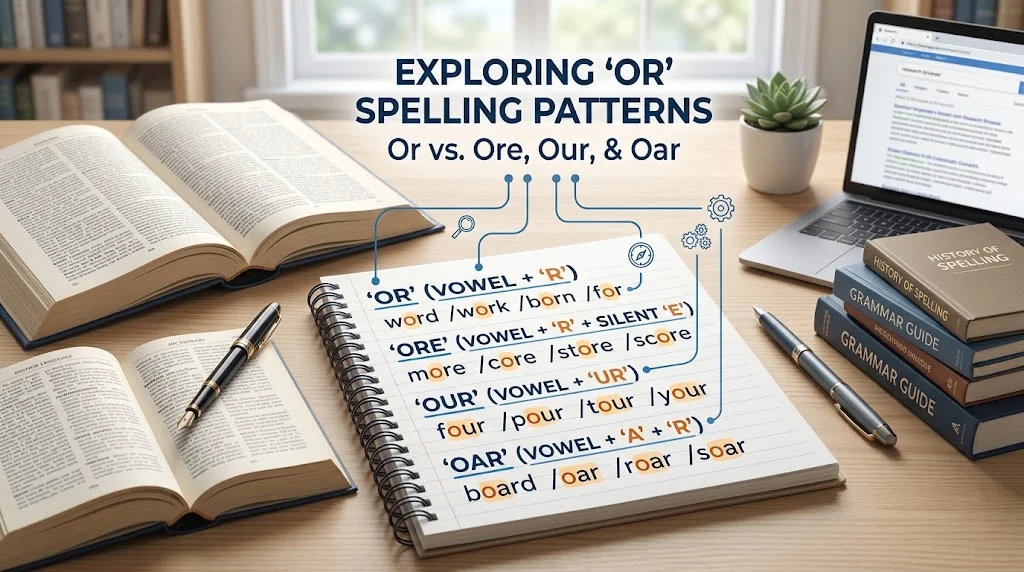
The phrase “words with or” usually refers to English words that contain the letters or together. Common examples include word, work, world, order, morning, story, sport, important, normal, and doctor.
Learning common letter patterns is one of the simplest ways to improve English vocabulary and spelling, yet the combination “or” can be surprisingly confusing. Words such as word, work, world, horse, more, and doctor contain the same two letters but do not always sound exactly the same. This creates problems for English learners, young students, writers, and even advanced speakers who rely heavily on pronunciation when spelling unfamiliar words.
Understanding where “or” appears, how it behaves in different words, and which common patterns are worth remembering gives learners a practical system rather than a collection of isolated spellings. The examples and explanations below focus on real English usage, pronunciation, spelling patterns, and common mistakes.
What Are Words With Or?
The phrase words with or describes English words containing the consecutive letters o and r.
The combination can occur in several positions.
At the beginning:
order
orange
organ
ordinary
In the middle:
morning
important
forest
normal
At the end:
for
door
floor
more
The most important point is that spelling and pronunciation are not always identical. English has many historical spelling patterns, and the letters “or” can represent different sounds in different words.
For example:
sport usually contains a clear “or” sound.
word has a different vowel sound in many accents.
work follows a similar pattern to “word.”
more has a different pronunciation from “morning.”
Therefore, learners should not assume that every occurrence of “or” has exactly the same pronunciation.
Or vs Other Common Letter Patterns: What’s the Difference?
When learning spelling, it helps to distinguish or from similar patterns such as ore, our, oar, and er. These combinations can sometimes sound similar, particularly in certain accents, but they are not interchangeable spellings.
The key lesson is simple.
The letters “or” form a spelling pattern.
Similar sounds do not necessarily require the same spelling.
English spelling depends on word history and established usage.
Pronunciation can vary between accents.
Is Or a Grammar, Vocabulary, or Usage Issue?
The letters “or” are primarily a spelling and vocabulary issue when we are discussing words that contain those letters. However, “or” is also an important grammatical word in English.
As a conjunction, or presents alternatives.
You can have tea or coffee.
Would you like to stay or leave?
We can meet today or tomorrow.
In this grammatical role, “or” does not simply describe a letter combination. It has a specific function in sentence structure.
The distinction matters because someone searching for words containing “or” may be interested in spelling, while someone asking about the word “or” may actually be asking about grammar.
In formal writing, the conjunction “or” is completely standard. It is widely used in academic, professional, technical, and everyday English.
Common Words With Or
There are hundreds of familiar English words containing “or.” Some are especially useful because they occur frequently in everyday communication.
Everyday Words
for
form
word
work
world
door
floor
more
story
morning
short
sport
These words are useful for beginners because they appear frequently in conversation, reading, and writing.
Longer Words
The pattern also appears in longer vocabulary.
important
information
organization
opportunity
performance
government
conversation
comfortable
historical
ordinary
Longer words are especially valuable for vocabulary development because learning a familiar spelling pattern can make unfamiliar words easier to recognize.
Words With Or at the Beginning
Some words begin directly with the letters “or.”
Examples include:
order
orange
organ
organic
ordinary
organization
original
orientation
Consider the sentence:
The manager placed the order yesterday.
Here, “or” appears at the beginning of “order.”
In academic writing:
The organization published an original report.
In technology:
The application allows users to organize their files.
Usage Recap
Words beginning with “or” are common in everyday and formal English. Pay attention to pronunciation because the letters “or” do not guarantee one identical sound in every word.
Words With Or in the Middle
Many common English words contain “or” in the middle.
Examples include:
morning
forest
normal
important
correct
foreign
shorter
worker
computer
information
Workplace example:
The worker completed the report before the meeting.
Academic example:
The research provides important information about language development.
Technology example:
The computer stores information on a local drive.
These examples show why recognizing spelling patterns matters. A learner who can identify familiar combinations can often read and spell longer words more confidently.
Usage Recap
The middle position is one of the most common places to find “or.” Look at the whole word rather than trying to pronounce each letter separately.
Words With Or at the End
The letters “or” can also appear at the end of words.
Examples include:
for
doctor
actor
author
editor
professor
visitor
For example:
The doctor arrived early.
The professor explained the topic clearly.
The editor reviewed the article.
In many words ending in “or,” the letters are associated with a person who performs an action or has a particular role. For example, an actor acts, an editor edits, and a visitor visits.
However, this is a useful spelling observation rather than an absolute rule. English contains many exceptions and historical forms.
Usage Recap
Words ending in “or” often describe people, professions, roles, or objects. Learning related word families can make these spellings easier to remember.
When You Should Not Confuse Or With Similar Spellings
Many spelling mistakes happen because learners hear a familiar sound and choose the wrong letter pattern.
Here are common situations to watch for.
1. Confusing Or With Ore
more and morning do not have the same spelling pattern.
2. Confusing Or With Our
four contains “our,” while for contains “or.”
3. Assuming Every Or Has the Same Sound
The pronunciation of “or” varies across words and accents.
4. Spelling From Sound Alone
English spelling cannot always be predicted from pronunciation.
5. Adding Extra Letters
A learner may incorrectly add “e” to a word that simply ends in “or.”
6. Removing The R
Some accents influence how strongly the final “r” is pronounced. Spelling should still follow the standard written form.
7. Confusing Word Families
Words such as actor, action, and active belong to related families but have different spellings.
Common Mistakes and Decision Rules
Decision Rule
If you are deciding how to spell a word that sounds similar to another word, do not rely only on pronunciation.
The complete word checking.
Check related words.
Check a reliable dictionary when you are uncertain.
The correct spelling depends on the established form of the word, not simply on how the letters sound.
Or in Modern Technology and AI Tools
Modern technology has introduced thousands of new terms into everyday vocabulary, and many contain “or.”
Consider words such as:
processor
browser
monitor
storage
information
organization
controller
generator
AI vocabulary also includes terms such as generator, transformer, information, and processor.
Understanding common spelling patterns can make technical vocabulary easier to read and remember. This is particularly useful for students learning English through technology, programming, artificial intelligence, and online education.
A Short History of Or
The spelling pattern “or” has a long history in English. Many modern English words developed through Old English, Middle English, French, Latin, and other linguistic influences. As pronunciation changed over centuries, spelling often remained relatively conservative.
This explains why English learners sometimes find words such as word, work, more, and four difficult to predict from pronunciation alone.
The spelling system is historical rather than perfectly phonetic.
“English spelling often preserves the history of a word even when modern pronunciation has changed.”
That principle is useful for understanding why spelling patterns should be learned through word families, reading, and repeated exposure rather than pronunciation alone.
Two Practical Case Studies
Case Study 1: English Learner Improving Spelling
Imagine a learner who frequently writes “mornning” instead of “morning.” By recognizing “or” as a stable spelling pattern and learning the complete word visually, the learner can reduce this type of error. Grouping related vocabulary can also make recall faster during writing.
Case Study 2: Student Writing Academic English
A student writing an essay may repeatedly misspell words such as important, information, and organization. Learning these as complete vocabulary items rather than attempting to spell them entirely from sound can improve accuracy and make proofreading more efficient.
The concrete result in both cases is greater spelling consistency, particularly when learners combine pattern recognition with dictionary checking and repeated reading.
Error Prevention Checklist
Always use “or” when
The standard spelling of the word contains the letters “or.”
You are writing a familiar word such as short, normal, or important.
You have confirmed the spelling in a reliable dictionary.
Never use “or” when
The standard word requires ore, our, oar, or another spelling.
You are changing a word’s spelling simply because it sounds similar.
You are guessing the spelling of an unfamiliar word from pronunciation alone.
Related Grammar Confusions You Should Master
Understanding spelling patterns is only one part of becoming a stronger English user. These related areas are also worth mastering:
- Or vs nor
- Either vs neither
- Then vs than
- Your vs you’re
- Their vs there vs they’re
- Affect vs effect
- Its vs it’s
- To vs too vs two
- Who vs whom
- Fewer vs less
These distinctions can improve both grammar accuracy and vocabulary control.
Advanced FAQs
What are common words with or?
Common examples include for, word, work, world, more, door, floor, short, sport, morning, order, important, and information.
What are five words that start with or?
Five examples are order, orange, organ, organic, and ordinary.
What are words that have or in the middle?
Examples include morning, forest, normal, important, correct, computer, information, and conversation.
What words end with or?
Examples include for, doctor, actor, author, editor, professor, and visitor.
Why is or pronounced differently in different words?
English pronunciation is influenced by word history, surrounding sounds, syllable structure, and regional accents. Consequently, the same letters can represent different sounds.
Is or a vowel combination?
The letters “or” combine a vowel letter with the consonant letter “r.” In pronunciation, they can function as a distinctive vowel sound or part of a larger sound pattern.
Is “or” also a grammar word?
Yes. As a conjunction, “or” connects alternatives, as in “Would you like tea or coffee?” It is separate from the question of whether a word happens to contain the letters “or.”
Conclusion
Learning words with or becomes much easier when spelling, pronunciation, vocabulary, and grammar are considered separately. The letters “or” appear in hundreds of everyday English words, but their pronunciation can vary considerably. Instead of trying to create one pronunciation rule for every word, learn common word families, notice spelling patterns, and study examples in context. This approach is more reliable for English learners and helps prevent mistakes in both casual and academic writing.
The most useful lesson is simple: spelling patterns can guide you, but the complete word determines the correct spelling and pronunciation. With regular reading and practice, words containing “or” become much easier to recognize, pronounce, and spell accurately.

Neil Gaiman is an American writer who contributes educational content to LingRoya.com. His work focuses on helping readers improve their English with clear, practical and easy to follow guidance.