Quick Answeer
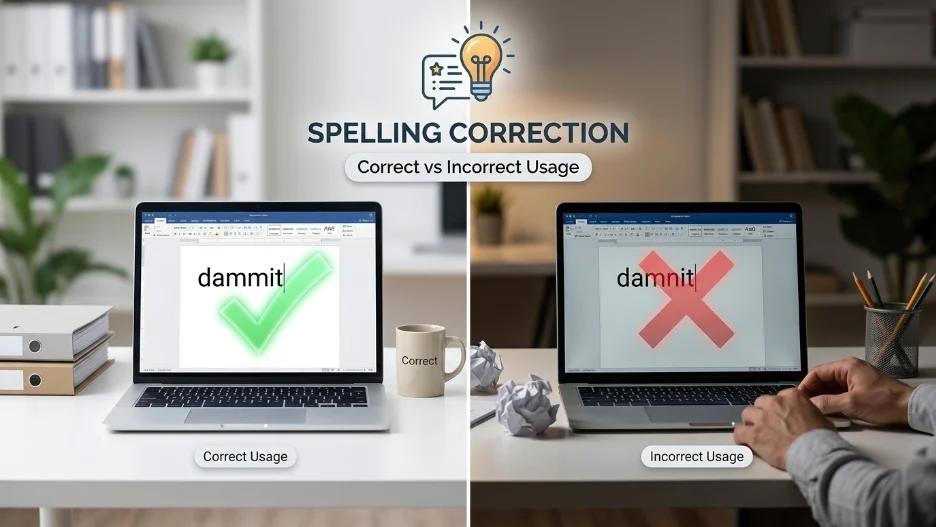
: Dammit is the standard and more widely accepted spelling. It is a mild exclamation used to express frustration, anger, or disappointment (e.g., “Dammit! I forgot my keys.”).Damnit is a less common variant spelling that appears in informal writing but is generally considered nonstandard. For most writing, dammit is the recommended choice.
Many English speakers wonder whether dammit or damnit is the correct spelling. Both forms are used as exclamations to express frustration, annoyance, or disappointment, which is why they often appear interchangeably in informal conversations and online writing.
In modern English, dammit is the standard and more widely accepted spelling. Damnit is a less common variant that occasionally appears in casual writing but is generally considered nonstandard. This guide explains the difference, correct usage, examples, and which spelling you should use in most situations.
Dammit vs Damnit: What is the Difference?
The core of this confusion lies in the difference between a standard spelling, a phonetic spelling, and a misspelling. To understand it fully, we need to break down the evolution of the phrase.
| Term | Spelling | Correctness | Usage Context | Tone/Formality |
| Dammit | Two ‘m’s, no ‘n’ | Correct | Informal writing, dialogue, expressing mild to moderate frustration | Casual, phonetic, conversational |
| Damn it | One ‘m’, one ‘n’ (two words) | Correct | Formal writing, emphatic statements, grammatically standard | Formal, forceful, emphatic |
| Damnit | One ‘m’, one ‘n’ (one word) | Incorrect | Common typo or misspelling | Unprofessional, grammatically wrong |
| Goddammit | Two ‘m’s, no ‘n’ (one word) | Acceptable Variant | Informal writing, expressing stronger frustration | Intensified version, more offensive to some |
The word “dammit” is essentially a contraction of “damn it” . When people speak, the ‘n’ in “damn” is often silent. So, we hear “dam it” rather than “damn it.” “Dammit” is a phonetic spelling, an attempt to write the word exactly as it sounds. “Damn it” is the original, grammatically correct form. However, “damnit” is a hybrid that doesn’t follow the rules of either; it tries to be a one word contraction but keeps the silent ‘n’, making it a common error .
In short, if you are writing informally and want to match the spoken sound, use dammit. For any formal or grammatically precise writing, use damn it. Never use damnit.
Is Dammit vs Damnit a Grammar, Vocabulary, or Usage Issue?
This is primarily a usage and spelling issue, though it has a grammatical root.
From a grammatical standpoint, the correct phrase is “damn it.” In this context, “damn” is a verb used as an imperative, and “it” is the object. You are literally asking a divine power to condemn something .
However, language evolves. “Dammit” has become so common in everyday speech that it has gained acceptance as an informal spelling. It is listed in major dictionaries like Merriam Webster and the American Heritage Dictionary as an interjection . It is a legitimate word, but it is informal or “eye dialect,” a nonstandard spelling that represents how a word is commonly pronounced .
So, while “damn it” is the grammatically correct two word phrase, “dammit” is a formally recognized single word exclamation. The choice between them is a matter of tone and formality, not right or wrong.
Practical Usage of “Dammit”
“Dammit” thrives in casual, emotional, or conversational contexts. It is a mild expletive used to show frustration, disappointment, or emphasis .
Workplace Example
Imagine a project manager working late:
“Dammit, I just realized I saved the wrong version of this file.”
Here, it conveys a moment of personal annoyance without being overly aggressive toward colleagues.
Academic Example
In a fictional dialogue for a novel set in a university library:
He slammed the book shut. “Dammit, I’ve been looking for this reference all week.”
This shows the character’s frustration in a realistic, relatable way.
Technology Example
A developer debugging some code:
“Dammit, this program keeps crashing on startup.”
This is a classic use: expressing mild exasperation at a frustrating but non catastrophic technical issue.
Usage Recap
Use “dammit” when you want to sound natural, human, and a little frustrated. It is the spelling of choice for fiction writers who want their characters to sound authentic and for anyone typing in a casual online forum or texting a friend.
Practical Usage of “Damn it”
“Damn it” carries more weight and formality. It is the original, un contracted version of the phrase. Writing it out as two words can make the exclamation feel more deliberate and emphatic.
Workplace Example
In a formal email to a boss:
“I’m afraid we’ve missed the deadline on the project, damn it.”
While still informal for a corporate setting, it is a better choice than “dammit” if you must express frustration in writing. It looks more serious and less slangy.
Academic Example
In a formal academic paper analyzing dialogue from a historical figure:
The general was recorded as exclaiming, “Damn it, man, hold the line!”
Using “damn it” here maintains a sense of historical and grammatical accuracy.
Technology Example
A comment in a piece of code:
// This function is failing for unknown reasons, damn it.
This is the standard way to add a touch of personality to a codebase while maintaining a professional look.
Usage Recap
Use “damn it” when you need a grammatically standard phrase or want a more emphatic, serious tone. It is the better choice for semi formal writing, professional contexts, or any situation where you feel “dammit” is too casual.
When You Should NOT Use Dammit or Damnit
Knowing when to use a phrase is just as important as knowing when to avoid it. Here are some common misuse scenarios .
- Formal Business Proposals: Using “dammit” or “damn it” in a formal proposal to a client will make you look unprofessional.
- Academic Essays: Unless it is part of a direct quote, using any form of this expletive in an academic essay is generally inappropriate.
- Corporate Emails to Management: It is almost always better to use more professional language to express disappointment.
- Professional Blog Posts: If you are writing a thought leadership piece for your company, avoid these terms to maintain credibility.
- When You Mean the Word “Dam” (as in a water barrier): Spelling it “dammit” would be a comical error.
- When You Are Being Polite: In a formal setting or with people you don’t know well, it is a swear word and may be offensive.
- When You Are Dictating to a Voice Assistant: It may mishear you, so it’s best to avoid.
- Never Use “Damnit”: This is not a use case; it is a mistake. Always avoid this spelling.
Common Mistakes and Decision Rules
The most common mistake is the spelling “damnit . This error happens because people know there is an ‘n’ in “damn,” but they are trying to write a single, contracted word.
| Correct Sentence | Incorrect Sentence | Explanation |
| Dammit, I knew I should have taken the other road. | Damnit, I knew I should have taken the other road. | “Damnit” is a common misspelling; “dammit” is the correct phonetic spelling. |
| Damn it, we need to focus. | Damnit, we need to focus. | When using a more formal tone, the two word spelling “damn it” is correct. |
| For the last time, it’s dammit, not damnit. | For the last time, it’s damnit, not dammit. | The first sentence is correct; the second is stating the opposite of the truth. |
| Please, dammit, just listen to me. | Please, damnit, just listen to me. | “Damnit” is never the correct form. |
Decision Rule Box
- If you are writing informally and want to sound like speech, use dammit.
- If you are writing formally or want to be grammatically precise, use damn it.
- If you are writing the word as one single word, use two ‘m’s: dammit.
- If you are tempted to write “damnit”, stop. It is a misspelling .
Dammit and Damn it in Modern Technology and AI Tools
It is interesting to see how modern tools handle this spelling distinction. Most spell checkers and grammar correction tools, like Grammarly or Microsoft Word, will flag “damnit” with a red squiggly line and suggest “dammit” or “damn it” as corrections . This is a clear sign that “damnit” is considered an error by the primary authorities on language in the digital age. For example, ProWritingAid notes that both “dammit” and “damn it” are correct but often questions from users show they are unsure .
AI chatbots and writing assistants will also suggest the correct forms. This is because they are trained on vast datasets of correct English, reinforcing that “dammit” and “damn it” are standard, and “damnit” is not.
The Etymology and Evolution of Dammit
The origin of the word goes back to the Latin word damnare, meaning “to condemn” or “to inflict loss upon” . It entered English through Old French and has been used as a mild oath for centuries. The phrase “damn it” literally meant to ask a deity to condemn something to hell.
The single word form “dammit” emerged much later. The Oxford English Dictionary (OED) traces it back to at least 1905 . This spelling came about because the ‘n’ in “damn” is often silent, so writers began to spell the word as it was pronounced in casual speech. It is an example of “eye dialect,” a literary technique where a word is spelled to match its pronunciation . This is why “dammit” feels more conversational and human than the more formal “damn it.”
Related Grammar Confusions You Should Master
If you have struggled with “dammit vs. damnit,” you might also find these other common confusions interesting. Mastering them will significantly improve your writing.
- A lot vs. Alot: “A lot” is the correct two word phrase. “Alot” is a misspelling.
- Its vs. It’s: “Its” is possessive. “It’s” is a contraction for “it is.”
- Your vs. You’re: “Your” is possessive. “You’re” is a contraction for “you are.”
- There, Their, and They’re: All sound the same but have very different meanings.
- Effect vs. Affect: “Effect” is usually a noun (a result). “Affect” is usually a verb (to influence).
- Alot vs. A lot: A common typo that can make your writing look unpolished.
- Everyday vs. Every day: “Everyday” is an adjective (ordinary). “Every day” means each day.
- Good vs. Well: “Good” is an adjective. “Well” is an adverb.
- Who vs. Whom: “Who” is for a subject. “Whom” is for an object.
- I vs. Me: “I” is for a subject. “Me” is for an object.
Advanced FAQs
Is dammit a bad word?
Yes. Dammit is considered a mild swear word used to express frustration, though it is generally less offensive than stronger profanity.
Is it dammit, damnit, or damn it?
Dammit and damn it are both correct. Damnit is a common misspelling and should be avoided.
What is the difference between dammit and damnit?
Dammit is the standard informal spelling, while damnit is simply an incorrect variant with no accepted use in standard English.
Why do people spell it as dammit?
Dammit reflects the way “damn it” is commonly pronounced, making it a natural informal contraction.
Where does the word dammit come from?
It developed as an informal spelling of “damn it,” which ultimately comes from the Latin damnare, meaning “to condemn.”
Is it okay to use dammit in a professional email?
No. Dammit is informal and should generally be avoided in professional or formal communication.
What does as near as dammit mean?
This informal British idiom means “almost exactly” or “very nearly.”
Conclusion
The battle between “dammit” and “damnit” is not much of a battle at all. One is correct, and the other is a common error. “Dammit” is the phonetic, informal spelling that reflects how we actually say the word. “Damn it” is the grammatically correct, two word phrase. Both are fine in the right context. The key is to never use “damnit,” which is the worst of both worlds: a misspelling that looks unprofessional. The next time you are frustrated and need to type it out, remember to drop the ‘n’. It is a small detail, but it makes a world of difference to grammar enthusiasts and, more importantly, to the quality of your writing.

Neil Gaiman is an American writer who contributes educational content to LingRoya.com. His work focuses on helping readers improve their English with clear, practical and easy to follow guidance.