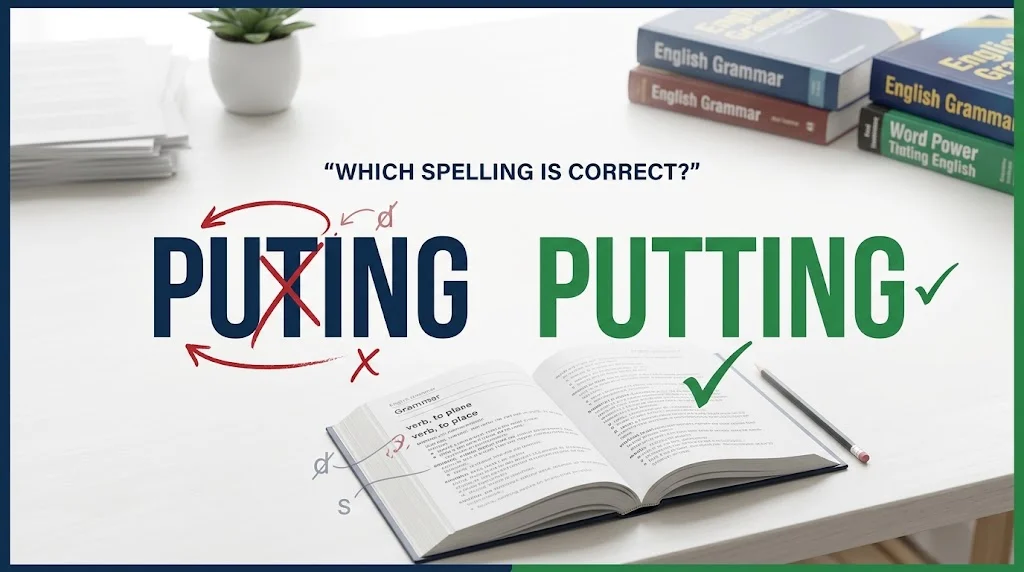
“Puting or putting” is a common spelling question because the verb “put” does not follow the usual pattern for adding “ing.” The correct form is “putting,” with two t’s. “Puting” is a misspelling.
If you are wondering whether to write “puting” or “putting,” always choose “putting” in standard English. “Putting” is the present participle and gerund form of the verb “put,” while “puting” is not a standard English spelling.
This small spelling difference matters in school assignments, professional writing, emails, websites, and everyday communication because a missing letter can make otherwise correct writing look careless or incorrect. The reason is simple: when “put” takes the “ing” ending, its final consonant is doubled, producing “putting.” Understanding this spelling rule makes it easier to recognize similar forms and avoid repeated mistakes.
Putting vs Puting: What’s the Difference?
The difference between “putting” and “puting” is straightforward. Putting is the correct English word. Puting is an incorrect spelling.
The word put is a verb. It can mean to move or place something in a particular position, to cause something to be in a particular state, or to express an action in many other contexts.
When “ing” is added to “put,” the correct form is putting.
| Form | Part of speech | Correct? | Meaning |
| Putting | Verb form, gerund, present participle | Yes | The action of placing, moving, or causing something |
| Puting | Nonstandard spelling | No | Incorrect spelling of putting |
| Put | Verb | Yes | To place, move, cause, or position something |
Mini Recap
“Putting” is the only standard spelling.
“Puting” is a spelling error.
The verb “put” becomes “putting” when “ing” is added.
The final “t” is doubled before the ending is attached.
This pattern is important for accurate English writing.
Is Putting vs Puting a Grammar, Vocabulary, or Usage Issue?
This is primarily a spelling and word formation issue, rather than a vocabulary difference.
There are not two interchangeable words called “putting” and “puting.” Instead, one is standard English and the other is an incorrect spelling.
For example:
Correct: She is putting the books on the shelf.
Incorrect: She is puting the books on the shelf.
The meaning intended by the writer is clear in the second sentence, but the spelling is still incorrect.
Formal and Informal Usage
Putting is appropriate in virtually every variety of standard English. You can use it in formal reports, academic essays, business emails, instructions, conversations, and casual messages.
Puting should not be treated as an informal alternative. Unlike some spelling variations that are accepted in different English speaking regions, “puting” is not a standard British or American spelling.
Academic and Casual Usage
Students should always write putting in assignments, examinations, essays, and research work.
In casual digital communication, people sometimes make spelling mistakes because they type quickly. Even so, putting remains the correct form.
Putting in Practical English
“Putting” appears frequently in everyday English because “put” is an extremely versatile verb.
Workplace Example
Correct: I am putting the updated figures into the report.
Here, “putting” describes the action of entering or placing information into a document.
Another example is:
The manager is putting together a new training plan.
In this sentence, “putting together” means creating or assembling something.
Academic Example
Correct: The researcher is putting the results into context.
Here, “putting” is part of the phrase “putting into context,” meaning explaining something by connecting it with relevant information.
Technology Example
Correct: I am putting the files into the shared folder.
Technology has not changed the spelling of the word. Whether you are putting files into cloud storage, putting information into a database, or putting text into an AI tool, the spelling remains the same.
Usage Recap
Use putting whenever you need the “ing” form of “put.”
It works naturally in professional, academic, casual, and technological contexts.
Puting in Practical English
Because “puting” is not a standard English word, it does not have legitimate workplace, academic, or technology usage.
Workplace Example
Incorrect:
I am puting the document in the correct folder.
Correct:
I am putting the document in the correct folder.
Academic Example
Incorrect:
The study is puting the evidence into a wider context.
Correct:
The study is putting the evidence into a wider context.
Technology Example
Incorrect:
The application is puting the data into storage.
Correct:
The application is putting the data into storage.
Usage Recap
Do not use “puting” as an alternative spelling.
If you are describing an ongoing action involving the verb “put,” use putting.
When You Should NOT Use Puting or Putting
There are several situations where writers commonly make mistakes with this word.
1. Do not write puting when adding “ing”
Incorrect:
She is puting the dishes away.
Correct:
She is putting the dishes away.
2. Do not treat puting as a British spelling
British English and American English both use putting.
3. Do not use putting when you need the simple form put
Incorrect:
Please putting the book here.
Correct:
Please put the book here.
After “please,” the base form is normally required.
4. Do not confuse putting with past tense
Putting describes an ongoing action or functions as a gerund.
She is putting the keys on the table.
The simple past is:
She put the keys on the table.
5. Do not assume every verb follows the same spelling pattern
English spelling rules depend on the structure of the individual word. “Put” is a short verb whose final consonant is doubled before “ing.”
6. Do not consider puting an acceptable informal form
Typing quickly does not make “puting” a recognized alternative.
7. Do not change the word to avoid the spelling issue
There is no need to replace “putting” with an awkward synonym simply because the spelling rule seems unusual.
Common Mistakes and Decision Rules
Decision Rule Box
If you mean the ongoing action of placing, moving, or causing something to be somewhere, use “putting.”
If you mean the basic action itself, use “put.”
There is no standard situation in which “puting” should replace “putting.”
Why Does Put Become Putting?
The spelling becomes easier to understand when you look at English word formation.
The base verb is put. When English adds the “ing” ending, the final consonant is doubled:
put + ing = putting
The double t is part of the standard spelling.
This may seem unusual because learners often learn a simpler pattern:
work + ing = working
read + ing = reading
play + ing = playing
However, English spelling contains several patterns that depend on the final letters and pronunciation of the base word. Short verbs such as “run” become “running,” “sit” becomes “sitting,” and “stop” becomes “stopping.”
“Put” follows the same broad consonant doubling principle:
put → putting
Putting in Modern Technology and AI Tools
Modern technology has created thousands of situations in which people use the word “putting.”
You might write:
Putting information into an AI prompt
Putting files into cloud storage
Putting data into a spreadsheet
Putting instructions into a software system
Putting content into a website
AI writing assistants may also encounter the misspelling “puting.” A good language tool should recognize it as a likely spelling error and suggest putting.
However, automated correction does not replace understanding. Writers should still know why the correct form contains two t letters, particularly when producing professional or academic content.
Etymology of Put and Putting
The verb put has a very old history in English. It is related to Middle English forms and has Germanic roots. Unlike many verbs, “put” has retained the same basic form across several grammatical uses.
Modern English uses “put” as both its present and past form:
I put the book here.
Yesterday, I put the book here.
When the “ing” ending is added, however, the spelling changes:
put + ing = putting
This makes “putting” distinctive because the base form stays short while the final consonant is doubled.
Expert Style Explanation
“The safest way to remember the spelling is to treat putting as put plus ing, with the final t doubled.”
This reflects the standard spelling pattern used in contemporary English.
Two Practical Case Studies
Case Study 1: Academic Writing
Imagine a student writing an essay about scientific evidence. The student repeatedly writes “puting” instead of “putting.”
A proofreading review identifies five occurrences and corrects each one. The final paper contains the standard spelling throughout.
Result: The student eliminates five spelling errors without changing the meaning or structure of the essay.
This example shows why a small spelling rule can have a noticeable effect on polished academic writing.
Case Study 2: Workplace Communication
Consider a professional preparing instructions for a team. The original document contains the sentence:
We are puting the updated files in the shared folder.
During editing, “puting” is changed to “putting.”
Result: One incorrect spelling is removed, and the instruction becomes consistent with standard written English.
These are illustrative editing examples rather than published experimental studies. Their purpose is to demonstrate how the rule works in realistic writing.
Error Prevention Checklist
Always use Putting when
☑ You are describing an action happening now.
You need the present participle of “put.”
☑ “Put” is functioning as a gerund.
You are writing formally or academically.
☑ You are describing an action involving files, information, objects, or ideas.
Never use Puting when
☒ You intend the standard English form of “putting.”
You are writing an academic assignment.
☒ You are preparing professional communication.
You are publishing website content.
☒ You are writing instructions or documentation.
Related Grammar Confusions You Should Master
Understanding “putting” also gives English learners a useful opportunity to review other common spelling and grammar distinctions.
- Run vs running
- Sit vs sitting
- Stop vs stopping
- Begin vs beginning
- Make vs making
- Lie vs lying
- Tie vs tying
- Write vs writing
- Use vs using
- Plan vs planning
These examples demonstrate that English verbs do not all form their “ing” forms in exactly the same way.
Frequently Asked Questions
Is puting or putting correct?
Putting is correct. “Puting” is a misspelling and is not a standard English word.
Why is putting spelled with two t letters?
The final consonant of “put” is doubled when the “ing” ending is added, producing “putting.”
Is puting a word in the dictionary?
“Puting” is not the standard English spelling of the present participle of “put.” The correct form is “putting.”
Is putting correct in British English?
Yes. British English uses putting, just like American English.
Is putting correct in American English?
Yes. Putting is the standard American English spelling.
Is putting a verb or a noun?
“Putting” can function as a present participle in a verb phrase or as a gerund when it acts like a noun.
What is the difference between put and putting?
“Put” is the base form of the verb, while “putting” is its “ing” form. The correct spelling of the latter contains two t letters.
How do I remember the spelling of putting?
Think of it as put + ing, then double the final t: putting.
Conclusion
The choice between “puting or putting” is not a matter of personal preference or regional spelling. Putting is the correct standard English form, while puting is a spelling error. The easiest way to remember the distinction is to recognize that “put” becomes “putting” when the “ing” ending is added.
Once this pattern becomes familiar, you can apply the same awareness to related words such as running, sitting, stopping, and planning. Whether you are writing an academic essay, workplace email, website article, or technology instruction, use putting whenever you need the “ing” form of “put.”

Philip Pullman is an American writer dedicated to creating clear and easy to follow English content. Through his work at LingRoya.com, he helps readers strengthen their language skills with practical and reliable guidance so that they can easily understand.