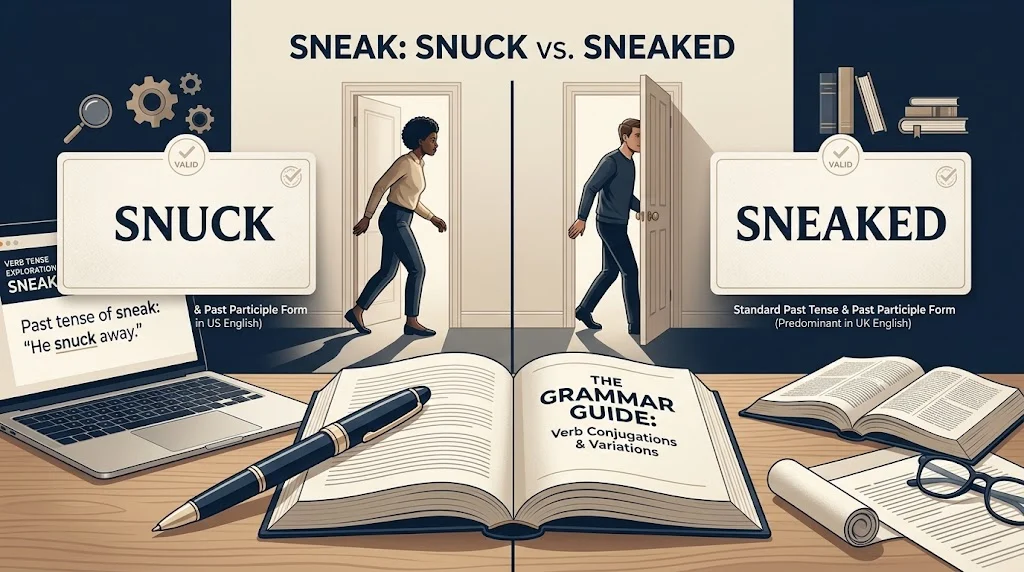
Snuck is especially common in American English and is widely accepted in informal and modern standard usage. Sneaked is traditional and remains common in British English and more formal contexts. Neither form changes the basic meaning.
The short introduction is that both forms are grammatically acceptable. Snuck is the irregular past tense that became especially popular in American English, while sneaked is the regular past tense and has a longer history in English. If you’re writing for an American audience, snuck will usually sound natural. For British English or a deliberately traditional style, sneaked may be preferable.
Snuck vs Sneaked: What’s the Difference?
Snuck and sneaked are both past tense and past participle forms of the verb sneak.
The verb sneak means to move quietly, secretly, or without attracting attention. It can also describe doing something secretly.
For example:
“She sneaked into the building after everyone had left.”
“She snuck into the building after everyone had left.”
Both sentences communicate essentially the same idea.
| Feature | Snuck | Sneaked |
| Base verb | Sneak | Sneak |
| Part of speech | Past tense and past participle | Past tense and past participle |
| Meaning | Moved or acted secretly | Moved or acted secretly |
| Formation | Irregular form | Regular form |
| Regional association | Especially common in American English | Traditional and common in British English |
| Formal acceptability | Accepted in modern standard English | Accepted in standard English |
| Example | He snuck outside. | He sneaked outside. |
Mini recap
Snuck and sneaked have the same basic meaning.
Snuck is especially common in American English.
Sneaked is the regular historical form and remains widely used.
Both forms can be grammatically correct.
The best choice depends on audience, style, and regional convention.
Is Snuck vs Sneaked a Grammar, Vocabulary, or Usage Issue?
This is primarily a grammar and usage question involving verb forms.
The two words are not different vocabulary items with different meanings. They are alternative past tense forms of the same verb.
English has many irregular verbs. For example, we say “go” and “went” rather than “goed.” Similarly, snuck developed as an irregular form of sneak.
Sneaked, however, follows the regular pattern of adding the past tense ending to the base verb.
The two forms are therefore not interchangeable in every stylistic situation, even though they are interchangeable in basic meaning.
Formal versus informal usage
Sneaked has traditionally been viewed as the more conventional form in some varieties of English. Snuck was once criticized by some language commentators because it developed as a nonstandard or irregular form.
Modern usage has changed considerably. Snuck is now firmly established in standard American English and appears in edited publications, dictionaries, journalism, and professional communication.
That does not mean every audience will have the same reaction. Some readers still perceive sneaked as more traditional or formal.
Academic versus casual usage
In academic writing, either form can be grammatically defensible, but consistency matters. If your institution or publisher follows British English, sneaked may fit the established style better.
In American academic writing, snuck is acceptable, although writers may choose sneaked when they want a more traditional tone.
The important lesson is that grammatical correctness and stylistic preference are not always the same thing.
How to Use Snuck Correctly
Snuck is the irregular past tense and past participle of sneak. It is particularly common in American English.
Consider:
“He snuck out before the meeting ended.”
“She snuck the letter into her bag.”
“They had snuck inside before the rain started.”
The word can describe physical movement as well as a secret action.
Workplace example
A manager might say, “The employee snuck out before the presentation ended.”
The sentence uses snuck to describe an action completed in the past.
In a more formal corporate report, however, a writer might choose “left without notice” because it communicates the same event in a more neutral tone.
Academic example
An American academic paper discussing behavior could state, “The participant snuck away from the observation area.”
The form is grammatically possible, although the academic context might favor a more precise phrase such as “left the observation area without authorization.”
Technology example
A technology article might say, “The application snuck onto the device during the installation process.”
This is an informal and vivid use of the verb. In technical documentation, “was installed without explicit user selection” would usually be more precise.
Snuck usage recap
Snuck is correct in modern standard English.
It is especially natural in American English.
It often sounds conversational and direct.
In highly formal technical writing, a more precise verb may sometimes be preferable.
How to Use Sneaked Correctly
Sneaked is the regular past tense and past participle of sneak. It remains fully acceptable in English.
Examples include:
“She sneaked out through the back door.”
“He sneaked a look at the answer.”
“They had sneaked into the room before the event began.”
The form is particularly useful when following a traditional or British English style.
Workplace example
A British business writer might write, “The employee sneaked out before the meeting finished.”
The sentence is grammatically correct and natural for many British readers.
Academic example
A researcher writing in a traditional style might say, “The subject sneaked away from the observation point.”
The form fits a formal written register without being grammatically unusual.
Technology example
A technology journalist could write, “The feature sneaked into the latest version of the application.”
This creates a slightly playful tone while remaining clear.
Sneaked usage recap
Sneaked is grammatically correct.
If it follows the regular past tense pattern.
It is common in British English and traditional writing.
It can also be used by American writers who prefer the regular form.
When You Should NOT Use Snuck or Sneaked
There are several situations where choosing either form without considering context can create an unnecessary problem.
- Do not claim that snuck is always incorrect.
Modern American English widely accepts it.
- Do not claim that sneaked is outdated or grammatically wrong.
It remains a standard English form.
- Do not switch between the forms randomly within the same document.
Consistency produces a more polished result.
- Do not choose a regional form without considering your audience.
American and British readers can have different preferences.
- Do not use either form when you need a highly precise technical description.
In some contexts, a phrase such as “entered without authorization” may be clearer than sneak.
- Do not assume that formal writing automatically requires sneaked.
Register depends on context, audience, and publication style.
- Do not treat snuck and sneaked as having different meanings.
The basic meaning is the same.
- Do not correct someone automatically simply because they use the form you personally prefer.
Regional English variation is not necessarily an error.
Common Mistakes and Decision Rules
| Correct sentence | Incorrect sentence | Explanation |
| He snuck out of the office. | He sneaked out of the office. | The second sentence is not actually incorrect. Both forms are acceptable. |
| She sneaked into the room. | She snuck into the room. | The second sentence is also correct, especially in American English. |
| They snuck away quietly. | They snuck away quiet. | Quietly is the appropriate adverb modifying the action. |
| He had sneaked into the building. | He had sneaked in the building. | The preposition into is appropriate when emphasizing movement inside. |
| She snuck a glance at the document. | She sneak a glance at the document. | A completed past action requires a past tense form. |
Decision Rule Box
When you prefer modern American English, snuck is usually the natural choice.
You prefer traditional or British English, sneaked is often the natural choice.
If your publisher has a style guide, follow its established preference.
If neither regional preference matters, either form can be grammatically correct.
Snuck and Sneaked in Modern Technology and AI Tools
Modern technology has made regional language differences easier to notice.
Grammar checkers, word processors, search engines, and AI writing systems may recommend different forms depending on their language settings. An American English setting may treat snuck as completely ordinary, while another system may favor sneaked because of its regional configuration.
AI generated content presents a related challenge. An AI system can produce fluent English while moving between American and British conventions within the same article. This can make the writing appear inconsistent even when individual sentences are grammatically correct.
Etymology and History of Snuck and Sneaked
The verb sneak is relatively recent compared with many basic English verbs. It developed in English to describe moving stealthily or acting secretly.
Sneaked follows the regular English pattern of forming the past tense by adding the standard past tense ending.
Snuck developed later as an irregular alternative. It became especially prominent in North American English during the nineteenth and twentieth centuries.
The history illustrates an important feature of English: irregular forms can become established even when a regular form already exists. Once a form becomes widespread among educated speakers and appears consistently in edited writing, it can become a legitimate part of standard usage.
“English does not remain fixed; accepted usage develops when a form becomes established across generations of speakers and writers.”
That principle explains why snuck can be both historically newer and completely acceptable in contemporary English.
Two Practical Case Studies
Case Study One: American Editorial Style
Imagine an American magazine editing an article about a celebrity who secretly entered a private event. The original draft alternates between sneaked and snuck.
The editor changes every instance to snuck because the publication follows American English and has a conversational editorial voice.
The concrete result is improved stylistic consistency. Readers encounter one established form instead of switching between competing conventions.
Case Study Two: British Publishing Style
Consider a British educational publisher preparing a grammar workbook. The editorial team follows British English throughout the publication.
The editors retain sneaked when presenting the past tense of sneak. The choice aligns with the publication’s established regional style and avoids introducing an American preference where it is unnecessary.
The practical result is a consistent language model for students and teachers using the material.
Error Prevention Checklist
Always use snuck when
You are writing in contemporary American English.
Your publication prefers the irregular form.
Your audience is accustomed to American English usage.
The conversational tone makes snuck sound natural.
Never use sneaked when
Your style guide specifically requires snuck.
When you are deliberately maintaining an American English convention throughout the document.
You are changing the form merely because you assume sneaked is always more correct.
You are correcting an accepted American usage without an editorial reason.
Related Grammar Confusions You Should Master
Understanding this distinction can lead to a broader understanding of English verb variation. Useful related topics include:
- Learned and learnt
- Dreamed and dreamt
- Spelled and spelt
- Burned and burnt
- Leaped and leapt
- Smelled and smelt
- Pleaded and pled
- Fit and fitted
- Gotten and got
- Proved and proven
These pairs show how English sometimes permits multiple forms while regional usage, historical development, and style determine which form sounds most natural.
FAQs
Is snuck or sneaked grammatically correct?
Both are grammatically correct past tense forms of sneak. Snuck is especially common in American English, while sneaked is the regular form and remains widely used, particularly in British English.
Is snuck a real word?
Yes. Snuck is a recognized and established past tense and past participle form of sneak. It is particularly common in contemporary American English.
Is sneaked better than snuck?
Neither is universally better. Sneaked may suit British or traditional writing, while snuck is often more natural for American readers. The best choice depends on audience and style.
Is snuck formal English?
Snuck is accepted in standard English, including edited American writing. However, some readers perceive sneaked as more traditional, so style and audience can influence the choice.
Is sneaked correct in American English?
Yes. Sneaked is grammatically acceptable in American English, although snuck is often more common in everyday American usage.
Is snuck correct in British English?
Snuck is understood in British English, but some British readers may prefer sneaked because it follows the regular verb pattern and traditional usage.
What is the past tense of sneak?
Both sneaked and snuck can function as the past tense of sneak. The choice is influenced by regional and stylistic preferences.
Conclusion
The choice between snuck and sneaked is a useful reminder that English has more than one legitimate path for forming some verb forms. Snuck is an established irregular past tense that is particularly common in American English. Sneaked is the regular form and remains widely accepted, especially in British and traditional usage.
Neither form changes the fundamental meaning of sneak. The real question is which form best matches your audience, region, tone, and editorial standards.
For American English, snuck will usually sound natural. For British English or a deliberately traditional style, sneaked may be the preferred choice. If you are working under a publication style guide, follow that guide rather than relying on personal preference.

Philip Pullman is an American writer dedicated to creating clear and easy to follow English content. Through his work at LingRoya.com, he helps readers strengthen their language skills with practical and reliable guidance so that they can easily understand.