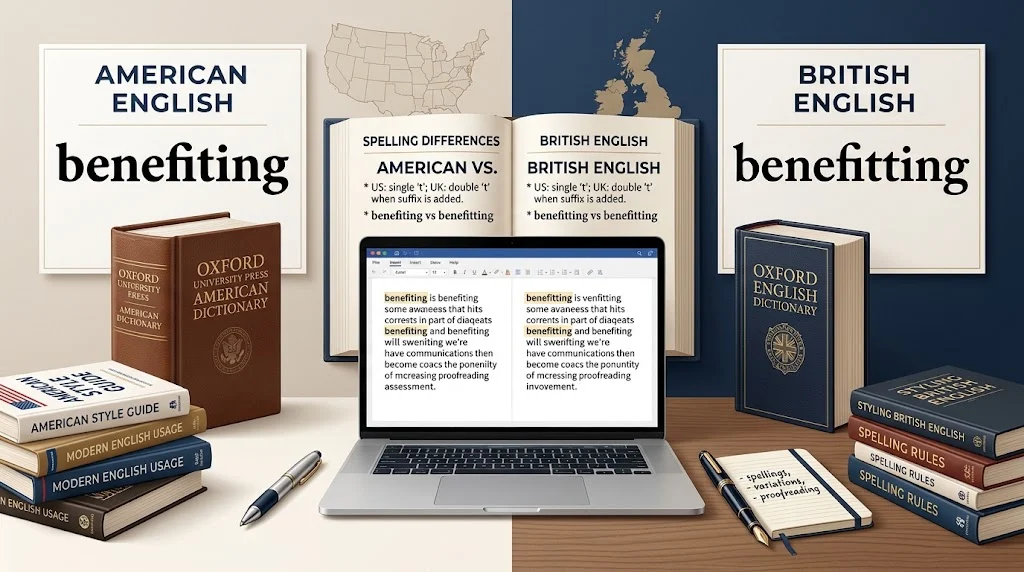
Both spellings are recognized in English, but benefitting and benefiting follow different spelling conventions. Benefiting with one t is the standard and more widely preferred form in American English, while benefitting with two t’s is common in British English and other varieties.
The safest choice for most international and American English writing is benefiting with one t. British English commonly accepts benefitting with two t’s because of a spelling convention that doubles the final consonant before adding certain suffixes. Neither spelling is automatically wrong. The important point is consistency within the same document.
Benefitting vs Benefiting: What’s the Difference?
Benefiting and benefitting are forms of the verb benefit. They can function as present participles in progressive constructions or as gerunds when the verb acts as a noun.
For example:
“The company is benefiting from the new policy.”
“Students are benefiting from additional resources.”
“Benefiting from experience takes time.”
The meaning does not change when the spelling changes. The difference lies in the treatment of the final consonant before the ending ing.
| Feature | Benefiting | Benefitting |
| Base verb | Benefit | Benefit |
| Part of speech | Verb form | Verb form |
| Meaning | Receiving an advantage | Receiving an advantage |
| Common regional preference | American English | British English |
| Spelling | One t | Two t’s |
| Example | The company is benefiting from growth. | The company is benefitting from growth. |
| Meaning difference | None | None |
Mini recap
Benefiting and benefitting have the same meaning.
Benefiting is especially common in American English.
Benefitting is widely used in British English.
Neither spelling changes the meaning of the sentence.
Consistency with your chosen variety of English is the most important consideration.
Is Benefitting vs Benefiting a Grammar, Vocabulary, or Usage Issue?
This is primarily a spelling and usage issue rather than a vocabulary distinction.
The verb benefit has exactly the same meaning regardless of whether the final t is doubled before the ending ing. Both forms describe receiving an advantage or gaining something positive.
They are therefore interchangeable in meaning, but regional writing conventions influence which spelling looks more natural.
In American English, writers generally use benefiting. The same pattern appears in related forms such as benefited, where American spelling normally keeps a single t.
British English has traditionally allowed more consonant doubling in certain words when suffixes are added. As a result, benefitting and benefitted are frequently encountered in British writing.
Formal versus informal usage
Both forms can appear in formal writing. The choice is not about whether the sentence is professional or casual. It is about which English spelling convention you are following.
Academic versus casual usage
Academic writers should follow the spelling standards required by their institution, publisher, or style guide. Casual writers can generally choose the regional form that matches their usual variety of English.
The key is consistency. Switching between benefiting and benefitting in the same document can make the writing appear poorly edited.
How to Use Benefiting Correctly
Benefiting is the preferred spelling in American English and is also widely understood internationally.
It means receiving an advantage or experiencing a positive result.
For example:
“The employees are benefiting from the new training program.”
“The local economy is benefiting from increased tourism.”
“The patient is benefiting from regular exercise.”
Workplace example
A business report might state:
“Employees are benefiting from the company’s flexible working policy.”
The word describes the positive effect employees are receiving from the policy.
Academic example
An academic paper might say:
“Students are benefiting from access to digital learning resources.”
Here, benefiting describes the positive result experienced by students.
Technology example
A technology article could state:
“Small businesses are benefiting from automated customer support.”
The sentence describes an advantage created by technology.
Benefiting usage recap
Use benefiting when following American English spelling conventions.
It is appropriate in formal, academic, professional, and casual writing.
Its meaning is exactly the same as benefitting.
How to Use Benefitting Correctly
Benefitting is a widely accepted spelling in British English and is also found in other varieties of English influenced by British spelling conventions.
For example:
“The organization is benefitting from increased investment.”
“The students are benefitting from the revised curriculum.”
“The community is benefitting from improved transport links.”
The double t does not create a different pronunciation or meaning. It simply reflects a spelling convention.
Workplace example
A British business report might say:
“The company is benefitting from strong international demand.”
This is perfectly natural within British English spelling.
Academic example
A British university publication might state:
“Researchers are benefitting from access to larger datasets.”
The spelling follows the regional convention.
Technology example
A British technology publication could write:
“Consumers are benefitting from faster internet services.”
Again, the meaning is identical to benefiting.
Benefitting usage recap
Use benefitting when following British English spelling conventions.
It is acceptable in professional and academic writing.
Do not treat the extra t as a change in meaning.
When You Should NOT Use Benefitting or Benefiting
There are several situations in which writers make avoidable mistakes.
- Do not switch between the two spellings randomly within one article.
Choose a regional convention and maintain it.
- Do not assume that benefitting is always incorrect.
It is a legitimate spelling in British English.
- Do not assume that benefiting is always the only acceptable form.
It is strongly preferred in American English but does not eliminate the British form.
- Do not change spelling simply because another website uses a different form.
Different English varieties follow different conventions.
- Do not mix American and British spelling without a deliberate reason.
A consistent editorial style is more professional.
- Do not confuse the spelling with the meaning.
Both forms mean receiving an advantage.
- Do not use either form when the intended meaning is different.
If you mean “giving someone an advantage,” the appropriate verb is usually benefiting someone only when the grammar supports that construction, or another verb such as helping or assisting depending on the sentence.
- Do not assume a spelling checker automatically determines your preferred English variety.
Software settings can influence which spelling a program accepts or recommends.
Common Mistakes and Decision Rules
| Correct sentence | Incorrect sentence | Explanation |
| American readers are benefiting from the service. | American readers are benefitting from the service. | Benefiting is the usual American spelling. |
| British readers are benefitting from the service. | British readers are benefiting from the service. | Benefitting is widely preferred in British usage. |
| Students are benefiting from the program. | Students are benefitting from the program. | The first form follows American spelling. |
| Students are benefitting from the program. | Students are benefiting from the program. | The first form follows British spelling. |
| The company is benefiting from growth. | The company is benefitingg from growth. | The final consonant is not tripled. |
Decision Rule Box
When you are writing in American English, use benefiting.
For writing in British English, benefitting is a standard and widely accepted choice.
If your publication has a style guide, follow its spelling preference.
If your audience is international, choose one convention and use it consistently.
Benefitting and Benefiting in Modern Technology and AI Tools
Technology has made regional spelling differences more visible.
Search engines, grammar checkers, word processors, content management systems, and AI writing tools may identify one spelling as preferred depending on their language settings.
An American English setting may recommend benefiting, while a British English setting may accept or recommend benefitting.
AI tools create another consideration. A generated article may unintentionally mix regional spelling conventions if its instructions do not specify the intended variety of English. For publishers targeting a particular country, specifying American English or British English can improve consistency.
Etymology and Spelling History
The word benefit ultimately traces back through French to Latin beneficium, referring to a favor, service, advantage, or benefit.
The modern English verb developed from the noun benefit. When English adds suffixes such as ing and ed, spelling conventions sometimes determine whether the final consonant is doubled.
British and American English developed different preferences over time. British spelling retains more consonant doubling in several words, while American spelling often simplifies the spelling.
This is why you may encounter pairs such as:
“benefiting” and “benefitting”
“benefited” and “benefitted”
The difference reflects spelling tradition rather than a difference in grammatical meaning.
“When two spellings carry the same meaning, good editing depends on consistency, audience awareness, and respect for the chosen variety of English.”
This principle is particularly useful for publishers working with international audiences.
Two Practical Case Studies
Case Study One: American Academic Publishing
Imagine an American university preparing a research report about how students benefit from online learning. The editorial team uses American English throughout the document.
The editors standardize every occurrence to benefiting. As a result, the document maintains one consistent spelling convention from the introduction through the references and supplementary material.
The concrete editorial result is consistency across the entire publication. Readers are not distracted by switching between regional forms.
Case Study Two: British Corporate Communication
Consider a British company preparing an annual report for investors. The company follows British English spelling across its communications.
Its editors retain benefitting in sentences describing the advantages created by new technology and investment. The spelling matches the company’s established language style and remains consistent with other British forms used throughout the report.
The practical result is a coherent corporate voice rather than an accidental mixture of regional conventions..
Error Prevention Checklist
Always use benefiting when
You are following American English.
For American style guide specifies the single t spelling.
Your publication consistently uses American spelling.
Your audience expects American English.
Never use benefitting when
[Your publication specifically requires American spelling.
If you are editing an American document for strict spelling consistency.
You have already established a single t spelling throughout the document and are correcting regional inconsistencies.
You are changing the spelling without checking the publication’s style guide.
Related Grammar Confusions You Should Master
Benefiting and benefitting belong to a larger group of English spelling and usage questions. Writers who want greater accuracy should also understand:
- Focused and focussed
- Traveled and travelled
- Canceled and cancelled
- Labeled and labelled
- Modeling and modelling
- Practice and practise
- License and licence
- Toward and towards
- Among and amongst
- Program and programme
These differences demonstrate why English cannot always be treated as a single uniform spelling system.
FAQs
What is the difference between benefitting and benefiting?
There is no difference in meaning. Both are forms of the verb benefit and mean receiving an advantage. Benefiting is especially common in American English, while benefitting is widely used in British English.
Is benefitting or benefiting correct?
Both spellings can be correct. The preferred form depends mainly on the variety of English being used. American English generally prefers benefiting, while British English commonly uses benefitting.
Is benefiting correct in British English?
Yes. Benefiting is understood in British English, although benefitting is a common British spelling. The best choice depends on the style guide and editorial convention being followed.
Is benefitting correct in American English?
Benefitting is understandable to American readers, but benefiting is the standard preferred spelling in American English.
Why does British English spell benefitting with two t’s?
British spelling conventions commonly double the final consonant in certain words when suffixes are added. This produces forms such as benefitting and benefitted.
Should I use benefiting in an academic paper?
If you are writing in American English, benefiting is normally the appropriate choice. If your university, journal, or publisher follows British English, its style guide may prefer benefitting.
How do I remember whether to use one t or two?
Think about your variety of English. American English generally uses benefiting with one t. British English commonly uses benefitting with two t’s.
Conclusion
The choice between benefitting and benefiting is not really a question of right versus wrong. It is mainly a question of English variety and editorial consistency.
If you are writing American English, benefiting is normally the best choice. If you are writing British English, benefitting is a well established form. Both words describe the same action and function grammatically in the same way.
For academic papers, websites, business documents, and professional communication, the most important rule is consistency. Decide which English variety you are using, check the relevant style guide, and apply the same spelling throughout your content.

Neil Gaiman is an American writer who contributes educational content to LingRoya.com. His work focuses on helping readers improve their English with clear, practical and easy to follow guidance.