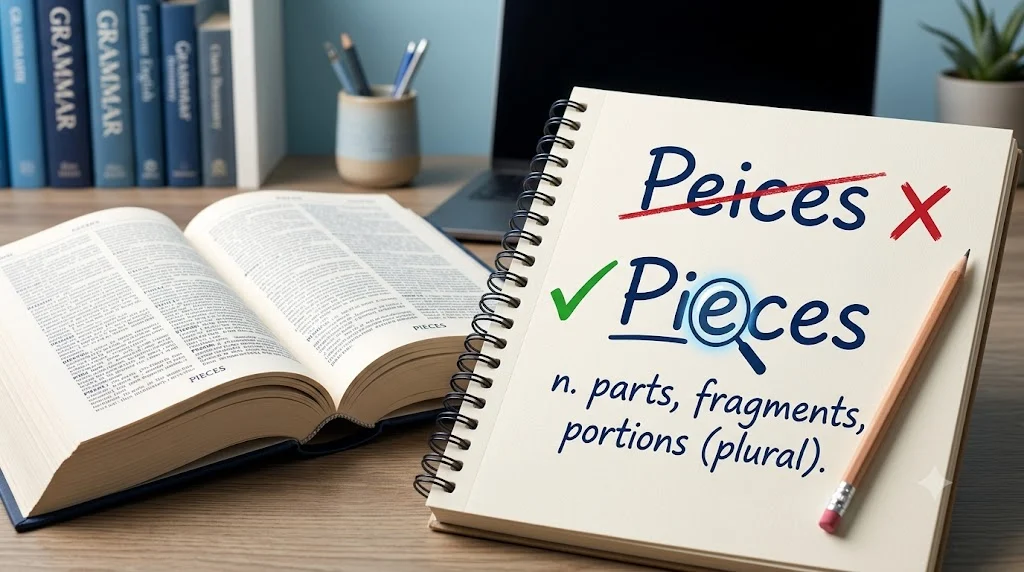
Pieces is the correct spelling of the plural noun piece, meaning individual parts, portions, or items. Peices is a common spelling mistake and is not considered correct standard English. If you’re writing an email, essay, report, or professional document, always use pieces.
The difference may look small, but spelling mistakes can create real problems. A misspelled word in a school assignment can affect how your writing is evaluated. In a workplace email, it can make your message look less polished. Even search engines, spell checkers, and AI writing tools may flag peices as an error.
Understanding why pieces is correct helps you avoid this mistake permanently. Once you recognize the spelling pattern and understand the word’s meaning, choosing the right form becomes much easier.
Peices or Pieces: The Quick Answer
The correct spelling is pieces. The word pieces is the plural form of piece, and it refers to two or more individual parts, objects, portions, or works. Peices is an incorrect spelling and should not be used in standard English.
For example:
I bought three pieces of cake.
The puzzle has one hundred pieces.
Please put the broken pieces in the box.
The key spelling pattern to remember is ie in pieces, not ei.
Pieces vs Peices: What’s the Difference?
The main difference is simple: pieces is a correctly spelled English word, while peices is not.
| Word | Part of Speech | Meaning | Correct? | Example |
| Pieces | Plural noun | Two or more parts, items, portions, or works | Yes | I found the missing pieces. |
| Peices | Misspelling | No standard English meaning | No | The spelling is incorrect. |
The singular form is piece.
The plural form is pieces.
The incorrect form peices often appears when writers accidentally reverse the ie sequence.
Mini Recap
Pieces is the correct plural spelling of piece.
Peices is a spelling error, not an alternative English word.
Use pieces when referring to multiple parts, objects, portions, or works.
Remember the spelling: p i e c e s.
Is Peices vs Pieces a Grammar, Vocabulary, or Usage Issue?
The confusion between peices and pieces is primarily a spelling issue, rather than a grammar or vocabulary issue.
The word pieces is part of standard English vocabulary. Its meaning depends on the context in which it appears. It can refer to physical objects, parts of something larger, portions of food, artistic works, musical compositions, or even individual items in a collection.
The form peices, however, is simply a misspelling. It isn’t an informal alternative, a regional variation, or a specialized technical term.
Are Pieces and Peices Interchangeable?
No. They aren’t interchangeable.
You should use pieces in every standard English context where you mean the plural of piece. There is no situation in ordinary English where peices is the preferred spelling.
Formal vs Informal Usage
The correct spelling pieces works in both formal and informal English.
You might write:
The machine consists of several separate pieces.
This is suitable for technical or professional writing.
You could also say:
I broke the cookie into small pieces.
That’s perfectly natural in casual conversation.
The spelling peices should be avoided in both settings.
Academic vs Casual Usage
In academic writing, spelling accuracy is particularly important. A sentence such as:
The experiment was divided into three separate pieces.
may be grammatically correct depending on the intended meaning, but if you accidentally write peices, your work may appear careless.
In casual messages, people may overlook a minor typo, but that doesn’t make peices correct. Standard spelling remains pieces regardless of the communication setting.
How to Use Pieces Correctly
Pieces is a plural noun used when talking about more than one piece. The meaning of piece changes slightly depending on context, but the basic idea is usually one individual part of something or one item considered separately.
Consider the following examples.
Workplace Example
The manager asked the team to review the documents and organize the important pieces of information.
Here, pieces refers to individual parts or items of information.
Another example is:
We need to replace several pieces of equipment.
In this sentence, pieces refers to individual items of equipment.
The word is common in business communication, manufacturing, logistics, construction, and many other professional fields.
Academic Example
The students analyzed several pieces of evidence before reaching a conclusion.
Here, pieces means individual items or examples of evidence.
You might also write:
The researcher examined different pieces of historical information.
The word can be useful in academic writing when referring to separate elements that collectively contribute to a larger subject.
Technology Example
The technician replaced two damaged pieces inside the computer.
In this context, pieces refers to separate physical components.
You might also see:
The software processes large pieces of data.
Here, pieces describes portions or units of data.
Usage Recap
Use pieces when you mean two or more individual parts, objects, portions, or works.
The word can appear in casual conversation, professional communication, academic writing, and technical contexts.
Always spell it pieces, with ie after the initial p.
How to Use Peices Correctly
The short answer is that you shouldn’t use peices in standard English.
Because peices is not an accepted spelling of the plural noun piece, there are no standard workplace, academic, or technology contexts in which it should replace pieces.
Workplace Example
Incorrect:
Please send me the remaining peices of the report.
Correct:
Please send me the remaining pieces of the report.
The second sentence uses the standard spelling.
Academic Example
Incorrect:
The study examined several peices of evidence.
Correct:
The study examined several pieces of evidence.
In academic writing, the correct spelling is especially important because repeated spelling errors can distract readers from your argument.
Technology Example
Incorrect:
The system combines several peices of data.
Correct:
The system combines several pieces of data.
The technology context doesn’t change the spelling. Whether you’re talking about data, hardware, software, or information, the correct plural form remains pieces.
Usage Recap
Peices should not be used as an alternative spelling.
It is a common typographical or spelling error.
Replace peices with pieces whenever you see it in your writing.
When You Should NOT Use Peices or Pieces
Although pieces is the correct spelling, it isn’t always the right word for every situation. The mistake isn’t always about spelling. Sometimes writers use piece or pieces when another noun would communicate the idea more precisely.
Here are common situations to watch for.
1. When You Mean a Complete Object
If you’re referring to a whole object rather than one part of something, item, object, or another specific noun may be better.
I bought five items from the store.
This may be clearer than:
I bought five pieces from the store.
The word pieces can be correct, but the context determines whether it’s the most precise choice.
2. When You Mean a Portion of Food
Piece can describe a portion of food, but other words may be more specific.
For example, you might say:
a slice of bread
a piece of cake
a portion of rice
Choosing the right noun makes your meaning clearer.
3. When You Mean Information
The phrase pieces of information is grammatically correct, but facts, details, or information may sometimes sound more natural.
We collected several important details.
This can be more direct than:
We collected several pieces of information.
4. When You Mean Evidence
The phrase pieces of evidence is standard English, particularly in formal contexts. However, depending on the sentence, evidence alone may be sufficient.
The investigators found new evidence.
There is no need to force the plural phrase when the uncountable noun evidence expresses the idea clearly.
5. When You Mean Individual Components
In technical writing, components, parts, or units may be more precise than pieces.
The machine contains several essential components.
This is often clearer than:
The machine contains several essential pieces.
6. When You Mean a Work of Art or Music
The word piece can refer to an artistic or musical work.
She performed a beautiful piano piece.
The plural is:
She performed several piano pieces.
This is correct, but don’t confuse the noun with another specialized term used in a particular field.
7. When You Are Writing a Formal Document
Avoid peices completely. A spell checker may identify it, but it’s better to recognize the correct spelling yourself.
8. When You Are Unsure About the Plural
Don’t invent the spelling peices. Start with the singular piece and add s:
piece + s = pieces
This is the simplest way to arrive at the correct spelling.
Common Mistakes: Peices or Pieces
| Correct Sentence | Incorrect Sentence | Explanation |
| I found the missing pieces. | I found the missing peices. | The correct spelling is pieces. |
| She bought two pieces of cake. | She bought two peices of cake. | Pieces is the plural of piece. |
| The puzzle has many pieces. | The puzzle has many peices. | The letters ie must appear in the correct order. |
| We need several pieces of equipment. | We need several peices of equipment. | The plural form is pieces. |
| The artist created three pieces. | The artist created three peices. | Pieces is used for multiple works of art. |
Decision Rule: Peices or Pieces
If you mean two or more parts, items, portions, or works, use PIECES.
If you have written PEICES, check the spelling and change it to PIECES.
There is no standard English situation in which peices should replace pieces.
A useful memory trick is to focus on the first four letters:
PIEC
Think of the word piece first. Then add s to make pieces.
piece → pieces
This method is much more reliable than trying to remember whether the word uses ie or ei in isolation.
Peices or Pieces in Modern Technology and AI Tools
Modern technology has made spelling mistakes easier to identify. Applications such as word processors, browser spell checkers, grammar assistants, and AI writing tools can often recognize peices as a likely misspelling.
When you type:
The box contains several peices.
a writing assistant may suggest:
The box contains several pieces.
AI tools can also help explain why the correction is necessary. However, automated correction isn’t always enough. A user should still understand the underlying spelling so they can recognize errors independently.
This matters because spell checkers don’t always catch every problem. A word can be spelled correctly but still be used incorrectly in context. In the case of peices, however, the issue is straightforward: the standard spelling is pieces.
For students, professionals, and content creators, combining human proofreading with digital tools is a practical way to improve accuracy.
The Etymology of Piece and Pieces
The English word piece has a long history. It entered Middle English through Anglo French and ultimately traces back to Latin petia, meaning a piece or portion.
Over time, piece developed a broad range of meanings in English. It can refer to a physical part, a portion of something, an individual object, or a creative work.
The plural form is created in the usual way by adding s:
piece → pieces
The spelling peices likely results from the common difficulty English speakers have with the placement of i and e. English contains many words with similar letter patterns, and the familiar spelling rule involving i before e does not work universally.
The safest approach is therefore to memorize the spelling of piece itself and then form the plural naturally.
An Expert Perspective on the Spelling
“The most reliable way to avoid the error is to learn the word as a complete spelling pattern: piece, then pieces.”
This reflects a practical principle in English spelling. While spelling rules can help, many common words are best learned through repeated exposure and active use. The more often you read and write piece and pieces, the more familiar the correct sequence becomes.
Two Practical Case Studies
Case Study 1: Professional Communication
Imagine an employee writing an internal email:
We have received all the peices required for the project.
The meaning is understandable, but the spelling error may reduce the professional quality of the message.
After correction:
We have received all the pieces required for the project.
The change is only one letter sequence, but the second version follows standard English spelling and looks more polished.
Result: The corrected version removes the spelling error without changing the intended meaning.
Case Study 2: Academic Writing
Consider a student writing:
The researcher analyzed several peices of evidence before presenting the conclusion.
The word peices is incorrect. The corrected sentence is:
The researcher analyzed several pieces of evidence before presenting the conclusion.
Result: The correction improves spelling accuracy while preserving the original academic meaning.
These examples show why seemingly minor spelling errors deserve attention. The problem isn’t that readers cannot understand peices. Most can. The issue is that standard written English expects pieces, and consistent accuracy builds credibility.
Author Expertise
Written by an English language and grammar content specialist focused on practical spelling, vocabulary, usage, and common word confusion for modern English readers.
Peices or Pieces: Error Prevention Checklist
Always use Pieces when:
Mean more than one piece.
Referring to multiple parts of something.
Several portions or individual items.
Discussing multiple works of art or music.
Writing an academic, professional, or formal document.
☑ You are referring to multiple components in a general sense.
Never use Peices when:
☒ You mean the plural of piece.
☒Writing an email or report.
Submitting academic work.
Publishing online content.
Communicating with customers or colleagues.
☒Using standard English.
The simplest rule is this: if the singular word is piece, the plural is pieces.
Related Grammar Confusions You Should Master
Learning pieces is useful, but English contains many other spelling and word choice pairs that cause similar confusion. Mastering these common distinctions can significantly improve writing accuracy.
1. Receive or Recieve
The correct spelling is receive. This is another common example of confusion involving ie and ei.
2. Believe or Beleive
The correct spelling is believe.
3. Weird or Wierd
The correct spelling is weird, which is another exception to the familiar spelling pattern.
4. Their or There
Their indicates possession, while there usually refers to a place or introduces an idea.
5. Your or You’re
Your shows possession. You’re is a contraction of you are.
6. Its or It’s
Its is possessive. It’s means it is or it has.
7. Affect or Effect
Affect is most commonly used as a verb, while effect is most commonly used as a noun.
8. Advice or Advise
Advice is a noun. Advise is a verb.
9. Practice or Practise
Practice is standard in American English for both noun and verb use, while British English generally distinguishes practice as a noun from practise as a verb.
10. Alot or A Lot
A lot is the correct standard form. Alot is not standard English.
These comparisons demonstrate an important lesson: English spelling often requires attention to both patterns and individual words.
FAQs
Is peices or pieces correct?
Pieces is correct. It is the plural form of piece. Peices is a common spelling mistake and is not accepted as the standard spelling in English.
How do you spell pieces correctly?
The correct spelling is pieces: P I E C E S. A useful way to remember it is to start with the singular word piece and add s.
Why do people spell pieces as peices?
People often write peices because English spelling contains many words with confusing ie and ei combinations. The letters are accidentally reversed, producing a common spelling error.
Is peices a word in the English dictionary?
Peices is not the standard spelling of the plural noun piece. In ordinary English writing, you should use pieces instead.
What is the plural of piece?
The plural of piece is pieces.
For example:
One piece of paper.
Two pieces of paper.
Is pieces singular or plural?
Pieces is plural. The singular form is piece.
For example, one piece is singular, while several pieces is plural.
What is the difference between piece and pieces?
Piece refers to one individual part, item, portion, or work. Pieces refers to two or more.
I found one piece.
I found several pieces.
How can I remember the spelling of pieces?
Remember the singular spelling first: piece. Then simply add s to form pieces. Avoid trying to reconstruct the spelling from the commonly remembered i before e rule.
Is pieces correct in formal writing?
Yes. Pieces is completely acceptable in formal, academic, professional, and casual English whenever it is the correct word for the intended meaning.
What is the easiest way to avoid the peices spelling mistake?
Remember this simple pattern:
piece → pieces
The sequence is ie, not ei. If you see peices in your writing, correct it to pieces.
Conclusion
When deciding between peices or pieces, the answer is straightforward: pieces is the only correct standard spelling. It is the plural form of piece and can describe multiple parts, objects, portions, works, or other individual items.
The spelling peices is simply a common error caused by reversing the letters i and e. It isn’t an alternative spelling and shouldn’t be used in academic writing, workplace communication, technology documentation, or everyday English.

Neil Gaiman is an American writer who contributes educational content to LingRoya.com. His work focuses on helping readers improve their English with clear, practical and easy to follow guidance.