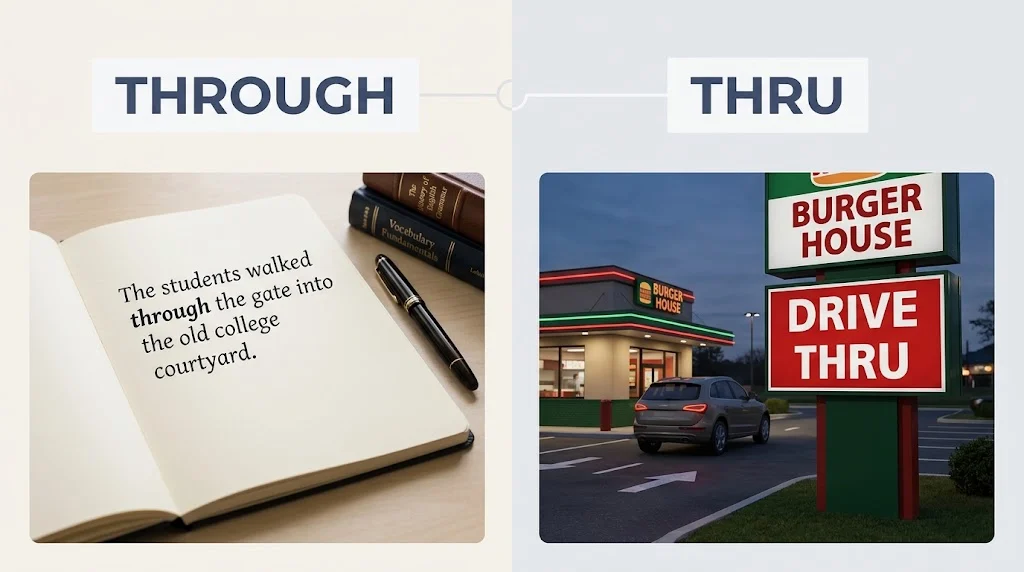
Through or thru are both recognized English spellings, but they differ in formality and usage. Through is the standard spelling used in academic writing, professional communication, and formal documents. Thru is an informal variant commonly found on road signs, in advertising, and in casual messages.
Have you ever noticed thru on a drive through sign and wondered whether it’s correct English? Both through and thru communicate the same basic meaning, but they aren’t equally suitable in every situation. Through is the standard spelling used in formal and everyday writing, while thru is a shortened variant often used where space matters or a casual tone is appropriate. Understanding this difference helps students, professionals, and content writers avoid spelling mistakes and choose words confidently. For reliable writing, use through as your default and reserve thru for established informal or space saving contexts.
Through vs Thru: What’s the Difference?
The main difference between through and thru is their level of formality. Through is the standard English spelling and can function as a preposition, adverb, or adjective. Thru is an informal spelling variant that appears mainly in signs, advertisements, and casual communication.
| Feature | Through | Thru |
|---|---|---|
| Part of speech | Preposition, adverb, adjective | Informal spelling variant of through |
| Meaning | From one side to another, during, or by means of | Generally the same as through |
| Formal writing | Recommended | Usually avoided |
| Academic writing | Standard choice | Generally inappropriate |
| Road signs | Used when space permits | Common on compact signs |
| Advertising | Common | Common in phrases such as drive thru |
| Text messages | Standard and acceptable | Informal and conversational |
| Professional documents | Recommended | Use only when officially required or quoted |
Quick Recap
Through is the standard spelling for nearly every writing situation.
Thru is a shortened, informal alternative.
Both forms can express the same basic meaning.
Formal documents, essays, and reports should generally use through.
Signs, brand names, and casual messages may use thru.
What Does Through Mean?
Through is a versatile English word that describes movement, time, completion, or the means by which something happens. Its precise meaning depends on the sentence.
As a preposition, it can describe movement from one side of something to another.
Example: The children walked through the forest.
As an adverb, it can indicate completion or movement from one end to another.
Example: The train passed through without stopping.
As an adjective, it can describe a direct connection or service.
Example: We booked a through train to the capital.
Through also appears in everyday expressions such as go through a difficult time, read through a report, and get through an examination.
Its flexibility makes it essential in spoken and written English. Whether you’re describing a physical journey, a process, or a challenging experience, through is the standard form.
What Does Thru Mean?
Thru is an informal variant of through. It carries essentially the same meaning but is generally used in contexts where brevity, convenience, or a familiar commercial style is preferred.
You might encounter it on restaurant signs, road signs, promotional materials, or informal digital messages.
Examples:
- The restaurant has a drive thru window.
- Please send the documents thru the office system.
- The sign points to the thru lane.
The first example reflects a widely recognized commercial expression. The second is understandable but would usually be edited to through in professional correspondence.
Thru isn’t simply a random spelling error. It has an established history of use, especially in American English. However, its informal character means it isn’t a suitable replacement for through in every situation.
Usage recap: Use thru when the context clearly supports informal or established abbreviated spelling. In ordinary prose, through remains the safer choice.
Is Through vs Thru a Grammar, Vocabulary, or Usage Issue?
The distinction between through and thru is mainly a spelling and usage issue, not a difference in grammar or meaning.
Are Through and Thru Interchangeable?
They are similar in meaning, but they’re not always interchangeable in practical writing.
For example:
Formal: The proposal was reviewed through the appropriate approval process.
Informal sign: Drive Thru Open.
The first sentence calls for standard spelling. The second uses a familiar commercial expression in which the shortened spelling is conventional.
Replacing through with thru in a formal report may not make the sentence impossible to understand, but it can make the writing appear careless or unnecessarily informal.
Formal vs Informal Usage
Through is appropriate for professional emails, academic essays, business reports, books, and official documents.
Thru is more common in advertising, informal notes, compact signage, and certain established names. A business may choose Drive Thru as part of its branding, for example.
Academic vs Casual Usage
Students should use through in essays, examinations, assignments, and research papers. Teachers and editors generally expect standard spelling in these contexts.
In casual texting, people may write thru to save space or type quickly. Still, through is perfectly natural in a message and doesn’t sound overly formal.
When to Use Through
Use through when you want standard spelling, clear communication, and a professional tone. It works across formal and informal contexts, making it the most versatile option.
Workplace Example
A project manager writes:
“We completed the review through consultation with every department.”
This sentence uses standard spelling in a professional context.
Academic Example
A student writes:
“The researchers collected data through interviews with local residents.”
Through correctly introduces the method used to collect the data.
Technology Example
A software guide states:
“Users can access their account through the mobile application.”
This is suitable wording for technical documentation and user instructions.
Usage recap: Through is the best default for workplace communication, education, technology, and general writing. You rarely need to replace it with thru.
When to Use Thru
Use thru when the shortened spelling suits an informal setting, a compact sign, or an established commercial expression. It is particularly familiar in American English.
Workplace Example
A restaurant displays the sign:
“Drive Thru Open.”
The shortened form is common in restaurant signage, where quick recognition and limited space matter.
Academic Example
A student is discussing a historical advertisement that contains the word thru. In this situation, the spelling can be reproduced when quoting the original source.
Outside a direct quotation or discussion of the spelling itself, the student should normally write through.
Technology Example
A fictional food delivery app might use “Order Thru” as the name of a promotional feature. The spelling could work as part of the brand’s informal style, although ordinary instructions should generally use through.
Usage recap: Thru is suitable for certain signs, branding choices, and informal contexts. Don’t use it as your default in ordinary professional or academic sentences.
When You Should NOT Use Through or Thru
Both spellings have appropriate uses, but several situations require care.
1. Don’t use thru in formal academic writing. Standard spelling is expected in essays, research papers, and examinations.
2. Don’t use thru in professional reports without a clear reason. Through usually communicates the same meaning with a more polished tone.
3. Don’t assume thru is always a spelling error. It is an established informal variant and appears in recognized commercial expressions.
4. Don’t change an official brand name automatically. Preserve a business’s chosen spelling when referring to its registered or published name.
5. Don’t alter direct quotations unnecessarily. If a source uses thru, preserve the original spelling when quoting it accurately.
6. Don’t use through when reproducing a sign that says thru. If the exact wording matters, retain the spelling displayed in the original.
7. Don’t choose thru simply to sound modern. In ordinary prose, the shortened form may distract readers rather than improve readability.
8. Don’t confuse shorter spelling with better writing. Clear, consistent language matters more than saving a few letters.
Common Mistakes: Through or Thru
The following table shows how the choice affects written communication.
| Correct sentence | Incorrect sentence | Explanation |
|---|---|---|
| We walked through the tunnel. | We walked thru the tunnel. | Through is preferred in standard prose. |
| Please send the form through email. | Please send the form thru email. | Through is the standard spelling, although “by email” may sound more natural. |
| The team worked through the night. | The team worked thru the night. | Through is the conventional choice in formal and general writing. |
| The restaurant has a drive thru. | The restaurant has a drive through. | Both forms can occur, but drive thru is a common commercial spelling. |
| She got through the examination. | She got thru the examination. | Through is the standard choice in educational contexts. |
| The sign reads “Drive Thru.” | The sign reads “Drive Through.” | The second sentence is inaccurate if the original sign actually says “Drive Thru.” |
The word incorrect in these examples depends on context. Thru can be understandable and acceptable in informal usage, but it isn’t the preferred form for standard prose.
Decision Rule
If you need standard spelling for a sentence, use through.
If you are reproducing an established informal expression, sign, or brand name, thru may be appropriate.
Remember that these aren’t two different actions or objects. They are alternative spellings with different levels of formality.
Through and Thru in Modern Technology and AI Tools
Digital communication has made shortened spellings more visible. Text messages, social media posts, advertisements, and mobile interfaces often favor brief wording.
For example, a restaurant might use Drive Thru on its ordering page, while its customer service policy says, “Customers can contact us through the website.”
AI writing tools and grammar checkers usually recommend through in standard prose. However, an automated editor may suggest changes to a brand name or quotation that should remain unchanged.
When editing with AI, consider the purpose of the text. A formal report needs standard spelling, while a campaign headline may intentionally use a shortened expression. Human review is still important because spelling suggestions don’t always account for branding, audience, and context.
Etymology: Where Do Through and Thru Come From?
Through developed from Old English thurh, with related forms appearing in the history of Germanic languages. Over centuries, its spelling and pronunciation evolved into the modern English word.
Thru emerged as a simplified spelling that removes the letters “ough.” English has a long history of spelling variation, and informal writing has often favored shorter forms.
The spelling thru became particularly familiar in American commercial language, especially in expressions such as drive thru. Its popularity in signs and advertising reflects the practical appeal of concise wording.
Although the shorter spelling has become recognizable, through remains the conventional form in standard written English.
Expert Insight: A Simple Editorial Principle
A useful principle for editors is this: Choose the spelling that fits the context, not merely the shortest spelling available.
Through is clear, standard, and appropriate across most forms of communication. Thru can be effective when a business wants a compact sign or a brand uses an established informal expression. The important distinction is whether the spelling supports the purpose of the text.
Two Practical Case Studies
Case Study 1: A Student Preparing an Essay
Imagine a college student writing about how people learn through experience. During proofreading, the student notices that several sentences use thru instead.
The student replaces these instances with through and checks the document for consistency.
Result: The essay follows standard spelling conventions and presents a more polished academic style. This is an illustrative example, not a report of measured research results.
Case Study 2: A Restaurant Designing Its Signage
Consider a restaurant creating a sign for its vehicle ordering lane. The design team chooses the phrase “Drive Thru” because it is familiar, concise, and easy to read quickly.
The same restaurant uses through in its employee handbook and customer service emails.
Result: The restaurant maintains a concise sign while preserving standard spelling in its formal communication. This is an illustrative scenario rather than a measured business outcome.
Error Prevention Checklist
Always Use Through When
- Writing academic assignments and research papers.
- Preparing professional emails and business reports.
- Creating formal website content and technical documentation.
- Writing ordinary sentences for a broad audience.
- You’re unsure which spelling is appropriate.
Never Use Thru When
- Your assignment or publication requires standard formal English.
- You are writing a formal report and have no reason to use an informal variant.
- The shortened form would make your sentence look inconsistent.
- You’re editing standard prose and simply want to save a few characters.
These guidelines don’t prohibit thru in every situation. They help you recognize when the conventional spelling is the better choice.
Related Grammar Confusions You Should Master
Understanding through and thru can help you recognize other spelling and usage distinctions.
- Everyday vs Every Day: The difference between an adjective and a time expression.
- Into vs In To: How meaning and sentence structure affect word choice.
- Though vs Through: Similar spelling but different meanings and pronunciation.
- Thorough vs Through: A distinction between completeness and movement or passage.
- Alot vs A Lot: Recognizing the standard two word expression.
- Alright vs All Right: Differences in conventional usage and editorial preference.
- Gonna vs Going To: Informal speech versus standard writing.
- Wanna vs Want To: A common spoken reduction and its written equivalent.
- Your vs You’re: Possessive form versus contraction.
- There vs Their vs They’re: Three forms with different grammatical functions.
Learning these distinctions strengthens spelling accuracy and helps you choose wording that suits the audience and purpose.
Frequently Asked Questions
1. Is through or thru the correct spelling?
Through is the standard spelling in English. Thru is an informal variant commonly used in signs, advertising, and casual communication.
2. Is thru a real word?
Yes, thru is a recognized informal spelling variant of through. However, through remains the preferred form in formal and academic writing.
3. Why do Americans write drive thru instead of drive through?
Many American businesses use drive thru because the shorter spelling is familiar, concise, and convenient for signs and branding. Drive through is also understandable and used.
4. Should I use through or thru in an essay?
Use through in essays, examinations, and academic assignments. Thru is generally too informal unless you are quoting a source or discussing the spelling itself.
5. Is thru grammatically incorrect?
Thru is not inherently a grammatical error. It is an informal spelling variant, although it may be inappropriate in contexts that require standard written English.
6. What is the difference between through and thru in a sentence?
The basic meaning is usually the same. The difference is primarily stylistic, because through is the standard spelling and thru is an informal alternative.
7. Is drive thru or drive through correct?
Both expressions are used. Drive thru is especially common in American commercial signage, while drive through is the standard spelling in ordinary prose.
8. Can I use thru in a professional email?
It’s best to use through in professional emails. Thru may look overly casual unless it appears in an official name, quotation, or intentionally informal message.
9. Does Microsoft Word consider thru incorrect?
The result depends on the application’s dictionary, language settings, and spelling preferences. A spellchecker may flag thru in standard prose even though the informal variant is recognized.
Conclusion
When deciding between through or thru, remember that the two spellings generally share the same meaning but differ in formality. Through is the standard choice for academic work, professional communication, technical writing, and everyday prose. Thru is an informal alternative often used on signs, in advertising, and in established commercial expressions.
If you’re uncertain, choose through. It works naturally in almost every context and is unlikely to look out of place. Reserve thru for situations where the shortened spelling is intentional and appropriate. This simple rule will help you write accurately, maintain consistency, and communicate with confidence.

Philip Pullman is an American writer dedicated to creating clear and easy to follow English content. Through his work at LingRoya.com, he helps readers strengthen their language skills with practical and reliable guidance so that they can easily understand.