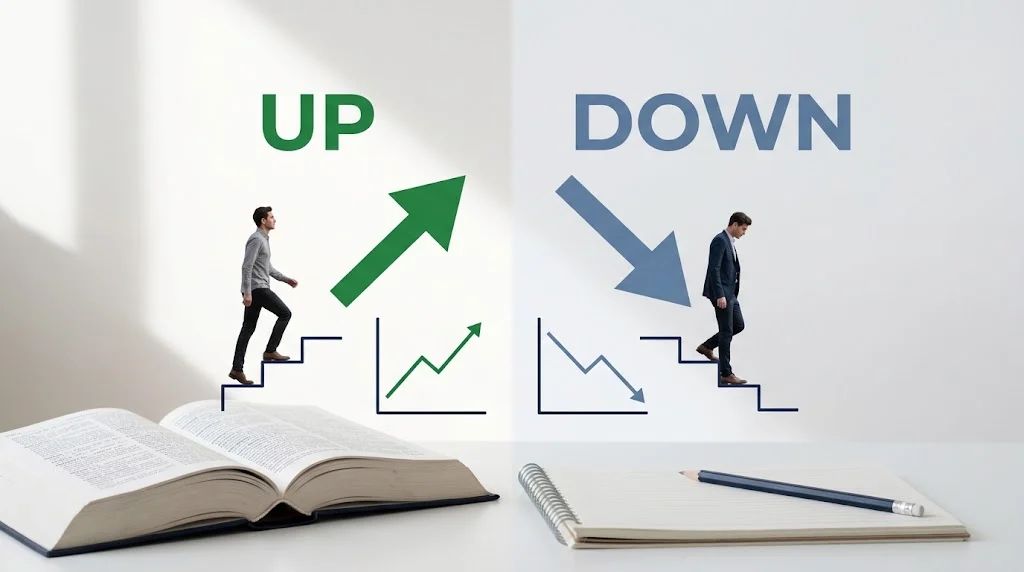
Up or down describes two opposite directions, with up indicating movement toward a higher position or level and down indicating movement toward a lower position or level. Both words are correct, and the right choice depends on the direction, context, or change being described, such as moving an object, checking a price, or following instructions.
Have you ever hesitated between saying up or down when describing movement, prices, progress, or directions? These common English words express opposite ideas, but their meanings can change slightly depending on the situation. Up generally refers to a higher position, increase, or improvement, while down often describes a lower position, decrease, or reduction
. Understanding how to use them correctly helps English learners, students, and professionals communicate clearly. Whether you’re writing a workplace report, giving directions, or discussing financial trends, choosing the right word makes your message more accurate and natural.
Up vs Down: What’s the Difference?
The main difference between up and down is the direction or change they express. Up commonly indicates movement toward a higher position or an increase, whereas down generally indicates movement toward a lower position or a decrease.
Both words can function as adverbs, prepositions, adjectives, and parts of phrasal verbs, depending on the sentence.
| Feature | Up | Down |
|---|---|---|
| Basic meaning | Toward a higher position | Toward a lower position |
| Part of speech | Adverb, preposition, adjective | Adverb, preposition, adjective |
| Physical movement | Moving upward | Moving downward |
| Numerical change | An increase | A decrease |
| Emotional meaning | Feeling cheerful or encouraged | Feeling sad or discouraged |
| Business usage | Sales went up | Sales went down |
| Example | She walked up the stairs. | She walked down the stairs. |
Quick Recap
- Up usually describes a higher position, increase, or upward movement.
- Down generally describes a lower position, decrease, or downward movement.
- Both words have several grammatical functions.
- Their meanings depend on context, including physical movement and figurative expressions.
- Neither word is more correct than the other. Choose the one that expresses your intended meaning.
What Does Up Mean?
Up is a versatile English word that commonly expresses movement toward a higher position, an increase in quantity, or a positive change. It can also appear in expressions involving completion, awareness, and preparation.
Examples:
- The children ran up the hill.
- Our monthly sales went up by ten percent.
- Please stand up when your name is called.
- She cheered me up after a difficult day.
In these sentences, up describes physical movement, numerical growth, a change in posture, and an improvement in someone’s mood.
The word doesn’t always mean something positive. For example, “The rent went up again” describes an increase that may be unwelcome.
What Does Down Mean?
Down generally describes movement toward a lower position, a decrease in quantity, or a decline in a condition or level. It also appears in expressions related to sadness, recording information, and reducing activity.
Examples:
- He walked down the stairs.
- The temperature went down overnight.
- Write down the address before you forget it.
- She felt down after receiving the disappointing news.
The word can describe a physical direction, a numerical reduction, the act of recording information, or an emotional state.
Like up, down doesn’t always carry a negative meaning. For example, “The price went down” may be good news for shoppers.
Is Up vs Down a Grammar, Vocabulary, or Usage Issue?
The difference between up and down is primarily a matter of vocabulary and usage, although grammar determines how each word fits into a sentence.
Are Up and Down Interchangeable?
No, not when they describe opposite directions or changes. Replacing one with the other can completely change a sentence’s meaning.
Consider these examples:
- “The elevator went up” means it moved to a higher floor.
- “The elevator went down” means it moved to a lower floor.
However, both words can appear in the same grammatical structures. You can say “prices went up” and “prices went down” without changing the sentence’s basic grammar.
Formal vs Informal Usage
Both words are acceptable in formal and informal English. In professional writing, you might choose more specific alternatives when they improve clarity.
For example, “The company’s revenue increased” may be more precise in a financial report than “The company’s revenue went up.”
Similarly, “The error rate decreased” may sound more appropriate in a research paper than “The error rate went down.”
Academic vs Casual Usage
In everyday conversation, up and down are natural and widely understood.
In academic writing, the choice depends on the subject and the level of precision required. A physics paper might discuss upward and downward motion, while a statistics report might describe increases and decreases in measured values.
When to Use Up
Use up when you mean movement toward a higher position, an increase, or another meaning established by an expression.
Workplace Example
“The manager asked the team to bring up the latest sales figures during the meeting.”
Here, bring up means to introduce or mention a topic.
Academic Example
“The temperature went up as the experiment progressed.”
This sentence describes an increase in temperature.
Technology Example
“Please back up your files before installing the software update.”
In this example, back up means to create a copy of data for protection.
Usage recap: Use up for upward movement, increases, and expressions such as stand up, bring up, and back up. Always consider the meaning of the complete phrase.
When to Use Down
Use down when describing movement toward a lower position, a reduction, or a meaning associated with a particular expression.
Workplace Example
“The supervisor asked employees to write down the new safety procedures.”
Here, write down means to record information.
Academic Example
“The researchers observed that the error rate went down after the intervention.”
The sentence describes a reduction in errors.
Technology Example
“The website went down for maintenance last night.”
In technology, went down means the website became unavailable.
Usage recap: Use down for downward movement, decreases, and expressions such as write down, slow down, and shut down.
When You Should NOT Use Up or Down
Although these words are simple, choosing them incorrectly can confuse readers. Avoid the following mistakes.
1. Don’t use up when you mean a decrease. If the temperature becomes lower, say it went down, not up.
2. Don’t use down when you mean an increase. If your savings grow, say they went up or increased.
3. Don’t assume up always means good. Rising expenses or increasing pollution may be undesirable.
4. Don’t assume down always means bad. Lower prices, reduced waiting times, and fewer errors can be positive developments.
5. Don’t replace established phrasal verbs carelessly. Give up means quit, while let down means disappoint. Replacing one particle can change the expression’s meaning.
6. Don’t confuse direction with orientation. An object can be upside down without moving downward.
7. Don’t use either word without checking the intended reference point. Going up a staircase describes movement toward a higher level, but the meaning of up in a chart may depend on its labels and conventions.
8. Don’t use vague wording in technical reports. If accuracy matters, specify whether a measurement increased, decreased, rose, or fell.
Common Mistakes and Decision Rules
The following table shows how context determines the correct choice.
| Correct sentence | Incorrect sentence | Explanation |
|---|---|---|
| The elevator went up to the fifth floor. | The elevator went down to the fifth floor. | Use up when the elevator moves to a higher floor from a lower starting point. |
| The temperature went down overnight. | The temperature went up overnight. | The correct choice depends on whether the temperature decreased or increased. |
| Sales went up last month. | Sales went down last month. | The second sentence reverses the meaning if sales increased. |
| Please write down the instructions. | Please write up the instructions. | Write down means record information. Write up usually means prepare a written report or document. |
| The server shut down unexpectedly. | The server shut up unexpectedly. | Shut down describes stopping a machine or system. Shut up has a different meaning. |
Notice that some sentences in the incorrect column are grammatically possible. They are incorrect only when they contradict the intended meaning or situation.
Decision Rule
Use up when something moves higher, increases, or matches an expression that requires up.
Use down when something moves lower, decreases, or matches an expression that requires down.
Check the context when the words appear in phrasal verbs, technical instructions, or figurative expressions.
Up and Down in Modern Technology and AI Tools
The words up and down are common in software development, data analysis, online communication, and artificial intelligence.
In technology, a server is described as up when it is operating and available, while a server is down when it is unavailable or not functioning as expected. These expressions are common in system monitoring and troubleshooting.
In data analysis, an upward trend may indicate that a value is increasing, while a downward trend indicates a decrease. However, the significance depends on the metric being measured.
AI writing tools can help identify unclear sentences and suggest more precise alternatives. For example, an editor might recommend changing “The results went up” to “The test scores increased” when the intended meaning concerns academic performance.
AI tools can also misinterpret directional language if they lack context. Writers should verify the intended meaning instead of automatically accepting every suggested correction.
Etymology: Where Do Up and Down Come From?
Both up and down have deep roots in the history of English.
Up comes from Old English up, which referred to a higher position or direction. Its central meaning has remained remarkably stable over time, although it has developed many figurative uses.
Down developed from Old English dūne, associated with a downward direction or movement. Over centuries, it became a common part of English expressions involving reductions, completion, and emotional states.
Today, these short words are essential to everyday communication. Their many uses show how physical directions can develop figurative meanings, such as prices going up, spirits lifting, or activity slowing down.
An Expert Perspective on Using Up and Down
A useful principle for clear English is to choose words according to the relationship you want to describe, rather than assuming that a word always carries the same emotional meaning.
For example, an increase in customer satisfaction may be positive, while an increase in costs may be negative. Likewise, a decrease in pollution is beneficial, whereas a decrease in product quality may be harmful.
Editorial principle: “Describe the direction accurately first, then explain whether the change is beneficial or harmful.”
This is an explanatory editorial principle, not a quotation attributed to a named linguist.
Two Practical Case Studies
Case Study 1: A Business Sales Report
Imagine a retail business reviewing its monthly performance. Its report shows that revenue increased from $20,000 to $24,000.
A clear statement would be: “Monthly revenue went up by $4,000.”
Writing that revenue went down would reverse the meaning and misrepresent the company’s performance. The business could also use the more formal phrase “Monthly revenue increased by $4,000.”
Result: The correct directional term communicates the financial change accurately. These figures illustrate a hypothetical example, not a documented business case.
Case Study 2: A Technology Support Team
Consider a technical support team investigating a website outage. The website stops responding, and monitoring software reports that the server is down.
The team documents the problem as: “The server went down at 10:15 a.m. and returned to service at 10:40 a.m.”
Using up instead would suggest the opposite system status in this context. Precise wording helps the team distinguish an outage from a successful recovery.
Result: The report provides a clearer timeline of the incident. This is an illustrative scenario, not a measured study.
Error Prevention Checklist
Always Use Up When
- Describing movement toward a higher position.
- Explaining an increase in a quantity or measurement.
- Using expressions such as stand up, back up, and bring up when their meanings fit the context.
- Describing a system that is operating, when the expression is appropriate.
Never Use Down When
- You specifically mean upward movement or an increase.
- The established expression requires up rather than down.
- The word would reverse the meaning of a measurement or instruction.
Remember that down remains correct when describing decreases, lower positions, and expressions such as shut down or write down. The goal is to communicate the intended meaning, not to avoid one word entirely.
Related Grammar Confusions You Should Master
Learning how up and down work can help you understand other commonly confused English words and expressions.
- Above vs Below: Positions in relation to a reference point.
- Over vs Under: Relative position, movement, and quantity.
- Rise vs Raise: Increasing something independently or causing it to increase.
- Increase vs Decrease: Changes in quantity or level.
- Higher vs Lower: Comparing levels, measurements, or positions.
- Bring vs Take: Movement in relation to a reference point.
- In vs Into: Location compared with movement toward the inside.
- On vs Off: Connection, operation, or position.
- Lay vs Lie: Placing something versus reclining.
- Accept vs Except: Receiving something versus excluding something.
These distinctions help you select accurate vocabulary in everyday conversation, academic writing, and professional communication.
Frequently Asked Questions
1. What is the difference between up and down?
Up generally describes movement toward a higher position or an increase, while down describes movement toward a lower position or a decrease. Their exact meanings depend on context.
2. When should I use up or down in a sentence?
Use up when something moves higher or increases, and use down when something moves lower or decreases. For phrasal verbs, follow the established meaning of the expression.
3. Does up always mean good and down always mean bad?
No. Up and down primarily describe direction or change. An increase in costs may be undesirable, while a decrease in prices may benefit consumers.
4. Is up or down a grammar rule?
The distinction is mainly about vocabulary and usage. Grammar determines how each word functions in a sentence, but the choice between them depends on the intended meaning.
5. What does it mean when prices go up or down?
When prices go up, they increase. When prices go down, they decrease. These expressions describe changes in cost over time.
6. What is the difference between write up and write down?
Write down usually means to record information. Write up commonly means to prepare a report, account, or formal written document.
7. What does up or down mean in technology?
In technology, up often means a system is operating or available, while down usually means it is unavailable or not functioning. In data analysis, the words can also describe increasing or decreasing values.
8. How can I remember when to use up or down?
Associate up with higher positions and increases, and down with lower positions and decreases. Then consider the full expression, since phrasal verbs can have meanings beyond physical direction.
9. Can up and down be used as nouns?
Yes, particularly in informal or specialized contexts. For example, “the ups and downs of life” uses the plural nouns to describe changing experiences, including successes and difficulties.
Conclusion
Choosing between up or down becomes easier when you focus on the direction, change, or expression you’re describing. Up commonly signals a higher position or an increase, while down usually indicates a lower position or a decrease. Neither word is automatically positive or negative, and both appear in many everyday expressions and technical contexts.
For clear writing, check the facts, consider your reference point, and make sure the word matches your intended meaning. When a phrasal verb is involved, verify the complete expression rather than relying only on the basic directional meaning. With these principles, you can use up and down confidently in conversations, academic assignments, workplace reports, and digital communication.

Neil Gaiman is an American writer who contributes educational content to LingRoya.com. His work focuses on helping readers improve their English with clear, practical and easy to follow guidance.