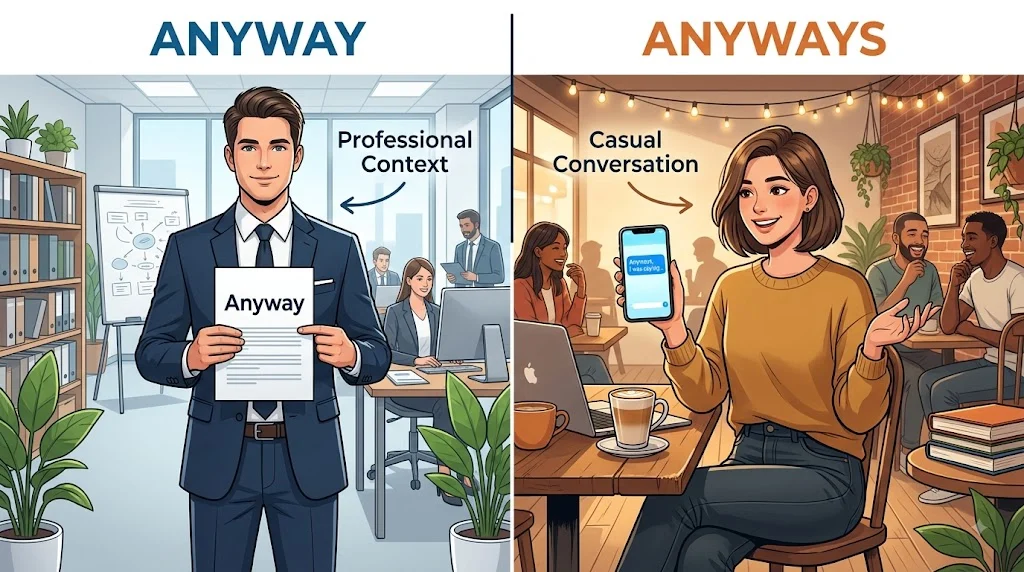
Anyway is the standard, grammatically correct adverb meaning “regardless,” “in any case,” or “nonetheless.” Anyways is its informal, colloquial variant that carries the exact same meaning but is considered nonstandard and inappropriate for formal writing, academic work, or professional communication.
Anyway and anyways are both used in English, but they are not equally common or formal. Anyway is the standard form and is widely accepted in both spoken and written English. It can mean “in spite of that,” “regardless,” or be used to return to a previous topic.
Anyways is generally considered informal and is more common in casual speech, especially in some varieties of American English. In formal, academic, and professional writing, anyway is the safer and more appropriate choice.
Anyway vs Anyways: What is the Difference?
Anyways is also an adverb, and it means exactly the same thing as anyway. However, the similarity ends there. Anyways is considered informal, colloquial, and nonstandard in formal English. Most dictionaries label it as “informal” or “dialectical”. It is the kind of word you might hear in casual conversation but should avoid in professional or academic writing.
Here is a comparison table to make the distinction clear:
| Feature | Anyway | Anyways |
| Part of speech | Adverb | Adverb |
| Meaning | Regardless, in any case, nonetheless | Regardless, in any case, nonetheless |
| Formality | Standard, neutral, formal | Informal, colloquial, nonstandard |
| Acceptable in academic writing | Yes | No |
| Acceptable in professional writing | Yes | No |
| Acceptable in casual speech | Yes | Yes |
| Dictionary status | Standard entry | Often labeled “nonstandard” or “dialectical” |
Is Anyway vs Anyways a Grammar, Vocabulary, or Usage Issue?
This is an important question because it helps us understand exactly what kind of problem we are dealing with. The distinction between anyway and anyways is primarily a usage issue rather than a strict grammar rule. Grammar rules govern how words are structured and how sentences are formed. Both anyway and anyways function as adverbs, so grammatically, they are both fine. The difference lies in how they are used in different contexts.
Are they interchangeable? Yes and no. They are interchangeable in meaning, but they are not interchangeable in terms of appropriateness. You can substitute one for the other in casual speech without changing the meaning. But in formal writing, only anyway is acceptable.
Formal versus informal usage: Anyway is the safe choice for any formal setting. It is the word you will find in newspapers, academic journals, business reports, and professional correspondence. Anyways, on the other hand, is the word you might use when chatting with friends, sending a quick text, or writing dialogue for a character who speaks informally.
Academic versus casual usage: In academic writing, anyway is the only acceptable option. Professors, editors, and style guides all recommend using anyway. Anyways would be marked as an error in most academic contexts. In casual writing, such as personal emails or social media posts, either word works, but anyway is still the safer bet if you want to sound polished.
Practical Usage of Anyway
Anyway is a versatile adverb with several common uses. Let us explore how to use it correctly in different contexts.
Workplace Example
“The presentation did not go as planned, but we secured the client anyway.”
In this sentence, anyway shows that the outcome was achieved despite the difficulties. It communicates resilience and a results oriented attitude, which is exactly what you want in a professional setting.
Academic Example
“The study had a small sample size. The findings were statistically significant anyway.”
Here, anyway acknowledges a limitation while affirming the validity of the results. It is a concise way to say “despite this limitation.”
Technology Example
“The software update caused some initial bugs, but the system performed well anyway.”
In tech writing, anyway helps you acknowledge problems while focusing on the positive outcome.
Usage Recap for Anyway: Use anyway in all formal, professional, and academic writing. It is the standard, correct form that will never be questioned by editors or readers.
Practical Usage of Anyways
Anyways is the informal cousin of anyway. It is used in the same ways but in different settings.
Workplace Example (Informal Context)
“I know the meeting ran long, but we got through the agenda anyways.”
This might be acceptable in a casual team chat or an internal email among colleagues who have a relaxed relationship. But in a formal report or an email to a client, you should use anyway.
Academic Example (Avoid)
“The results were inconclusive, but we proceeded anyways.”
This would be considered incorrect in academic writing. A professor or journal editor would mark it as an error.
Technology Example (Casual)
“The app crashed a few times, but it worked fine anyways.”
This is fine for a casual user review or a social media post, but not for official documentation.
Usage Recap for Anyways: Anyways is best reserved for casual conversation, dialogue in creative writing, and informal digital communication. When in doubt, choose anyway.
When You Should NOT Use Anyway or Anyways
Knowing when not to use these words is just as important as knowing when to use them. Here are some common scenarios where you should avoid both or choose carefully.
- In formal academic papers: Always use anyway. Anyways is not acceptable.
- In business reports or professional correspondence: Stick with anyway to maintain a professional tone.
- When you mean “in any manner” or “by any means”: In this case, you need any way (two words), not anyway or anyways. For example, “Is there any way to fix this?” not “Is there anyway to fix this?”
- In edited publications: Most newspapers, magazines, and books use anyway. Anyways is rare in edited text unless it appears in dialogue.
- When precision matters: If you are writing for an audience that expects standard English, choose anyway.
- In job applications or cover letters: Always use anyway. Anyways could create a negative impression.
- When following a style guide: The Chicago Manual of Style and AP Stylebook both recommend anyway over anyways.
- In translated or ESL contexts: Learners of English should always use anyway to avoid confusion.
Common Mistakes and Decision Rules
Here is a table showing common mistakes and how to correct them.
| Correct Sentence | Incorrect Sentence | Explanation |
| I was tired, but I went to the party anyway. | I was tired, but I went to the party anyways. | Use anyway in standard writing. |
| Is there any way we can finish this today? | Is there anyway we can finish this today? | “Any way” (two words) means “any method.” |
| Anyway, let’s move on to the next topic. | Anyways, let’s move on to the next topic. | Anyway is preferred for transitions. |
| She helped me in any way she could. | She helped me in anyway she could. | “Any way” means “in any manner.” |
Decision Rule Box
For the action or outcome despite circumstances, use anyway.
If you mean the method or manner, use any way (two words).
If you are writing casually and want to sound conversational, you can use anyways, but be aware that it is informal.
Anyway and Anyways in Modern Technology and AI Tools
In the age of AI writing assistants and grammar checkers, the distinction between anyway and anyways is more relevant than ever. Tools like Grammarly, LanguageTool, and Microsoft Editor will flag anyways as informal or nonstandard and suggest changing it to anyway. This is because these tools are designed to promote standard, professional English. If you are using AI to help you write, you will likely see a recommendation to use anyway instead of anyways.
Interestingly, many AI language models are trained on large datasets that include both forms. This means an AI might generate either anyway or anyways depending on the context. However, if you ask an AI to write in a formal tone, it will almost always choose anyway. This reflects the broader consensus in the English speaking world that anyway is the correct choice for formal writing.
The History and Authority Behind These Words
The word anyways has a surprisingly long history. According to Merriam Webster, anyways has been in use since the early 13th century. It originally meant “in any manner or respect.” Over the centuries, it appeared regularly in written texts, including legal documents and literature. The use of the final “s” was common in Middle English adverbs, much like we still see in words like “always” and “unawares”.
However, in the 19th century, the sense of anyways meaning “at any rate” or “in any case” emerged. This is the sense that most people use today, and it is also the sense that attracts the most criticism. Many language authorities consider it nonstandard or informal.
Expert quote: As one language commentator put it, “Knowledge is knowing anyways is technically a word. Wisdom is knowing not to include it in formal writing”. This captures the essence of the debate perfectly.
Case Studies
Case Study 1: The Job Applicant
A recent graduate applied for a position at a prestigious consulting firm. Her cover letter was well written, but she used “anyways” twice. The hiring manager, a stickler for proper English, noticed the usage and flagged it as a minor but telling error. The candidate was not invited for an interview. While it is impossible to say this was the only reason, it certainly did not help her case. The lesson is clear: in professional contexts, always use anyway.
Case Study 2: The Bestselling Novelist
A popular fiction writer used “anyways” extensively in the dialogue of a teenage character. Critics praised the authenticity of the character’s voice. The usage was intentional and effective. This shows that anyways has its place in creative writing, especially when you want to capture the way people actually speak.
Error Prevention Checklist
Always use anyway when:
- Writing a formal document, report, or email
- Submitting an academic paper or assignment
- Applying for a job or writing a cover letter
- Publishing content that will be read by a professional audience
- Following a style guide like AP or Chicago
- Writing for an international or ESL audience
Never use anyways when:
- Writing in a formal or academic context
- You want to sound professional and polished
- You are unsure about the appropriate tone
- You are writing for an editor or publisher who values standard English
Related Grammar Confusions You Should Master
- Toward vs towards
- Anyway vs any way
- Anytime vs any time
- Everyday vs every day
- Awhile vs a while
- Cannot vs can not
- Further vs farther
- Who vs whom
- That vs which
- Lay vs lie
FAQs
Is “anyways” a real word?
Yes, anyways is a real word. It is listed in major dictionaries including Merriam Webster and Cambridge. However, it is labeled as informal, nonstandard, or dialectical.
Can I use “anyways” in a formal essay?
No, you should not use anyways in a formal essay. Academic writing requires standard English, and anyway is the correct choice.
What is the difference between “anyway” and “any way”?
Anyway (one word) means “regardless” or “in any case.” Any way (two words) means “in any manner” or “by any means”.
Is “anyways” grammatically incorrect?
Grammatically, anyways functions as an adverb just like anyway. The issue is not grammar but usage. It is considered nonstandard in formal English.
Why do people say “anyways”?
People say anyways because it is common in casual speech and has been used for centuries. It adds a conversational, informal tone to language.
Should I use “anyway” or “anyways” in an email to a client?
Use anyway. It is professional and standard. Anyways would be too informal for client communication.
Conclusion
In conclusion, anyway is the standard and preferred form in English, especially in formal and professional writing. Anyways is informal and can be used in casual conversations, but anyway is the better choice for clear and correct writing.

Philip Pullman is an American writer dedicated to creating clear and easy to follow English content. Through his work at LingRoya.com, he helps readers strengthen their language skills with practical and reliable guidance so that they can easily understand.