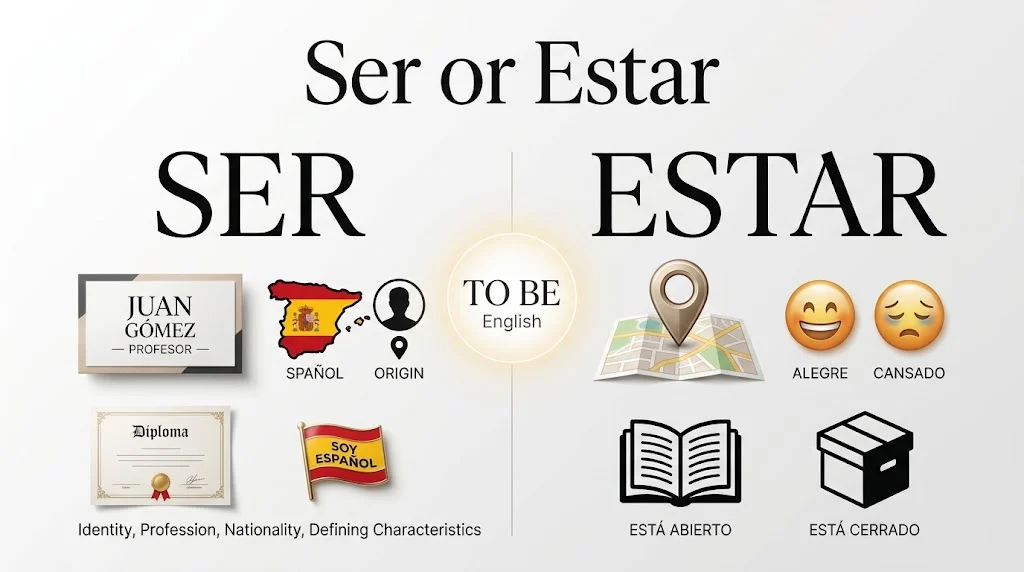
Ser and estar are both Spanish verbs meaning “to be,” but they are used in different situations. Ser generally identifies what something is, where it comes from, or characteristics viewed as defining, while estar commonly describes states, conditions, locations, and situations.
The question of ser or estar is one of the first major challenges for people learning Spanish. English uses a single verb, “to be,” for situations that Spanish divides between two verbs. That difference can make simple sentences surprisingly difficult for beginners.
Ser is used to identify or classify people and things, while estar is often used to describe location, condition, feelings, and temporary or resulting states. However, the popular idea that ser always means something permanent and estar always means something temporary is too simplistic. Context matters.
Ser vs Estar: What’s the Difference?
Both ser and estar are irregular Spanish verbs that translate into English as “to be.” Their uses, however, are different.
| Verb | Part of speech | Main uses | Example | English meaning |
| Ser | Verb | Identity, origin, profession, characteristics, time, relationships | Ella es médica. | She is a doctor. |
| Estar | Verb | Location, condition, feelings, results, ongoing states | Ella está cansada. | She is tired. |
Ser
Ser identifies what a person or thing is. It commonly expresses identity, origin, nationality, profession, relationships, possession, time, dates, and characteristics.
Estar
Estar describes where someone or something is, how someone feels, or what condition something is in. It is also used with progressive forms to describe actions in progress.
A simple recap is:
Ser identifies or classifies.
Estar describes states and locations.
Both mean “to be.”
Context determines which verb is appropriate.
Is Ser vs Estar a Grammar, Vocabulary, or Usage Issue?
The difference between ser and estar is primarily a grammar and usage issue.
It is not simply a matter of choosing two synonyms. Spanish treats these verbs as distinct grammatical tools.
They are therefore not interchangeable in most ordinary sentences.
In formal Spanish, academic Spanish, professional communication, and casual conversation, the distinction remains important.
The popular shortcut says:
Ser equals permanent.
Estar equals temporary.
This can help at the beginning, but it eventually becomes misleading.
For instance, “Soy estudiante” means “I am a student,” even though being a student is not necessarily permanent. Likewise, “Está muerto” uses estar even though death is not temporary.
A better approach is to understand the categories and patterns associated with each verb.
How to Use Ser Correctly
Ser is commonly used for identity and classification.
Identity
“Soy Ana.”
“I am Ana.”
The speaker identifies herself.
Profession
“Mi hermano es profesor.”
“My brother is a teacher.”
Profession commonly uses ser.
Origin
“Somos de México.”
“We are from Mexico.”
Origin is expressed with ser.
Nationality
“Ella es española.”
“She is Spanish.”
Nationality normally uses ser.
Characteristics
“Carlos es alto.”
“Carlos is tall.”
The sentence presents tallness as a characteristic of Carlos.
Time and Dates
“Son las tres.”
“It is three o’clock.”
“Hoy es lunes.”
“Today is Monday.”
Workplace Example
“María es la directora de marketing.”
“María is the marketing director.”
The sentence identifies her professional role.
Academic Example
“El profesor es experto en lingüística.”
“The professor is an expert in linguistics.”
The sentence identifies a characteristic or professional status.
Technology Example
“Este programa es gratuito.”
“This program is free.”
The sentence describes a defining feature of the program.
Usage Recap for Ser
Use ser for identity, origin, profession, nationality, relationships, time, dates, and many characteristics.
Think about the question:
What is it? Who is it? Where is it from? What is it like as a defining characteristic?
If the sentence answers one of these questions, ser may be appropriate.
How to Use Estar Correctly
Estar commonly describes location, condition, feelings, and states.
Location
“Estoy en casa.”
“I am at home.”
Location of people and things generally uses estar.
“Madrid está en España.”
“Madrid is in Spain.”
Feelings
“Estoy feliz.”
“I am happy.”
“Estamos cansados.”
“We are tired.”
These sentences describe current states.
Conditions
“La puerta está abierta.”
“The door is open.”
The sentence describes the current condition of the door.
Results
“La ventana está rota.”
“The window is broken.”
The sentence focuses on the resulting state.
Workplace Example
“Los empleados están ocupados.”
“The employees are busy.”
The sentence describes their current condition.
Academic Example
“Los estudiantes están preparados para el examen.”
“The students are prepared for the exam.”
Prepared describes their current state.
Technology Example
“El sistema está conectado.”
“The system is connected.”
The sentence describes the current state of the system.
Usage Recap for Estar
Use estar for location, feelings, conditions, results, and many temporary or current states.
Think about:
Where is it? How is it? What condition is it in right now?
These questions often point toward estar.
When You Should NOT Use Ser or Estar
Several common situations cause problems for learners.
1. Do not assume permanent always means ser
“Está muerto” uses estar even though death is permanent.
2. Do not assume temporary always means estar
“Es estudiante” uses ser even though someone may eventually stop being a student.
3. Do not use ser for ordinary physical location
“El libro está en la mesa” is correct for the location of a book.
4. Do not use estar automatically for every feeling
Some expressions describing characteristics use ser rather than estar.
5. Do not translate “to be” mechanically
English uses one verb, but Spanish requires you to consider the context.
6. Do not memorize only “ser equals permanent”
That shortcut does not explain many real Spanish sentences.
7. Do not treat ser and estar as interchangeable synonyms
Changing the verb can change the meaning of a sentence.
8. Do not ignore adjective meaning
Some adjectives change meaning depending on whether they appear with ser or estar.
Adjectives That Change Meaning With Ser and Estar
One of the most interesting features of Spanish is that choosing ser or estar can alter the meaning of an adjective.
Consider ser aburrido and estar aburrido.
“Él es aburrido” means “He is boring.”
“Él está aburrido” means “He is bored.”
Another example is ser listo and estar listo.
“Ella es lista” means “She is clever.”
“Ella está lista” means “She is ready.”
Similarly:
“Es rico” can mean “He is rich.”
“Está rico” can mean “It tastes good” when referring to food.
These examples demonstrate why the permanent versus temporary rule is not enough. The choice of verb can affect the meaning of the entire expression.
Common Mistakes and Decision Rules
| Correct sentence | Incorrect sentence | Explanation |
| Soy de España. | Estoy de España. | Origin normally uses ser. |
| Estoy en España. | Soy en España. | Location uses estar. |
| Ella es médica. | Ella está médica. | Profession normally uses ser. |
| Ella está cansada. | Ella es cansada. | A current state uses estar. |
| Hoy es martes. | Hoy está martes. | Days and dates use ser. |
| La puerta está abierta. | La puerta es abierta. | Current condition uses estar. |
| Él es aburrido. | Él está aburrido. | Ser aburrido means boring. |
| Él está aburrido. | Él es aburrido. | Estar aburrido means bored. |
Decision Rule Box
If you are identifying what someone or something is, use ser.
If you are describing a location, condition, feeling, or current state, use estar.
Do not rely solely on the word “permanent.” Learn the grammatical categories and the meaning of common adjective combinations.
Ser and Estar in Modern Technology and AI Tools
Technology has made Spanish learning more interactive, but digital tools can sometimes encourage learners to translate too literally.
An English sentence such as “The system is ready” may require estar in Spanish:
“El sistema está listo.”
However, “The system is reliable” could use ser:
“El sistema es fiable.”
AI language tools can help explain these distinctions by providing examples and contrasting meanings. They can also identify grammatical errors and generate practice exercises.
Still, learners should understand the underlying rule. A translation system may provide the correct answer, but knowing why ser or estar is required helps you apply the pattern to new sentences.
Etymology: Where Do Ser and Estar Come From?
The history of ser is especially interesting because modern Spanish ser developed from forms associated with several historical Latin verbs, particularly forms related to being and existence.
Estar comes from Latin stare, meaning “to stand” or “to remain standing.” Over time, it developed into the modern Spanish verb used for states, conditions, and locations.
Their different histories help explain why Spanish ended up with two major verbs corresponding to the English verb “to be.”
A useful expert style rule is:
“Learn ser and estar by function and context, not by the single rule of permanent versus temporary.”
That approach gives learners a much more accurate foundation.
Two Practical Case Studies
Case Study 1: Describing a Person
Consider these two sentences:
“Juan es aburrido.”
“Juan está aburrido.”
The first says Juan is boring. It describes a characteristic of Juan.
The second says Juan is bored. It describes his current emotional state.
The only major change is the verb, but the meaning changes substantially.
The practical result is important for learners because using the wrong verb can accidentally communicate something very different from what was intended.
Case Study 2: Describing Food
Consider:
“La comida es buena.”
“La comida está buena.”
The first can describe the food as good in a broader or characteristic sense.
The second commonly means the food tastes good or is good in its current condition.
Again, choosing ser or estar affects interpretation.
These examples show why memorizing isolated translations is less effective than learning Spanish expressions in context.
Error Prevention Checklist
Always use ser when
You identify a person or thing.
Describe origin or nationality.
You state a profession or role.
Give the time or date.
You describe many defining characteristics.
Describe relationships or identity.
Never use estar when
You are stating someone’s origin.
Giving the time.
You are identifying a profession in a standard sentence.
Naming a person’s nationality.
You are replacing ser simply because the situation is not permanent.
Related Grammar Confusions You Should Master
Once you understand ser and estar, several other Spanish grammar topics become easier to study.
- Por or para
- Saber or conocer
- Haber or tener
- Bueno or bien
- Muy or mucho
- Qué or cuál
- Tú or usted
- Preterite or imperfect
- Saber or poder
- Ser or estar with adjectives
These distinctions are important because Spanish often expresses ideas differently from English. Learning the patterns in context will make your Spanish more natural and precise.
FAQs
When should I use ser in Spanish?
Use ser for identity, origin, nationality, profession, relationships, time, dates, and many characteristics. For example, “Soy profesor” means “I am a teacher.”
When should I use estar in Spanish?
Use estar for location, feelings, conditions, results, and many temporary or current states. For example, “Estoy cansado” means “I am tired.”
Does using ser instead of estar change meaning?
Yes. In some cases, changing the verb changes the meaning significantly. “Es aburrido” means “He is boring,” while “Está aburrido” means “He is bored.”
Do you use ser or estar for location?
For the location of people and things, use estar. For example, “El libro está en la mesa” means “The book is on the table.” Events can behave differently and may use ser.
Do you use ser or estar for feelings?
Many current feelings and emotional states use estar. For example, “Estoy feliz” means “I am happy” and “Estamos cansados” means “We are tired.”
Do you use ser or estar for professions?
Professions generally use ser. For example, “Ella es doctora” means “She is a doctor.”
Conclusion
The choice between ser or estar becomes much easier when you stop treating it as a simple permanent versus temporary distinction. Ser is commonly used for identity, origin, profession, nationality, time, relationships, and characteristics, while estar is commonly used for location, feelings, conditions, results, and current states.
The two verbs are not interchangeable, and choosing the wrong one can change the meaning of a sentence. For accurate Spanish, learn each verb by function, pay attention to context, and memorize common adjective combinations that change meaning.

Philip Pullman is an American writer dedicated to creating clear and easy to follow English content. Through his work at LingRoya.com, he helps readers strengthen their language skills with practical and reliable guidance so that they can easily understand.