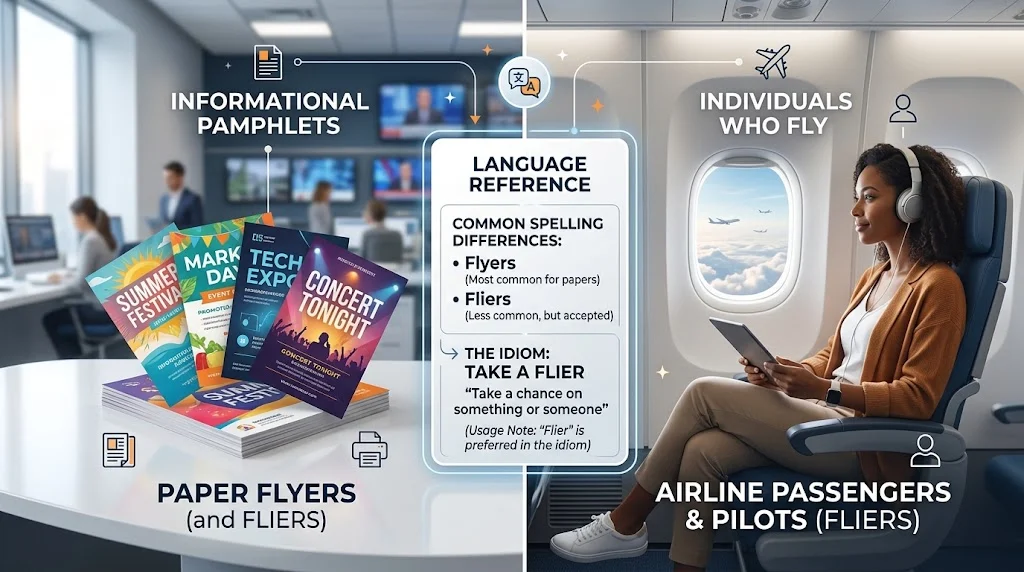
Both fliers or flyers can be correct spellings, but modern English strongly favors flyer for a person who travels by air and for a printed advertisement. Flier remains an accepted variant and is especially established in expressions such as “take a flier,” meaning to take a risk.
Flier is a noun. It can mean a person or thing that flies, a person who travels by air, or a risky venture. It can also refer to an advertising sheet, although that meaning is often spelled flyer in contemporary English. Merriam Webster lists flier as the main entry while identifying flyer as a variant, and notes that flyer is usually preferred for an advertising circular.
Flyer is also a noun. It commonly means a small printed sheet used to advertise an event, product, service, or campaign. It can also mean a person who flies or travels by plane. Oxford lists flyer and flier as alternatives, while the Associated Press recommends flyer for both an aircraft passenger and a handbill.
| Feature | Flier | Flyer |
| Part of speech | Noun | Noun |
| Advertising sheet | Correct, less common in some styles | Very common |
| Air traveler | Correct | Very common |
| Person who flies | Correct | Correct |
| Risky venture | Common in “take a flier” | Less preferred in this expression |
| Formal writing | Acceptable | Often the safer general choice |
| Modern American usage | Established variant | Highly common |
Mini Recap
Flier is not wrong.
Flyer is often the clearest modern choice.
For advertisements, flyer is especially natural.
For the expression “take a flier,” flier remains the established spelling.
Is Fliers vs Flyers a Grammar, Vocabulary, or Usage Issue?
This is primarily a vocabulary and usage issue, not a grammar problem.
You are not choosing between two different grammatical structures. Both flier and flyer function as nouns. The real question is which spelling best communicates the intended meaning and fits the style standard being followed.
The distinction becomes particularly interesting because English has never completely standardized these two spellings.
For an advertising handbill, flyer is the dominant modern choice in many contexts. Cambridge defines a flyer as a small piece of paper containing information about a product or event.
For an air traveler, both forms are recognized. Cambridge gives “flyer” as the main form and identifies “flier” as another form, while the Associated Press specifically recommends “flyer.”
In academic writing, consistency matters more than personal preference. If a university department follows a particular style guide, follow that guide throughout the document.
In casual writing, either form may be understood immediately. Most readers will not consider flier an error simply because they personally prefer flyer.
The practical distinction is therefore one of convention, audience, and style rather than basic correctness.
How to Use Flyer Correctly
The spelling flyer is especially useful when you mean an advertising sheet, promotional handout, or printed notice.
Consider this sentence:
The marketing team created a flyer for the new restaurant opening.
Here, flyer clearly refers to a promotional document.
Workplace Example
A manager might write:
Please send the updated event flyer to the sales team.
This is natural business English because the word identifies a promotional document.
Academic Example
A university department could write:
Students received a flyer explaining the scholarship application process.
The word refers to a printed information sheet.
Technology Example
Digital marketing platforms routinely use terminology such as “flyer design,” “digital flyer,” and “online flyer.” In these contexts, flyer is generally the most recognizable spelling.
Usage Recap
Use flyer when discussing promotional material, advertisements, event notices, or informational handouts. It is also a strong general choice for a person who travels by plane.
How to Use Flier Correctly
Flier has a longer history and remains a legitimate English spelling. Merriam Webster traces its first known use to the fifteenth century and lists several meanings, including someone who flies and a risky undertaking.
For example:
She is an experienced flier who travels internationally every month.
This sentence is grammatically correct.
Another established use appears in:
He decided to take a flier on the new business.
Here, take a flier means to take a chance or make a risky investment or decision. Merriam Webster specifically identifies this expression.
Workplace Example
The executive is a frequent flier and spends much of the year visiting overseas offices.
The meaning is clear: the executive travels frequently by aircraft.
Academic Example
The study examined how experienced fliers respond to turbulence.
Here, fliers refers to people who fly or travel by air.
Technology Example
A technology publication might describe autonomous aircraft, drones, or model aircraft operators as fliers, although flyers is also possible depending on editorial preference.
Usage Recap
Use flier confidently when it fits your chosen style or when writing the established expression take a flier. It is not an incorrect form of flyer.
When You Should NOT Use Fliers or Flyers
There are several situations where choosing one spelling without considering meaning or context can create confusion.
- Do not assume flier is always the correct spelling simply because it appears in older dictionaries.
- Do not assume flyer is always the only acceptable spelling. Major dictionaries recognize both forms.
- Do not switch between flier and flyer randomly within the same article or publication.
- Do not use flier in a professional marketing campaign if your organization’s style guide consistently uses flyer.
- Do not change take a flier to take a flyer merely because you normally prefer the second spelling. Both can occur, but flier is the established editorial preference in the Associated Press guidance.
- Do not treat a spelling difference as a pronunciation difference. In ordinary English, the two forms are pronounced essentially the same.
- Do not assume British and American usage will always follow exactly the same pattern.
- Do not call one spelling universally correct and the other universally wrong. The evidence from major dictionaries does not support that claim.
Common Mistakes and Decision Rules
| Correct sentence | Incorrect or less suitable sentence | Explanation |
| We distributed flyers for the concert. | We distributed flier for the concert. | The plural noun needs the plural form, and flyer is especially common for advertising material. |
| She is a frequent flyer. | She is a frequent flier. | The second sentence is not inherently wrong, but flyer is the preferred form in AP style. |
| He took a flier on the investment. | He took a flyer on the investment. | The first spelling follows the established AP preference for the expression. |
| The company printed 5,000 flyers. | The company printed 5,000 fliers. | Both can be understood, but flyer is the usual modern marketing spelling. |
| Oxford lists flyer and flier as alternatives. | Oxford says flier is always wrong. | Oxford recognizes both forms. |
Decision Rule Box
If you mean a printed advertisement or promotional sheet, choose flyer as the safest modern option.
If you mean a person who flies or travels by aircraft, both flyer and flier are acceptable, although flyer is preferred by AP style.
If you mean a risky undertaking, use flier in the established expression take a flier.
Fliers and Flyers in Modern Technology and AI Tools
Digital publishing has made the spelling flyer even more visible.
Design applications, marketing platforms, event management systems, and social media tools commonly describe promotional graphics as flyers. A digital flyer may never be printed at all. It can exist as an image, PDF, email graphic, or social media post.
AI writing and design tools create another interesting usage problem. An AI system may generate both spellings because both occur in legitimate English. That does not necessarily mean the system has made a mistake.
The better editorial approach is to establish a style rule before generating or editing large quantities of content. For example, a marketing organization might choose flyer for all promotional materials and reserve flier for the expression “take a flier.”
Consistency helps readers recognize intentional terminology rather than random spelling variation.
Etymology of Flier and Flyer
Both spellings developed from the verb fly combined with the noun forming element associated with a person or thing that performs an action.
The spelling flier has a particularly long history. Merriam Webster records its first known use in the fifteenth century.
The spelling flyer developed as a competing form and became especially common in the sense of an advertising circular. Modern dictionaries now recognize substantial overlap between the two forms.
This is a good example of how English spelling evolves. A language does not always eliminate competing forms simply because they have the same pronunciation.
What Style Experts Say About Flier and Flyer
The Associated Press offers one of the clearest practical rules for professional writers: use flyer for a person flying in an aircraft and for handbills, while retaining flier in the expression take a flier.
Merriam Webster takes a more descriptive dictionary approach. It identifies flier as the primary entry while describing flyer as a less common spelling for the person who flies and as the usual form for an advertising circular.
Oxford likewise recognizes the relationship between the two forms and lists both meanings under its entries.
The important lesson is that authoritative sources agree on the legitimacy of both spellings while differing somewhat in which form they prefer for individual meanings.
Two Practical Case Studies
Case Study One: The Marketing Team
Imagine a university marketing department preparing a campaign for an annual conference. The first draft contains “conference fliers,” “digital fliers,” and “download the conference flier.”
An editorial review changes all promotional references to flyer.
The concrete result is a consistent terminology system across the campaign. The same word appears on the website, registration page, email graphics, and printed materials. No meaning changes, but the editorial style becomes more uniform.
This reflects modern dictionary usage, where flyer is strongly established for an advertising circular.
Case Study Two: The Newsroom
Consider a newsroom following Associated Press style. An editor sees the sentence “She is a frequent flier who took a flyer on the new airline.”
Following AP guidance, the editor changes the first occurrence to frequent flyer but retains take a flier.
The concrete result is a sentence that follows the publication’s stated style rule while preserving the established idiom. This is precisely the kind of consistency that professional editing is designed to achieve.
Error Prevention Checklist
Always use flyer when
- You mean a promotional handout.
- You are writing marketing copy and your style guide favors the modern common form.
- You mean a person who travels by aircraft and are following AP style.
- You want one broadly recognizable spelling for general readers.
Never use flier when
- Your organization has explicitly standardized on flyer.
- You are writing a style sensitive publication that requires AP usage and mean an aircraft passenger.
- You are treating flier and flyer as completely unrelated words.
- You are changing a carefully established terminology system without a reason.
Related Grammar Confusions You Should Master
If you want to improve your English usage beyond this spelling question, these related distinctions are worth mastering:
- Affect vs effect
- Advice vs advise
- Compliment vs complement
- Stationary vs stationery
- Principal vs principle
- Lay vs lie
- Further vs farther
- Fewer vs less
- Who vs whom
- Then vs than
These pairs demonstrate the same larger lesson: spelling, meaning, grammar, and usage often overlap, but they are not identical concepts.
FAQs
Are fliers and flyers the same word?
They can have the same meanings. Both can refer to people who fly or travel by aircraft, and both can refer to advertising sheets. Modern usage often favors flyer for promotional material.
Is flyer or flier correct for an advertisement?
Flyer is the safest general choice for an advertisement or handbill. Merriam Webster specifically notes that the advertising sense is usually spelled flyer.
Is it frequent flyer or frequent flier?
Both forms can be found, but frequent flyer is the preferred form in Associated Press style.
Is it take a flier or take a flyer?
Take a flier is the established spelling recommended by Associated Press style when the phrase means taking a major risk.
Which is more common, flier or flyer?
Modern English uses flyer very widely, particularly for advertising sheets and air travelers. Flier remains established and is recognized by major dictionaries.
Is flier a misspelling of flyer?
No. Flier is a legitimate English word with a long history. Merriam Webster records its first known use in the fifteenth century.
Should I use flyer or flier in academic writing?
Either may be correct, but consistency is important. If your institution or publication follows a style guide, use its preferred form. Otherwise, flyer is a practical choice for promotional material.
Is flyer more common in American English?
Yes, flyer is extremely common in American English, especially in expressions such as “frequent flyer” and for promotional handouts. Oxford’s American dictionary identifies flyer as equivalent to flier.
How do you spell flyers for an event?
The most broadly recognizable choice is flyers. For example: “We printed flyers for the community event.” Cambridge and Merriam Webster both support the advertising sense.
Conclusion
The answer to fliers or flyers depends on what you mean and which style guide you follow. Both spellings are legitimate, but flyer is usually the strongest modern choice for advertising material and is also widely preferred for people who travel by air. Flier remains an established alternative and is particularly useful in the expression take a flier.
For everyday writing, choose flyer when you mean a promotional handout. For aviation, flyer is also a safe choice. When writing “take a flier,” retain flier if you want to follow AP style. Above all, don’t treat the two spellings as a simple right versus wrong pair. Their relationship is more interesting, and more flexible, than that.

Philip Pullman is an American writer dedicated to creating clear and easy to follow English content. Through his work at LingRoya.com, he helps readers strengthen their language skills with practical and reliable guidance so that they can easily understand.