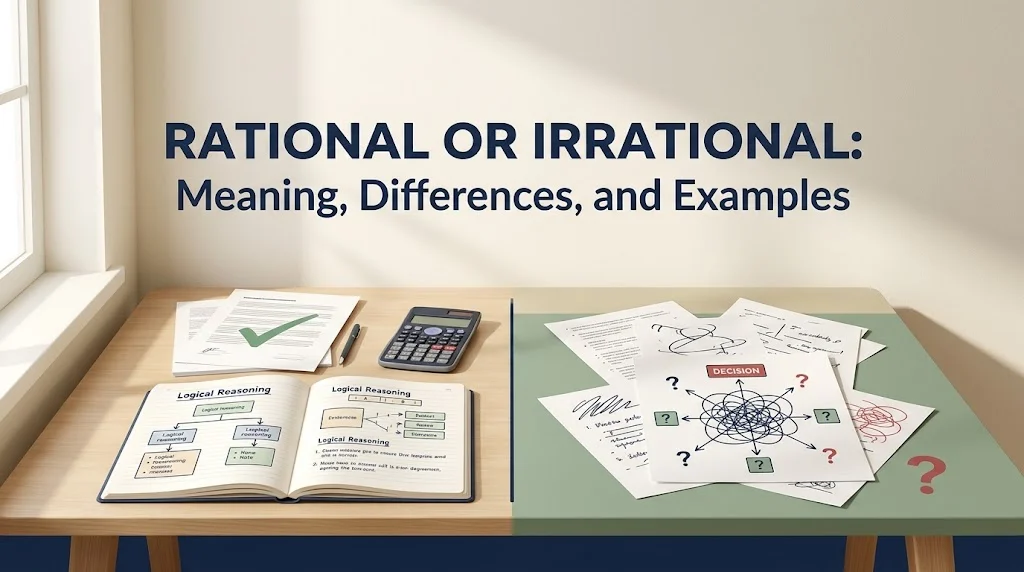
Rational or irrational describes two different ways of thinking, deciding, or understanding something. Rational means based on reason, logic, and evidence, while irrational means lacking sound reasoning or going against logical judgment.
Have you ever made a decision based on facts, only to see someone else act on fear or assumptions? The difference often comes down to whether the thinking is rational or irrational. In English, these words describe reasoning that follows logic or departs from it.
They also have specific meanings in mathematics, where rational and irrational numbers are classified according to whether they can be expressed as a ratio of integers. As a language and usage distinction, understanding these terms helps you communicate more precisely, evaluate arguments fairly, and avoid confusing logical decisions with emotional reactions.
Rational vs Irrational: What’s the Difference?
The main difference between rational and irrational is the relationship between an idea and logical reasoning. Although the words are opposites, their meanings depend partly on context.
Rational is an adjective that describes something based on reason, evidence, or logical thought. A rational person considers available information before making a decision.
Irrational is an adjective that describes something inconsistent with sound reasoning or unsupported by sufficient evidence. An irrational reaction may arise from fear, misunderstanding, or an exaggerated belief.
| Feature | Rational | Irrational |
| Part of speech | Adjective | Adjective |
| Meaning | Based on reason and logic | Contrary to sound reasoning |
| Decision making | Considers evidence and consequences | May disregard evidence or consequences |
| Emotional influence | Evaluates emotions alongside facts | May be dominated by fear or assumptions |
| Everyday example | Saving money for an emergency | Spending all your savings on an unsupported promise |
| Mathematical meaning | Expressible as a ratio of integers | Not expressible as a ratio of integers |
Quick recap
Rational thinking relies on logic, evidence, and careful evaluation.
Irrational thinking ignores or misinterprets important evidence.
Neither term automatically describes someone’s intelligence or character.
In mathematics, the distinction concerns numerical properties rather than human behavior.
Is Rational vs Irrational a Grammar, Vocabulary, or Usage Issue?
The difference between rational and irrational is primarily a vocabulary and usage issue, although grammar determines how each word fits into a sentence.
Both words are adjectives. They can modify nouns, describe a person’s reasoning, or characterize an action, belief, argument, or decision.
For example, “She made a rational choice” describes a decision supported by sensible reasoning. In contrast, “His fear of harmless objects seemed irrational” suggests that his fear was disproportionate to the actual danger.
The words are not interchangeable because they communicate opposite meanings. Replacing one with the other can reverse the meaning of a sentence.
Formal versus informal usage
Both terms appear in formal and informal English. In academic writing, rational commonly describes logical arguments, evidence based decisions, and reasoned conclusions. Irrational is useful when discussing flawed assumptions, inconsistent arguments, or decisions that lack sufficient justification.
In casual conversation, someone might say, “That sounds rational,” to approve of a sensible plan. They might also say, “That fear seems irrational,” to question a reaction that appears unsupported by the circumstances.
However, calling a person irrational can sound judgmental. In professional or sensitive conversations, describing a specific decision as “unsupported by the evidence” may be more constructive.
How to Use Rational Correctly
Use rational when describing reasoning that follows logic, considers evidence, or evaluates possible outcomes. A rational decision does not have to be perfect. It simply reflects a reasonable assessment of the information available.
Workplace example
A manager reviews employee performance, project costs, and deadlines before assigning resources. This is a rational approach because the decision considers relevant evidence rather than personal favoritism.
Example: “The team adopted a rational strategy after reviewing the project risks.”
Academic example
A student compares research findings from several reliable sources before developing an argument. The student uses rational reasoning by evaluating evidence and considering alternative explanations.
Example: “Her rational analysis helped explain why the original hypothesis was incorrect.”
Technology example
A software engineer compares processing speed, reliability, security, and cost before selecting a technology platform. The choice is rational because it follows measurable requirements.
Example: “The company made a rational decision to upgrade its system after evaluating performance data.”
Usage recap
Use rational for sensible decisions, logical arguments, evidence based conclusions, and reasoned behavior. Remember that a rational choice can still produce an unexpected result because reasonable decisions depend on the quality of the available information.
How to Use Irrational Correctly
Use irrational when a thought, belief, reaction, or decision conflicts with sound reasoning or lacks adequate justification. The term should describe the reasoning or behavior rather than serve as an automatic judgment about someone’s worth or intelligence.
Workplace example
An employee rejects a reliable proposal solely because they dislike the person who suggested it. If the proposal is evaluated without considering its actual merits, the response may be irrational.
Example: “Rejecting the proposal without reviewing the evidence was an irrational response.”
Academic example
A writer insists that a conclusion is correct while repeatedly ignoring credible evidence that contradicts it. This approach weakens the argument because it refuses to engage with relevant information.
Example: “The researcher identified an irrational assumption in the original argument.”
Technology example
A business owner refuses to install a necessary security update because of an unsupported rumor that every update damages computers. Ignoring reliable technical guidance may lead to an irrational decision.
Example: “The decision to ignore the verified security warning was irrational.”
Usage recap
Use irrational when reasoning is unsupported, inconsistent, or contrary to relevant evidence. Avoid using it simply because someone disagrees with you. Different opinions can be reasonable when people have different priorities or information.
When You Should NOT Use Rational or Irrational
These words are useful, but several common situations require extra care.
1. When you mean emotionally detached. A rational person can experience strong emotions. Use unemotional or calm when that is your intended meaning.
2. When you mean unintelligent. Irrational does not mean unintelligent. A knowledgeable person can make a poorly reasoned decision.
3. When you mean unusual. An unusual preference is not necessarily irrational. Use unconventional or uncommon when describing something different from normal expectations.
4. When you mean morally wrong. A decision can be rational but unethical. Use unethical when the central issue concerns moral standards.
5. When you mean mathematically incorrect. An incorrect calculation is not automatically an irrational number. Mathematical rationality refers to whether a number can be expressed as a ratio of integers.
6. When you mean uncertain. A person who lacks enough information is not necessarily irrational. Use uncertain or undecided when appropriate.
7. When you mean impulsive. An impulsive action happens without much forethought. It may be irrational, but the words do not have identical meanings.
8. When you mean emotionally understandable. A strong reaction to grief, danger, or disappointment should not automatically be labeled irrational. Consider the circumstances before judging the reasoning behind it.
Common Mistakes and Decision Rules
Writers sometimes confuse rational with reasonable, irrational with emotional, or irrational numbers with incorrect numbers. The following examples clarify these distinctions.
| Correct sentence | Incorrect sentence | Explanation |
| She made a rational decision after reviewing the evidence. | She made an irrational decision after reviewing the evidence. | The second sentence changes the intended meaning if the decision was logically supported. |
| His fear was irrational because no credible danger existed. | His fear was rational because no credible danger existed. | The second sentence contradicts the stated lack of danger. |
| Emotions can influence rational decisions. | Rational people never experience emotions. | Rational thinking does not require an absence of emotion. |
| The number 2\sqrt{2}2 is irrational. | The number 2\sqrt{2}2 is incorrect. | An irrational number is a valid mathematical number. |
| Her argument was irrational because it ignored the available evidence. | Her argument was irrational because it was unpopular. | Unpopularity alone does not establish poor reasoning. |
The decision rule
Choose rational when the reasoning follows evidence, logic, and a reasonable assessment of consequences.
Choose irrational when the reasoning contradicts relevant evidence or relies on unjustified assumptions.
For mathematics, ask whether the number can be written as a fraction of two integers with a nonzero denominator.
Rational and Irrational in Modern Technology and AI Tools
The distinction between rational and irrational is especially useful when discussing artificial intelligence, automated decision systems, and data analysis.
An AI system may produce an answer that appears rational because it follows a structured process or uses available data. However, a logical sounding explanation does not guarantee that the answer is accurate. The underlying information may be incomplete, outdated, or biased.
For example, a recruitment algorithm might rank candidates using predefined criteria. Its process may appear rational, but the outcome could still be unfair if the criteria reflect historical discrimination.
Similarly, calling an AI response irrational should mean that its reasoning is inconsistent, unsupported, or contradictory, not merely that it differs from a user’s opinion.
In technology discussions, the most reliable approach is to evaluate the evidence, assumptions, consistency, and consequences behind a decision.
Etymology of Rational and Irrational
The word rational comes through Latin rationalis, meaning reasonable or related to reasoning, from ratio, meaning reason, calculation, or reckoning.
The word irrational combines the negative prefix ir, a form of in, with rational. The prefix reverses the meaning, creating a word that describes something contrary to reason.
This shared origin explains why the terms are opposites in everyday English and why both are used in discussions of logic and mathematics.
Expert Insight: Why Context Matters
“Sound reasoning depends not only on reaching a conclusion, but also on whether the evidence and assumptions support that conclusion.”
This principle is useful when deciding whether an argument is rational or irrational. A conclusion may happen to be correct even when the reasoning behind it is weak. Likewise, a carefully reasoned decision may lead to an unfavorable result because of uncertainty or circumstances beyond someone’s control.
The quality of reasoning and the eventual outcome should therefore be evaluated separately.
Two Practical Case Studies
The following illustrative scenarios show how the distinction applies in everyday decisions.
Case Study 1: A Business Investment
A small business owner must choose between two suppliers. One offers a lower price but has a history of late deliveries. The other charges slightly more but consistently meets deadlines.
The owner compares total costs, delivery records, product quality, and the risk of customer complaints before choosing the second supplier.
Result: The owner makes a rational decision because the evaluation considers both immediate costs and long term consequences. Choosing the cheapest option automatically would not necessarily have been the most rational approach.
Case Study 2: An Online Security Warning
A company receives a verified notification that its software contains a security vulnerability. An employee dismisses the warning because a colleague once installed an update that caused a minor technical problem.
The employee refuses to review the current warning, consult technical guidance, or consider the potential risks.
Result: The refusal is irrational because it relies on an isolated past experience while disregarding relevant evidence. Reviewing the update’s reliability and planning a safe installation would be a more reasonable response.
These examples demonstrate that rational thinking involves evaluating the whole situation, while irrational thinking often depends on incomplete evidence or unjustified assumptions.
Error Prevention Checklist
Use this checklist when editing your writing or evaluating an argument.
Always use rational when:
- The decision is supported by relevant evidence.
- An argument follows a consistent line of reasoning.
- A person considers risks, benefits, and consequences.
- A mathematical number can be expressed as a ratio of integers, when using the mathematical definition.
Never use irrational when:
- You simply disagree with someone’s opinion.
- You want to describe a person as unintelligent without explaining their reasoning.
- You mean unusual, emotional, or unconventional.
- You are describing a mathematically valid irrational number as if it were an error.
Before choosing either word, identify the specific reasoning or mathematical property you want to describe.
Related Grammar Confusions You Should Master
Understanding related word pairs can improve your vocabulary and make your writing more precise.
- Logical vs illogical: Whether reasoning follows a consistent pattern.
- Reasonable vs unreasonable: Whether something is fair, sensible, or appropriate in context.
- Emotional vs rational: The distinction between emotional influence and reasoned evaluation.
- Objective vs subjective: Whether a judgment relies on observable evidence or personal perspective.
- Practical vs theoretical: The difference between real world application and ideas or principles.
- Fact vs opinion: Whether a statement can be verified or expresses a personal viewpoint.
- Inference vs assumption: The difference between a conclusion drawn from evidence and an idea accepted without sufficient proof.
- Accurate vs precise: Whether information is correct and how specifically it is expressed.
- Rational vs irrational numbers: Whether a number can be represented as a ratio of integers.
- Effective vs efficient: Whether something achieves its goal and whether it uses resources economically.
Frequently Asked Questions About Rational or Irrational
1. What is the difference between rational and irrational?
Rational means based on reason, logic, or evidence, while irrational describes reasoning that lacks adequate support or conflicts with logical judgment.
2. Is rational the opposite of irrational?
Yes. In everyday English, rational and irrational are opposites because rational describes reasoned thinking, while irrational describes thinking that departs from sound reasoning.
3. Can a person be rational and emotional at the same time?
Yes. A person can experience strong emotions and still evaluate evidence carefully. Rationality involves how someone reasons, not whether they experience feelings.
4. What does rational mean in simple words?
Rational means sensible or logical, especially when a person makes a decision after considering facts, evidence, and possible consequences.
5. What does irrational mean in simple words?
Irrational means not supported by sound reasoning. An irrational decision may be based on an unjustified fear, a false assumption, or a refusal to consider relevant evidence.
6. What is the difference between rational and irrational numbers?
A rational number can be expressed as a fraction of two integers with a nonzero denominator. An irrational number cannot be expressed in that form. For example, 3/43/43/4 is rational, while 2\sqrt{2}2 is irrational.
7. Is irrational the same as illogical?
The words overlap, but they are not always identical. Illogical emphasizes a failure of logic or consistency, while irrational can also describe beliefs, fears, or decisions that lack reasonable justification.
8. Can a rational decision have a bad outcome?
Yes. A rational decision can lead to an unfavorable result when information is incomplete, circumstances change, or an unpredictable event occurs. The quality of the reasoning matters independently of the outcome.
9. How do you use rational and irrational in a sentence?
Use rational to describe reasoning supported by evidence, as in “She made a rational choice.” Use irrational for reasoning that lacks adequate support, as in “Ignoring the verified warning was irrational.”
Conclusion: Choosing Rational or Irrational Correctly
Understanding rational or irrational helps you communicate more clearly, evaluate arguments fairly, and make better distinctions between evidence based decisions and unsupported reactions. Rational describes reasoning guided by logic, while irrational describes reasoning that conflicts with relevant evidence or lacks sufficient justification. Neither term should be used simply to dismiss an opposing opinion, and neither automatically defines a person’s intelligence.
In mathematics, the same words have a precise meaning based on whether a number can be expressed as a ratio of integers. By considering context before choosing either term, you can use both words accurately in everyday conversations, academic writing, workplace communication, and mathematical explanations.

Margaret Atwood is an American writer who contributes to LingRoya.com creating clear and engaging content about the English language and everyday communication. She enjoys helping readers build confidence in their writing through simple, practical guidance.