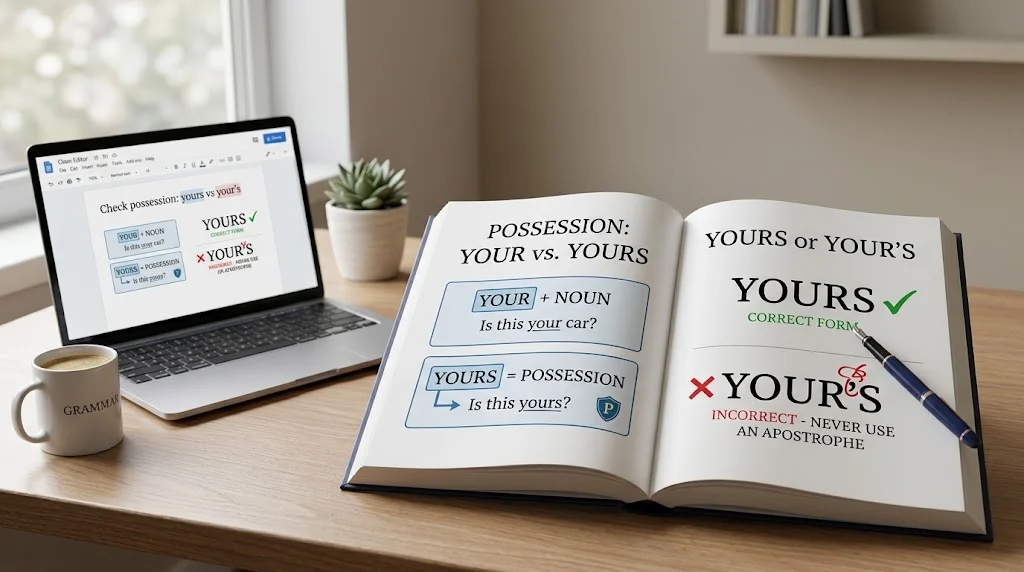
Yours is the correct possessive pronoun, while your’s is an incorrect spelling. Yours can stand alone to show ownership, as in “This book is yours.” The apostrophe is not used in this possessive form.
A tiny apostrophe can completely change whether a word is considered correct, and your’s or yours is one of the clearest examples. Many English learners assume that an apostrophe should appear because apostrophes often indicate possession, but English does not form every possessive word in the same way. Yours is already a complete possessive pronoun, so adding an apostrophe creates an incorrect form.
This distinction matters in emails, academic writing, business communication, websites, applications, and everyday messages. Once you understand how your and yours work, the rule becomes simple enough to remember whenever you write.
Your’s or Yours: What’s the Difference?
The difference is straightforward. Yours is correct, while your’s is not considered standard English.
| Form | Part of speech | Correct? | Main function | Example |
| Yours | Possessive pronoun | Yes | Shows ownership without a following noun | The blue jacket is yours. |
| Your’s | Nonstandard spelling | No | Intended to show possession | Your’s is incorrect. |
| Your | Possessive determiner | Yes | Shows possession before a noun | Your jacket is blue. |
A possessive pronoun replaces a noun phrase and can stand independently. For example, “This laptop is yours” means that the laptop belongs to you.
Your works differently. It normally comes directly before a noun. You can say “your laptop,” “your idea,” or “your answer,” but you cannot normally use your by itself in the same way as yours.
Mini Recap
Yours is the standard possessive pronoun.
Your’s is an incorrect spelling in standard English.
Your normally appears before a noun.
Yours can stand alone after a verb such as “is.”
Is Your’s vs Yours a Grammar, Vocabulary, or Usage Issue?
The your’s or yours question is primarily a grammar and usage issue, with spelling involved as well.
The problem occurs because English learners often apply a general apostrophe rule too broadly. Apostrophes can indicate possession with many nouns, such as “Sarah’s book” or “the teacher’s desk.” However, possessive pronouns follow their own established forms.
For example, we write:
“This is Sarah’s book.”
“This book is hers.”
The first sentence uses a possessive noun. The second uses a possessive pronoun.
The same pattern applies to your and yours:
“This is your book.”
“This book is yours.”
There is no need for an apostrophe in yours.
Formal vs Casual Usage
In formal writing, yours should always be used instead of your’s. This applies to academic papers, business documents, reports, professional emails, applications, and published content.
In casual online communication, people sometimes write your’s because they believe the apostrophe indicates possession. However, informal usage does not make the spelling standard.
Academic vs Casual Usage
Academic writing requires grammatical accuracy and conventional spelling. Using your’s may be marked as an error by a teacher, editor, or proofreader.
Casual conversations may contain spelling mistakes without causing serious misunderstanding, but learning the standard form is still useful because the same mistake can easily appear later in professional writing.
How to Use Your Correctly
Your is a possessive determiner. It identifies something associated with or belonging to the person being addressed.
Workplace Example
“Please send your report before the meeting.”
Here, your modifies the noun report. It tells the reader whose report is being discussed.
Another example is:
“Your manager requested an updated document.”
Your comes directly before manager.
Academic Example
“Your research demonstrates an interesting relationship between language and culture.”
Again, your modifies the noun research.
Technology Example
“Your account settings can be changed from the profile page.”
The word your identifies the account belonging to the person being addressed.
Usage Recap
Use your when a noun follows it.
Your answer is correct.
When your computer needs an update.
Your presentation was excellent.
A useful memory trick is to think of your as a word that usually needs a noun beside it.
How to Use Yours Correctly
Yours is a possessive pronoun. It indicates ownership without requiring a noun immediately after it.
Workplace Example
“My proposal is similar to yours.”
Here, yours replaces “your proposal.”
Academic Example
“The conclusion in this paper is different from yours.”
Yours means “your conclusion.”
Technology Example
“This account is yours, but the other account belongs to your colleague.”
Yours identifies ownership without repeating the noun account.
Yours also appears in traditional letter closings, such as “Yours sincerely” and “Yours faithfully,” depending on the variety of English and the style of correspondence.
Usage Recap
Use yours when the possessive expression stands independently.
The decision is yours.
Is this notebook yours?
My opinion differs from yours.
The red folder is yours.
When You Should NOT Use Your’s or Yours
Understanding when not to use each form can prevent many errors.
1. Do not use your’s as a possessive pronoun
Incorrect:
“This phone is your’s.”
Correct:
“This phone is yours.”
2. Do not use yours directly before a noun
Incorrect:
“Yours phone is on the desk.”
Correct:
“Your phone is on the desk.”
3. Do not use your by itself when you need a possessive pronoun
Incorrect:
“This seat is your.”
Correct:
“This seat is yours.”
4. Do not add an apostrophe simply because ownership is involved
Possession does not automatically require an apostrophe. Possessive pronouns such as yours, hers, ours, theirs, and its do not use apostrophes in their standard forms.
5. Do not confuse yours with you’re
You’re is a contraction meaning “you are.”
“You’re ready.”
Yours indicates possession.
“The choice is yours.”
6. Do not confuse your with you’re
“Your answer is correct.”
“You’re correct.”
These sentences have different grammatical structures.
7. Do not treat your’s as an alternative spelling
Your’s is not simply a less formal version of yours. It is a nonstandard form that should be avoided in edited English.
Common Mistakes: Your’s, Your, and Yours
| Correct sentence | Incorrect sentence | Explanation |
| This book is yours. | This book is your’s. | Yours is the correct possessive pronoun. |
| Your car is outside. | Yours car is outside. | Your must come before the noun car. |
| Is this pen yours? | Is this pen your? | Yours can stand independently. |
| Your idea is useful. | Your’s idea is useful. | Your modifies the noun idea. |
| My answer differs from yours. | My answer differs from your’s. | Yours does not take an apostrophe. |
| Your account is active. | You’re account is active. | You’re means you are. |
Decision Rule Box
If a noun comes immediately after the word, use “your.”
If the possessive expression stands alone, use “yours.”
Never add an apostrophe to create the standard possessive pronoun “yours.”
For example:
“Your laptop is new.”
“The laptop is yours.”
This simple contrast solves most your and yours questions.
Your’s or Yours in Modern Technology and AI Tools
Modern technology has made spelling accuracy even more visible. Search engines, grammar checkers, word processors, email platforms, and AI writing assistants frequently identify nonstandard forms such as your’s.
This matters because digital writing is often public or professionally important. A spelling error in a personal message may be harmless, but the same error on a business website, academic assignment, application, or professional email can affect how polished the writing appears.
AI tools can also explain the difference between your and yours, but users should understand the grammatical principle rather than blindly accepting automated corrections. Knowing the rule makes it easier to recognize incorrect suggestions and edit writing confidently.
Why Does Yours Have No Apostrophe?
The history of English possessive forms helps explain why the spelling can feel unusual.
English uses apostrophes in several possessive constructions, especially with nouns. For example, “the student’s book” indicates that the book belongs to the student.
However, possessive pronouns developed separate forms. Modern English uses mine, yours, his, hers, ours, and theirs as independent possessive pronouns.
These forms do not require apostrophes.
There is an important parallel with its and it’s. Its indicates possession, while it’s is normally a contraction of “it is” or “it has.” The apostrophe changes the grammatical function rather than simply marking possession.
The same principle applies to yours. The spelling is established as yours, not your’s.
An Expert Style Explanation
A useful way to remember the rule is this:
“Possessive pronouns already contain the grammatical information needed to express ownership, so adding an apostrophe to yours is unnecessary.”
In practical terms, think about what follows the word. If you need a noun, use your. If you have already mentioned the noun or can leave it understood, use yours.
Compare:
“Your presentation was impressive.”
“Your presentation was more detailed than mine, but yours was easier to follow.”
The second yours replaces “your presentation.”
Two Practical Case Studies
Case Study 1: Professional Email Editing
Consider an employee writing:
“Please review the attached proposal and compare it with your’s.”
The intended meaning is clear, but the possessive form is incorrect. An edited version would be:
“Please review the attached proposal and compare it with yours.”
The correction removes the apostrophe while preserving the meaning. In a professional editing exercise, the measurable result is one unnecessary character removed and the sentence brought into standard written English.
Case Study 2: Academic Proofreading
Imagine a student writing:
“Your conclusion is stronger than your’s.”
The sentence contains a common possessive error. The corrected version is:
“Your conclusion is stronger than yours.”
The change illustrates the central rule: your introduces the noun conclusion, while yours replaces the phrase “your conclusion.” The result is a grammatically standard sentence without changing the student’s intended comparison.
These examples demonstrate why understanding the underlying structure is more useful than memorizing a spelling in isolation.
Error Prevention Checklist
Always Use Your When
The word is followed by a noun.
You are describing something associated with the reader.
Examples include your name, your work, your computer, and your decision.
Always Use Yours When
The possessive expression stands alone.
The noun has already been mentioned.
You are comparing one person’s possession with another person’s possession.
Examples include “The choice is yours” and “My answer is different from yours.”
Never Use Your’s When
You are writing standard English.
Submitting academic work.
You are preparing professional communication.
Publishing website content.
You mean the possessive pronoun belonging to you.
Related Grammar Confusions You Should Master
Learning the your’s or yours distinction also makes several related English problems easier to understand.
- Your vs you’re
- Its vs it’s
- Their vs there vs they’re
- Whose vs who’s
- Who vs whom
- Affect vs effect
- Then vs than
- Its vs their possessive usage
- Who’s vs whose in questions
- Possessive nouns vs possessive pronouns
These pairs are especially useful for English learners because many mistakes happen when spelling, pronunciation, and grammatical function overlap.
FAQs
Is your’s grammatically correct?
No. Your’s is not the standard English spelling of the possessive pronoun. The correct form is yours.
Which is correct, your’s or yours?
Yours is correct. It is the possessive pronoun used to indicate that something belongs to you.
Why is there no apostrophe in yours?
Yours is an established possessive pronoun. Standard English does not require an apostrophe in possessive pronouns such as yours, hers, ours, or theirs.
Is yours a possessive pronoun?
Yes. Yours is a possessive pronoun because it can stand independently and represent something belonging to the person being addressed.
What is the difference between your and yours?
Your normally comes before a noun, while yours can stand alone. For example, “your book” uses your, while “the book is yours” uses yours.
Can I write your’s in an informal message?
You may encounter your’s in informal writing, but it is still considered a nonstandard spelling. If you want to use standard English, write yours.
Is yours used in formal English?
Yes. Yours is completely standard in formal English. It is appropriate in academic writing, business communication, professional documents, and edited publications.
Is yours a contraction?
No. Yours is not a contraction. It is a possessive pronoun. An apostrophe should not be added to it.
Which is correct, this is yours or this is your?
“This is yours” is correct when the sentence ends with the possessive pronoun. “This is your” normally requires a noun afterward, such as “This is your book.”
Conclusion
The answer to your’s or yours is simple: yours is the correct standard form. Your is used before a noun, while yours functions as a possessive pronoun and can stand independently. The apostrophe in your’s is unnecessary and creates a nonstandard spelling. Once you remember the difference between a possessive determiner and a possessive pronoun, this common English mistake becomes easy to avoid. Whether you are writing an academic assignment, professional email, website article, or everyday message, choosing yours will keep your writing accurate and polished.

Margaret Atwood is an American writer who contributes to LingRoya.com creating clear and engaging content about the English language and everyday communication. She enjoys helping readers build confidence in their writing through simple, practical guidance.