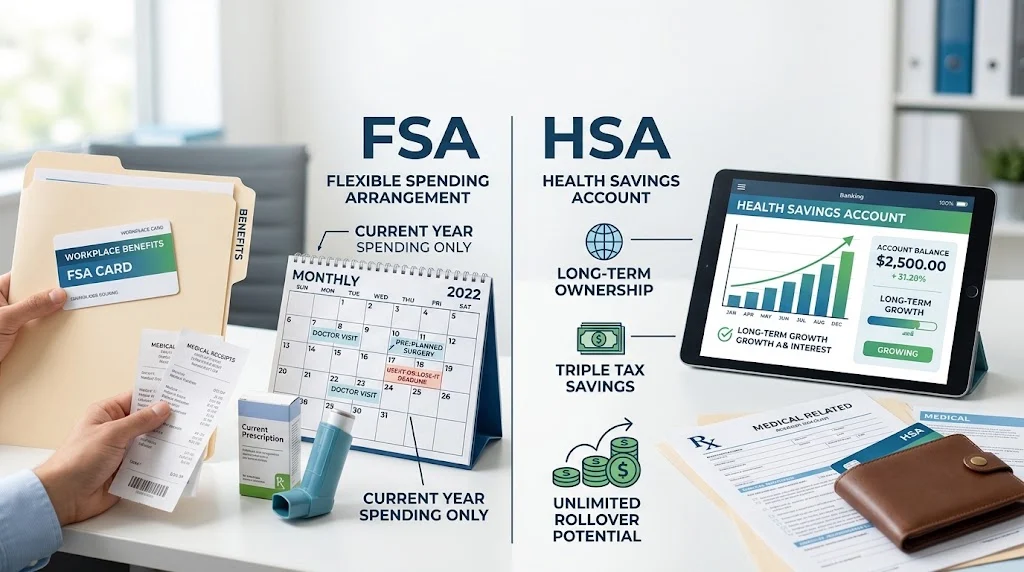
FSA or HSA refers to two different tax advantaged ways to pay for qualified health care expenses in the United States. An FSA is generally an employer sponsored account designed for current year medical spending, while an HSA belongs to an eligible individual and can build savings over time.
If you are comparing FSA or HSA options during open enrollment, the decision is about more than simply choosing an account with tax benefits. A Health Flexible Spending Arrangement, or FSA, is commonly connected to an employer benefit plan and is intended primarily for eligible health expenses during a plan year.
A Health Savings Account, or HSA, is individually owned and generally requires qualifying high deductible health plan coverage. Confusing the two can lead to unexpected forfeitures, contribution problems, or loss of valuable long term savings opportunities. Current IRS guidance makes the distinction especially important because contribution limits, eligibility rules, and qualifying coverage requirements change over time
FSA vs HSA: What’s the Difference?
An FSA, or Health Flexible Spending Arrangement, is a tax advantaged workplace benefit that lets an employee set aside money for qualified medical expenses. The account is generally connected to an employer cafeteria plan, and the employee chooses an amount to contribute through salary reduction.
An HSA, or Health Savings Account, is a tax advantaged account owned by an eligible individual. To contribute, a person generally needs qualifying high deductible health plan coverage and must satisfy other eligibility requirements. Unlike an FSA, an HSA can remain with the individual when employment changes.
Mini recap: An FSA is mainly designed for planned health spending through an employer benefit plan. An HSA is individually owned and can support both present and future health expenses. HSA balances can roll forward from year to year. FSA rules are more dependent on the specific employer plan.
Is FSA vs HSA a Grammar, Vocabulary, or Usage Issue?
FSA vs HSA is not a grammar issue. It is a terminology and usage distinction involving two different financial and health benefit arrangements.
The terms aren’t interchangeable because they describe different account structures. Both can provide tax advantages for eligible health expenses, but their eligibility requirements and treatment of unused funds differ.
In workplace communication, benefits documents, tax discussions, and financial planning, using the correct term matters. Saying that an HSA works exactly like an FSA can create a misleading impression because an HSA generally belongs to the individual and can continue accumulating funds, whereas an FSA is typically associated with an employer plan and has stricter plan year rules.
For academic writing, professional benefits explanations, and financial education, spell out the full term at first mention. After that, FSA and HSA are standard abbreviations.
How an FSA Works
An FSA allows an eligible employee to contribute pretax money through an employer sponsored cafeteria plan. The funds can generally be used for qualified medical expenses under the applicable rules.
The major attraction is predictable spending. Suppose you know that you will have regular dental treatment, prescription costs, vision expenses, or other eligible health expenses. Electing an appropriate amount can allow those expenses to be paid with pretax dollars.
For 2026, the health FSA salary reduction limit is $3,400. If the employer plan permits a carryover, the maximum carryover is $680. An employer may instead offer a grace period, and an employer does not have to provide either option.
Workplace Example
An employee expects $2,000 in predictable eligible medical and dental expenses during the year. The employee may decide that an FSA fits those circumstances because the account is designed around planned current year spending.
Academic Example
A benefits course might explain an FSA as an employer linked tax advantaged arrangement for qualified health expenses. The important concept is the connection between the account and the employer benefit plan.
Technology Example
An employee may use an online benefits portal to select an FSA contribution amount, check the available balance, submit receipts, and review eligible expenses.
FSA usage recap: Think of an FSA primarily as a tool for planned health spending during a benefit period. Always check the employer plan for its specific carryover, grace period, reimbursement, and deadline rules.
How an HSA Works
An HSA is different because it is individually owned. A qualifying person can generally contribute to the account when covered by an eligible high deductible health plan and when other eligibility requirements are satisfied.
For 2026, the HSA contribution limit is $4,400 for self only coverage and $8,750 for family coverage. The 2026 qualifying high deductible health plan rules include a minimum deductible of $1,700 for self only coverage and $3,400 for family coverage, with maximum out of pocket limits of $8,500 and $17,000 respectively.
HSA money can roll over from year to year. The account may also earn interest or investment returns, depending on the provider and account structure. Qualified medical withdrawals can generally be made tax free.
Workplace Example
An employee with qualifying coverage might contribute to an HSA through payroll while also receiving an employer contribution. The employee can then use the account for eligible medical expenses or preserve the balance for future needs.
Academic Example
A personal finance course may present an HSA as both a health spending account and a potential long term savings vehicle because unused funds can remain in the account.
Technology Example
Modern HSA platforms may allow users to view balances, upload documentation, pay eligible expenses, and manage investment options digitally.
HSA usage recap: Think of an HSA as an individually owned health account that can support both current medical costs and longer term savings.
When You Should NOT Use FSA or HSA
There are several situations where selecting the wrong account can create unnecessary problems.
- Do not choose an FSA contribution amount without considering your expected eligible expenses and your employer plan rules.
- Do not assume unused FSA money automatically remains available forever.
- Do not contribute to an HSA simply because an employer offers one. Confirm that you actually satisfy the eligibility requirements.
- Do not assume every health insurance plan makes you eligible for HSA contributions.
- Do not assume a general purpose health FSA can always be combined with HSA contributions. IRS guidance generally treats participation in a health FSA as disqualifying unless an applicable exception applies, such as certain limited purpose or post deductible arrangements.
- Do not use either account for an expense merely because you consider it beneficial to your general health. IRS rules distinguish qualified medical care from ordinary wellness expenses.
- Do not assume insurance premiums are generally reimbursable through a health FSA or HSA.
- Do not ignore documentation requirements for reimbursed expenses.
Common Mistakes and Decision Rules
Decision Rule Box: If you expect predictable eligible expenses and your employer offers a suitable plan, an FSA may be practical. If you qualify for an HSA and want an account that can remain available for future health expenses, an HSA may provide greater long term flexibility.
FSA and HSA in Modern Technology and AI Tools
Modern benefits platforms make account management easier. Employees can check balances, review transactions, submit documentation, and search eligible expenses through digital portals.
AI based tools can also help users organize benefit information, compare plan features, estimate expected spending, and identify questions to ask a benefits administrator. However, an AI tool should not replace the official plan documents or IRS guidance when eligibility or tax treatment is involved.
This distinction matters because a recommendation that looks financially attractive may still be unsuitable if the user’s health plan does not satisfy HSA requirements.
Etymology and Terminology
The term flexible spending arrangement describes the flexibility employees receive in setting aside money for qualifying expenses through an employer benefit structure.
The term health savings account emphasizes saving for health expenses. Unlike the name FSA, which highlights spending flexibility, HSA highlights the ability to retain and accumulate funds.
Both terms belong to the broader language of American employee benefits and tax advantaged health care planning.
Expert Perspective
A useful way to understand the distinction is this:
“The most important difference is not the abbreviation. It is how eligibility, ownership, and unused funds are treated.”
That principle keeps the comparison practical. An account should be judged according to its rules, not simply by the fact that both accounts can help pay qualified medical expenses.
Two Illustrative Case Studies
Case Study One: Predictable Medical Spending
Consider an employee who expects approximately $2,400 in eligible medical, dental, and vision expenses during 2026. The employee has access to a health FSA through work.
If the employee elects $2,400 and actually incurs eligible expenses of approximately that amount, the FSA can provide a straightforward way to direct pretax salary toward expected costs.
Result: The employee matches the account with predictable spending and reduces the risk of leaving a large unused balance.
Case Study Two: Long Term Health Savings
Consider an employee who has qualifying HSA coverage and expects only $1,500 in medical expenses during the year. Instead of treating the account purely as a spending vehicle, the employee contributes an amount permitted by the applicable limit and leaves unused funds in the HSA.
If the balance remains unused, it can generally carry forward rather than disappearing at the end of the year. Depending on the provider, the account may also earn interest or investment returns.
Result: The employee can preserve the unused balance for future qualified medical expenses, creating a potentially valuable long term health savings resource.
These are illustrative examples rather than individualized financial advice.
Error Prevention Checklist
Always use FSA when
You have access through an employer plan and expect predictable qualified health expenses.
Understand the plan’s spending deadline and carryover or grace period rules.
You have estimated your likely eligible expenses before choosing a contribution amount.
Never use HSA when
You have not confirmed that your health coverage and other circumstances make you eligible to contribute.
Assume that every insurance plan qualifies for HSA contributions.
You treat HSA funds as though they expire at the end of each year.
Ignore the tax consequences of non qualified withdrawals.
FSA or HSA: Which One Should You Choose?
There is no universal winner. The better option depends on your health plan, expected expenses, employer benefits, contribution opportunities, and financial goals.
An FSA can make sense when you have predictable eligible expenses and want to use an employer sponsored pretax benefit during the plan year. An HSA can be particularly attractive when you qualify for one and want to combine health spending with longer term savings.
For 2026, the contrast is significant. Health FSA salary reduction contributions are limited to $3,400, while HSA contributions can reach $4,400 for self only coverage or $8,750 for family coverage. HSA funds can generally roll over, while FSA funds are subject to employer plan rules governing carryover and grace periods. (IRS)
Related Grammar Confusions You Should Master
Although FSA vs HSA is a benefits terminology question rather than a grammar confusion, readers researching workplace and financial language may also encounter these commonly confused terms:
- HSA vs HRA
- FSA vs HRA
- Health insurance vs health plan
- Premium vs deductible
- Deductible vs copayment
- Copayment vs coinsurance
- Tax deduction vs tax credit
- Pretax vs tax free
- Reimbursement vs payment
- Eligibility vs enrollment
Understanding these distinctions makes health benefits documents much easier to interpret.
Frequently Asked Questions
What is the difference between FSA and HSA?
An FSA is generally an employer linked arrangement for qualified health expenses, while an HSA is individually owned and generally requires qualifying high deductible health plan coverage.
Is an FSA or HSA better?
Neither is automatically better. An FSA can suit predictable current expenses, while an HSA can be especially valuable for eligible individuals who want funds to remain available for future health costs.
Does HSA money expire?
Generally, no. HSA balances roll over from year to year and remain available for future qualified expenses.
Does FSA money expire?
Generally, FSA funds are subject to use it or lose it rules, although an employer plan may offer a permitted carryover or grace period.
What is the HSA contribution limit for 2026?
For 2026, the annual HSA contribution limit is $4,400 for self only coverage and $8,750 for family coverage.
What is the FSA contribution limit for 2026?
For plan years beginning in 2026, the health FSA salary reduction contribution limit is $3,400.
Can an HSA be used for qualified medical expenses?
Yes. HSA funds can generally be used tax free for qualified medical expenses under the applicable rules.
Conclusion
Understanding FSA or HSA terminology is essential when comparing American workplace health benefits. An FSA is generally designed around current qualified health spending and employer plan rules, while an HSA offers eligible individuals greater ownership and the ability to retain unused funds for future health expenses.
The right choice depends on your health coverage, expected medical costs, employer offerings, and long term financial goals. Before contributing, review your actual plan documents and current IRS requirements rather than relying on assumptions. For 2026, the contribution limits and eligibility rules make careful comparison especially worthwhile.

Philip Pullman is an American writer dedicated to creating clear and easy to follow English content. Through his work at LingRoya.com, he helps readers strengthen their language skills with practical and reliable guidance so that they can easily understand.