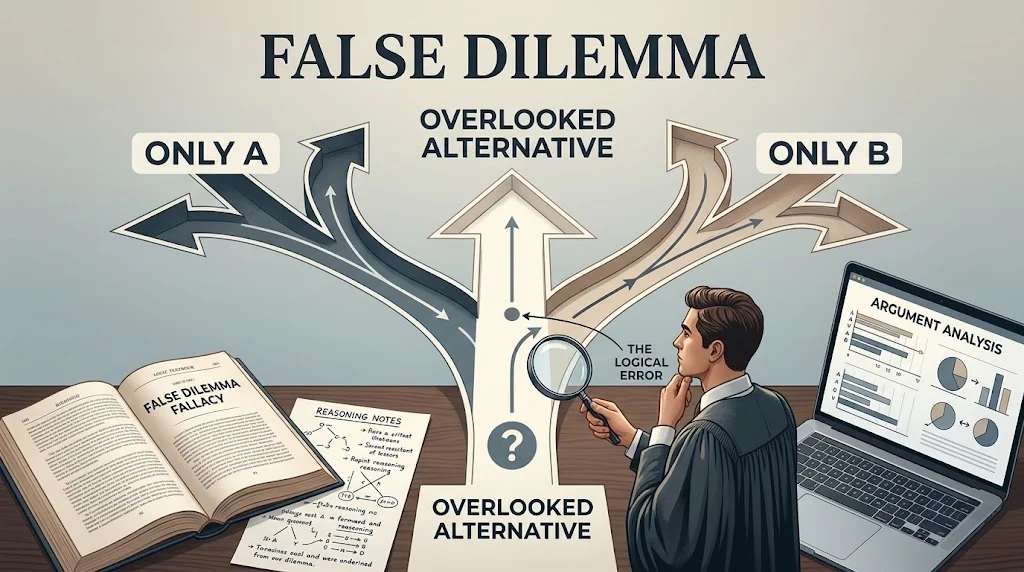
The either or fallacy occurs when an argument incorrectly presents two choices as though they are the only possible options, even though other alternatives exist. It is also known as a false dilemma or false dichotomy.
Have you ever heard someone say, “Either you support this decision, or you are against us”? That statement may sound decisive, but it can hide a serious problem in reasoning. The either or fallacy occurs when someone reduces a situation to two exclusive alternatives without establishing that those are genuinely the only possibilities. In real life, many questions have several possible answers, degrees of agreement, or alternative solutions.
This fallacy matters because it can make weak arguments sound powerful. Politicians, advertisers, commentators, managers, students, and everyday speakers can all unintentionally create false choices. Learning to identify the missing possibilities is therefore an important critical thinking skill.
Either Or Fallacy vs False Dilemma: What’s the Difference?
The expression either or fallacy describes a particular error in reasoning. A false dilemma is the more widely used logical term for the same basic problem.
An either or construction itself is not fallacious. English speakers use “either A or B” correctly when there really are two relevant alternatives.
For example:
“Either we will take the train or we will drive.”
If those genuinely are the only available transportation options, there is no fallacy.
The problem appears when an argument claims that only two choices exist when other meaningful possibilities have been ignored.
For example:
“Either you agree with the proposal or you don’t care about the company.”
A person could disagree with the proposal while caring deeply about the company. The statement creates an artificial choice.
Mini Recap
An either or statement is not automatically a fallacy.
The error occurs when the stated alternatives are incomplete.
False dilemma and false dichotomy are closely related terms.
The best test is to ask whether realistic third options exist.
Is the Either Or Fallacy a Grammar, Vocabulary, or Usage Issue?
This is primarily a logic and critical thinking issue, not a grammar mistake.
The words “either” and “or” are perfectly normal grammatical elements. They become part of a reasoning error only when they are used to restrict a situation unfairly.
Consider:
“Either Maria or Daniel will present the report.”
This is a straightforward statement about two possible presenters.
Now consider:
“Either Maria supports the proposal or she wants the project to fail.”
That reasoning is questionable because Maria could oppose the proposal for many other reasons. She might believe the proposal is too expensive, poorly timed, legally problematic, or simply ineffective.
Are the Two Concepts Interchangeable?
False dilemma, false dichotomy, and either or fallacy are often used to describe substantially the same reasoning pattern. False dilemma is particularly common in textbooks on informal logic and critical thinking.
Formal vs Informal Usage
The concept appears in both formal and informal arguments. Academic writers usually prefer precise terms such as false dilemma or false dichotomy when analyzing reasoning.
In ordinary conversation, people may simply describe the problem as “giving someone a false choice.”
Academic vs Casual Usage
In academic writing, identifying the omitted alternatives is more important than merely labeling an argument fallacious. A strong analysis explains why the alternatives are incomplete and what possibilities have been excluded.
How to Recognize an Either Or Fallacy
The easiest way to recognize this reasoning error is to listen for language that creates an unnecessarily narrow choice.
Common patterns include:
“Either you are with us or against us.”
“Either we act now or everything will fail.”
“You either love this product or hate it.”
“Either we cut the budget or the company will collapse.”
“Either you accept my solution or you don’t want to solve the problem.”
None of these statements is automatically fallacious. The important question is whether the two choices genuinely exhaust the relevant possibilities.
Suppose a company says:
“Either we reduce staff or we will have to close.”
Perhaps other options exist. The company might reduce executive compensation, renegotiate contracts, seek financing, reduce office expenses, change pricing, delay expansion, or restructure operations.
If those possibilities are realistic, presenting only two choices may mislead decision makers.
Practical Examples of the Either Or Fallacy
Workplace Example
A manager says:
“Either you work overtime this weekend or you aren’t committed to the team.”
This creates a false choice. An employee could be committed to the team while having family obligations, medical appointments, another scheduled responsibility, or a legitimate concern about excessive working hours.
A stronger statement would recognize those possibilities and discuss the actual staffing problem.
Usage recap: When evaluating workplace arguments, ask whether the proposed choices genuinely cover every reasonable solution.
Academic Example
A student writes:
“Either technology improves education or it damages education.”
This is overly simplistic. Technology can improve some aspects of education while creating problems in others. Its effects can vary according to the technology, teaching method, subject, age group, and implementation.
A stronger argument might examine both benefits and limitations rather than forcing the discussion into two absolute positions.
Usage recap: Academic reasoning should acknowledge complexity when evidence supports more than two outcomes.
Technology Example
A technology commentator says:
“Either artificial intelligence will replace all human workers or AI is useless.”
That argument excludes many intermediate possibilities. AI can automate some tasks, assist workers, create new roles, change existing occupations, and affect different industries in different ways.
Usage recap: Technology debates often benefit from distinguishing between complete replacement, partial automation, assistance, transformation, and limited adoption.
When You Should NOT Use the Either Or Fallacy
There are several situations where people commonly create false choices.
- When several solutions are available
If a problem has multiple practical solutions, don’t pretend that only two exist.
- When opinions exist on a spectrum
People can partially agree, disagree with certain details, or remain uncertain.
- When causes are complex
A situation may result from several interacting causes rather than one of two alternatives.
- When outcomes have degrees
Success and failure aren’t always absolute. A project can produce mixed results.
- When important alternatives have been ignored
A missing third option can completely change the conclusion.
- When emotional pressure is replacing evidence
Statements designed to force loyalty or opposition deserve careful examination.
- When a debate contains several independent questions
Agreeing with one part of an argument does not necessarily require accepting every part.
- When the alternatives are artificially constructed
If the speaker defines the choices in a way that makes one option obviously unattractive, the argument deserves additional scrutiny.
Common Mistakes and Decision Rules
Decision Rule Box
If an argument presents two choices, ask whether those choices genuinely exhaust the realistic possibilities.
If a reasonable third option exists, investigate whether the argument has created a false dilemma.
If the alternatives really are exhaustive, the either or structure may be perfectly legitimate.
The Either Or Fallacy in Modern Technology and AI Tools
Modern technology has created new opportunities for false dichotomies because complex subjects are often compressed into short headlines, posts, and video clips.
AI discussions provide many examples:
“AI will either save humanity or destroy it.”
“Either AI is intelligent like a human or it is completely useless.”
“Either companies adopt AI immediately or they will disappear.”
These statements can attract attention because they simplify complicated questions. However, real technological change is usually more gradual.
AI systems can be highly capable in one task while unreliable in another. Businesses can adopt AI for selected processes without replacing their entire workforce. Consumers can use AI occasionally without making it central to their lives.
Critical thinking requires separating dramatic framing from the actual range of possibilities.
Why the Either Or Fallacy Is Persuasive
False choices work because humans often prefer simple explanations. Two clearly defined options can feel easier to understand than a complicated collection of possibilities.
Emotional language can make this effect stronger.
Consider:
“Either we act today or our future is lost.”
The sentence creates urgency and discourages reflection. Instead of asking what actions are available, the listener is pushed toward immediate acceptance.
Another persuasive technique is social pressure:
“Either you’re serious about success or you’re making excuses.”
A person might actually be serious about success while questioning the proposed method.
The strongest defense is to slow down and ask:
“What other possibilities are there?”
That single question can expose an artificial dilemma.
Etymology and History of the Concept
The concept of a false dilemma belongs to the broader study of informal logic and argumentation. The word dilemma comes through Latin from Greek roots associated with a proposition involving two assumptions or alternatives.
A genuine dilemma can involve two alternatives that have logical consequences. The problem arises when an argument presents two alternatives as exhaustive without sufficient justification.
The related expression false dichotomy emphasizes the artificial division of a subject into two opposing categories.
An Expert Perspective
“A limited choice becomes fallacious when the argument gives no adequate reason to believe that the stated alternatives are exhaustive.”
This principle captures the heart of the problem. The presence of two alternatives isn’t enough to establish a fallacy. The crucial question is whether relevant alternatives have been improperly excluded.
Two Practical Case Studies
Case Study One: Business Decision Making
Imagine a company facing a budget shortfall of $500,000. Leadership tells employees:
“Either we eliminate 20 positions or the company will become insolvent.”
Suppose a financial review identifies four additional measures that could collectively address the shortfall: renegotiating supplier contracts, reducing nonessential spending, delaying an expansion project, and changing executive compensation.
The original statement therefore presents an incomplete choice.
The concrete result of expanding the options is that management can evaluate five broad strategies instead of treating layoffs as the only possible solution. Even if layoffs eventually remain necessary, the decision becomes evidence based rather than artificially restricted.
Case Study Two: Education Policy
Suppose a school district argues:
“Either we prohibit smartphones completely or students will never learn effectively.”
Further investigation reveals alternatives such as restricted use during lessons, phone storage systems, educational applications, digital citizenship instruction, and teacher controlled access.
The concrete result is a broader policy discussion in which the district can compare several interventions rather than choosing between total prohibition and educational failure.
The lesson is important: identifying additional options doesn’t automatically prove that one alternative is better. It simply improves the quality of the reasoning process.
Author Bio
Written from a critical thinking, linguistics, and English usage perspective, with emphasis on clear definitions, logical reasoning, argument analysis, and practical communication.
Error Prevention Checklist
Always ask whether
☐ The two alternatives are genuinely exhaustive.
☐ A realistic third option exists.
☐ The speaker has provided evidence for excluding alternatives.
☐ The issue can reasonably have mixed outcomes.
☐ The choices are genuinely independent alternatives.
Never assume that
☐ Two choices are the only choices merely because someone says they are.
☐ Disagreement means opposition to everything.
☐ Partial agreement equals complete agreement.
☐ A complex issue must have a simple binary answer.
☐ Emotional urgency proves that the stated choices are exhaustive.
Related Reasoning Confusions You Should Master
Understanding false dilemmas becomes easier when you study other common reasoning errors.
- Straw man arguments
- Slippery slope reasoning
- Circular reasoning
- Hasty generalization
- Appeal to authority
- Appeal to emotion
- Ad hominem arguments
- Red herring arguments
- Post hoc reasoning
- Bandwagon reasoning
These fallacies differ from one another, but they share an important feature: they can make an argument appear stronger than the evidence actually supports.
FAQs
What is an either or fallacy?
An either or fallacy occurs when an argument presents two alternatives as the only possible choices even though other reasonable possibilities exist. It is commonly called a false dilemma or false dichotomy.
Is every either or statement a fallacy?
No. An either or statement is fallacious only when the alternatives are incorrectly presented as exhaustive. If two choices genuinely are the only relevant possibilities, the reasoning may be perfectly valid.
What is another name for an either or fallacy?
False dilemma and false dichotomy are common alternative terms. The expression false choice is also frequently used in ordinary communication.
How do you identify a false dilemma?
Ask whether the argument gives adequate reason to believe that only two possibilities exist. Then look for a realistic third option, intermediate position, mixed outcome, or additional explanation.
What is an example of a false dilemma?
“Either you support this policy or you don’t care about the community” is a false dilemma if someone can care about the community while opposing the policy for legitimate reasons.
Why is a false dilemma misleading?
It can pressure people into choosing between artificially constructed alternatives. This can hide important evidence, eliminate reasonable solutions, and make a weak argument appear more convincing.
Conclusion
The either or fallacy is a reasoning error that occurs when someone presents two alternatives as though they are the only possibilities when the evidence does not justify that restriction. The words “either” and “or” themselves aren’t the problem. The problem is the unsupported assumption that nothing exists between, beyond, or outside the stated choices. Whether you’re evaluating a workplace decision, an academic argument, a political claim, or a statement about artificial intelligence, ask one simple question: What other possibilities have been left out? That question can reveal a false dilemma and lead to more accurate, balanced reasoning.

Margaret Atwood is an American writer who contributes to LingRoya.com creating clear and engaging content about the English language and everyday communication. She enjoys helping readers build confidence in their writing through simple, practical guidance.