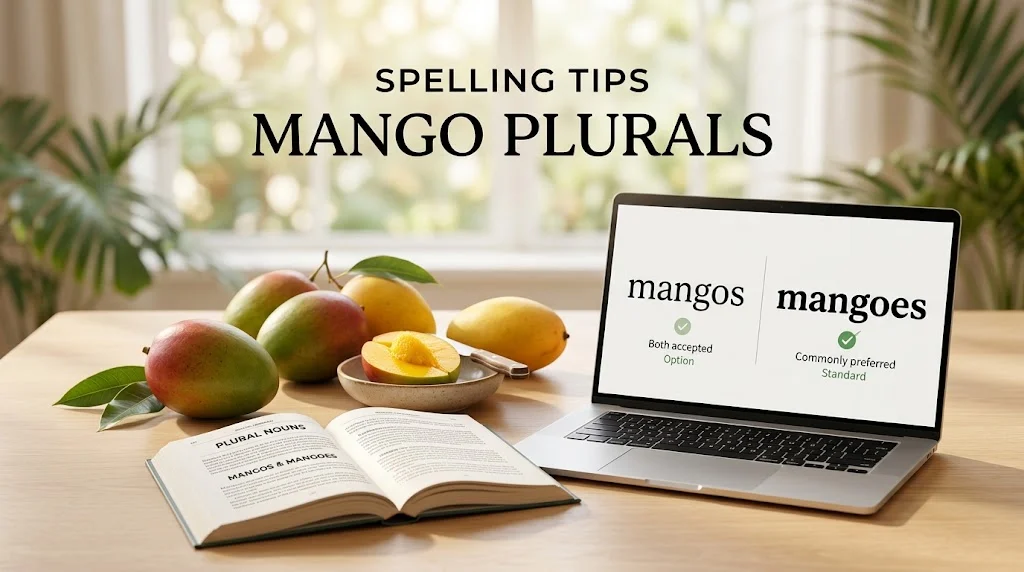
Both mangos and mangoes are accepted plural forms of mango, the tropical fruit. Mangoes is generally the more common spelling in modern English, while mangos is also grammatically correct and widely used.
If you have ever wondered whether to write mangos or mangoes, you are not alone. English has several nouns that form their plurals in more than one accepted way, and mango is a good example. Both forms are correct, but mangoes appears more frequently in general English and is often the safer choice for formal, academic, and professional writing.
Mangos is not a spelling mistake, however, and you may encounter it in dictionaries, menus, recipes, product descriptions, and everyday communication. Understanding why both forms exist can help you avoid unnecessary corrections and choose the spelling that best fits your audience, publication style, and context.
Mangos or Mangoes: What’s the Difference?
Mango is a noun. It refers to the fruit produced by trees belonging to the genus Mangifera. When you are talking about more than one mango, you need a plural form.
Both mangos and mangoes function as plural nouns.
| Form | Part of speech | Meaning | Usage |
| mango | Noun | One tropical fruit | Singular |
| mangos | Noun | More than one mango | Accepted plural |
| mangoes | Noun | More than one mango | Accepted plural and commonly preferred |
The important point is that there is no difference in meaning between mangos and mangoes.
Both forms refer to multiple mango fruits.
Mangoes is often the more familiar spelling to readers.
Mangos remains a legitimate plural form and should not automatically be treated as an error.
A Simple Example
Singular:
I bought one mango from the market.
Plural:
I bought several mangoes from the market.
You could also write:
I bought several mangos from the market.
The meaning remains exactly the same.
Is Mangos or Mangoes a Grammar, Vocabulary, or Usage Issue?
This is primarily a spelling and usage issue, not a difference in vocabulary or meaning.
The singular noun is mango. English allows two plural spellings, mangos and mangoes. This happens because English has historically developed different ways of forming plurals, particularly with nouns ending in the letter o.
Some nouns ending in o commonly take es, while others simply take s. In some cases, both forms have become established through usage.
For example, you may see different plural patterns with words such as tomato, potato, hero, piano, photo, and mango.
The situation is slightly different from a pair of words that have completely different meanings. Mangos and mangoes are simply two accepted plural spellings of the same noun.
Formal Versus Informal Writing
In professional, academic, or educational writing, mangoes may be the more familiar choice for a broad English speaking audience.
That does not make mangos incorrect.
If your organization, publisher, school, or style guide consistently uses mangos, following that established preference can be appropriate.
Academic Versus Casual Usage
Academic writing generally benefits from consistency. If you choose mangoes, use mangoes throughout the document. If a particular scientific journal or publication has its own style preference, follow that guidance.
In casual writing, either form can communicate the intended meaning clearly.
How to Use Mangoes Correctly
Mangoes is the plural form many readers expect to see in everyday English.
Workplace Example
A restaurant manager might write:
We ordered fifty mangoes for this weekend’s catering event.
A grocery business could say:
Fresh mangoes will be available throughout the summer season.
These sentences are natural because mangoes clearly identifies more than one fruit.
Academic Example
A student writing about agriculture might write:
Mangoes are cultivated in many tropical and subtropical regions.
A research paper could state:
The study examined the nutritional characteristics of different mangoes.
Here, mangoes works naturally in formal informational writing.
Technology Example
Technology does not change the spelling rule.
For example, an online grocery application might display:
Organic mangoes are now available for delivery.
A recipe application could include:
Add two ripe mangoes to the blender.
Search engines, databases, content management systems, and artificial intelligence tools may encounter either spelling. The important factor is understanding that both refer to the same fruit.
Usage Recap
Use mangoes when you want the plural spelling that many readers are accustomed to seeing. It works naturally in professional, academic, commercial, and everyday English.
How to Use Mangos Correctly
Mangos is also an accepted plural spelling of mango.
For example:
The farmer harvested hundreds of mangos this season.
Another example is:
These mangos are especially sweet when fully ripe.
Neither sentence is grammatically wrong.
Workplace Example
A food supplier could write:
Our company distributes fresh mangos to local supermarkets.
This is perfectly understandable and grammatically acceptable.
Academic Example
A textbook could theoretically state:
Several varieties of mangos were examined during the experiment.
Although many editors might prefer mangoes, the use of mangos does not automatically make the sentence incorrect.
Technology Example
A food delivery platform might list:
Fresh mangos available today.
The spelling is still understandable to users and correctly represents the plural noun.
Usage Recap
Mangos is a legitimate alternative plural. It is particularly useful when it matches the established spelling preference of a publisher, organization, database, or regional writing style.
When You Should NOT Use Mangos or Mangoes
There are several situations where writers accidentally use a plural when they actually need the singular form.
- When referring to one fruit
Incorrect:
I ate three mango.
Correct:
I ate three mangoes.
- When using mango as an adjective
Some expressions use mango as a noun modifier.
Example:
She bought mango juice.
Here, mango describes the type of juice, so you do not need a plural form.
- When the sentence refers to the fruit in general
Example:
Mango is rich in nutrients.
Here, mango can be used as a general mass or category reference.
- When describing one specific fruit
Example:
This mango is perfectly ripe.
Mangos or mangoes would be incorrect because only one fruit is being discussed.
- When following a publication style guide
If a publication has chosen one spelling, do not switch between forms randomly.
- When mixing singular and plural grammar
Incorrect:
These mango is sweet.
Correct:
These mangoes are sweet.
- When assuming one form is automatically wrong
Mangos should not automatically be marked as a spelling error simply because mangoes is more familiar.
- When changing the spelling inside one document without reason
Consistency matters. Pick the accepted form that suits your style and use it consistently.
Common Mistakes and Decision Rules
| Correct sentence | Incorrect sentence | Explanation |
| I bought two mangoes. | I bought two mango. | A plural quantity requires a plural noun. |
| This mango is ripe. | This mangoes is ripe. | One fruit requires the singular form. |
| The mangoes taste sweet. | The mangoes tastes sweet. | A plural subject takes the plural verb taste. |
| Several mangos were harvested. | Several mango was harvested. | Mangos is an accepted plural form. |
| Mango juice is popular. | Mangoes juice is popular. | Mango functions as a noun modifier here. |
Decision Rule Box
If you mean one fruit, use mango.
If you mean more than one fruit, use mangoes or mangos.
If you want the more familiar plural spelling for general readers, mangoes is usually a straightforward choice.
If your chosen style guide uses mangos, that spelling is also acceptable.
The key rule is simple: do not treat the two plural forms as words with different meanings.
Mangos and Mangoes in Modern Technology and AI Tools
Modern writing technology has made spelling variation easier to notice.
Search engines may return results for both forms. Spell checkers may also behave differently depending on their dictionaries, language settings, and regional preferences.
Artificial intelligence tools can generally understand both forms because the semantic meaning is the same. If you are writing content for search engines, however, natural language and reader expectations matter more than repeatedly forcing one spelling into every sentence.
For websites, product pages, recipes, and educational articles, consistency is more useful than switching between forms simply to create keyword variations.
If your target audience commonly searches for one spelling, you can mention the alternative naturally while maintaining a clear primary spelling throughout the article.
Why Are Both Plural Forms Used?
The spelling variation exists because English pluralization is not completely uniform.
Many English nouns ending in o can form plurals with s, es, or, in some cases, either ending. Historical development, borrowing from other languages, pronunciation, and established usage have all influenced these patterns.
Mango entered English through a long history of linguistic contact involving languages and regions associated with South Asia. Its plural development reflects the flexibility of English rather than a simple mathematical spelling rule.
This is why memorizing a single rule such as “every noun ending in o must take es” does not work reliably.
An Expert Style Explanation
“When English permits two established plural forms with the same meaning, context and consistency are more important than treating one accepted form as an error.”
This principle is useful beyond mango. English contains many spelling variations that developed through historical usage rather than through one perfectly consistent grammatical formula.
Case Study 1: Food Writing
Imagine a food website publishing a recipe for a tropical smoothie.
Version A says:
Blend two mangoes with banana, yogurt, and ice.
Version B says:
Blend two mangos with banana, yogurt, and ice.
Both sentences communicate the same instruction.
For a broad consumer audience, an editor might select mangoes because it is more familiar to many readers. The decision improves stylistic consistency rather than correcting a genuine grammatical mistake.
Case Study 2: Agricultural Writing
Consider an agricultural report discussing fruit production:
Farmers harvested 2,000 mangoes during the season.
An editor who prefers mangos could write:
Farmers harvested 2,000 mangos during the season.
The numerical information and meaning remain unchanged.
The practical lesson is that writers should establish a style preference before producing large amounts of content. This prevents unnecessary variation across reports, webpages, product catalogs, and educational materials.
Error Prevention Checklist
Always use mango when:
- You are talking about one fruit.
- The noun follows a singular determiner such as this or a.
- You are using mango as a category or descriptive noun.
Use mangoes when:
- You want the familiar plural form.
- You are writing for a broad general audience.
- Your publication style prefers mangoes.
- You want consistent usage throughout an article.
Use mangos when:
- Your established style guide prefers it.
- Your organization consistently uses it.
- You are following a source or publication that uses this spelling.
- You understand that it is an accepted plural rather than a spelling mistake.
Related Grammar Confusions You Should Master
Understanding mango pluralization can lead to several other useful English distinctions. Consider studying these related topics:
- Potato or potatoes
- Tomato or tomatoes
- Photo or photos
- Piano or pianos
- Hero or heroes
- Zero or zeros
- Roofs or rooves
- Gases or gasses
- Octopuses or octopi
- Buses or busses
These examples demonstrate an important feature of English: plural formation often depends on established usage and word history rather than one universal spelling rule.
Frequently Asked Questions
Is mangos or mangoes correct?
Both mangos and mangoes are correct plural forms of mango. Mangoes is commonly preferred in general English, while mangos remains an accepted alternative.
Which is more common, mangos or mangoes?
Mangoes is generally the more familiar spelling to many English readers. However, mangos is also established and should not automatically be considered incorrect.
Is mangos a real word?
Yes. Mangos is a recognized plural form of mango and has the same meaning as mangoes.
Is mangoes grammatically correct?
Yes. Mangoes is a standard plural form of the noun mango and is widely used in everyday, professional, academic, and commercial writing.
Should I write mangoes in academic writing?
Mangoes is a clear choice for academic writing, especially when addressing a broad audience. However, a specific publication’s style guide should always take priority.
Why does mango have two plural forms?
English allows variation in the pluralization of some nouns ending in o. Historical usage and language development have resulted in both mangos and mangoes becoming established forms.
Is mangos considered a spelling mistake?
No. Mangos is an accepted plural spelling. Calling it an outright spelling mistake would be inaccurate.
Can I use mangos and mangoes in the same article?
You can, but consistency is usually better. Choose one spelling based on your audience or style guide and use it throughout the article.
What is the singular of mangoes?
The singular form is mango.
Do mangos and mangoes have different meanings?
No. Both forms mean more than one mango fruit. The difference is spelling rather than meaning.
Conclusion
The choice between mangos and mangoes does not involve two different words or meanings. Both are accepted plural forms of mango. Mangoes is often the more familiar option for general and formal English, while mangos is also correct and may be preferred by particular writers, organizations, or style guides.
The most useful rule is simple: use mango for one fruit and either mangoes or mangos for more than one. When writing for a broad audience, mangoes is a practical choice because it is widely recognized. Most importantly, remain consistent throughout your writing and follow any applicable style guide.

Neil Gaiman is an American writer who contributes educational content to LingRoya.com. His work focuses on helping readers improve their English with clear, practical and easy to follow guidance.